Srimad Bhagavatam at ISKCON Newtown Kolkata – August 2026 | Srimad Bhagavatam 11.25 | HG Chaitanya Charan Prabhu
Purushottam Nitai Das
September 3, 2026
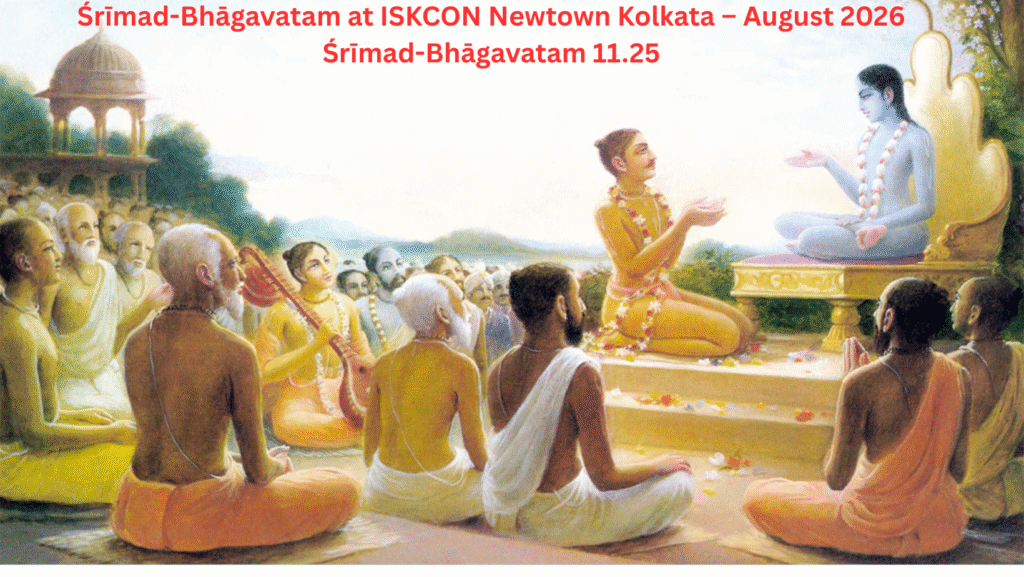
Below are the important points from the morning Śrīmad-Bhāgavatam classes at ISKCON Newtown Temple, Kolkata, during August 2026 given by HG Chaitanya Charan Prabhu. The classes cover Srimad Bhagavatam 11.25 (Canto 11, Chapter 25 of Śrīmad-Bhāgavatam), “The Three Modes of Nature and Beyond.”
Srimad Bhagavatam Class by HG Chaitanya Charan Prabhu on 4th August 2026
- Verse Number: SB 11.25.7
- Chapter Name: The Three Modes of Nature and Beyond
Important Points from Translation & Purport
- When a person devotes himself to religiosity, economic development and sense gratification, the faith, wealth and sensual enjoyment obtained by his endeavors display the interaction of the three modes of nature.
Important Points from Class
- Understanding three gunas ontologically and functionally.
- In science there is a debate that whether we are trying to understand nature ontologically or functionally. Much of science is not how nature exists but how it affects us.
- Gunas -> Ontological – guna mayi -> refers to material world made of gunas. Gunas are building blocks of the universe just like pixels on TV screen.
- Gunas are also described as ropes which bind a living entity. For example, in Bhagavad Gita 14.5, the word nibadhnanti is used. Nibadhnanti (निबध्नन्ति) means to bind, tie, or constrain.
- Gunas shape interaction between consciousness and matter.
- Consciousness of soul can expand or contract.
- CIT (Consciousness) is the feature of the soul and CITTA is feature of the embodied soul.
- There is transformation of consciousness. It happens because of the interaction of consciousness and matter.
- Interaction of matter and consciousness is gunas.
- How consciousness and matter intermingle.
- Soul -> mind -> (1) Jnanendriya (2) Karmendriya
- Through Jnanendriya, we perceive, with mind, we process, and with Karmendriya, we pursue.
- Jnanendriya: Perceive (Bhagavad Gita (BG) 18.20-22), Mind (Process) BG 18.30-35, Karmendriya (Pursue)(BG 18.23 – 30).
- Perceive, Process and Pursue happen simultaneously.
- We Perceive in Sattva, Rajas and Tamas. How we perceive in Sattva, Rajas and Tamas is given in Bhagavad Gita.
- Perceiving in Sattva Guna: BG 18.20
- Perceiving in Rajo Guna: BG 18.21
- Perceiving in Tamo Guna: BG 18.22
- In Sattva Guna, perception is integrated. We see part and also the whole i.e. bigger picture.
- In Rajo Guna, perception is fixated. We see parts which either delight us or threaten us.
- In Tamo guna, perception is fragmented – any part which at that point seems important and it becomes everything. For e.g. a person says one word which is agitating, and we judge a person based on that particular word and forget everything which he has done.
- Between two skilled people rivalry is natural but it should not lead to enmity. Rivalry happens when both seek same goal. Enmity is to destroy someone.
- If one thing becomes everything then this is a sign of tamo guna.
- From structural perspective, all three gunas are required – sattva, rajas, tamas.
- Even Tamo guna is required. Capacity to switch off is tamas, eg. sleeping is in tamas. In body all three gunas are there.
- From ethical perspective, we want to be in sattva guna.
Srimad Bhagavatam Class by HG Chaitanya Charan Prabhu on 5th August 2026
- Verse Number: SB 11.25.8
- Chapter Name: The Three Modes of Nature and Beyond
Important Points from Translation & Purport
- According to Śrīla Śrīdhara Svāmī, religious duties performed for promotion to heaven are understood to be in the mode of passion
- Those performed to enjoy ordinary family life are in the mode of ignorance.
- And those performed selflessly to fulfill one’s occupational duty in the varṇāśrama system are in the mode of goodness.
Important Points from Class
- Most people are in combination of sattva, rajas, tamas.
- For example, one person may eat meat which is in tamo guna, but his other activities may be regulated, and regulation is in sattva guna. A person may use swear words which is tamasic, but his other parts of speech may be meaningful.
- We understand a concept either analytically or synthetically.
- Analytical means to break down something and understand and synthetically means in combination i.e. together.
- We understand concepts either analytically or synthetically.
- For example, a child learns mother tongue in a synthetic way, i.e. initially while learning he will not think of nouns, verbs, adjectives etc. But later when he wants to learn some different language, say English or French, then he may learn in an analytical way.
- Elaboration on Perception is in Bhagavad Gita 18.20 – 18.22.
- Sattva: Perception is Integrated. Part amidst whole.
- Rajas: Perception is Fixated. Part above whole.
- Tamas: Perception is Fragmented. Part away from whole, eventually part becomes the whole.
- Tamasic vision – leads to prejudice, biases, fanaticism. One Temple President of Iskcon was using swear word. When he asked, he said, “I grew up in a tough neighborhood where people used swear words after every 3 words. Earlier I used to use lots of swear words, but it has reduced now.” His one behavior is tamasic, but others may not be tamasic. Don’t take one particular habit of a devotee and judge him based on that.
- Rajasic Vision: Fixated: Part above the whole. We may consider our service most important. In Rajo guna, we focus more on quantity than on quality. For example, if someone is distributing more books than he is considered most important. But some devotees may distribute less books but may develop good connections with people. We think my service is most important. We see my part the biggest.
- In Iskcon, sometimes among devotees there is Quote Warfare. We take one quote of Prabhupada or scripture and make it most important. Quantity is important but not most important. Some may judge a devotee by how many slokas he is quoting in the class. Quoting slokas is important but explaining is also important.
- In Rajo guna, we are aware of the whole but in Tamo guna, we are not.
- For example, Dhritarashtra was in tamo guna.
- Equality is not neutrality.
- Sattva: Part amidst whole. In Sattva, focus is on my specific service but one considers other services important too.
- Change happens “Outside In” and “Inside Out.”
- Change – Outside In: Changing the atmosphere. For example, an alcoholic goes to deaddiction center to get rid of alcohol.
- Change – Inside Out: Changing our priorities, desires, aspirations. BG 15.7.
- Both approaches are required – “Outside In” and “Inside Out.”
- Our action depends on atmosphere and environment.
- People say work hard and party hard. Work is in rajo guna and party is in tamo guna. We generally oscillate between rajo guna and tamo guna i.e. between bhoga and tyaga.
- We need motivation to do service.
- Nature can be changed –
- If guna’s are building block then can it be changed.
Srimad Bhagavatam Class by HG Chaitanya Charan Prabhu on 8th August 2026
- Verse Number: SB 11.25.12
- Chapter Name: The Three Modes of Nature and Beyond
Important Points from Translation & Purport
- When a conditioned soul adopts a material mentality, the modes exert their influence within the jurisdiction of that mentality.
- But if one purifies one’s mind in the devotional service of the Lord, the modes of nature can no longer act upon him, since they have no influence on the spiritual platform.
Important Points from Class
- Perceive, Process, Pursue
- If we consider this world false and other world is true then if this world is false then suffering is also false which is not true.
- Pleasure may or may not be reality, but pain is a reality. Pain of hunger, thirst, loneliness, being misunderstood and so on.
- Everything we do is to avoid pain and get pleasure.
- All philosophy in this world begins with how to deal with pain
- Pain and pleasure are real, but our imagination aggravates them.
- Rajas – consciousness is focussed on pleasure
- Tamas – consciousness is focussed on fear. In fear person may be traumatised.
- Fear is gift, sign of intelligence. Fear is to know what is good or bad. For e.g Prabhupada would say that devotees are not sufficiently fearful of maya. There are two types of fear – Healthy Fear & Unhealthy Fear.
- Bhaya – Circumstantial (Physical) – Healthy.
- Bhaya – Conditional (Psychological) – Unhealthy
- Bhaya – Existential (Spirtual) – Toxic
- Existential Fear – Life & World, People & Relationship, Activities & Ambitions.
- In Christianity there is a debate that if pets will go to heaven pr not.
- Impersonalism is existential fear.
- Impersonalism says world is maya, vaisnavas say that this world is real.
- Good Intention is not the substitute for Good Intelligence
- Philosophically we may not say world is false, but we may act as if world is false.
- Our roles and responsibilities are important
- We should not be pain conscious, but we should be Krishna Conscious.
- We should focus on that this is the place where we can serve Krishna.
- Gunas are not spiritual.
- Living sattvic – gives some pleasure.
- Within the world people have choices for sattva, rajas, tamo.
- Choices in the world has real consequences. Like voting for a particular party can make significant differences in people’s life.
- Micro choices can make differences and can later make macro differences.
- Rajo Guna, we do service which are glamorous
- In Tamo Guna, we do service which gives least trouble
- Love for Krishna comes though service attitude.
Srimad Bhagavatam Class by HG Chaitanya Charan Prabhu on 10th August 2026
- Verse Number: SB 11.25.18
- Chapter Name: The Three Modes of Nature and Beyond
Important Points from Translation & Purport
- Food that is wholesome, pure and obtained without difficulty is in the mode of goodness.
- Food that gives immediate pleasure to the senses is in the mode of passion.
- Food that is unclean and causes distress is in the mode of ignorance.
Important Points from Class
- Sattva Guna: Person is balanced. He understands various roles and responsibilities and balances it.
- Rajo Guna:He is stretched; hefocuses excessively on a specific area.
- Tamo Guna: Addicted, for a person one area becomes important, and he becomes addicted to it.
- Key difference between Sattva, Rajas and Tamas is boundaries
- Today we use the word “addiction” in terms of behavior – like addiction to alcohol, internet.
- Scope of Action: Yudhisthir is told after he becomes king that you have three areas to focus on – Family (kama) – Pleasure, Job (Artha) – Profit, Religion (dharma) – Piety. He is told to pursue these three in balance.
- In Sattva – we give appropriate attention to each of them.
- In Rajas – Person is obsessed with work; they neglect family and spirituality. They stretch themselves.
- In Tamas: One thing occupies entire consciousness. In tamas one becomes addicted. There is no sense of boundaries.
- We have to balance our life – This is why Srila Bhaktivinod Thakura gave 8-hour rule.
- Desire everyone has. For example, everyone is troubled by lust. But based on the gunas people handle it differently. In Sattva, one works, get a job and get married. In Rajas, one looks here and there to satisfy lust. In Tamas, there is no respect for boundaries, one becomes addicted to lust.
- In Rajas too there are boundaries but not as much as sattva.
- Rajas and Tamas – There is big difference. Like Drinking is rajsic, but drinking and driving is tamasic. Some things are addictive, so one should be careful. For example, alcohol is addictive but not food.
- Violence for justice is not tamasic, but violence for revenge is.
- Drinking is tamas, drinking excessively is tamas multiplied by 2 and so on.
- Even for animals we say some are sattvic, some rajasic and some tamasic. For e.g. cow is in sattva, tiger in rajas and monkeys in tamas.
- Gunas are subtle and nuanced.
- Tamasic in terms of perception. For e.g. one senior devotee said that since Prabhupada used to bathe using buckets, all devotees should use buckets and not shower for bathing. If one does not follow this then he/she is not Prabhupada’s follower. This is tamasic in terms of action.
- In Iskcon too devotees are either conservative or liberal, and both can go to extremes.
- One devotee said: Prabhupada wanted devotees to create varnashrama, so focus on that and take girls out of school.
- Our ultimate purpose may be transcendental but gunas do affect us.
- Values – Ultimate (Fundamental)
- Values – Functional, driving car to reach destination(ultimate). Driving skills are functional.
- Bhakti can also be practiced in tamasic way.
- Can there be too much Krishna Consciousness? No. But we can have too much fixation on one aspect of Krishna Consciousness.
- We should be conscious of holy names, Srimad Bhagavatam, reciprocation with devotees. In our spiritual life we have to balance.
- Sarva dharmyam paritrajya – As per the context Krishna says give kula dharma and kshatriya dharma and surrender to me. Arjuna finally served Krishna as a Kshatriya.
- Lord Chaitanya took sannyasa but was not inconsiderate about his mother.
Srimad Bhagavatam Class by HG Chaitanya Charan Prabhu on 12th August 2026
- Verse Number: SB 11.25.14
- Chapter Name: The Three Modes of Nature and Beyond
Important Points from Translation & Purport
- When the mode of passion, which causes attachment, separatism and activity, conquers ignorance and goodness, a man begins to work hard to acquire prestige and fortune.
- Thus in the mode of passion he experiences anxiety and struggle.
Important Points from Class
- Sattva: Regulated
- Rajas: Extended
- Tamas: Addicted – One aspect of bhakti comes at the cost of other things. It may be dress code, gender roles etc.
- In India mostly we are attracting conservative people to Krishna Consciousness.
- In West we are attracting mostly liberals. During Covid time, some devotees were against vaccination, so they wanted their spiritual masters to speak against vaccination. The spiritual master left the devotees to decide if they want to be vaccinated or not. This upset some devotees and they left Krishna Consciousness. This is when one aspect becomes most important and one does not see the big picture.
- Rajas: We have sense of big picture, but one thing becomes more important.
- Rajas: Occasional and Regular/Default
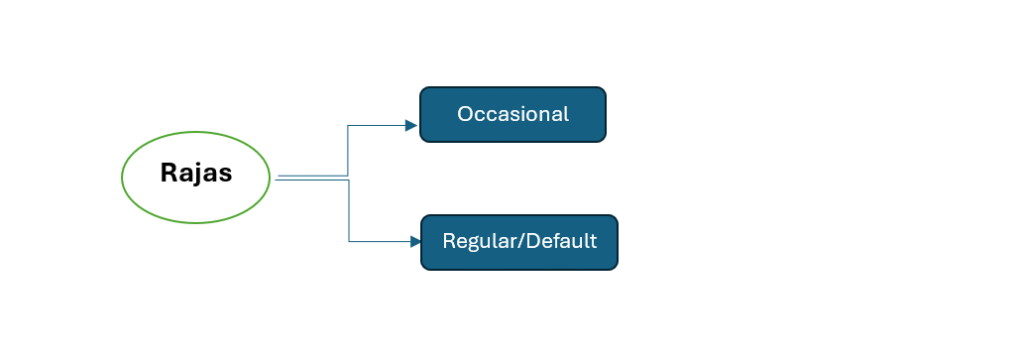
- Occasional: Sometimes one may have to spend more time on a particular service. Like if temple construction deadline is approaching then one has to work day and night. Or if in office there is project deadline then devotees may have to work till late-night. This is fine. But if it becomes regular then it is a problem. In such scenarios, one thing becomes important and another gets neglected. One may start doing it for the sake of prestige or power as mentioned in the verse SB 11.25.14
- Rajas: One thing that becomes more important for a particular time is not a problem but if it becomes regular or default then it is a problem.
- How can Rajas come in the practice of Bhakti?
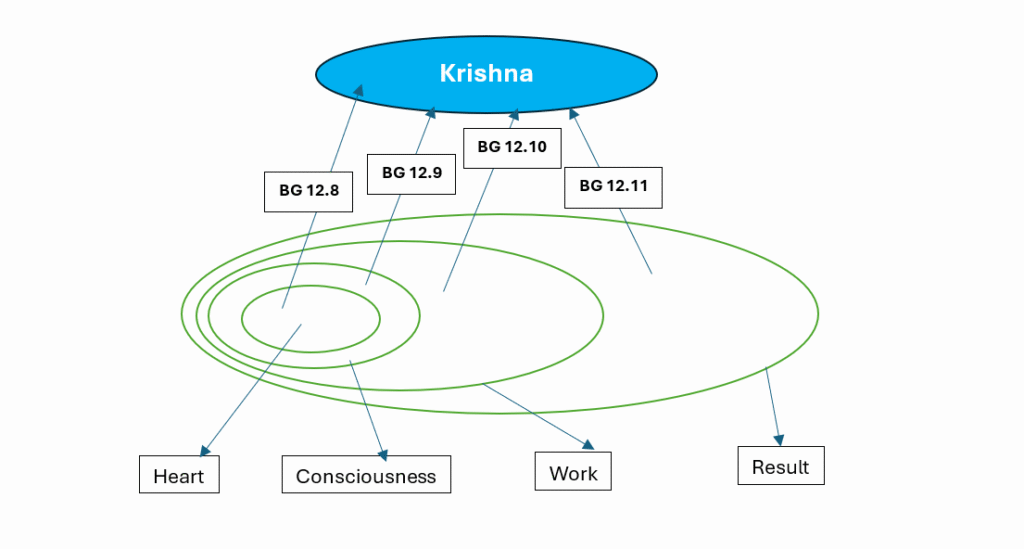
- In Bhagavad Gita Chapter 12, Lord Krishna says that we can approach Krishna at four levels
- BG 12.8: We can offer our heart to Krishna.
- BG12.9: We can offer our Consciousness to Krishna.
- BG12.10: We can offer Work to Krishna.
- BG 12.11: We can offer out results to Krishna.
- Someone offering heart to Krishna can also offer result to Krishna. For eg. Srila Prabhupada’s heart was with Krishna, but he offered results also to Krishna.
- In Bhagavad Gita 2.47, when Krishna says do not be attached to the result then it does not mean do not be concerned about the result. For example, we see when result was not coming in India, then Prabhupada went to west to preach.
- Equality does not mean neutrality, but it is reciprocity.
- Examples of Rajas: When a person comes to the temple then we do not see him as a soul who has come to take shelter of Krishna, instead, we try to figure out if he can contribute financially or not.
- Rajas: Doing sadhana for prestige.
- We should know that for us primary fruit is deeper relationship with Krishna.
- We should always focus on long-term goals and not short-term goals. Something may work now but may be harmful later. For example, when a child is crying parents give him a mobile to watch videos, but the child may get addicted to mobile which will be harmful to him later.
- To come out of Rajas, we should associate with devotees who are offering their hearts to Krishna.




Search
Recent Posts
-
Srimad Bhagavatam at ISKCON Newtown...
September 3, 2026
-
Srimad Bhagavatam at ISKCON Newtown...
September 1, 2026
-
Janmashtami: Celebrating Krishna’s Appearance Through...
August 17, 2026
-

Gopinatha Pattanayaka: 6 Lessons for...
August 16, 2026
-
What Does Krishna Say About...
August 11, 2026