HH Bhakti Raghav Swami Maharaj’s class on Daiva Varnashrama Dharma | ISKCON Newtown, Kolkata
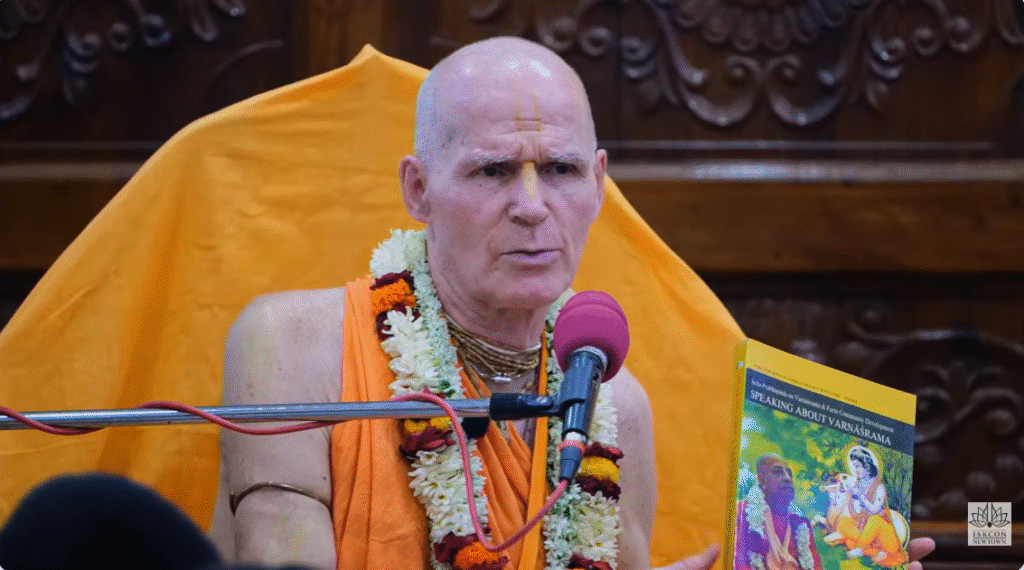
Devotees at Iskcon Newtown, Kolkata got an opportunity to associate with HH Bhakti Raghava Swami Maharaj on 17th May 2026.
Maharaja gave Sunday evening class from 5 pm – 7 pm on the topic “Daiva Varnashrama Dharma.” The entire temple hall was full of devotees as all were eager to hear from Maharaja.
In the class, Maharaja spoke on the necessity of establishing daiva varnashrama especially for Iskcon devotees, so that they have a stable and peaceful life. When mind is at peace then practicing devotion to Krishna is easy.
Below is what maharaja said in the class
Understanding Daiva Varnashrama Dharma
Honoured to come here again, but this time I am getting an opportunity to take darshan of Sri Sri Nitai Gauranga. By the grace of Srila Prabhupada, many temples are coming up in Kolkata.
We have been chosen to speak on a very relevant topic dear to Srila Prabhupada.
The topic is “Daiva Varnashrama Dharma.”
It is the foundation for both material and spiritual well-being.
The subject is “How to Make Vrindavan Villages.”
We need to understand the meaning of dharma.
Sanatana Dharma should be close to the hearts of devotees. We hear about dharma in Bhagavad-gita and Srimad-Bhagavatam. In the First Canto of Srimad-Bhagavatam, dharma is described: sa vai pumsam…
Devotees know that para-dharma is focused on bhakti, which is the eternal activity of the jiva, the living entity. So, para-dharma is also referred to as Jaiva Dharma.
We do not know much about material sva-dharma, which means Daiva Varnashrama Dharma. Our acharyas and sastras explain that it is important to understand this sva-dharma so that we can develop para-dharma.
In modern society, both spiritual and material dharma are not known. Therefore, we have an extremely chaotic condition and a precarious situation in the world.
It is amazing that our devotees know spiritual dharma but know less about material sva-dharma. Therefore, there is an urgent need to introduce material sva-dharma for the devotees and also for outsiders.
If, at the end of the presentation, you grasp at least one principle, then I will feel successful.
Vedic Culture and Village Life
We fail to understand that Vedic culture is agrarian, which means village culture. In modern times, we are disconnected from rural culture.
Krishna appeared in Vrindavan not only to show us the rasa dance. Lord Krishna and Lord Balarama showed the simple lifestyle of the vast majority of people.
On 8th May, we launched a global initiative called “Make Vrindavan Village” to bring awareness and reintroduce this lifestyle which Krishna demonstrated 5,000 years ago. It is still existing in a few places. Fifty to one hundred years back, it was much more widespread.
In 1976, when I first came to India, 85% of the population lived in villages. The population in villages has now gone down by 75% and will reduce further. This means we are leaving our Vedic culture, because Vedic culture exists in villages.
Srila Prabhupada gave a unique definition of intelligence: “Intelligence means not to leave your village.”
Personal Journey to Krishna Consciousness
Being born in Canada, it took me 25 years to know the name of Krishna, and it was even more difficult to know about Krishna’s activities.
I was working as a social worker. I did not know what life was, so how could I help others?
I saw the 100 best books of the world in a library, and then I first came in touch with Bhagavad-gita. In bookshops, no one knew about Bhagavad-gita. It took me a month to get a Bhagavad-gita, which was not Srila Prabhupada’s Bhagavad-gita.
After becoming a devotee, and then after 25 years, I could understand what Varnashrama is.
We can learn Varnashrama by understanding what Srila Prabhupada says about it.
Creating an Alternative Civilization
Of the five seminars, I am presenting the fourth seminar.
The fourth seminar topic is: “Creating an Alternative Civilization – ISKCON’s Mission for the Next 50 Years.” If we understand how modern civilization is adharmic, then we also have to know the alternative.
In 1974, Srila Prabhupada requested all centres to establish an education faculty to establish Varnashrama.
Vedic Education: Academic and Vocational
True education should prepare students for life and not only for the economy. Purpose of education is character formation.
Vocational education means apprenticeship for Vaisyas and Sudras.
In Srimad-Bhagavatam 10.11.37 purport, Srila Prabhupada writes, “The brāhmaṇas were trained in a literary, academic education, the kṣatriyas were trained to take care of the state, and the vaiśyas learned how to cultivate the land and take care of the cows and calves.”
Krishna and Balarama, when They were six years old, went for calf herding. Srila Prabhupada says this is what Vedic education is.
Both academic and vocational education are essential.
Vedic Economy was based on agriculture and Cow Protection
Bhisma’s instruction to Yudhisthira on Varnashrama
Bhisma, for eight weeks, gave instructions to Maharaja Yudhisthira while lying on a bed of arrows.
Bhisma speaks about three gifts of nature. If one wants to be happy, healthy, and wealthy, one should make these three gifts of nature the centre of one’s life. Urban living simply does not provide this.
First gift – Mother Cow.
Second gift – Mother Earth.
Third gift – Mother Saraswati, knowledge.
Sastras say that brahmanas and cows are of the same family because both are situated in the mode of goodness. Krishna wants us to associate with cows so that we come to goodness, and then practicing bhakti becomes easy.
Bhakti is possible when the mind is in goodness. The purpose of Vedic culture is to bring us to goodness and then go beyond it.
Bhisma asks Yudhisthira to make sure that everyone is following varna and asrama. Srila Prabhupada explains, “The conception of four castes and four orders of life, as planned by the Lord Himself (Bg. 4.13), is to accelerate transcendental qualities of the individual person so that he may gradually realize his spiritual identity and thus act accordingly to get free from material bondage, or conditional life.” SB 1.9.26 purport
Questions, Yugalastakam, and Prasadam
After the class, Maharaja answered many queries of the devotees. Devotees also took books from Maharaja which he had written.
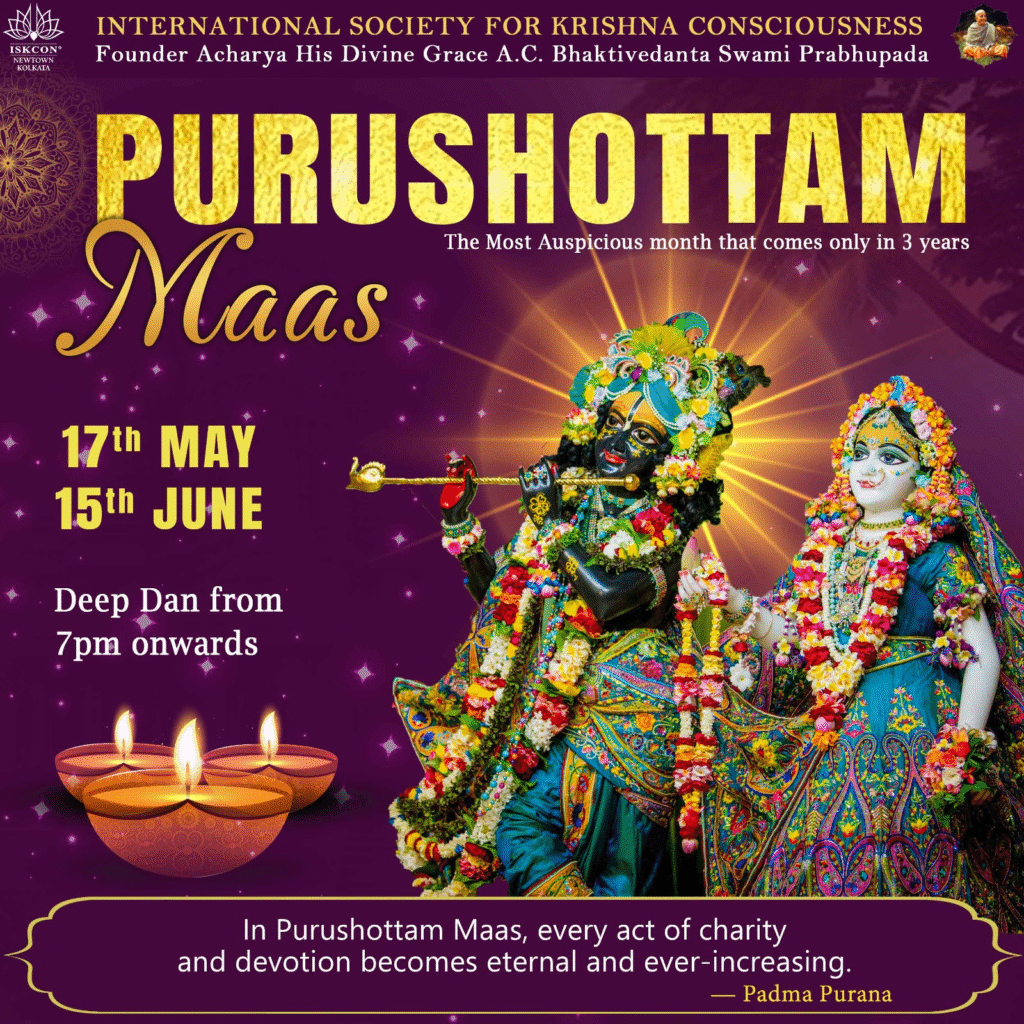
As it was the beginning of Purushottam Maas, after the program devotees sang Yugalastakam of Srila Jiva Goswami and offered lamps to Sri Sri Radha Govinda and Sri Sri Nitai Gauranga. After offering lamps to the Lord, the devotees enjoyed dinner prasadam.




Search
Recent Posts
-
Srimad Bhagavatam at ISKCON Newtown...
October 2, 2026
-
Haridas Thakura: The Foremost Devotee...
September 28, 2026
-
Overcoming Obstacles in Our Spiritual...
September 24, 2026
-
Krishna Katha and Memories of...
September 22, 2026
-
Choose Krishna in All Circumstances...
September 20, 2026