Uddhava Gita: Learning from Life Through the 24 Gurus
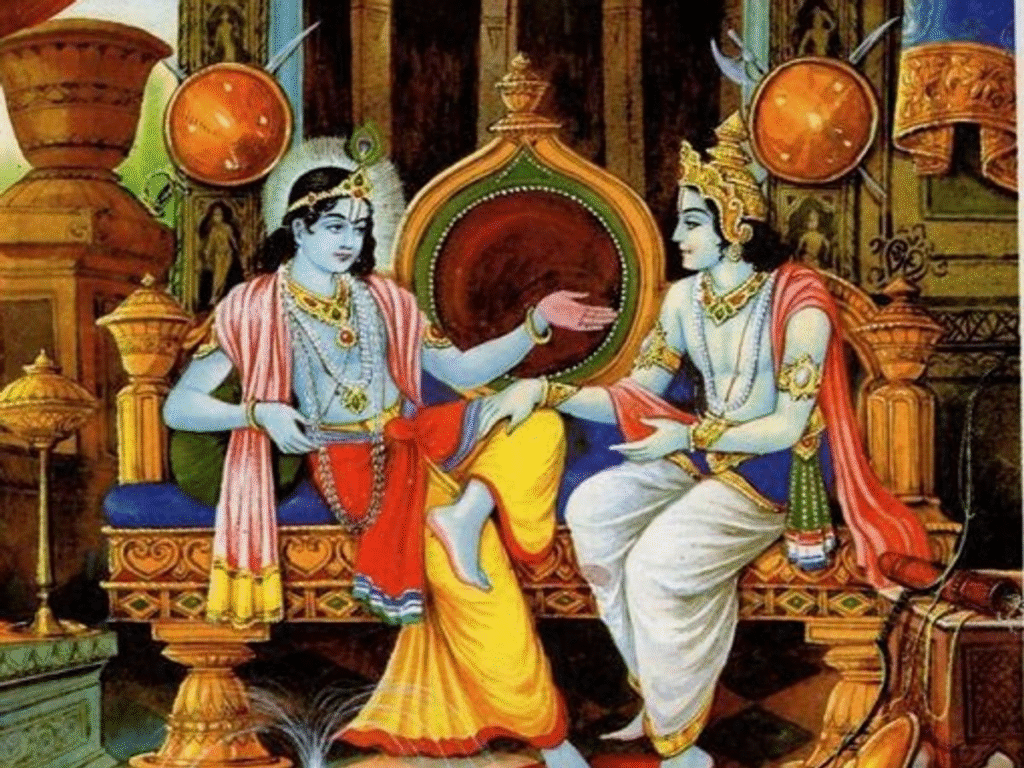
One of the central themes of the Uddhava Gita is that we learn from life itself. We learn from our experiences, from pain, from love, from success, and from failure. Ultimately, all learning culminates in one lesson: where and how to direct our love.
As Krishna decided to conclude His earthly pastimes, Uddhava wanted to go with Him. But Krishna wanted Uddhava to remain in this world and guide others. Krishna instructed him and prepared him to continue his spiritual journey and be a teacher to others.
This verse, Srimad Bhagavatam 11.7.20, is the starting point from where the description of 24 gurus starts in Uddhava Gita.
“An intelligent person, expert in perceiving the world around him and in applying sound logic, can achieve real benefit through his own intelligence. Thus sometimes one acts as one’s own instructing spiritual master.” Srimad Bhagavatam 11.7.20
It teaches us that one can become one’s own teacher when guru is not there. The teachings of 24 gurus in Uddhava Gita shows how one learns from one’s observation.
We can understand this subject through three dimensions:
- Principle
- Process
- Purpose
Krishna Teaches Through the Word and the World
We say, “Krishnam Vande Jagadgurum.”
One meaning of Jagat-Guru is that Krishna is the guru of everyone in the universe. Another meaning is that Krishna teaches through the jagat itself—the world around us.
The universe is a university in which Krishna teaches us.
He teaches us through:
- Scriptures – Word.
- Nature – World.
Scripture is the Word. Nature is the World.
God does not communicate wisdom only through sacred texts. The same Lord also teaches through the experiences He arranges within this world. After all, the world itself functions under His supervision:
mayādhyakṣeṇa prakṛtiḥ sūyate sa-carācaram
(Bhagavad-gita 9.10)
Material nature acts under Krishna’s direction.
Yet there is an important challenge.
The world can be seen either as Krishna’s world or as Maya’s world.
If we simply look at the world through material consciousness, we will primarily see objects for sense enjoyment. The world then becomes a source of distraction. To perceive Krishna’s presence within the world requires spiritual training.
This is where the guru becomes indispensable.
The guru-disciple relationship is eternal because the guru teaches us how to see.
The spiritual master does not merely provide information. He provides vision.
Therefore Narottama Dasa Thakura prays:
cakṣu-dāna dila yei, janme janme prabhu sei
“He who has given me spiritual vision is my master life after life.”
Through the guru we learn scripture. Through scripture we learn how to interpret the world.
Without this foundation, our observations may simply reinforce illusion.
Proper Dependence on Guru
The necessity of guru does not mean unhealthy dependence.
Dependence on guru should not be primarily physical, financial, or emotional.
Physical dependence means unnecessarily burdening the guru instead of helping carry forward his mission.
Emotional dependence occurs when a disciple’s spiritual stability becomes dependent on receiving a particular amount of personal attention, recognition, or affirmation.
One senior devotee recalled receiving a message from a disciple who felt neglected because he had not received enough attention from his spiritual authority and therefore wanted to leave spiritual life. Such situations demonstrate how emotional dependence can sometimes masquerade as spiritual dependence.
As spiritual practitioners mature, they should become spiritually dependent rather than emotionally needy.
Spiritual dependence means drawing strength from the guru’s teachings, example, and connection to Krishna.
We serve the spiritual master through:
- His life
- His teachings (vani)
- His legacy
Guru’s life teaches us how to practice devotional service. His teachings guide our understanding. His legacy provides practical systems through which people can remember Krishna.
Srila Prabhupada emphasized that a genuine spiritual master should provide practical means by which people can remember Krishna and advance spiritually.
Developing Independent Thoughtfulness
One of Srila Prabhupada’s most important instructions was that devotees should become “independently thoughtful.”
A disciple should not outsource all decision-making to the spiritual master.
The guru provides principles, values, and vision, but the disciple must learn how to apply them.
Krishna Himself demonstrated this approach with Arjuna.
Throughout the Bhagavad-gita, Krishna educates Arjuna, answers his questions, removes his confusion, and reveals profound spiritual truths. Yet at the conclusion He does not force Arjuna. Instead He says:
vimṛśyaitad aśeṣeṇa yathecchasi tathā kuru – Thus I have explained to you knowledge still more confidential. Deliberate on this fully, and then do what you wish to do. Bhagavad-gita 18.63
Krishna wanted Arjuna to think.
A significant example appears after the war when Aśvatthāmā was captured. Krishna was physically present, yet He did not simply dictate every detail of what Arjuna should do. Arjuna had to weigh competing principles and make a thoughtful decision. Krishna ultimately approved Arjuna’s judgment.
The purpose of spiritual education is not merely to provide answers. It is to develop mature spiritual intelligence.
Similarly, after Krishna departed from this world, Arjuna continued making decisions based on the wisdom Krishna had imparted. Krishna had prepared him to face life independently.
The goal of the guru-disciple relationship is therefore not chronic dependency but spiritual maturity.
Avoiding Blind Following and Cult Mentality
There is a significant difference between surrender and thoughtlessness.
Independent thinking must always function within the framework of guru, sadhu, and śāstra.
Blind following can become dangerous.
A genuine spiritual tradition encourages thoughtful understanding, not mechanical conformity.
Researchers who study radicalization have observed that many people become attracted to extremist movements because such groups simplify life. Complex moral questions are replaced with simple instructions: “Do not think. Simply obey.”
This pattern was evident in the growth of organizations such as ISIS. Some recruits, including educated individuals from developed countries, were attracted not merely by ideology but by the promise of certainty and simplicity. By surrendering their capacity for independent judgment, many became victims of manipulation and tragedy.
The lesson applies far beyond political extremism.
Whenever people stop thinking and simply surrender their intelligence to another person or institution, they become vulnerable to being misled.
For this reason, spiritual life should strengthen intelligence, not weaken it.
Srila Prabhupada strongly opposed any tendency toward blind following. He wanted devotees to understand philosophy deeply and apply it intelligently.
Unthinking people are easier to control, but thoughtful people are better equipped to serve Krishna responsibly.
Understanding the Letter and Spirit
As devotees mature, they learn to understand both the letter and the spirit of instructions.
We may broadly think of three levels:
| Level | Understanding |
| Kanistha | Follows neither the letter nor the spirit |
| Madhyama | Follows the letter but misses the spirit |
| Uttama | Understands and follows both the letter and the spirit |
The highest level is not merely following instructions mechanically but understanding the purpose behind them.
This is why spiritual traditions remain dynamic and relevant across generations.
For example, Sri Chaitanya Mahaprabhu avoided meeting kings because of the social circumstances of His time. Srila Prabhupada, however, actively met political leaders, scholars, and influential people because different circumstances required different applications of the same spiritual principles.
Similarly, Srila Prabhupada strongly criticized certain aspects of modern education, yet he also encouraged engagement with educated people and intellectual communities.
The principle remained the same. The application varied according to circumstance.
The 24 Gurus in Uddhava Gita: Learning from Nature
Krishna then explains how learning from life works.
The Avadhuta Brahmana describes twenty-four gurus.
Interestingly, none of these 24 gurus formally preach in Uddhava Gita,
They are simply elements of nature and ordinary features of life.
The earth, air, sky, water, mountain, python, moth, honeybee, and many others become teachers.
The Avadhuta learns through observation.
The mountain teaches steadiness and service.
The earth teaches tolerance.
The sky teaches detachment.
Learning is not restricted to formal classrooms.
Life itself becomes a classroom.
Three Sources of Knowledge – Pratyaksa, Anumana and Sabda
Vedic philosophy describes three important means of acquiring knowledge:
Pratyakṣa — Direct Observation
Knowledge obtained through our senses.
Anumana — Inference and Reasoning
Knowledge obtained through analysis and logical conclusions.
Śabda — Revealed Knowledge
Knowledge received from scripture and spiritual authorities.
Pratyakṣa and anumāna are valuable but incomplete.
Our senses are limited.
We do not always perceive reality accurately.
Inference can lead to correct conclusions, but it can also become speculation.
Therefore observation and reasoning require guidance.
That guidance comes from śabda.
How Realization Develops Through Expereince
Śabda provides the framework through which we interpret experience.
Whatever we learn through observation and reasoning should harmonize with scriptural wisdom.
When this happens, realization develops.
Realization means that truths heard from scripture become confirmed through personal experience.
For example, scripture teaches that material wealth cannot guarantee happiness.
Initially we may accept this on faith.
Later we may observe wealthy people suffering from anxiety, loneliness, or dissatisfaction.
Our experience then confirms what scripture already taught.
This is realization.
Pratyakṣa and anumāna have now become aligned with śabda.
The same world that once distracted us from Krishna now reminds us of Krishna.
Srila Prabhupada demonstrated such vision. When he arrived in America, many people saw unprecedented prosperity. Yet Prabhupada also saw widespread anxiety, dissatisfaction, and spiritual emptiness. He famously described modern industrial civilization as ugra-sthāna—a place of intense materialistic activity.
Prabhupada was not seeing merely with material eyes. He was seeing through the lens of scripture.
The 24 gurus in Uddhava Gita teach us how to cultivate this kind of vision.
Learning from the World to Serve Krishna
The purpose of learning from the world is not merely intellectual enrichment.
The purpose is to deepen our relationship with Krishna and improve our service to Him.
If śabda is absent, observation and reasoning can easily become servants of Maya.
When guided by scripture, they become servants of Krishna.
This principle is especially important in preaching and outreach.
The world is constantly changing.
Technology changes.
Communication changes.
Social realities change.
Methods of outreach may therefore need to evolve.
During the pandemic, for example, devotees rapidly adopted online platforms such as Zoom to continue sharing Krishna consciousness.
The principles remained unchanged.
The methods adapted.
Relevance and Potency in spiritual outreach
Srila Prabhupada explains that effective preaching requires realization.
To communicate effectively, we must understand people.
One useful framework is NICE:
- Needs
- Interests
- Concerns
- Expectations
We understand these through observation and inference.
This gives relevance.
Scripture provides potency.
If we only understand people but neglect scripture, our message loses spiritual power.
If we know scripture but fail to understand people, our message may become difficult for others to relate to.
Successful outreach combines both.
Relevance comes from understanding the audience.
Potency comes from understanding scripture.
Conclusion – Life becomes a Teacher
The theme of this section of the Uddhava Gita is simple yet profound: learn from life. Through the 24 gurus in Uddhava Gita, Krishna teaches how every experience can help us grow in our spiritual life.
Krishna teaches through both the Word and the World.
The guru teaches us how to understand the Word.
The Word teaches us how to interpret the World.
Through observation (pratyakṣa) and inference (anumāna), guided by revealed knowledge (śabda), we gradually develop realization.
The purpose is not merely to become knowledgeable.
The purpose is to see Krishna everywhere, learn from every experience, and use everything in His service.
In this way, life itself becomes a teacher, the world becomes a classroom, and every experience becomes an opportunity to move closer to Krishna.
(Above article is based on the lecture given by HG Chaitanya Charan Prabhu at Iskcon Newtown Kolkata on 17th June 2026)
Read Series of articles on Uddhava Gita:
Search
Recent Posts
-
Srimad Bhagavatam at ISKCON Newtown...
October 2, 2026
-
Haridas Thakura: The Foremost Devotee...
September 28, 2026
-
Overcoming Obstacles in Our Spiritual...
September 24, 2026
-
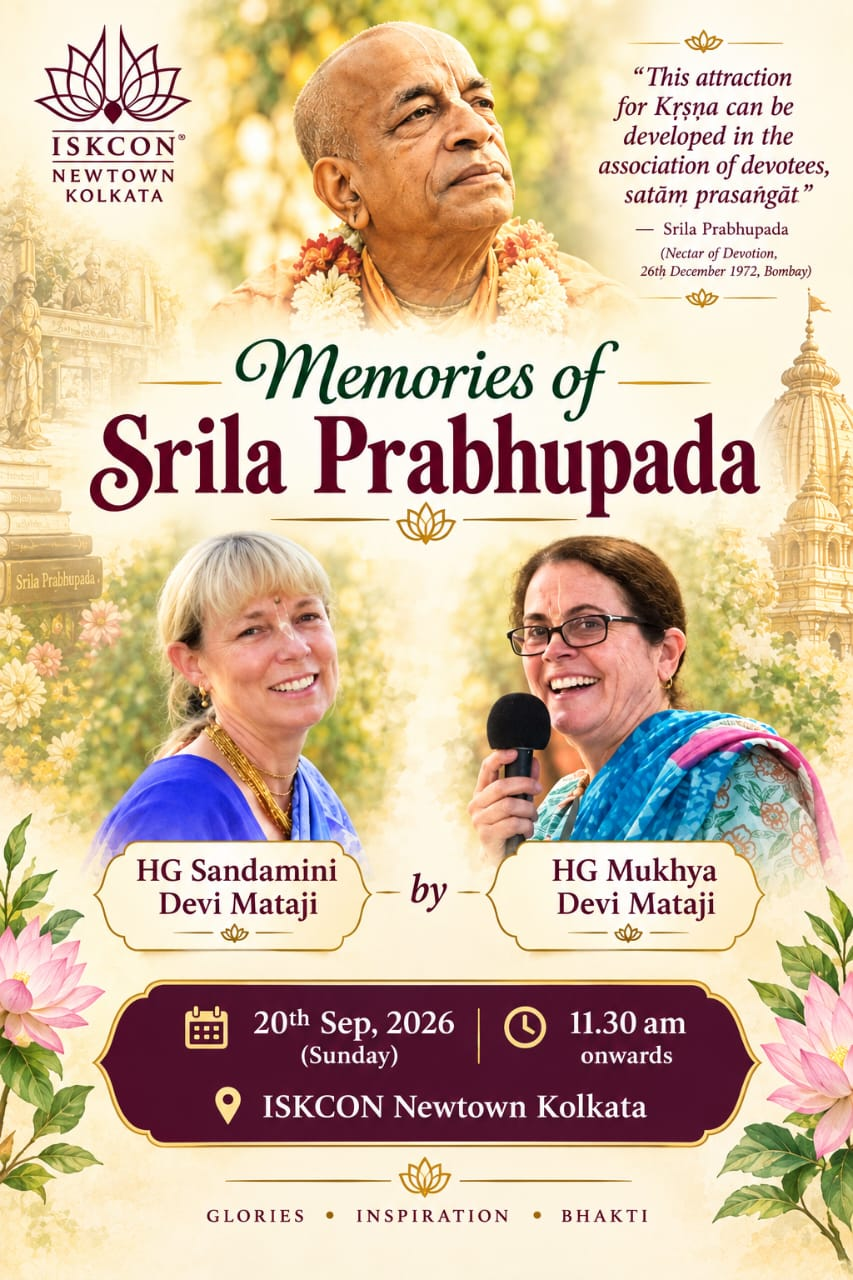
Krishna Katha and Memories of...
September 22, 2026
-
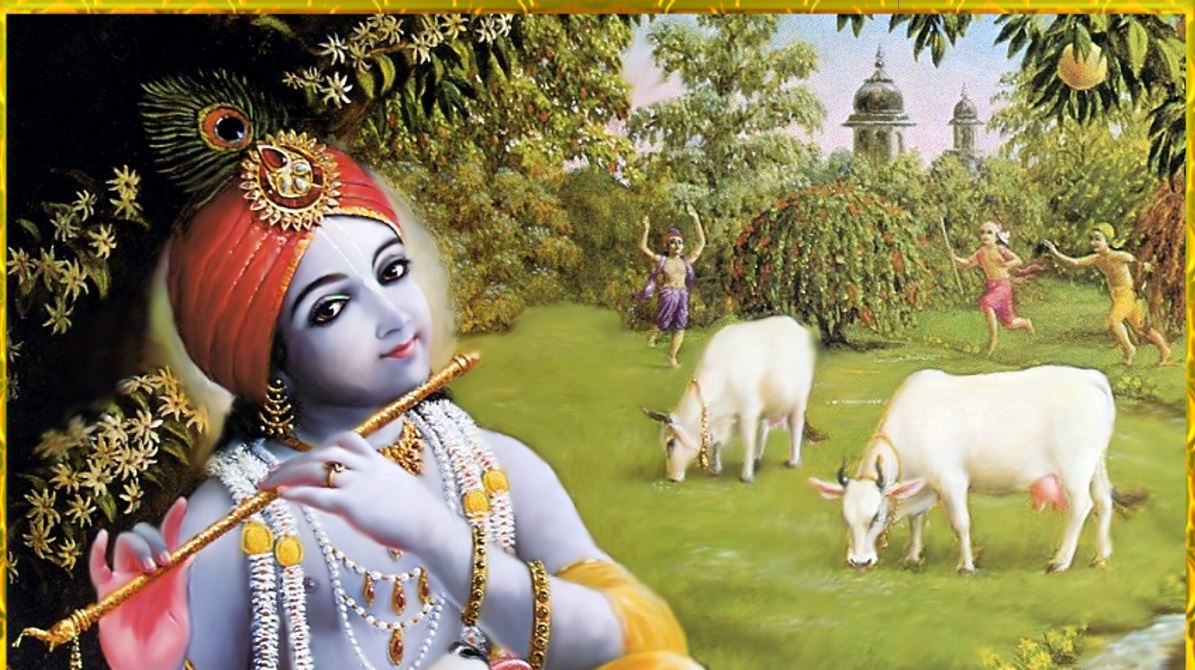
Choose Krishna in All Circumstances...
September 20, 2026
Aila Gita: Lessons on Responsibility and Self-Control
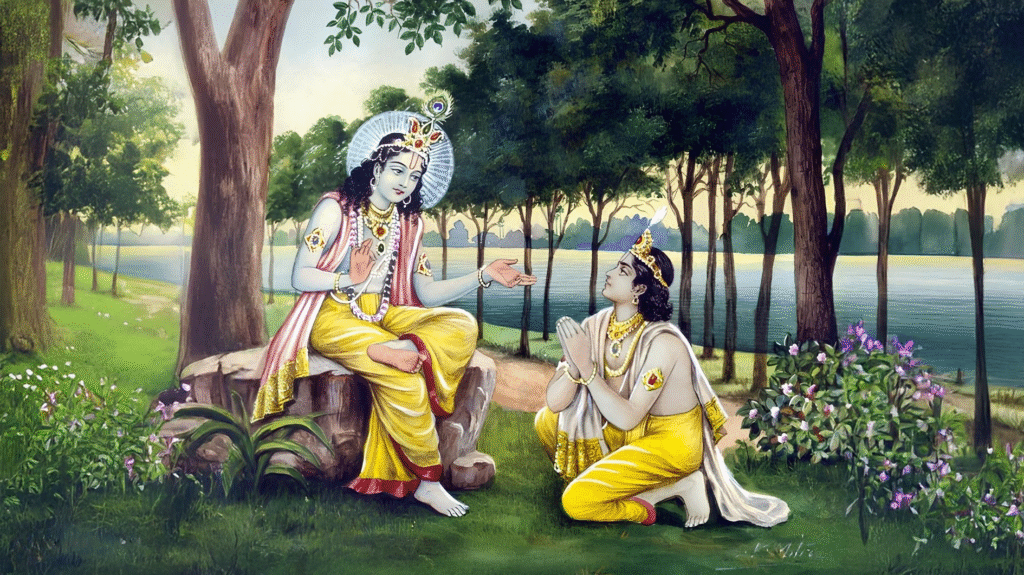
In 11th Canto of Srimad Bhagavatam, the last story which Krishna says to Uddhava is Aila Gita. Krishna through different perspectives and pastime, gives knowledge to Uddhava.
Krishna is giving knowledge to Uddhava so that he becomes detached from the world.
In 9th canto, it is mentioned that how Puruva was a great king, but when he saw Urvasi, he got attracted to her. But later Urvasi left him.
Pururva laments and then does yajna to get her. He is able to get her too but again Urvasi leaves.
When Urvasi leaves Pururva then Pururva goes through different stages of transformation. This is discussed in the chapter Aila Gita of Bhagavatam.
First Stage
Puruva is angry with her. He thinks, “I have given her so many things, I gave her love but still she left.”
Second Stage
He thinks I wasted my time with her. When someone leaves a person, then the person thinks before she left me I should have left her.
Third Stage
He thinks about his own “responsibility.” He thinks, “What is her fault? It was I who thought a rope to be a snake. I could not understand who I was and I could not control my mind.”
Fourth Stage
He becomes detached, he leaves kingdom and wanders.
Finally, devotion for the Lord comes.
Fifth Stage
From Aila Gita, we understand the importance of taking responsbilty in one’s life.
Let us will discuss taking responsibility in one’s life with the abbreviation – APT: A (Analyze) P(Protect) T(Transcend)
Analyze(A) The Cause
In Aila Gita, we see how Puruva, critically analyses the cause of his suffering.
A person gets angry and may blame others for that. May be the other person might have said something, but we are responsible for our action.
Let us see how responsible circumstances are and how responsible we are.
If someone does something wrong then we have to analyze why this happened. There is soul, which is now covered by mind, and mind gets influenced by circumstances (i.e. with the world around us). Mind has different conditionings. Soul has intention.
There are 3 reasons why people do something.
Circumstances
For e.g. a person may drink alcohol at a party and say that his friends forced him to drink. But his friends did not open his mouth and poured liquor in it. Circumstances can be one cause for behaving in a particular way, then there is conditioning.
Conditioning
Conditioning means one has certain samskara based on which one does things. Samskara ca be positive or negative. Someone may have bad experiences in his childhood which may create bad impression in his mind. So, we can say samskara is “some scar.” Based on samskara, one does certain things. Then there is intention.
Intention
One chooses to do certain things. For eg. no one called a person to drink but he chooses to drink alcohol. There was one rich person who was addicted to alcohol. His family members asked the neighborhood shops to not give him alcohol. So, he would fill the petrol tank of his vehicle with alcohol and drink it using a straw. This is intentional.
These are three contributors – circumstances, conditioning and intention (choice).
Understanding circumstances, conditioning and intention (choice) through example
We see examples of Ravana and Ajamila. Both are afflicted by lust, but there situations are different. Ajamila had gone for service and got distracted when he saw a prostitute and a man. His cause for distraction was circumstances. Ajamila’s situation starts with circumstances.
For Ravana, circumstances did not come to him, he created the circumstance. He thought when Sita will be alone, he would force her to come with me. His action was intentional. When we intend to do something, we create circumstances.
For eg, when we open app, something obscene pops up, then that is circumstantial but when we go and open a particular site with obscene content then that is intentional. In Australia, social media is banned for teenagers. But teenagers are using VPN to bypass the ban.
If someone wants to correct oneself then one has to see what factors are contributing more.
Ajamila – first sight – 100% circumstantial. He came back from that place, but mind did not come back. He kept thinking about it.
When he went first time to the lady, we can say 80%-90% circumstantial. We can this is conditioning, so he did something.
For Ajamila, one thing was “To be with her” and second was “She be with me.” Now, for “She be with me”, he had to give up his wife, parents, job. He was a brahmana but when he started living with the prostitute then no one invited him for yajna or for other sacred sacrifices. When he decides that “she be with me” then this was not conditioning but this was intentional.
For eg. A fort has walls around. Enemies may attack it from outside and walls may break down. These are circumstances. Sometimes there can be attack on the fort from inside too, this is conditioning. But if someone is breaking the wall from inside to bring it down then this is intentional.
While fighting against anarthas, sometimes we may fail. This is sign of weakness.
For Ravana it was not weakness, but it was his wickedness. Ravana was not fighting against the anarthas, but he was fighting for it. This is the characteristic of a demon. A demon does not fight against anarthas like lust but fights for it to get it.
So, first we have to analyse why we are behaving in a particular way.
Till the time we blame circumstances, we cannot grow.
In Aila Gita, we see Pururva after analysing his situation stops blaming circumstances.
Protect(P)
For protecting anything, we need boundaries.
From Aila Gita, we learn the importance of boundaries, if we do not have it then we are bound to suffer like Pururva.
Boundaries are two types – Internal & External
One Bollywood actor who is taking interest in devotional life was angry with Iskcon when he heard one prominent Iskcon speaker blaming Bollywood for rise in rape cases in India. He said movies do not glorify rapes. People are indulging in it because they are animals.
Suppose that in shop nice things are displayed, it does not mean that one goes and steal things from there and blame shop for that.
External boundaries are two – Law & Culture
Law
Law will punish you if you are wrong. For e.g. drink and drive is a big crime.
Culture
It is based on the environment where we live. Using abusive words in public, smoking are part of the culture where we grew up.
Internal boundaries are two – Intelligence & Conscience
Intelligence
It tells us that this action will result in bad outcomes, will create problem. For e.g. someone with diabetes will use his intelligence and will not indulge in sweets. Even Ravana had that much intelligence that I should not force myself upon Site because he had been cursed.
No one can say that I cannot control my conditioning. For e.g. someone is saying that I can’t give up meat but if doctor says that if you do not give up you will die then that person will give it up.
Conscience
Not just this will lead to bad, but this is bad. For e.g. if a new person comes to temple and we behave badly with him. But later come to know that he is a senior disciple of a prominent guru then we will immediately go a seek forgiveness from him fearing that our action will be reported by him to his guru. But if a young devotee comes to temple and I do not behave badly with him thinking that he is a guest to the temple then this is conscience.
Even if there is no boundary then some boundary is required.
Transcend(T)
It is going beyond conditioning. Best example is Haridas Thakura. Even though the prostitute came, he was not at all affected by it.
Aila Gita too teaches about transcedence. When one achieves it one becomes satisfied and free from all material attachments and entanglements.
“Thus losing his desire to be on the same planet as Urvaśī, Mahārāja Purūravā began to wander the earth free of all material association and completely satisfied within the self.” Srimad Bhagavatam 11.26.35
By bhakti we can transcend the conditioning. But it will take time. So we have to also focus on boundaries. Whatever boundaries work, we should go for it.
Law: If law is favorable then this is good, but law is not in our control.
Culture: this is also partly in our control not completely. We cannot change the culture, but we can choose the culture. Choose which culture you want to belong to. If we are with devotees, then we get a devotional culture. By culture, controlling our conditioning is easy. For e.g. in temple people come wearing decent dress, not to agitate others.
Intelligence: This is mostly in our control. With our intelligence, we can understand if we do this then this will happen. So, hearing lectures and reading scriptures are very important to develop intelligence. Whatever anarthas is troubling us, we should hear those lectures which will help us to deal with those anarthas.
Conscience: This is best. But it is gradual and happens through purification. If we develop proper conscience then we do not do certain things because we know this will displease Krishna. And our life’s purpose is to please Krishna and not displease him – anukulyasya sankalpah, pratikulyasya varjanam.
Key takeaways
Self-control: For self-control, we cannot blame circumstances and also, we cannot rely completely on will power. If we just blame circumstances and think that we can control everything by will power then this is not possible.
For self-control, first we have to through intelligence and then to transcendence.
With intelligence we protect ourselves from circumstances and strengthen our will power.
Till the time we do not have love for Krishna, then till the time with buddhi, intelligence, we should do bhakti.
Summary
- Context: Aila Gita. It teaches us that instead of blaming circumstances for our suffering, we should take responsibility for our actions, become detached from things which causes sufferings and ultiamtely develop devotion for the Lord.
- We see Pururva is 1st blaming, 2nd he takes responsibility, 3rd he develops detachment and fianlly develops devotion.
- Taking responsibility
Analyse – Circumstances, Conditioning, Intention (choice). Intention – Ravana’s action. Ajamila’s start was based on circumstances then intentional. All three are contributors.
Protect: To protect ourselves we need boundaries.
1. External Boundary: Culture & Law
2. Internal Boundary: Intelligence & Conscience
Choose whichever boundary works is best boundary.
Safest boundary is conscience. But most controllable is intelligence.
- For Self-control – Increase intelligence
Different people have different levels or types of anarthas – Some people have more lust, less anger, less greed. Some may have less lust, more anger, less greed and so on.
- Srila Prabhupada instruction
Responsibility in our spiritual life is upon us. Srila Prabhupada says every individual has to fly his own plane.
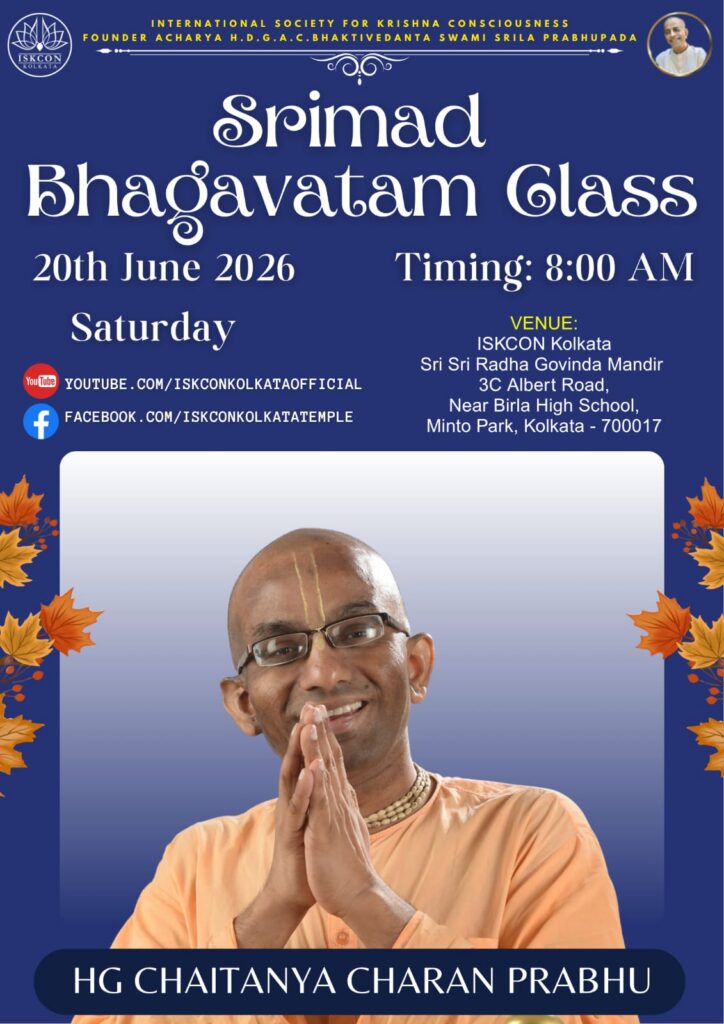
(The above article is based on the Srimad Bhagavatam Class given by HG Chaitanya Charan Prabhu at Iskcon Kolkata on 20th June 2026)
Search
Recent Posts
-
Srimad Bhagavatam at ISKCON Newtown...
October 2, 2026
-
Haridas Thakura: The Foremost Devotee...
September 28, 2026
-
Overcoming Obstacles in Our Spiritual...
September 24, 2026
-
Krishna Katha and Memories of...
September 22, 2026
-
Choose Krishna in All Circumstances...
September 20, 2026
Two qualifications to understand the message of Bhagavad Gita

Ever wonder why even after reading Bhagavad Gita, people are not interested in dedicating their life to Krishna. The answer is given by Krishna himself in Bhagavad Gita. In the verse 4.3 of this book, Krishna says that to understand his message which he is giving in Bhagavad Gita one should be his friend and also his devotee. These are the two qualifications required to understand Bhagavad Gita.
Krishna spoke Gita to Arjuna, and even Dhritarashtra through Sanjaya came to know about the knowledge but still the blind king was not able to appreciate the knowledge. It was because he wasn’t a devotee of Krishna and never considered Krishna his friend.
In fact, he became more disturbed when at the end Sanjaya informs him that wherever Krishna is and wherever Arjuna is opulence, victory, extraordinary power and morality is guaranteed. Bhagavad Gita 18.78.
Any sane man after knowing Gita and knowing who Krishna is would have immediately given up all false notions and would have taken shelter of Krishna just like Arjuna.
Krishna spoke this great knowledge 5000 years ago and after that many people tried to share this with others. But there are people who may know all the 700 verses of Gita but are still not interested in Krishna. Why? The answer is simple – they have not developed friendly relationships with Krishna and have not decided to become a devotee of Krishna.
Srila Prabhupada knew this fact so the first thing he did was to make everyone a devotee of Krishna. In fact, the most important qualifications to share the knowledge of this great literature is to first be a devotee of Krishna. Intellectual rendition may attract people’s attention but may not transform people’s heart.
Knowing Gita from Srila Prabhupada
Srila Prabhupada being a pure devotee of Krishna could easily comprehend the message which Krishna wanted to share with all the suffering souls of this world. And moreover, Prabhupada knew Krishna’s heart. He knew that Krishna wants everyone to get connected to him and come back to him.
Prabhupada worked on this mission. He dedicated his life in bringing people closer to Krishna and making them understand Krishna’s message as it is. This is why he wrote book Bhagavad Gita as it is.
Many so-called scholars to capitalize the popularity of Gita wrote commentary on Bhagavad Gita but added their own interpretation and so the original message of Krishna was lost.
But Prabhupada said to us what Krishna wanted to share with us. Those who heard him their heart got transformed and could understand their relationship with Krishna. Prabhupada went to west and the western people after hearing Gita from Prabhupada gave their life to Krishna.
Today we see thousands and thousands of people chanting the names of Krishna all over the world, singing the glories of Krishna, worshipping Krishna in the temple selflessly.
This is because they have come to know that Krishna is the topmost reality, he is everyone’s friend, and the goal of all living beings is to become a devotee of Krishna.
With this understanding, knowing Gita becomes easy. The message of Krishna penetrates our heart and love of Krishna manifests in it.
Three Reflections
- In Bhagavad Gita 4.3, Krishna says that to understand his message which he is giving, one should be his friend and also his devotee.
- There are people who may know all the 700 verses of Gita but are still not interested in Krishna.
- Those who heard from Srila Prabhupada, their heart got transformed and they could understand their relationship with Krishna.
Ask Yourself
- Do I consider Krishna my true well-wishing friend?
Action Item
- Hear at least one lecture of Srila Prabhupada on Bhagavad Gita per week.

Search
Recent Posts
-
Srimad Bhagavatam at ISKCON Newtown...
October 2, 2026
-
Haridas Thakura: The Foremost Devotee...
September 28, 2026
-
Overcoming Obstacles in Our Spiritual...
September 24, 2026
-
Krishna Katha and Memories of...
September 22, 2026
-
Choose Krishna in All Circumstances...
September 20, 2026
Gita’s wisdom makes us strong enough to face any challenges of this world

Our internal thoughts and consciousness mostly determine how we see the world around us. We have almost no control on how people around us is going to behave with us and how the situations and circumstances are going to shape up. Sometimes everything may be as per our liking and sometimes just the opposite may happen.
If we are not internally strong and wise, then we will remain forever at the mercy of our surroundings. So, it is important that we always remain prepared and alert to deal with any kind of people and any sort of situations.
Our consciousness shapes our vision. External world may not change for us or will never change for us but if we purify our consciousness then the way we see the world will drastically change.
Krishna transformed Arjuna’s life
Let us take the example of Arjuna. Just before the Mahabharat war he was in a pitiable situation. He was so overwhelmed with emotions that he was willing to leave the battlefield and was ready to live by begging.
Although he was a fearsome fighter, had defeated great warriors but he was not able to hold his bow and arrow, they were slipping from his hand, and he was not able to even stand properly. It was not that he had become fearful seeing the Kaurava armies who were his own relatives, but he was utterly confused about his duty.
But he was fortunate because Krishna was with him. Krishna’s guidance transformed Arjuna’s life.
The external situation for Arjuna remained the same. He had to fight the war; he had to fight against his grandfather Bhisma, guru Drona and his cousin brothers. But Krishna’s timely intervention dispelled all his ignorance. He now knew what to do, what not to do and why to do. Arjuna’s consciousness changed and he became ready to battle against the mammoth army of Kauravas. He eventually became victorious in the gruesome war.
Gita’s timeless wisdom
The knowledge which Krishna gave to Arjuna is available with us in the form of Bhagavad Gita. If we read it and understand it then we will also be equipped with the knowledge to deal with the external world. Gita’s wisdom will transform us internally. It will make us internally strong, will help us to understand the world around us and most importantly it will help us to understand who we are.
If we imbibe the true spirit of Gita, then we won’t get bewildered when we encounter difficulties. Gita’s wisdom nourishes intelligence, strengthens will power and imparts discriminatory power. Armed with these weapons we can face the challenges of life with vigour.
Most importantly, this life transforming book teaches us that we belong to Krishna and if we live as per the teachings of Krishna then Krishna will always be there for us just as he was with Arjuna.
Three Reflections
- External world may not change for us or will never change for us but if we purify our consciousness then the way we see the world will drastically change.
- The external situation for Arjuna remained the same but Krishna’s timely intervention dispelled all his ignorance.
- If we live as per the teachings of Krishna, then Krishna will always be there for us just as he was with Arjuna.
Ask Yourself
- Do I get bewildered by how people around us behave with me?
Action Item
- Read 2nd chapter of Bhagavad Gita and try to understand what Krishna says about the relationship we have in this world with different people.

Search
Recent Posts
-
Srimad Bhagavatam at ISKCON Newtown...
October 2, 2026
-
Haridas Thakura: The Foremost Devotee...
September 28, 2026
-
Overcoming Obstacles in Our Spiritual...
September 24, 2026
-
Krishna Katha and Memories of...
September 22, 2026
-
Choose Krishna in All Circumstances...
September 20, 2026
Do you always look for glofication?|Bhagavad Gita 16.3

Although we would hesitate to admit it but it’s a fact that more than hunger for food most of us have hunger for glorification. Any activity we do we want to be appreciated for it. And if someone fails to oblige us then we immediately become morose and go to the extent of detesting that individual.
We like to be in the company of those who constantly massage our ego. And we try to orchestrate our life in a way so that we can attract other’s attention.
What they think about me? What will their reaction be if I do this? Is my importance intact or increasing or diminishing? These thoughts continuously occupy our mind. And instead of living for ourselves we become a dancing doll whose key is in other people’s hand.
But the world is such that we would never always continue to be the “centre of attraction.” Someone is going to eclipse us some day. And those who used to play an important role in making us feel important effortlessly shift their loyalty. Our heart cries and we moan in silence but we can do nothing about it.
This is why wise sages in the past have always warned us against running for name and fame. Lord Krishna says the same in Bhagavad Gita.
In Bhagavad Gita 16.3, the Supreme Lord says that one should be “free from passion for honour”, ati-mānitā. This is a divinue attribute, which we should try to cultivate. If we can do so, we can live peacefully. So, we should not be obsessed about what others think or feel about us. It’s a useless endeavour and return is mostly heart breaking. Instead we should use this life for purification and not for proving our worth to others. In fact, we should not be concerned about our own glorification but instead we should always try to make sure that Krishna is always glorified.
Ask Yourself
- Do you always think of impressing others?
- If yes, then are you in control of your life or is your life in other’s control?
Search
Recent Posts
-
Srimad Bhagavatam at ISKCON Newtown...
October 2, 2026
-
Haridas Thakura: The Foremost Devotee...
September 28, 2026
-
Overcoming Obstacles in Our Spiritual...
September 24, 2026
-
Krishna Katha and Memories of...
September 22, 2026
-
Choose Krishna in All Circumstances...
September 20, 2026
How spirituality can help fight Coronavirus effectively?

1.3 billion Indians are observing Janata Curfew on 22nd March, to fight Covid-19. Billions of people in different parts of the world are already under lockdown. Schools are closed, colleges are closed, offices are closed, malls and theatres are closed, flights have been canceled, trains and buses have stopped running. There is an undeclared curfew in almost all the parts of the world.
Coronavirus, the tiny little virus, which cannot be seen with our eyes have brought the whole world to a standstill.

Scientists are working to find a cure for the deadly disease and hopefully, they will succeed.
The virus is spreading because of human to human transmission and as of now there is no cure, so billions of people find themselves vulnerable. Prime Minister of India, Narendra Modi, said in his nationwide address that this is more dangerous than World War 1 and World War 2.

As we are now locked down inside our houses it is the best time to ask ourselves as why such a calamity has dawned upon entire humanity. This disaster can also be a wakeup call for all of us.
The virus spread from seafood and animal market in Wuhan, China. A report in CNN explains, “In the likely epicenter of the virus — the so-called wet-markets of Wuhan, China — where wild animals are held captive together and sold as delicacies or pets, a terrifying mix of viruses and species can occur.”

It is now widely believed that bats are the carrier of the virus. They might have either directly passed it to humans or through some intermediate host. Although as of now there is no conclusion about its origin but researchers agree that its origin is from non-human species.

It was transmitted to humans because some ate the animal which was carrying that virus.
Humans are not supposed to eat animals or drink their blood. But especially in China, the concept is – you can eat anything on the land except motorcars, anything in the sky except airplanes, anything in the sea except ships. Why blame China, people in many parts of the world are today practicing the same eating habits. Unfortunately, even in India too. They are not just eating animals but are also drinking their blood. And surprisingly we call ourselves humans and them as animals.
Bird flu, swine flu, mad cow disease, and now coronavirus which have resulted in deaths of thousands of people all over the world have spread because human beings eat animals.
Have we ever read about potato flu, brinjal flu, tomato flu, milk flu, curd flu, paneer flu or mad cauliflower disease, mad spinach disease?
We are not supposed to kill animals and eat and drink their blood. We are supposed to live on food grains, fruits, vegetables, and milk. As per my wife, Dr Ketaki, who is a dentist, “The human dentition and digestive system have been designed for the intake of vegetarian food and not non-vegetarian food.”
In fact, the scriptures go one step ahead and say that vegetarian food should first be offered to the Lord and then consumed. Bhagavad Gita 9.27.
The Lord purifies the food and when we take that pure food then we remain healthy. And a healthy body is generally free from diseases.

But if we go against the laws of the nature created by God, then nature will react. If we exploit the nature, then we will be exploited.
If we eat animals, we will have to live like animals in cages. Like animals we are now forced to lock ourselves inside our houses, we cannot go out. And eventually we will die like animals.
God has made us humans so why not live like humans?
Srila Prabhupada always cautioned that if we play with the nature then we will have to suffer. In one of the conversations, he explains, “We act according to our whims and the resultant action is there immediately. Nature’s law, God’s law, is there. It is not God’s creation that somebody is suffering from some painful condition and somebody is enjoying. No. We infect ourselves with some contamination because this material world is full of contamination. You must remain very cautious. Otherwise you will have to suffer.” — Conversation in Mayapur, 19th Mar 1976.
As we have isolated ourselves from the world to save ourselves from the virus it is also a time for us to go deep within and introspect why we are suffering and what steps we should take so that we do not suffer in future.
God does not want us to suffer. Therefore, he gave us sacred Vedas which explains how we can live happily in this world and how we can minimize our suffering. The Vedas elaborately explains how to live and how not to live, what to eat and what not to eat.
Srila Prabhupada writes in Srimad Bhagavatam 7.15.24 Purport, "By practice, one should avoid eating in such a way that other living entities will be disturbed and suffer. Since I suffer when pinched or killed by others, I should not attempt to pinch or kill any other living entity. People do not know that because of killing innocent animals they themselves will have to suffer severe reactions from material nature. Any country where people indulge in unnecessary killing of animals will have to suffer from wars and pestilence imposed by material nature. Comparing one’s own suffering to the suffering of others, therefore, one should be kind to all living entities. One cannot avoid the sufferings inflicted by providence, and therefore when suffering comes one should fully absorb oneself in chanting the Hare Kṛṣṇa mantra."

So if we want to free ourselves from the sufferings then we should try to reconnect ourselves to our roots, to the teachings of the Vedas and to the Supreme Lord who is our best well-wisher.
As we are locked inside our houses, we have an option to spend time watching news channels, movies, serials or programs like big boss. We can also spend time tweeting, updating status on Facebook, forwarding unlimited WhatsApp messages, watching funny TikTok videos, posting pictures on Instagram or Pinterest.
Or else we can spend time reading books like Bhagavad Gita and Srimad Bhagavatam which will nourish our intelligence and bring us closer to God.

When King Parikshit faced the biggest challenge in his life then he without wasting even a single moment took shelter of the Supreme Lord. He spent his days hearing the transcendental teachings of Srimad Bhagavatam from Sukhadeva Goswami, son of Ved Vyas.
If we take shelter of the Lord, shelter of the sacred Vedas and pray to the Lord then our miseries will surely vanish. In Bhagavad Gita 3.10 Krishna explains the process by which we all can be happy in this world,
“In the beginning of creation, the Lord of all creatures sent forth generations of men and demigods, along with sacrifices for Viṣṇu, and blessed them by saying, “Be thou happy by this yajna [sacrifice] because its performance will bestow upon you everything desirable for living happily and achieving liberation.”
The best yagya in this Kali Yuga, the age of downfall and suffering, is the sankirtan yagya. In Srimad Bhagavatam 11.5.32 it is mentioned that in this age of Kali Yuga intelligent men and women chant the holy names of the Supreme Lord.
During World War 2, there was a danger that Kolkata may be bombed. Thousands of residents were fleeing Kolkata during that time but Srila Prabhupada was not afraid. He said let us do sankirtan and with few devotees he did sankirtan on the streets of Kolkata. No bombs were dropped on Kolkata.
As the coronavirus disease spreads from people to people contact so we cannot come together to perform sankirtan physically but each one of us can individually chant the holy names of the Lord.
As to protect ourselves from the coronavirus infection we are asked to wash our hands with soap constantly and also use sanitizer, similarly, we should clean our hearts and sanitize our consciousness from the contamination of the world by sincerely and regularly chanting the holy names of the Lord like the Hare Krishna Mahamantra – Hare Krishna Hare Krishna Krishna Krishna Hare Hare/Hare Rama Hare Rama Rama Rama Hare Hare.

This will protect us, protect our family members, friends and relatives, and the entire world. If we take shelter of Krishna, the Supreme Lord, he will protect us and the whole world from this pandemic.
Let us contemplate:
- Is God responsible for our suffering or we are responsible for our suffering?
- Why eat animals when sacred Vedas asks us not to do?
- Why not follow the teachings of sacred books like Bhagavad Gita which is a manual for humankind and live happily in this world?
Search
Recent Posts
-
Srimad Bhagavatam at ISKCON Newtown...
October 2, 2026
-
Haridas Thakura: The Foremost Devotee...
September 28, 2026
-
Overcoming Obstacles in Our Spiritual...
September 24, 2026
-
Krishna Katha and Memories of...
September 22, 2026
-
Choose Krishna in All Circumstances...
September 20, 2026
Prime Minister Modi to launch world’s largest Bhagavad Gita which weighs 800 kg

Iskcon is coming up with an edition of Bhagavad Gita which will be largest in the world. Currently there is only one copy of this Gita available. The devotees in Italy under the leadership of Madhu Sevita Das have worked hard to print and publish it.
Speaking to Iskcon News Yudhistir Govinda Das, head of ISKCON Communications in India, said, “This Astounding Bhagavad Gita is truly a masterpiece. There is only one copy in the world of this book which weighs 800 kg and measures 3.8 x 2.8 meters. This copy of the Gita will surely generate a lot of awareness and interest around the world about the teachings of this sacred text.”
Gopal Krishna Goswami, ISKCON’s Governing Body Commissioner and Chairman of the India Bureau, and Yudhistir Govinda Das recently met Prime Minister Modi at his official residence and requested him to participate in the launch of this unique Gita. Mr. Modi was excited to hear about it and have agreed to participate in the book launch.
Iskcon has been playing a phenomenal role in spreading the teachings of Bhagavad Gita in each and every corner of the world. Appreciating the efforts of Iskcon, the 2nd World Hindu Congress held at Chicago, United States, honoured ISKCON for its effort in making Bhagavad Gita popular all over the world.

Search
Recent Posts
-
Srimad Bhagavatam at ISKCON Newtown...
October 2, 2026
-
Haridas Thakura: The Foremost Devotee...
September 28, 2026
-
Overcoming Obstacles in Our Spiritual...
September 24, 2026
-
Krishna Katha and Memories of...
September 22, 2026
-
Choose Krishna in All Circumstances...
September 20, 2026
Suicide in the spur of the moment
Search
Recent Posts
-
Srimad Bhagavatam at ISKCON Newtown...
October 2, 2026
-
Haridas Thakura: The Foremost Devotee...
September 28, 2026
-
Overcoming Obstacles in Our Spiritual...
September 24, 2026
-
Krishna Katha and Memories of...
September 22, 2026
-
Choose Krishna in All Circumstances...
September 20, 2026
Let us guard our mind like a gardener guarding his gorgeous garden

(Pic source: wikipedia)
Search
Recent Posts
-
Srimad Bhagavatam at ISKCON Newtown...
October 2, 2026
-
Haridas Thakura: The Foremost Devotee...
September 28, 2026
-
Overcoming Obstacles in Our Spiritual...
September 24, 2026
-
Krishna Katha and Memories of...
September 22, 2026
-
Choose Krishna in All Circumstances...
September 20, 2026
Devotion with determination opens the gate for perfection
Search
Recent Posts
-
Srimad Bhagavatam at ISKCON Newtown...
October 2, 2026
-
Haridas Thakura: The Foremost Devotee...
September 28, 2026
-
Overcoming Obstacles in Our Spiritual...
September 24, 2026
-
Krishna Katha and Memories of...
September 22, 2026
-
Choose Krishna in All Circumstances...
September 20, 2026