55th Kolkata Rath Yatra 2026 – Srimad Bhagavatam Class by HH Bhakti Purusottama Swami Maharaja on SB 1.15.7 (19th July 2026)
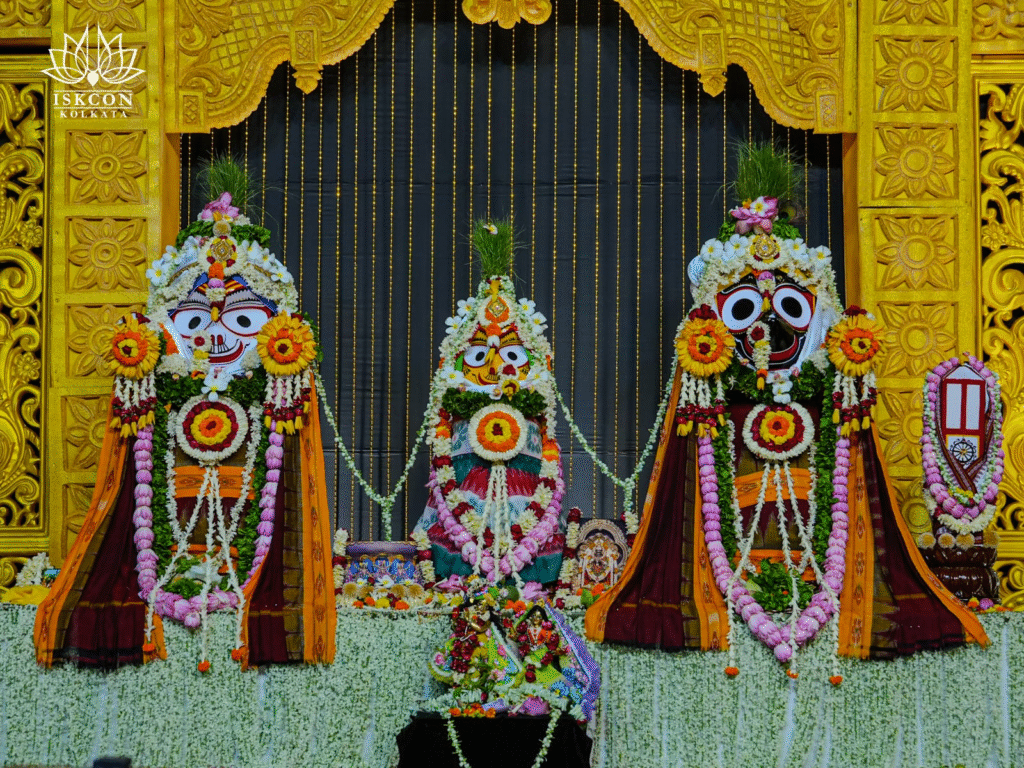
What is the connection between Krishna and Lord Jagannath? While speaking on Śrīmad-Bhāgavatam 1.15.7, HH Bhakti Purushottam Swami Maharaja explained how Krishna’s final earthly pastimes are connected with Lord Jagannath, His mercy upon tribal devotees, Nila Madhava, and the sacred tradition of the Dayitapatis. Below article is based on the class which Maharaja gave on 19 July 2026 at the Kolkata Rath Yatra Pandal.
Krishna Is the Supreme Controller of Everything
After Krishna leaves the planet, Arjuna is speaking this verse to Yudhisthira. Arjuna says that by Krishna’s mercy, he got the strength to defeat the lusty princes and was able to marry Draupadi by piercing the eye of the fish.
It is not just about Arjuna; whatever strength we get is because of Krishna. Anything that happens to us is because of Krishna. But unfortunately, when something good happens, we think it is because of us, and if something bad happens, we blame God for it.
This is the mentality of demons. Devotees know that everything is done by Krishna, so they give credit to Krishna for everything. Krishna is in the heart of all, and from Him comes everything. Bhagavad Gita 15.15.
Knowledge and remembrance come from Him. We talk because the Lord allows us to talk, and we see because God wants us to see. All our senses are controlled by the demigods.
Demigods are īśvaras. Īśvara means controller. Above the īśvaras is Parameśvara, the Supreme Controller. Krishna is the Supreme Controller, and everything happens because of Him—sarva-kāraṇa-kāraṇam.
Krishna pre-plans everything. This is why Krishna says to Arjuna that, “I have already killed the Kauravas. You do it on the battlefield and take credit for it.”
Although we endeavour, the motivation for endeavour comes from Krishna. It is because of the Lord’s grace that we even think.
This is why devotees are neither too excited upon success nor depressed upon failure. Thus, they are free from karma-bandhana.
Lord Krishna’s Final Earthly Pastimes
This śloka of Śrīmad-Bhāgavatam was spoken by Arjuna when Lord Krishna had already gone to Goloka.
Although it is not mentioned in Śrīmad-Bhāgavatam, in the scriptures it is mentioned that after killing all the demons, Krishna went to Mathura from Dvārakā. There He blew the conch shell and wore the dress of a cowherd boy. When the Vrajavāsīs heard the conch shell, they understood that Krishna was coming.
So Krishna entered Vṛndāvana, met Nanda and Yaśodā, and married the gopīs. There is also evidence that when both Krishna and Rādhārāṇī were young, Brahmā had got Them married. Again, in Vṛndāvana there was marriage, dance, rāsa-līlā, and all the Vrajavāsīs went to Goloka, the spiritual world. Nanda-nandana Krishna and Rādhārāṇī too went to Goloka. But Vāsudeva Krishna went back to Dvārakā.
In Dvārakā, He started thinking, “I have delivered the world, but what about My family in Dvārakā?” So, we have the well-known incident of the residents of Dvārakā making fun of the sādhus and getting cursed by them. They dressed Sāmba so that he looked like a pregnant lady.
They approached the sages and asked them to tell whether she would give birth to a boy or a girl. The sages got angry and said that whatever she gave birth to would be the cause of the destruction of the Yadu dynasty. A lump of iron came out from Sāmba’s body. The iron lump was grinded, but one small piece of iron was left. From the iron powder, sticks like bamboo but as hard as iron appeared.
Once when there was a quarrel among the Dvārakāvāsīs, they killed each other with the same bamboo sticks. Krishna knew all this. After this incident, He was resting under a tree.
Jara the Hunter and the Connection to Lord Jagannath
Today, I see people come to Rath Yatra but do not know much about the festival. They also do not know the connection between Krishna and Lord Jagannath.
I will share how Krishna and Lord Jagannath are related. In fact, Lord Jagannath and Lord Krishna are same. I will also share how Krishna and Lord Jagannath are so merciful to tribals and how the tribals are attached to the Lord.
The person who shot Krishna in the foot was a tribal named Jara. Lord enacted this pastime because he wanted to return back to the spiritual world. While he was about to leave, something interesting happens. He called Arjuna and asked him to touch Him. But Arjuna was apprehensive that if he touched the Lord, then all his strength and power would go away with the Lord. But when the Lord asked again, he held Krishna’s hand. And Arjuna lost all his strength. This is why we see that later Arjuna was not able to fight the people when he was taking Krishna’s queens to Hastinapur.
Jara was Vāli in his previous life.
A celestial chariot came to take Krishna to the spiritual world. But for the demons, Krishna left His body. Some say that when Krishna’s body was put on the funeral pyre, His heart did not burn. His heart was thrown into the ocean, and it floated to Puri. That same heart is the Brahma Padārtha in Lord Jagannath’s deity. This is why Lord Jagannath is Lord Krishna.
The Lord’s Mercy Upon Tribal Devotees
We see here how a tribal is associated with the Lord’s pastimes.
In Lord Rama’s pastimes also, we see how Śabarī, a tribal woman, served the Lord. In fact, she had so much love for the Lord that before giving Him berries to eat, she tasted them to check whether they were sweet or sour. The Vedic rule did not work here. The Lord did not say that He accepts food only from a brāhmaṇa who chants mantras. The Lord happily accepted Śabarī’s offering.
We read how Bhrigu Muni behaved with Lord Vishnu when he wanted to know who among Brahmā, Shiva, and Vishnu is the Supreme Lord. Bhrigu kicked Lord Vishnu to test His tolerance. Although Lord Vishnu tolerated it, His wife, Lakshmi Devi, did not forgive Bhrigu. This is why brāhmaṇas are always poor.
We see how tribals deal with the Lord and how the brāhmaṇas do.
Nila Madhava, Daru Brahma, and the Dayitapatis
During the first 50 years of Brahmā’s life, the Lord was worshipped as Nila Madhava in Puri. Only the demigods would see Him and worship Him as Nila Madhava. Among human beings, only Vishvavasu, a Śabara tribal, was able to see Him and serve Him.
When Indradyumna Maharaja came, Nila Madhava disappeared. Then there was a celestial voice saying, “Now I will be worshipped as Daru Brahma.” That Nila Madhava appeared as Daru Brahma.
After the first 50 years of Brahmā’s life, the Lord is worshipped as Lord Jagannath in Puri.
In Puri, even today, the descendants of Vishvavasu serve the Lord. They are called Dayitapatis. Dayita means “dear.” For example, we sing, “Rādhe Jaya Jaya Mādhava-Dayite.”
The Dayitapatis say, “Neither are we brāhmaṇas nor bhaktas, but we are part of the family of Lord Jagannath.”
Why Lord Jagannath Comes Out During Rath Yatra
When the Lord’s Nava Kalevara takes place, the Dayitapatis perform śrāddha rituals, just as we follow śrāddha rituals.
From Lord Jagannath, we receive karuṇā, whereas from other forms of the Lord, we receive kṛpā.
For example, we go to Lord Krishna’s temple or Lord Rama’s temple and receive kṛpā. But Lord Jagannath personally comes out and shows karuṇā to everyone. Lord Chaitanya is also like that.
In Lord Rama’s pastimes again, we see that He met Guha, a tribal king. Saints and sages do not easily receive the mercy of the Lord’s lotus feet, but Lord Rama embraced Guha.
In the song Jaya Radhe Jaya Krishna Jaya Vrindavan, there is the phrase “Abhīra Nagarī.” Abhīra means tribal. The gopīs say that the tribal girls are so fortunate because they smear their bodies with the dust of Krishna’s feet. When Krishna would go to the forest to herd the cows, the sand would become red because of the kuṅkuma on Krishna’s feet. The tribal girls would apply that sand to their bodies, and their bodies would become red.
We see how tribals are connected to the Supreme Personality of Godhead.
ISKCON Tribal Care and the Devotion of Tribal Communities
We have started ISKCON Tribal Care, and we see how interested they are in devotional life. There are many such examples.
Example 1
There were tribal children whom we brought to our āśrama and started teaching. We found that they quickly learned Śikṣāṣṭakam, Dāmodarāṣṭakam, Brahma-saṁhitā, and many verses from Bhagavad-gītā. They are God-gifted and have talent too. Also, they are not distracted by TV, smartphones, or social media.
Example 2
Once when I went to Assam, to a tribal area, I saw pictures of Pañca-tattva in many homes. I was surprised at how they had got these pictures. These tribals narrated an interesting story. They said, “We have been worshipping Them for the last 500 years.” They said that 500 years ago there was a person named Parthahajum. He was fed up with something and went to commit suicide in the Brahmaputra.
But he heard a voice asking him to go to Puri. The voice said that all his desires would be fulfilled in Puri. He had no money and no boat, so he decided to swim. While he was swimming, a local king saw him and asked him why he was risking his life in the river. After hearing his story, the king arranged for his visit to Puri.
When he came to Puri, it was the day of Rath Yatra. Lord Chaitanya and Lord Nityananda were performing saṅkīrtana. He became excited and began dancing. Everyone inquired, “Who is he?” Chaitanya Mahaprabhu said, “He is a devotee of Lord Nityananda.”
Lord Nityananda asked him to go, take a bath, and come back to Him. When he returned, Lord Nityananda gave him dīkṣā. He was empowered by the Lord. He introduced Pañca-tattva worship in the Hajum tribe of Assam.
These were some of the important points from the Srimad Bhagavatam Class by HH Bhakti Purushottam Swami Maharaja on 19th July 2026 at Kolkata Rath Yatra Pandal.
55th Kolkata Rath Yātrā 2026 – Śrīmad-Bhāgavatam Class Series
Search
Recent Posts
-
Srimad Bhagavatam at ISKCON Newtown...
September 1, 2026
-
Janmashtami: Celebrating Krishna’s Appearance Through...
August 17, 2026
-

Gopinatha Pattanayaka: 6 Lessons for...
August 16, 2026
-
What Does Krishna Say About...
August 11, 2026
-
Are you ready to choose...
August 2, 2026
55th Kolkata Rath Yatra 2026 – Srimad Bhagavatam Class by HH Subhag Swami Maharaja (18th July)
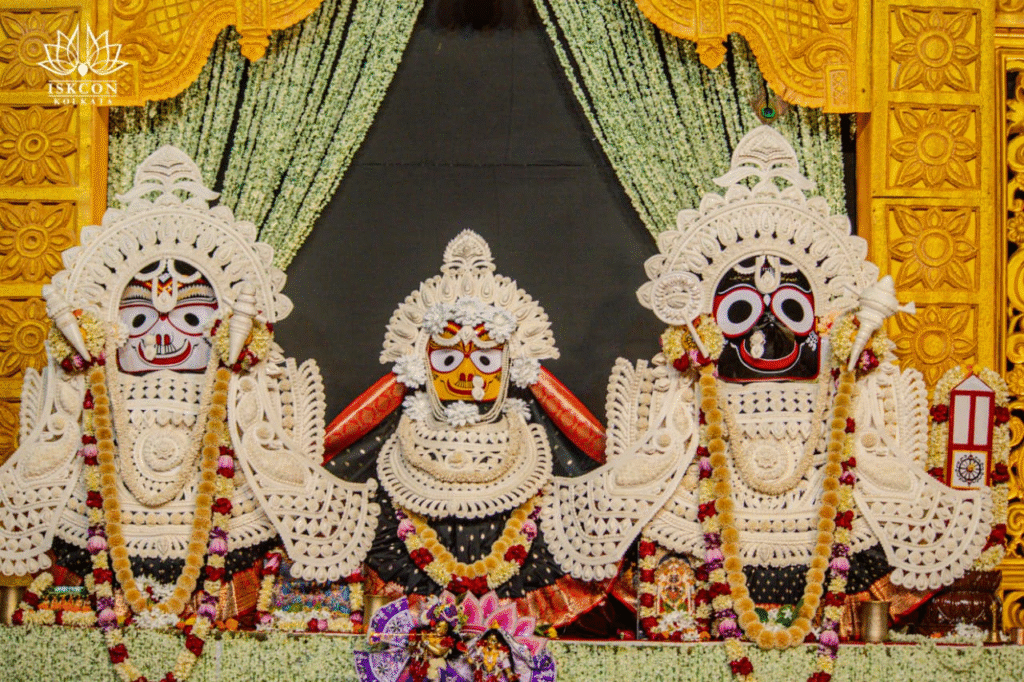
Following are the important points from the Srimad Bhagavatam Class given by HH Subhag Swami Maharaja at the 55th Kolkata Rath Yatra Pandal on 18 July 2026. Maharaja spoke on the verse SB 1.15.6
Yoga, Viyoga and Our Constitutional Position
One is called viyoga and the other is yoga. Chanting connects us to Krishna, which is yoga. Viyoga means feeling separation from Krishna.
We suffer because we forget Krishna. It is said, “Kṛṣṇa bhuli’ sei jīva…” Another place it is said, “Anādi bahirmukha jīva…” We are forgetting Krishna because we are trying to enjoy this material world.
We are taṭastha-śakti, i.e., the marginal energy of the Lord, situated between His external and internal energies. When we render service to Krishna, we are under His internal energy. When we forget Him, we come under bahiraṅga-śakti (the external energy).
Since we wanted to enjoy like Krishna, we have been sent to this material world. Thus, sometimes we become Brahmā, sometimes Indra, sometimes ghosts, animals, birds, trees, and so on.
When we are fortunate enough to attain a human birth, we get the opportunity to come out of the cycle of birth and death. Human life is very rare. We transmigrate through 8.4 million species, and by surrendering to Krishna, serving Him, and taking guidance from devotees, we become free from the clutches of māyā.
Śrīmad-Bhāgavatam and Krishna – The Source of Everything
Śrīmad-Bhāgavatam is the essence of all Vedic literature. It begins with “janmādy asya yataḥ…”, where the Vedānta-sūtra begins its explanation. The opening verse concludes with “satyaṁ paraṁ dhīmahi”—meditating upon the Absolute Truth.
Krishna says in the Bhagavad-gītā, “ahaṁ sarvasya prabhavo”—”I am the source of everything.” Both the spiritual and material worlds emanate from Him. Those who are truly wise surrender unto Him.
The symptoms of those who serve Krishna are described in the verse “mac-cittā mad-gata-prāṇāḥ…”
Lord Chaitanya and the Mood of Separation
To enjoy loving exchanges, Krishna expands Himself as Rādhā and Krishna, and later appears as Śrī Krishna Chaitanya: “Śrī-kṛṣṇa-caitanya rādhā-kṛṣṇa nahe anya.”
As Lord Chaitanya, He shows how Śrīmatī Rādhārāṇī feels separation from Krishna, just as Arjuna also experienced separation from Krishna.
By accepting the mood of Śrīmatī Rādhārāṇī, Lord Chaitanya teaches us the highest way of serving Krishna. Feeling separation from Krishna actually means remaining united with Him—externally there is separation, but internally there is union. The symptom of this stage is ecstasy.
Since we are fallen and under the influence of māyā, our ācāryas teach us how to gradually come to this elevated stage. Just as Mahāprabhu instructed the Six Goswāmīs, and the Goswāmīs instructed our ācāryas, we should follow in their footsteps.
When Krishna went to Mathurā, Śrīmatī Rādhārāṇī felt intense separation. She prayed, “He Mathurānātha! He Dīna-dayāla!” “I cannot see You. When will I see You again? My heart is restless, not knowing what to do.”
The Need for Qualification
We are currently at the lower stage of devotional service. At present, we cannot fully appreciate the mood of Śrīmatī Rādhārāṇī and Lord Chaitanya Mahāprabhu.
Just as a child in kindergarten cannot understand a master’s degree, spiritual advancement happens gradually. A child progresses from kindergarten to primary school and then to higher levels. Similarly, one must become qualified before advancing in devotional life.
As we progress higher, many do not continue the journey. Advancement requires sincerity and qualification.
In our organization, there were around 10,000 disciples of Śrīla Prabhupāda. After fifty years, only a small percentage remained. Some devotees had left their bodies, but many others also did not remain steady in devotional service.
Remaining Steady in Bhakti
Devotional service is like walking on the edge of a razor. One has to be very careful in bhakti.
Krishna says, “daivī hy eṣā guṇamayī mama māyā duratyayā.” Māyā tests us at every moment. As we advance in devotional life, the tests become more difficult.
But Krishna also assures us:
“mām eva ye prapadyante māyām etāṁ taranti te.”
Those who surrender unto Him cross beyond māyā.
It is not easy to come to devotional life. The scriptures say: “bahūnāṁ janmanām ante…”
To come to the conclusion that Krishna is everything is su-durlabha—very rare.
Again it is said: “manuṣyāṇāṁ sahasreṣu…”
Out of thousands of people, only one or two attain perfection.
Spiritual Happiness and Transformation of Consciousness
It is also said, “brahma-bhūtaḥ prasannātmā…” Only in spiritual life can one experience real happiness. People outside spiritual life are generally full of anxiety.
Krishna is sat-cit-ānanda—eternal, full of knowledge, and full of bliss. You will notice a difference in your consciousness before practicing Krishna consciousness and after sincerely practicing Krishna consciousness.
The smile of a devotee is different from the smile of people absorbed in material life.
When you are hungry and you eat, you experience tuṣṭi (satisfaction) and puṣṭi (strength). As you continue eating, your hunger gradually disappears. Similarly, as you practice Krishna consciousness, you will notice a transformation in your consciousness. Earlier there may have been tension and anxiety. In spiritual life there may still be problems, but there is no anxiety. You live in Vaikuṇṭha, and in Vaikuṇṭha there is no kuṇṭha (anxiety).
Temporary Happiness vs Eternal Happiness
Many people name their child Gopal and affectionately say, “This is my Gopal.” Such attachment keeps them in this material world, and they return again to their “Gopal.” But devotees aspire to go to the spiritual world to serve the real Gopal—Lord Krishna.
People become joyful on seeing their grandson or other family members. But we should understand that these relationships are temporary. Except for bhakti and Krishna, everything in this material world is temporary. Therefore, we should not become attached to temporary things.
People experience great sadness when their son, wife, husband, father, or other loved ones pass away. That is material misery. However, the separation experienced by devotees from Krishna is completely different. This is what Lord Chaitanya Mahaprabhu and Śrīmatī Rādhārāṇī teach us—the highest love is love in separation.
Just as one must become qualified to pursue a PhD, similarly, one must become spiritually qualified to understand the mood of Lord Chaitanya Mahaprabhu and Śrīmatī Rādhārāṇī.
The Beginning of Devotional Life
We first begin with vaidhi-bhakti.
Associate with devotees.
Chant the Hare Krishna mahā-mantra.
Rise early in the morning, take bath, decorate the body with tilaka, attend maṅgala-ārati, and chant Hare Krishna.
Hear from senior devotees regularly. By hearing for a long time, the heart becomes purified.
As stated in Śrīmad-Bhāgavatam: “naṣṭa-prāyeṣv abhadreṣu…”
Gradually, one becomes free from the modes of passion and ignorance and comes to the platform of goodness.
Purification of the Heart
What are the symptoms of passion and ignorance? They are lust, greed, anger, pride, and envy. By practicing bhakti, these unwanted qualities gradually disappear.
The mode of goodness means prakāśa (illumination). Divine knowledge (divya-jñāna) awakens.
Krishna says: “bhaktyā mām abhijānāti.”
Through devotional service, we understand our eternal relationship with God. This process cleanses the dust accumulated within the heart.
Freedom from Bodily Identification
We identify ourselves with temporary bodily designations: “I am Indian,” “I am fair,” “I am a doctor,” “I am a dog,” “I am a tiger.” All these are bodily designations.
When we become free from false ego, we rise above these temporary identities.
Material desires gradually disappear.
We engage our mind and senses in the service of Krishna.
We begin to understand, “I am not this body. I am an eternal part and parcel of Krishna. My only duty is to serve Him.”
This advancement happens gradually, stage by stage.
The Nine Stages of Bhakti
The scriptures describe the gradual development of devotional service through nine stages:
- Ādau Śraddhā – One develops initial faith and comes to ISKCON to hear Krishna-kathā.
- Sādhu-saṅga – One associates with devotees.
- Bhajana-kriyā – Under the guidance of the spiritual master, one rises early, engages in devotional practices until around 10 a.m., and spends the rest of the day rendering service assigned by the authorities. One feels as though one is no longer living in Kolkata but in Vaikuṇṭha.
- Anartha-nivṛtti – One gradually becomes free from unwanted desires, such as eating outside food, watching movies, and other material habits. One also begins to follow the four regulative principles.
- Niṣṭhā – Steadiness in devotional service.
- Ruci – Developing genuine taste for hari-kathā and devotional practices.
- Āsakti – Deep attachment to Krishna and devotional service. One cannot remain without practicing bhakti.
- Bhāva – One naturally and spontaneously thinks of Krishna.
- Prema – Pure love of Godhead, the ultimate goal of devotional life.
Arjuna is on the platform of bhāva-bhakti. We are presently below that stage and must gradually progress along the same path. Eventually, some devotees attain spontaneous attraction for Krishna.
Questions & Answers with Maharaja
Before concluding his Srimad-Bhagavatam class, HH Subhag Swami Maharaja invited questions from the devotees and answered them to their satisfaction.
Q1. How can we quickly attain anartha-nivṛtti?
If we sincerely follow the instructions of the spiritual master, anartha-nivṛtti will come quickly. Otherwise, it may take many lifetimes.
We should honestly ask ourselves whether we still have attachment to sense gratification.
We have to develop a higher taste, as explained by Śrī Yāmunācārya.
For example, if we develop a taste for Krishna-prasāda, we naturally give up the bad habit of eating outside food.
The highest material pleasure is the attraction between a man and a woman. Yāmunācārya says that after experiencing the higher taste of devotional service, he spits at the very thought of such material enjoyment. We may not be able to say this now, but by sincerely following the process of bhakti, we can gradually come to that stage.
Q2. Bhakti gives a higher taste, but why do devotees still fall down?
Just as not every student reaches the highest class, not everyone advances to higher stages of devotional life. One has to sincerely study and practice.
The two strongest attractions in this material world are wealth and the opposite sex.
Since we have been attached to these things for countless lifetimes, is it easy to give them up? No.
However, by associating with devotees, rendering service, and faithfully following the instructions of the spiritual master, we receive the spiritual strength to protect ourselves.
Q3. How do we develop the strength to follow the instructions of the spiritual master?
Associate with devotees who are firmly fixed in spiritual life.
For example, waking up early every day may seem difficult. But when we see other devotees rising early and enthusiastically engaging in devotional service, we become inspired to do the same.
As the saying goes: “Jaise saṅga, vaise raṅga.” We become influenced by the association we keep.
Q4. How can we save ourselves from prayāsa (over-endeavour for material success or fame)?
Use common sense. Ask yourself, “How much can I realistically do?” Do whatever is practical according to your capacity.
For example, I should not think that I can immediately become Śrīla Prabhupāda. We should honestly assess our own level and proceed accordingly.
Q5. What is the secret of your selfless service for the last 55 years? Please guide us so that we can also render selfless service.
The scriptures say: “yasya deve parā bhaktir yathā deve tathā gurau…”
One who has equal faith in Krishna and the spiritual master receives all the confidential truths of the scriptures.
If we deeply reflect on this verse, we will find the answer. The secret of selfless service is contained within this śloka.
Q6. How can we completely surrender to Krishna and develop faith in Him when the mind is always fearful?
It is said: “Bhajo re mana…” If we take shelter of Krishna, we become fearless and free from lamentation.
By associating with God, we become happy and joyful.
The mind can become either our friend or our enemy—it depends on us.
Everyone’s mind is restless. Even Arjuna admitted this.
Krishna replied: “abhyāsena tu kaunteya vairāgyeṇa ca gṛhyate.”
Through constant practice and detachment, the mind can be controlled. We develop this higher taste by strictly following the instructions of the spiritual master.
We should make the mind our friend by training it to obey us. Otherwise, the mind becomes our enemy and drags us toward material life. When the mind tells us to do something wrong, we should firmly say, “No, I will not do it.”
By repeatedly practicing this, the mind gradually comes under control. Otherwise, impure thoughts enter the mind and eventually overpower us.
It is like a tug of war. If we become spiritually strong through chanting, hearing, association, and service, then whenever the mind proposes something improper, we will have the strength to say “No.” In this way, we gradually become victorious over the mind.
These were some of the important points from the Srimad Bhagavatam Class by HH Subhag Swami Maharaja on 18th July 2026 at 55th Kolkata Rath Yatra Pandal.
55th Kolkata Rath Yātrā 2026 – Śrīmad-Bhāgavatam Class Series
Search
Recent Posts
-
Srimad Bhagavatam at ISKCON Newtown...
September 1, 2026
-
Janmashtami: Celebrating Krishna’s Appearance Through...
August 17, 2026
-
Gopinatha Pattanayaka: 6 Lessons for...
August 16, 2026
-
What Does Krishna Say About...
August 11, 2026
-
Are you ready to choose...
August 2, 2026
55th Kolkata Rath Yatra – Srimad Bhagavatam Class by HG Atul Krishna Prabhu (17 July 2026)
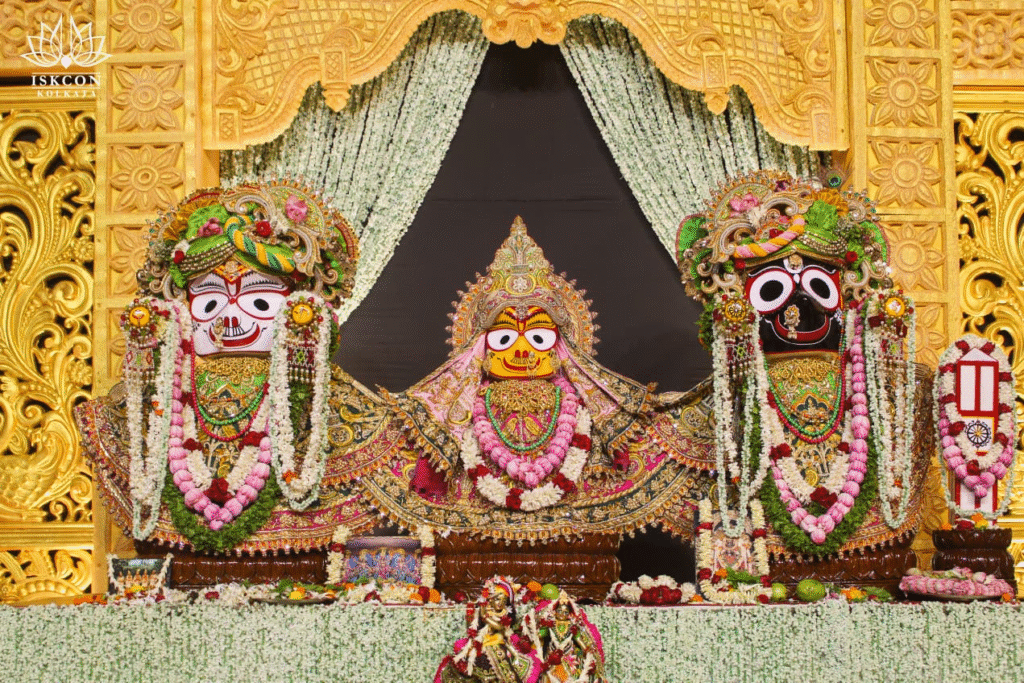
Lecture Summary: The Glory of Rath Yātrā, Lord Caitanya’s Mission, and the Empowerment of the Gosvāmīs
Following are the important points from the Srimad Bhagavatam Class given by HG Atul Krishna Prabhu at the 55th Kolkata Rath Yatra Pandal on 17 July 2026.
The class began with the devotional song Udilo Aruṇa Pūrab Bhāge by Śrīla Bhaktivinoda Ṭhākura.
1. The Appearance and Service of Rūpa and Sanātana Gosvāmīs
- Both Rūpa Gosvāmī and Sanātana Gosvāmī were born in Jessore, about four hours from Māyāpur. This place is now in Bangladesh. They grew up in East Bengal.
- Both are eternal associates of the Supreme Lord. In the spiritual world, Rūpa Gosvāmī is Rūpa Mañjarī, and Sanātana Gosvāmī is Lavaṅga Mañjarī.
- They appeared to serve Lord Caitanya. Interestingly, they never went to Navadvīpa to serve Him.
- Rūpa and Sanātana Gosvāmīs never visited Māyāpur. Among the Six Gosvāmīs of Vṛndāvana, only Śrīla Jīva Gosvāmī is said to have visited Māyāpur.
- They were empowered to write transcendental literature.
- They possessed profound knowledge of all the śāstras. In The Nectar of Devotion, Śrīla Prabhupāda lists many of the scriptures that were consulted while compiling the book.
- The Lord delights in glorifying His devotees.
2. Navadvīpa During Lord Caitanya Mahāprabhu’s Time
- During Lord Caitanya Mahāprabhu’s time, Navadvīpa was the foremost city of scholars. People came there to acquire knowledge.
- Thousands of people bathed daily at the Ganges ghāṭas. It is said that nearly one hundred thousand people would bathe in the Ganges during Mahāprabhu’s time.
- Scriptures state that if one fasts on Gaura Pūrṇimā and bathes in the Ganges at Māyāpur, one attains Goloka along with one thousand of one’s ancestors.
- During Mahāprabhu’s time, life revolved around the Ganges.
- Navadvīpa had no wide roads, motorcycles, or trucks.
- Scholars from all over India came to Navadvīpa. Many materialistic scholars even composed poetry to criticize the Vaiṣṇavas.
- The capital of Bengal at that time was Malda. Visitors can still see the palace of Nawab Hussain Shah and the prison where Sanātana Gosvāmī was kept.
3. Lord Caitanya Mahāprabhu’s Pastimes and Instructions
- Lord Caitanya Mahāprabhu first met Lakṣmīpriyā at the Ganges ghāṭa. They saw each other, recognized one another, and smiled. Lakṣmīpriyā worshipped Mahāprabhu on the banks of the Ganges.
- While residing in Navadvīpa, Lord Caitanya would perform ecstatic nighttime kīrtanas at Śrīvāsa Aṅgana. Only His confidential devotees were allowed to participate. During these kīrtanas, He manifested extraordinary ecstatic symptoms.
- In South India, Lord Caitanya instructed the Kūrma Brāhmaṇa:”Yāre dekha, tāre kaha ‘Kṛṣṇa’-upadeśa.”
- At Rāmakeli, He declared:”Pṛthivīte āche yata nagarādi grāma…”
- Lord Caitanya instructed Lord Nityānanda Prabhu to preach throughout Bengal.
- From this, we can understand how dear to Mahāprabhu are those devotees who preach in Bengal.
4. The Glory of Rath Yātrā
- One of the most enjoyable experiences in a devotee’s life is participating in the Rath Yātrā festival.
- During the Kolkata Rath Yātrā procession, Lord Jagannātha’s chariot passes through the busy Dharamtala–Esplanade intersection. Traffic comes to a complete halt, and devotees joyfully dance before the Lord.
- Dancing during Rath Yātrā is especially pleasing to Lord Jagannātha.
- Rath Yātrā gives everyone the opportunity to participate in the saṅkīrtana movement that the Lord loves.
- On this special day, Lord Jagannātha comes out to freely bestow His darśana upon everyone.
- Even those unfamiliar with the festival become amazed when they see the Lord majestically seated upon His chariot. As the Lord of the universe, all roads and all cities belong to Him.
- Rath Yātrā is meant for the pleasure of the Lord.
- Prabhuji prayed to always have the opportunity to see Lord Jagannātha on His chariot every year.
- A devotee carrying a basket full of fruits and incense eagerly tried to offer them to Subhadrā Devī. Although security personnel attempted to stop him, his devotion prevailed.
- Everyone who participates in Rath Yātrā receives the Lord’s mercy. Those engaged in serving the festival receive even greater mercy.
5. Empowered Devotees and the Lord’s Mission
- Arjuna was empowered to fulfill Lord Kṛṣṇa’s mission.
- Similarly, Rūpa and Sanātana Gosvāmīs were empowered to establish the philosophy of devotional service through their writings.
- After accepting sannyāsa, Lord Caitanya Mahāprabhu preached to exalted personalities such as Veṅkaṭa Bhaṭṭa, Rāmānanda Rāya, and Sārvabhauma Bhaṭṭācārya.
- At the same time, He instructed Rūpa and Sanātana Gosvāmīs to reveal the holy places of Vṛndāvana and compose transcendental literature.
- The Lord always desires to give credit to His devotees.
6. The Mood of the Ācāryas
- When Śrīla Prabhupāda first met Śrīla Bhaktisiddhānta Sarasvatī Ṭhākura, he was immediately instructed to preach Kṛṣṇa consciousness in the Western countries.
- Śrīla Bhaktisiddhānta Sarasvatī Ṭhākura constantly meditated on fulfilling Śrīla Bhaktivinoda Ṭhākura’s vision that people from all over the world would come to Māyāpur and perform saṅkīrtana together.
- Śrīla Prabhupāda instructed His Holiness Jayapatākā Swami Mahārāja to make the Kolkata Rath Yātrā one of the biggest in the world.
- Mahārāja has dedicated himself to fulfilling this instruction and expanding Lord Caitanya’s mission worldwide.
- Even many of Śrīla Bhaktisiddhānta Sarasvatī Ṭhākura’s highly qualified disciples could not accomplish what Śrīla Prabhupāda achieved.
- Śrīla Prabhupāda even sent his gṛhastha disciples to London to preach. Empowered by their spiritual master, they accomplished what seemed impossible.
- Many influential personalities, including George Harrison, embraced Kṛṣṇa consciousness.
- During that period, the Hare Kṛṣṇa mahā-mantra became so well known that it could even be heard on the radio.
7. Conclusion
- The Lord empowers sincere devotees to accomplish extraordinary service.
- Inspired by the examples of Lord Caitanya, the Gosvāmīs, Śrīla Bhaktisiddhānta Sarasvatī Ṭhākura, Śrīla Prabhupāda, and H.H. Jayapatākā Swami Mahārāja, we should all work together to accomplish something glorious for Lord Jagannātha in Kolkata.
These were some of the important points from the Srimad Bhagavatam Class by HG Atul Krishna Prabhu on 17th July 2026 at Rath Yatra Pandal.
55th Kolkata Rath Yātrā 2026 – Śrīmad-Bhāgavatam Class Series
Search
Recent Posts
-
Srimad Bhagavatam at ISKCON Newtown...
September 1, 2026
-
Janmashtami: Celebrating Krishna’s Appearance Through...
August 17, 2026
-
Gopinatha Pattanayaka: 6 Lessons for...
August 16, 2026
-
What Does Krishna Say About...
August 11, 2026
-
Are you ready to choose...
August 2, 2026
55th Kolkata Rath Yatra 2026: Thousands Brave the Rain to Pull Lord Jagannath’s Chariot
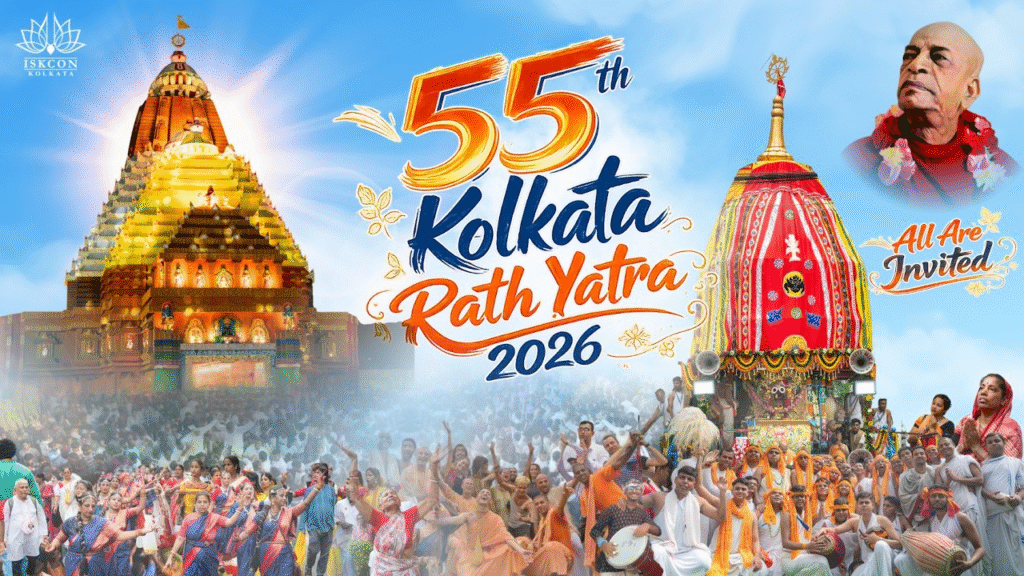
The 55th Kolkata Rath Yatra was celebrated on 16th July 2026 with immense enthusiasm and devotion. The grand procession began from ISKCON Kolkata, Albert Road Temple, and culminated at the TAI Brigade Ground, where the deities will remain till Ulta Rath Yatra which is on 24th July.
Thousands of devotees from all walks of life participated in this magnificent Festival of Chariots. Throughout the route, devotees had lovingly set up small welcome stalls to receive Lord Jagannath, Lord Baladeva, and Subhadra Devi.
At numerous locations, delicious bhoga was offered to the Lord, arati was performed, and devotees welcomed the procession with folded hands and joyful cries of “Jai Jagannath!”
Chief Minister Inaugurates the Festival
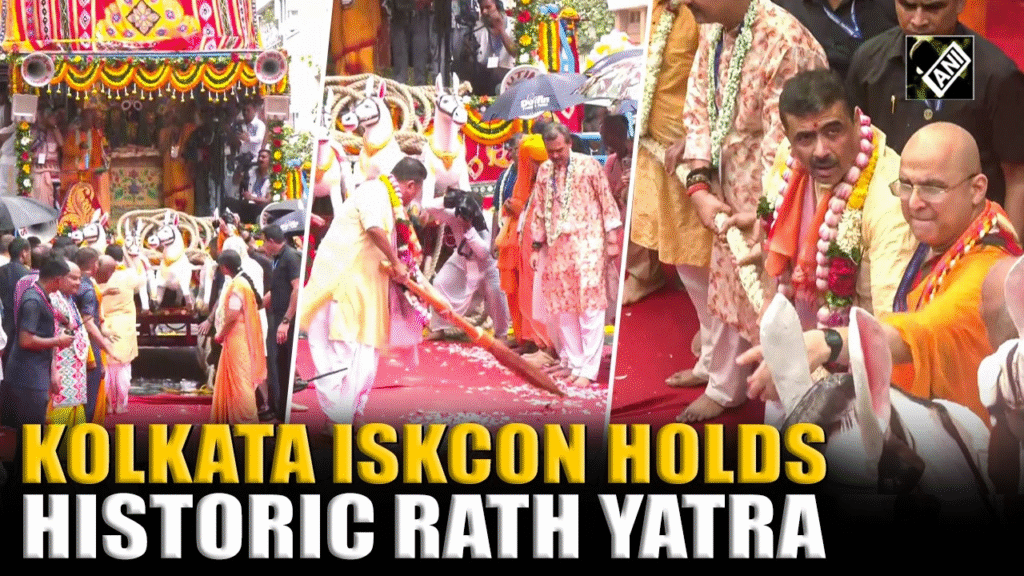
The Chief Minister of West Bengal, Suvendu Adhikari, who assumed office earlier this year, 2026, inaugurated the 55th Kolkata Rath Yatra for the first time.
With great reverence, he performed the arati of Lord Jagannath, swept the road with a golden broom according to the traditional Chhera Pahara ceremony, and also pulled the ropes of Lord Jagannath’s chariot, marking the auspicious beginning of the procession.
Rain Could Not Dampen the Devotees’ Spirit
Before the procession began, heavy rain lashed Kolkata. It almost appeared as if the rain-god himself was cleansing the entire route in preparation for the arrival of the Lord of the Universe—Lord Jagannath, accompanied by His elder brother Lord Baladeva and younger sister Subhadra Devi.
The rain, however, failed to diminish the enthusiasm of the devotees. Some stood under umbrellas, while others took shelter beneath flyovers and bridges. Yet everyone continued loudly chanting “Jai Jagannath!” and the Hare Krishna Mahamantra, eagerly waiting for the procession to begin.
Even amidst the downpour, devotees continued distributing transcendental literature, including Bhagavad-gita As It Is, Krishna Book, and Back to Godhead magazines, inviting everyone to reconnect with Krishna.
Delay Increased the Devotees’ Eagerness
The Rath Yatra was delayed by nearly three hours due to a technical issue with the wheel of Lord Baladeva’s chariot. Although everyone waited patiently, the delay only intensified the devotees’ eagerness. They were not restless out of frustration but because of their deep desire to pull the sacred ropes and accompany the Lord on His divine journey.
When the procession finally began at around 4:30 p.m., a loud roar of “Jai Jagannath!” filled the air. Devotees breathed a sigh of relief, thanking the Lord for granting them the opportunity to participate in His transcendental pastime.
A Festival that Unites the World
Srila Prabhupada often said that universal brotherhood is possible only when humanity comes under the shelter of the Universal Father, Lord Krishna. This truth becomes vividly visible during the Rath Yatra festival.
People from every caste, creed, religion, nationality, language, age group, and economic background came together as one family. Everyone danced, chanted, clapped, and joyfully marched behind the chariots, forgetting all material designations.
Several vibrant kirtan groups led ecstatic congregational chanting throughout the procession. Devotees danced with raised hands, filling the streets of Kolkata with spiritual joy and devotion.
The Majestic Chariots of the Lord
The procession was led by the chariot of Lord Baladeva, which also carried the deity of His Divine Grace A.C. Bhaktivedanta Swami Srila Prabhupada. The second chariot carried Subhadra Devi, while the grand chariot of Lord Jagannath followed behind.
The beautifully decorated chariots looked magnificent. Seeing thousands of devotees dancing and chanting before Them, it appeared as if the Lord Himself was pleased by the loving devotion of His children.
Everyone Wanted to Pull the Sacred Rope
As the chariots rolled forward, devotees eagerly rushed to touch and pull the ropes. Every devotee wanted even a few moments of service. Yet, while doing so, many lovingly made space for others, encouraging everyone to receive the Lord’s mercy.
I too got an opporunity to pull the ropes of the chariots.
This beautifully reflected the essence of Krishna consciousness—to recognize every living being as a beloved child of Krishna and help one another reconnect with Him.
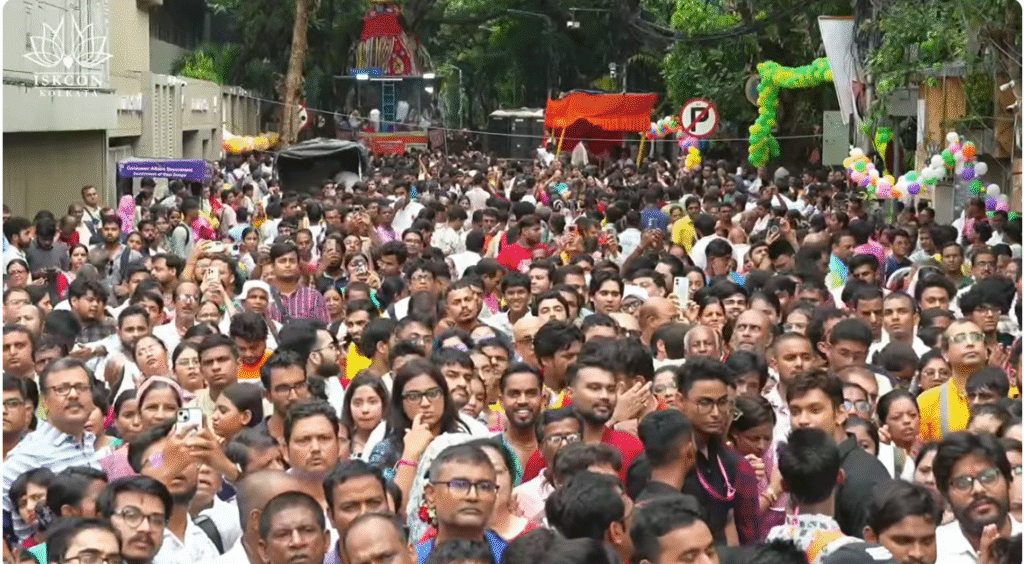
Bhoga, Books and Prasadam Along the Route
Throughout the procession, countless devotees stood on both sides of the road to receive the Lord’s darshan. At various locations, bhoga was lovingly offered, arati was performed, and Jagannath prasadam was distributed to the public.
Devotees also enthusiastically distributed Bhagavad-gita As It Is, Krishna Book, and Back to Godhead magazines, encouraging people to take home transcendental knowledge. Many happily accepted these spiritual gifts, taking the first step on their journey in Krishna consciousness.
Several devotees had also arranged refreshment stalls along the route, serving drinking water, juice, and light refreshments to thousands of pilgrims who had been walking for hours.
Devotion Beyond All Obstacles
Many devotees had travelled from distant parts of Kolkata by bus, metro, and local trains. Some had even taken a week’s leave from work and travelled from different parts of India solely to participate in the complete Rath Yatra festival.
Although the weather presented many challenges and even washed away the beautiful rangolis traditionally prepared along the route, nothing could diminish the devotees’ enthusiasm. Their love for Lord Jagannath transformed every obstacle into another opportunity for devotional service.
The 55th Kolkata Rath Yatra of 2026 once again demonstrated that when Lord Jagannath comes out to bless the world, no obstacle—not even torrential rain—can stop His devotees from dancing, chanting, serving, and pulling His sacred chariot. It was a day filled with devotion, unity, and transcendental joy that will remain forever etched in the hearts of all who participated.
55th Kolkata Rath Yātrā 2026 – Śrīmad-Bhāgavatam Class Series
Search
Recent Posts
-
Srimad Bhagavatam at ISKCON Newtown...
September 1, 2026
-
Janmashtami: Celebrating Krishna’s Appearance Through...
August 17, 2026
-
Gopinatha Pattanayaka: 6 Lessons for...
August 16, 2026
-
What Does Krishna Say About...
August 11, 2026
-
Are you ready to choose...
August 2, 2026
Uddhava Gita on Learning from Pain: How the Mind Amplifies Suffering
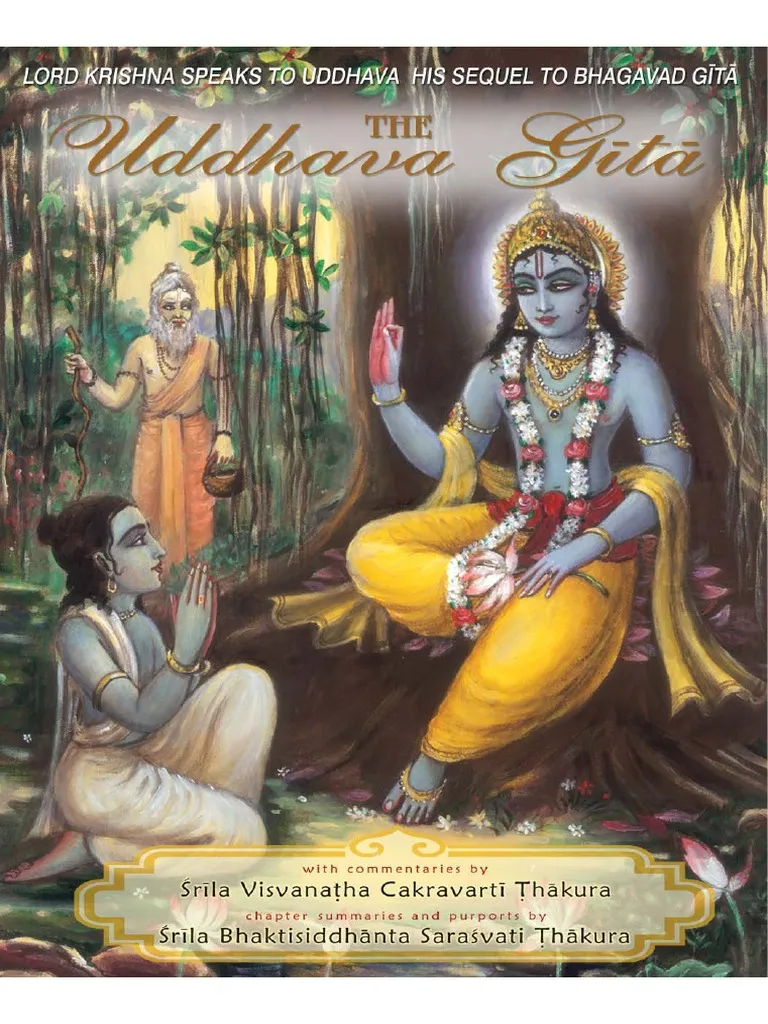
Learning from pain is an important spiritual skill which we should develop. If we do not do so then pain will consume us. But if we learn from it then we can grow in our life.
Let us try to understand how we can learn from pain.
It is the nature of the mind to amplify things. Sometimes the pain may not be that much but mind makes it look bigger. We may come cross situations, where we know we are overreacting but we don’t stop because mind do not allow us to stop.
For example, someone speaks something hurtful to us, and we speak more hurtful words to that person.
The fuel of amplification – why did it happen?
Mind creates story around pain and also around pleasure.
SAD: Modern Psychological Problem
Today the main psychological problem is that people are sad. Let us understand it using the acronym SAD.
- S: Stress
- A: Anxiety
- D: Depression
These are not much discussed in the scriptures.
Root Cause of all Problems as per scriptures
Instead, the scriptures talk about the three vices – lust, anger and greed. This is mentioned in Bhagavad Gita.
- Kama (lust / excessive material desire)
- Krodha (anger)
- Lobha (greed)
To the outside world, these vices do not seem to be a matter of concern. For e.g. a psychologist may not think lust or greed is a problem. For them, inability to fulfil lust is a problem.
In scriptures focus is not on “how mind troubles us” but “why mind troubles us.”
Scriptures teach us that if we are afflicted by lust, anger and greed then it causes stress, anxiety and depression. For example, when one is greedy, he is in anxiety. Dhritrashtra was in constant anxiety because he had greed for the kingdom and wanted his son to be the king.
The more material desires we have the more disturbed we are.
Vices are like the root of tree and stress, anxiety, depression are fruits of the tree.
Vices are the main cause of suffering.
When we address the vices then mind gets purified.
Outside people try to address anxiety by focussing on pacification of the mind and not purification of the mind.
An alcoholic wants to drink alcohol, so gets into anxiety. One solution is to give him alcohol, but it will not solve the problem. His disease will not go away and he will continue to remain in anxiety. But if a person gives up alcohol, then his anxiety is gone forever.
Mind exaggerates Pain and Pleasure
As mind exaggerates pleasure, it exaggerates pain too.
In the physical world things go wrong. For example, sometimes it is too hot and sometimes it is too cold. Amplification of pain happens because mind thinks “The world should be like this” but actually “the world is not the way I want it to be.”
There is always a gap between “How I think things should be” vs “How things actually are”
So, the pain is distance between “Mind’s should” and “World’s is”.
For e.g. In a program, I may want two serving of sweets, but only one serving is given to all.
Distance between “Mind’s should” and “World is” can be understood by the acronym – ERA.
E: Expectation (Desire to enjoy in the Future)
Things should be like this. In scriptures, the example is of Pingala. She thinks I am attractive, so people should come to me. But when are expectations are not met then she suffers. Frustration of expectation gives mind pain. Pingala thought – This should happen.” She was thinking of enjoying in the future.
R: Resentment (of the past)
This should not have happened. This was the story of Avanti Brahman. He lost everything in short span of time. Mind keeps dwelling how it could have happened and why it should not have happened.
A: Attachment: It is more for the present.
This should always be with me. Example is of Pururva. He was thinking Urvasi should be always with me. I am a king; it should be an honour for her to be with me. Also, I have done so much for her.
Mind does not react for everything. Based on our ERA, it reacts.
Attachment leads to expectation and resentment too.
Scriptures describe this as:
- Soka (lamentation – past): Example: I have lost something.
- Moha (illusion – present): Example: I will enjoy if I ger this.
- Bhaya (fear – future). Example: Something wrong may happen with me.
Today words like lamentation are considered old fashioned. Instead, words like grieving or resentment are used. Most of the time resentment is not about getting, but the impact of not getting.
Similarly, hankering is not used, but craving, longing, are being used,
Scriptures do talk about mental challenges, but focus is to understand the root cause.
For Pingala, nothing happens externally but big things happen internally.
Context Specific Teachings in Scriptures
When scriptures focus on one teaching, it focusses on one teaching only.
So, in Uddhava Gita, focus is how to practice bhakti when guru is not there.
This is why the name of the guru for Pingala, Avanti Brahmana, Pururva is not mentioned. Teachings are always context specific.
When Srila Prabhupada sent devotees to iron country i.e. Soviet Union in 1970s then there was no guarantee that they will come back. Prabhupada told them pray to Krishna and he will give intelligence – dadami budhi..
Uddhava is going to be alone when Krishna departs from this world, so it is being explained by Krishna that realization may come anywhere and at any time.
Many times, sudden moment of illumination comes. It is called epiphany.
Learning from life: If we are curious, then world will teach.
Learning from pain: If we do not allow pain to consume, then realization will come.
Lesson from pain
Pain may lead to detachment but one has to function in this world. Learning from pain does not mean to suppress suffering but to develop wisdom and understand the reality of this world.
Life is dynamic. So, every moment, we have to make decisions. Something, we have to let go and something we have to hold on. Sometimes we do it consciously and sometimes unconsciously.
We are constantly hold something and leave something.
During Srila Bhakti Siddhanta Saraswati Thakura’s time, Gaudiya Math had developed good relationships with British government. So, when Srila Bhakti Siddhanta Saraswati Thakura’s disciples went to Britain they got invitation from top government officers to speak in august forums. But nothing much happened in terms of preaching.
When Srila Prabhupada went to America, then he found that people in higher social circles are interested in his talk but are not ready to commit themselves to spiritual life. So, Prabhupada changed his strategy and began preaching to those who were ready to commit to devotional life. These were mostly hippies and at that time were not much established in the society but they were willing to become dedicated devotees.
Two Approaches to Spirituality
- Shock Absorber
- People want comfort and relief from anxiety.
- After whole day work, they come for Shayan Aarti to get relief from all the stress.
- These people won’t take services as they won’t to take anxiety.
- People in these categories are – ārtaḥ (the distressed) and artha–arthī (one who desires material gain). Bhagavad Gita 7.16
- Goal Transformer
- Spirituality as transformation of life.
- Krishna as the ultimate goal
Spiritual Outreach – Top Down and Bottom Up
Outreach can happen two ways -top down and bottom up.
Top down: We preach to some influential person and because of which many people get influenced. For example, if the head of the state becomes devotees, he will use resources to propagate Krishna Consciousness.
Bottom up: Srila Prabhupada used this approach in USA. He preached to hippies.
Should devotees not have expectations? Off course, they should have. But focus should be on purpose and not on path. If one path does not work, then use another path to achieve the purpose. Srila Prabhupada used this approach.
While preaching in India Srila Prabhupada used a different strategy. He started making life members and building big temples. Prabhupada’s purpose was to serve Krishna, and he kept on adjusting the path to achieve the purpose.
What to hold and what to let go, we have to keep on deciding.
Mind stories get aggravated when we hold on something.
Dynamic Life: Holding and Letting Go
Life constantly demands decisions:
- What to hold on to
- What to let go of
This is guided by:
- Anukūla (favorable → hold on)
- Pratikūla (unfavorable → let go)
Addressing Emotional Need helps in Bhakti
One pain we often neglect is emotional pain. We have emotional needs which we need to address. This is why it is important to have meaningful relationships with our family members and devotees.
Iskcon is a place where we get an opportunity to absorb ourselves in devotion to Krishna. But Iskcon is also a place where we should develop strong relationship with the devotees.
Iskcon is like
- Home (belonging): We feel that we belong to a spiritual family.
- Office (service): Here we are delegates various services.
- School (learning): We attend classes and learn who we are and how to develop relationship with Krishna.
- Training ground (growth): We get trained in various services.
Paramārthika vs Vyavahārika
- Paramārthika: Spiritual reality (Understanding that we belong to Krishna)
- Vyavahārika: Practical/operational reality (functioning daily in life)
We understand that spirituality cannot heal physical pain. As devotees, we understand difference between soul and body but we do not much understand difference between soul and mind.
We also need to know that there is difference between Spiritual strength and Emotional strength.
All bhakti activity will give spiritual strength, but bhakti activity may necessarily not give emotional strength. We have to find out what I need for emotional strength.
For some chanting gives emotional strength.
But some needs emotional strength to chant.
So, we need to nurture emotional strength. We should talk to devotees, try to unburden ourselves. We should feel cared for. In any relationship appreciation is important. Appreciation is need of human heart.
When we get appreciation for what we do, we feel valued and care for. But we should be careful that we are not getting attached to appreciation for whatever we do.
Summary
Learning from pain is the central message of this discusison.
Mind constructs stories and amplifies it. Mind amplifies both pleasure and pain.
Today people are always in
S: Stress
A: Anxiety
D: Depression
So, all are SAD.
Root cause of all suffering:
- Kama (lust)
- Krodha (anger)
- Lobha (greed)
Cause of Pain
Distance between “mind’s should” and “world is” is the cause of pain.
Greater Distance, greater pain. Understanding it by the acronym – ERA.
E: Expectation. Eg. Pingala
R: Resentment. Eg. Avanti Brahman
A: Attachment. Eg Pururva
Life should be Dynamic
Hold on to Purpose: eg Prabhuada did not give the purpose of spreading Krishna Consciousness
Let go path: Prabhupada changed the path to achieve the purpose.
Handling Pain
Just learning from pain is not important, we should also know how to handle pain. Pain can be tolerated if it is small. If pain is big then it needs to be addressed.
The Uddhava Gita teaches the importance of learning from pain. We see how Pingala, Avanti Brahman and Pururva learned from pain and transformed their lives. So, we should never succumb to pain, but we should transcend all pain by taking shelter of the Supreme Lord Krishna who relieves pain of all who take his shelter.
Note: Above article is based on the lecture given by HG Chaitanya Charan Prabhu at Iskcon Newtown Kolkata on 19th June 2026)
Read Series of articles on Uddhava Gita
Search
Recent Posts
-
Srimad Bhagavatam at ISKCON Newtown...
September 1, 2026
-
Janmashtami: Celebrating Krishna’s Appearance Through...
August 17, 2026
-
Gopinatha Pattanayaka: 6 Lessons for...
August 16, 2026
-
What Does Krishna Say About...
August 11, 2026
-
Are you ready to choose...
August 2, 2026
Krishna’s Love: Attachment vs Affection in Srimad Bhagavatam 11.20.8
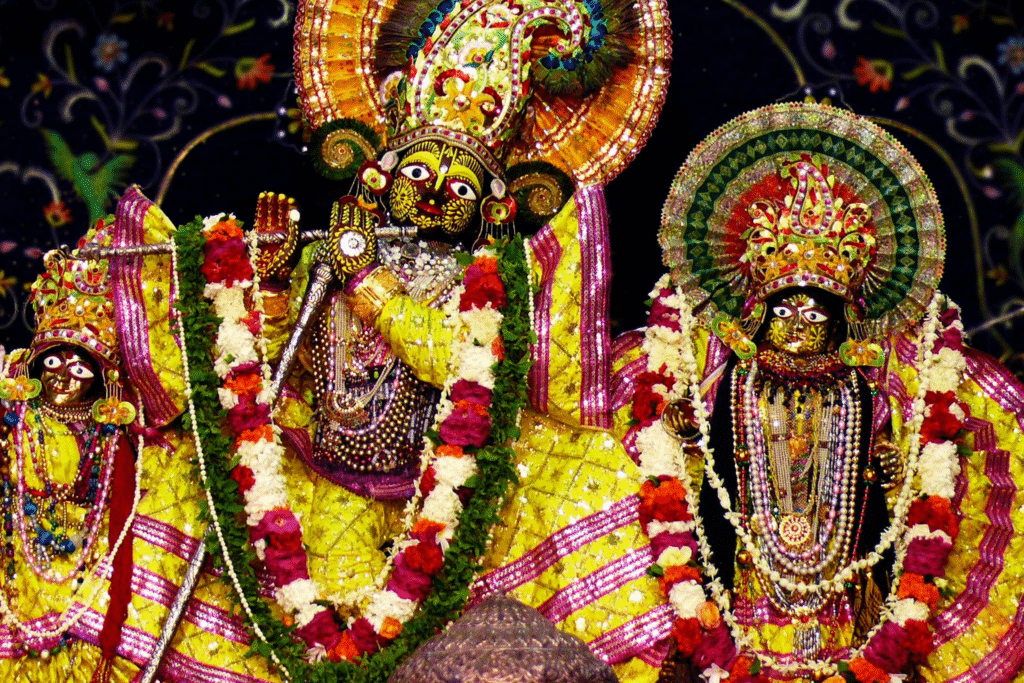
Insights from Srimad Bhagavatam 11.20.8, Dhruva Maharaja’s Life, and the Journey from Artha to Paramartha
It is important to understand love of this world and Krishna’s love. Love what we get in this world may be real but it cannot fully satsify us, only Krishna’s love can completely satisfy us. This is beautifully expalined in Srimad Bhagavatam.
A central theme in Śrīmad-Bhāgavatam 11.20.8 is that a devotee should be “na nirviṇṇo nāti-saktaḥ”—neither too detached nor too attached. This verse appears in the section where Krishna explains how bhakti is superior to mere jñāna and vairāgya.
“If somehow or other by good fortune one develops faith in hearing and chanting My glories, such a person, being neither disgusted with nor very much attached to material life, should achieve perfection through the path of loving devotion to Me.” Śrīmad-Bhāgavatam 11.20.8
Everything attractive in this world ultimately comes from Krishna. Whatever beauty, strength, intelligence, fame, wealth, or opulence we see is a reflection of Krishna’s opulence. Krishna says in Bhagavad Gita 10.41: “Know that all opulent, beautiful and glorious creations spring from but a spark of My splendor.”
We may call these attractions artha. They are like drops of water, while Krishna is the ocean. All drops come from the ocean, but not all drops take us back to the ocean. In this world we are attracted to many things, but we need to ask: Is this drop taking me toward Krishna or away from Krishna? If it takes me toward Krishna, it is anukūla (favourable). If it takes me away from Krishna, it is pratikūla (unfavourable).
Unless we become pure, we may not immediately become attracted to Krishna directly. In bhakti, different people are attracted by different aspects. Some are attracted to kirtan, some to philosophical presentations, some to deity worship, and almost everyone is attracted to prasadam. The ocean may seem far away, but the drops are close to us. Therefore, we should learn how to use the drops to reach the ocean.
Devotion: The Education and Elevation of Emotion
Many people think devotion is emotion. Those who think devotion is merely emotion often create commotion. Devotion is actually the education and elevation of emotion. At present our emotions flow in many different directions. Without education and elevation, our feelings can lead to failings.
A child may want to eat chocolates all day. If parents simply satisfy every emotional desire of the child, they will ruin the child’s health. Therefore, we should not simply be carried away by emotions. This principle applies in both material and spiritual life.
This universe can be called a “University of Adversity.” We are meant to learn from our experiences. One of the lessons we learn is how to apply the principle of not being too attached and not being too adverse, as taught in Śrīmad-Bhāgavatam 11.20.8.
Krishna does not ask us to become emotionless. Rather, He teaches us how to refine our emotions and direct them toward Him. Bhakti is not the rejection of emotion; it is the purification of emotion.
Dhruva Maharaja and the Power of a Drop of Love
The story of Dhruva Maharaja illustrates this principle beautifully.
In my own childhood, I contracted polio. Once a relative sympathetically remarked how unfortunate it was. My mother replied, “Whatever he lacks physically, God will provide intellectually.” Her love and care shaped my life. She never considered me a burden.
Later, when I came to Krishna consciousness and heard statements that all love in this world is maya, I found it difficult to relate to them. Had I not received a deeper understanding, my spiritual journey could have become difficult.
I received that understanding through Dhruva’s story. While reading Dhruva’s pastime, one statement by his mother struck me deeply. She told him that Lord Vishnu could offer him more love than many mothers combined.
At that moment I realized that Dhruva’s mother’s love was not false. It was real. But it was a drop, whereas Vishnu’s love is an ocean.
In this world, we are so hungry for love that even a drop can transform a person’s life. For example, if someone is contemplating suicide, a few kind words may be enough to save that person’s life. Such love is not false.
If Dhruva had not loved and trusted his mother, he would never have accepted her instruction to go to the forest in search of Vishnu. Although his father neglected him, his mother’s love was genuine. It was a drop that led him toward the ocean.
Only Krishna’s Love Is Complete
Love has two aspects: taking care and letting go. We should do whatever we can to care for others. At the same time, we should not think that we are the ocean. Whether we are receiving love or giving love, we should understand that we are all drops connected to the ocean of Krishna’s love.
When we become too attached, we mistake the drop for the ocean. That is why Krishna advises us to avoid both extremes: na nirviṇṇo nāti-saktaḥ.
The love found in this world is not false, but it cannot completely satisfy the heart. Sometimes, especially when we are new to bhakti, we develop unrealistic expectations and swing to extremes.
For example, some devotees quote Citraketu Maharaja’s pastime and conclude that one should not be attached to parents because the soul has had many fathers and mothers in many lifetimes. However, we should remember the context. The soul spoke those words after leaving the body and being temporarily brought back by Narada Muni.
Contrast this with Krishna’s own behavior. After killing Kamsa, Krishna met Vasudeva and Devaki and told them that because of Him they had suffered greatly, and He desired to serve them. Clearly, Krishna did not teach neglect of relationships.
The point is that we must move from artha to paramārtha. If a drop points us toward the ocean, we value it. If it takes us away from the ocean, we let it go.
Even when Dhruva Maharaja was returning to Godhead, he remembered his mother. Thus, neither extreme is correct. To see only the ocean and reject every drop is an error. To see only the drop and forget the ocean is also an error.
We should not be attached, but we should have affection.
Attachment, Affection, and the Complexity of Relationships
We need to understand that attachment and affection are not the same. Attachment binds and blinds. Dhritarashtra’s attachment to Duryodhana prevented him from doing what was right. He could not say no to his son even when he knew that Duryodhana was acting wrongly.
Many people think education means making complicated things simple. That is certainly one aspect of education. However, education also means revealing complexity in what appears simple. Human relationships are one such area.
Abandonment of responsibility is not spirituality. Krishna teaches in the Bhagavad Gita that not all renunciation is true renunciation.
The opposite of attachment is not necessarily detachment.
In the mode of passion, attachment often turns into aversion. Aversion is a strong negative reaction. Even though we dislike someone or something, our mind remains absorbed in it.
In the mode of ignorance, attachment often turns into apathy. Apathy is emotional numbness. It is extremely dangerous because it destroys concern, responsibility, and compassion.
Apathy is not detachment. Apathy often arises from frustration, whereas detachment arises from spiritual understanding.
Frustration is like starving. The desire to eat is there, but the ability is absent.
Renunciation is like fasting. The ability to eat is present, but the desire is willingly restrained for a higher purpose.
Therefore, frustration should never be mistaken for renunciation.
Commitment with Detachment
The sattvic alternative is commitment with detachment.
Commitment means understanding that we are souls playing particular roles in Krishna’s arrangement. If we are playing a role, we should play it responsibly. A parent should act as a responsible parent. A teacher should act as a responsible teacher. A leader should act as a responsible leader.
At the same time, commitment does not mean clinging. A parent cares for a five-year-old differently than for a twenty-five-year-old. Wisdom lies in knowing when to step in and when to step back.
Vidura demonstrated this principle perfectly. He sincerely tried to guide Dhritarashtra. When Dhritarashtra repeatedly rejected his guidance, Vidura stepped away from that role. He remained committed to doing his duty but detached from controlling the outcome.
Thus, commitment means doing our part, while detachment means not becoming obsessed with the results.
The same principle applies in spiritual life. We should be grateful to everyone who has helped us move closer to Krishna. However, if a particular association is no longer helping us advance spiritually, we must thoughtfully evaluate that association.
What to hold and what to let go is a decision each of us must make. No one can make that decision for us. We cannot outsource our responsibility. Spiritual training is meant to help us become responsible decision-makers.
Protective Love Versus Possessive Love
His Holiness Radhanath Swami Maharaja often says that even if we cannot get along with someone, we should at least avoid spoiling the relationship.
This brings us to another important distinction: protective versus possessive love.
Protective love focuses on a person’s well-being. Through association, encouragement, inspiration, education, and guidance, we try to help that person move closer to Krishna.
Possessive love focuses on control. It makes us feel threatened by others. It often expresses itself through guilt-inducing statements such as, “I have done so much for you.”
Protective love helps others reach the ocean.
Possessive love wants to keep them attached to the drop.
We should never think that we are the only drop capable of taking someone to the ocean.
Similarly, there is a difference between gratitude and indebtedness.
Gratitude is positive and natural. It arises from appreciation.
Indebtedness feels burdensome. Duryodhana exploited Karna’s sense of indebtedness and used it to bind him.
Therefore, we should be grateful to every drop that has helped us move toward Krishna, but we should not become trapped by unhealthy indebtedness.
Becoming a Drop That Leads Others to Krishna
Ultimately, the goal of life is neither to reject all drops nor to mistake any drop for the ocean.
The goal is to appreciate every drop that directs us toward Krishna and to become such a drop for others.
We move from artha to paramārtha, from temporary attractions to the supreme purpose of life. We learn that love is not maya. Love is real. But the love we experience in this world is a drop, whereas Krishna’s love is the ocean.
Devotion is not merely emotion; it is the education and elevation of emotion.
Attachment can degrade into aversion or apathy. The higher alternative is commitment with detachment.
We should be protective, not possessive; grateful, not burdened by indebtedness.
Inspiration can come from many people, but our role models should be chosen carefully. The scriptures contain extraordinary examples, and while drawing inspiration from them, we should seek proper guidance in applying those teachings to our own lives.
In this way, we learn to love Krishna—the ocean from whom all drops arise and to whom all drops ultimately belong.
Note: Above article is based on Srimad Bhagavatam Class given by HG Chaitanya Charan Prabhu at Iskcon Newtown Kolkata on 21st June 2026.
Read Series of articles on Uddhava Gita:
Search
Recent Posts
-
Srimad Bhagavatam at ISKCON Newtown...
September 1, 2026
-
Janmashtami: Celebrating Krishna’s Appearance Through...
August 17, 2026
-
Gopinatha Pattanayaka: 6 Lessons for...
August 16, 2026
-
What Does Krishna Say About...
August 11, 2026
-
Are you ready to choose...
August 2, 2026
Uddhava Gita: Learning from Life Through the 24 Gurus
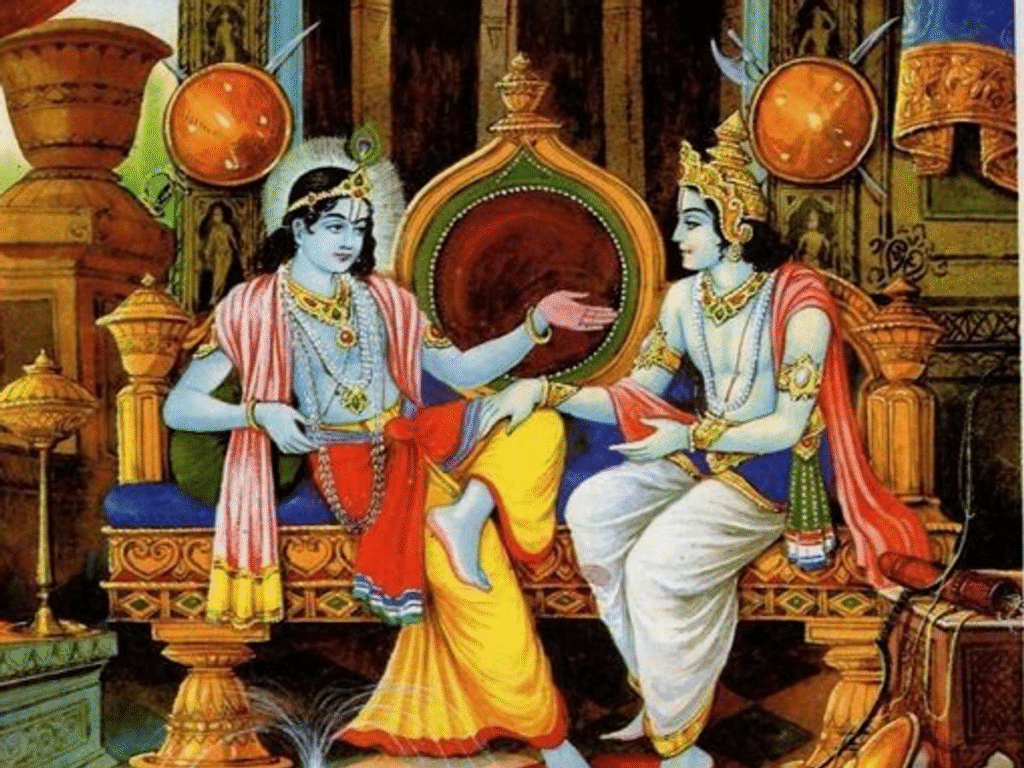
One of the central themes of the Uddhava Gita is that we learn from life itself. We learn from our experiences, from pain, from love, from success, and from failure. Ultimately, all learning culminates in one lesson: where and how to direct our love.
As Krishna decided to conclude His earthly pastimes, Uddhava wanted to go with Him. But Krishna wanted Uddhava to remain in this world and guide others. Krishna instructed him and prepared him to continue his spiritual journey and be a teacher to others.
This verse, Srimad Bhagavatam 11.7.20, is the starting point from where the description of 24 gurus starts in Uddhava Gita.
“An intelligent person, expert in perceiving the world around him and in applying sound logic, can achieve real benefit through his own intelligence. Thus sometimes one acts as one’s own instructing spiritual master.” Srimad Bhagavatam 11.7.20
It teaches us that one can become one’s own teacher when guru is not there. The teachings of 24 gurus in Uddhava Gita shows how one learns from one’s observation.
We can understand this subject through three dimensions:
- Principle
- Process
- Purpose
Krishna Teaches Through the Word and the World
We say, “Krishnam Vande Jagadgurum.”
One meaning of Jagat-Guru is that Krishna is the guru of everyone in the universe. Another meaning is that Krishna teaches through the jagat itself—the world around us.
The universe is a university in which Krishna teaches us.
He teaches us through:
- Scriptures – Word.
- Nature – World.
Scripture is the Word. Nature is the World.
God does not communicate wisdom only through sacred texts. The same Lord also teaches through the experiences He arranges within this world. After all, the world itself functions under His supervision:
mayādhyakṣeṇa prakṛtiḥ sūyate sa-carācaram
(Bhagavad-gita 9.10)
Material nature acts under Krishna’s direction.
Yet there is an important challenge.
The world can be seen either as Krishna’s world or as Maya’s world.
If we simply look at the world through material consciousness, we will primarily see objects for sense enjoyment. The world then becomes a source of distraction. To perceive Krishna’s presence within the world requires spiritual training.
This is where the guru becomes indispensable.
The guru-disciple relationship is eternal because the guru teaches us how to see.
The spiritual master does not merely provide information. He provides vision.
Therefore Narottama Dasa Thakura prays:
cakṣu-dāna dila yei, janme janme prabhu sei
“He who has given me spiritual vision is my master life after life.”
Through the guru we learn scripture. Through scripture we learn how to interpret the world.
Without this foundation, our observations may simply reinforce illusion.
Proper Dependence on Guru
The necessity of guru does not mean unhealthy dependence.
Dependence on guru should not be primarily physical, financial, or emotional.
Physical dependence means unnecessarily burdening the guru instead of helping carry forward his mission.
Emotional dependence occurs when a disciple’s spiritual stability becomes dependent on receiving a particular amount of personal attention, recognition, or affirmation.
One senior devotee recalled receiving a message from a disciple who felt neglected because he had not received enough attention from his spiritual authority and therefore wanted to leave spiritual life. Such situations demonstrate how emotional dependence can sometimes masquerade as spiritual dependence.
As spiritual practitioners mature, they should become spiritually dependent rather than emotionally needy.
Spiritual dependence means drawing strength from the guru’s teachings, example, and connection to Krishna.
We serve the spiritual master through:
- His life
- His teachings (vani)
- His legacy
Guru’s life teaches us how to practice devotional service. His teachings guide our understanding. His legacy provides practical systems through which people can remember Krishna.
Srila Prabhupada emphasized that a genuine spiritual master should provide practical means by which people can remember Krishna and advance spiritually.
Developing Independent Thoughtfulness
One of Srila Prabhupada’s most important instructions was that devotees should become “independently thoughtful.”
A disciple should not outsource all decision-making to the spiritual master.
The guru provides principles, values, and vision, but the disciple must learn how to apply them.
Krishna Himself demonstrated this approach with Arjuna.
Throughout the Bhagavad-gita, Krishna educates Arjuna, answers his questions, removes his confusion, and reveals profound spiritual truths. Yet at the conclusion He does not force Arjuna. Instead He says:
vimṛśyaitad aśeṣeṇa yathecchasi tathā kuru – Thus I have explained to you knowledge still more confidential. Deliberate on this fully, and then do what you wish to do. Bhagavad-gita 18.63
Krishna wanted Arjuna to think.
A significant example appears after the war when Aśvatthāmā was captured. Krishna was physically present, yet He did not simply dictate every detail of what Arjuna should do. Arjuna had to weigh competing principles and make a thoughtful decision. Krishna ultimately approved Arjuna’s judgment.
The purpose of spiritual education is not merely to provide answers. It is to develop mature spiritual intelligence.
Similarly, after Krishna departed from this world, Arjuna continued making decisions based on the wisdom Krishna had imparted. Krishna had prepared him to face life independently.
The goal of the guru-disciple relationship is therefore not chronic dependency but spiritual maturity.
Avoiding Blind Following and Cult Mentality
There is a significant difference between surrender and thoughtlessness.
Independent thinking must always function within the framework of guru, sadhu, and śāstra.
Blind following can become dangerous.
A genuine spiritual tradition encourages thoughtful understanding, not mechanical conformity.
Researchers who study radicalization have observed that many people become attracted to extremist movements because such groups simplify life. Complex moral questions are replaced with simple instructions: “Do not think. Simply obey.”
This pattern was evident in the growth of organizations such as ISIS. Some recruits, including educated individuals from developed countries, were attracted not merely by ideology but by the promise of certainty and simplicity. By surrendering their capacity for independent judgment, many became victims of manipulation and tragedy.
The lesson applies far beyond political extremism.
Whenever people stop thinking and simply surrender their intelligence to another person or institution, they become vulnerable to being misled.
For this reason, spiritual life should strengthen intelligence, not weaken it.
Srila Prabhupada strongly opposed any tendency toward blind following. He wanted devotees to understand philosophy deeply and apply it intelligently.
Unthinking people are easier to control, but thoughtful people are better equipped to serve Krishna responsibly.
Understanding the Letter and Spirit
As devotees mature, they learn to understand both the letter and the spirit of instructions.
We may broadly think of three levels:
| Level | Understanding |
| Kanistha | Follows neither the letter nor the spirit |
| Madhyama | Follows the letter but misses the spirit |
| Uttama | Understands and follows both the letter and the spirit |
The highest level is not merely following instructions mechanically but understanding the purpose behind them.
This is why spiritual traditions remain dynamic and relevant across generations.
For example, Sri Chaitanya Mahaprabhu avoided meeting kings because of the social circumstances of His time. Srila Prabhupada, however, actively met political leaders, scholars, and influential people because different circumstances required different applications of the same spiritual principles.
Similarly, Srila Prabhupada strongly criticized certain aspects of modern education, yet he also encouraged engagement with educated people and intellectual communities.
The principle remained the same. The application varied according to circumstance.
The 24 Gurus in Uddhava Gita: Learning from Nature
Krishna then explains how learning from life works.
The Avadhuta Brahmana describes twenty-four gurus.
Interestingly, none of these 24 gurus formally preach in Uddhava Gita,
They are simply elements of nature and ordinary features of life.
The earth, air, sky, water, mountain, python, moth, honeybee, and many others become teachers.
The Avadhuta learns through observation.
The mountain teaches steadiness and service.
The earth teaches tolerance.
The sky teaches detachment.
Learning is not restricted to formal classrooms.
Life itself becomes a classroom.
Three Sources of Knowledge – Pratyaksa, Anumana and Sabda
Vedic philosophy describes three important means of acquiring knowledge:
Pratyakṣa — Direct Observation
Knowledge obtained through our senses.
Anumana — Inference and Reasoning
Knowledge obtained through analysis and logical conclusions.
Śabda — Revealed Knowledge
Knowledge received from scripture and spiritual authorities.
Pratyakṣa and anumāna are valuable but incomplete.
Our senses are limited.
We do not always perceive reality accurately.
Inference can lead to correct conclusions, but it can also become speculation.
Therefore observation and reasoning require guidance.
That guidance comes from śabda.
How Realization Develops Through Expereince
Śabda provides the framework through which we interpret experience.
Whatever we learn through observation and reasoning should harmonize with scriptural wisdom.
When this happens, realization develops.
Realization means that truths heard from scripture become confirmed through personal experience.
For example, scripture teaches that material wealth cannot guarantee happiness.
Initially we may accept this on faith.
Later we may observe wealthy people suffering from anxiety, loneliness, or dissatisfaction.
Our experience then confirms what scripture already taught.
This is realization.
Pratyakṣa and anumāna have now become aligned with śabda.
The same world that once distracted us from Krishna now reminds us of Krishna.
Srila Prabhupada demonstrated such vision. When he arrived in America, many people saw unprecedented prosperity. Yet Prabhupada also saw widespread anxiety, dissatisfaction, and spiritual emptiness. He famously described modern industrial civilization as ugra-sthāna—a place of intense materialistic activity.
Prabhupada was not seeing merely with material eyes. He was seeing through the lens of scripture.
The 24 gurus in Uddhava Gita teach us how to cultivate this kind of vision.
Learning from the World to Serve Krishna
The purpose of learning from the world is not merely intellectual enrichment.
The purpose is to deepen our relationship with Krishna and improve our service to Him.
If śabda is absent, observation and reasoning can easily become servants of Maya.
When guided by scripture, they become servants of Krishna.
This principle is especially important in preaching and outreach.
The world is constantly changing.
Technology changes.
Communication changes.
Social realities change.
Methods of outreach may therefore need to evolve.
During the pandemic, for example, devotees rapidly adopted online platforms such as Zoom to continue sharing Krishna consciousness.
The principles remained unchanged.
The methods adapted.
Relevance and Potency in spiritual outreach
Srila Prabhupada explains that effective preaching requires realization.
To communicate effectively, we must understand people.
One useful framework is NICE:
- Needs
- Interests
- Concerns
- Expectations
We understand these through observation and inference.
This gives relevance.
Scripture provides potency.
If we only understand people but neglect scripture, our message loses spiritual power.
If we know scripture but fail to understand people, our message may become difficult for others to relate to.
Successful outreach combines both.
Relevance comes from understanding the audience.
Potency comes from understanding scripture.
Conclusion – Life becomes a Teacher
The theme of this section of the Uddhava Gita is simple yet profound: learn from life. Through the 24 gurus in Uddhava Gita, Krishna teaches how every experience can help us grow in our spiritual life.
Krishna teaches through both the Word and the World.
The guru teaches us how to understand the Word.
The Word teaches us how to interpret the World.
Through observation (pratyakṣa) and inference (anumāna), guided by revealed knowledge (śabda), we gradually develop realization.
The purpose is not merely to become knowledgeable.
The purpose is to see Krishna everywhere, learn from every experience, and use everything in His service.
In this way, life itself becomes a teacher, the world becomes a classroom, and every experience becomes an opportunity to move closer to Krishna.
(Above article is based on the lecture given by HG Chaitanya Charan Prabhu at Iskcon Newtown Kolkata on 17th June 2026)
Read Series of articles on Uddhava Gita:
Search
Recent Posts
-
Srimad Bhagavatam at ISKCON Newtown...
September 1, 2026
-
Janmashtami: Celebrating Krishna’s Appearance Through...
August 17, 2026
-
Gopinatha Pattanayaka: 6 Lessons for...
August 16, 2026
-
What Does Krishna Say About...
August 11, 2026
-
Are you ready to choose...
August 2, 2026
Aila Gita: Lessons on Responsibility and Self-Control
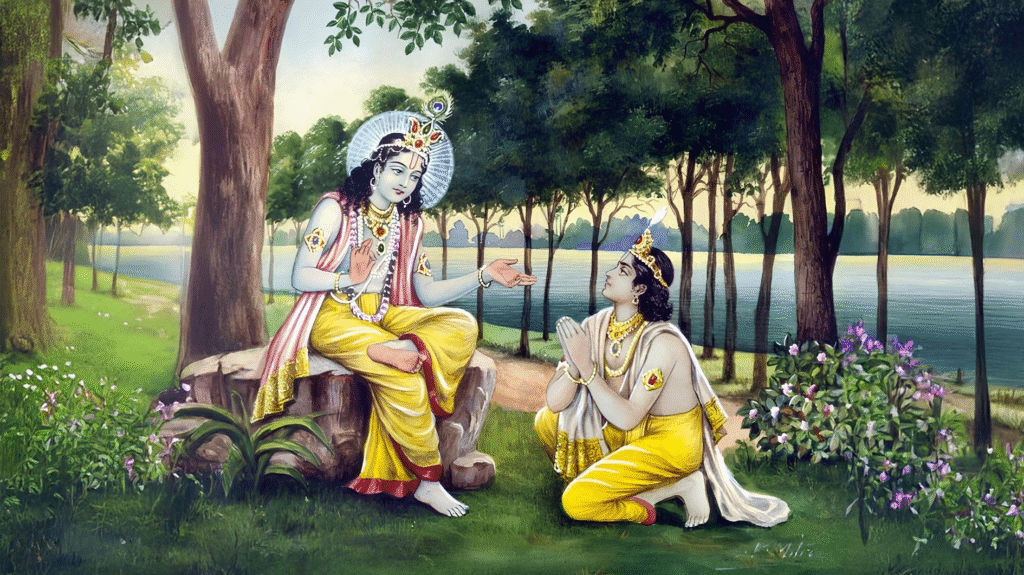
In 11th Canto of Srimad Bhagavatam, the last story which Krishna says to Uddhava is Aila Gita. Krishna through different perspectives and pastime, gives knowledge to Uddhava.
Krishna is giving knowledge to Uddhava so that he becomes detached from the world.
In 9th canto, it is mentioned that how Puruva was a great king, but when he saw Urvasi, he got attracted to her. But later Urvasi left him.
Pururva laments and then does yajna to get her. He is able to get her too but again Urvasi leaves.
When Urvasi leaves Pururva then Pururva goes through different stages of transformation. This is discussed in the chapter Aila Gita of Bhagavatam.
First Stage
Puruva is angry with her. He thinks, “I have given her so many things, I gave her love but still she left.”
Second Stage
He thinks I wasted my time with her. When someone leaves a person, then the person thinks before she left me I should have left her.
Third Stage
He thinks about his own “responsibility.” He thinks, “What is her fault? It was I who thought a rope to be a snake. I could not understand who I was and I could not control my mind.”
Fourth Stage
He becomes detached, he leaves kingdom and wanders.
Finally, devotion for the Lord comes.
Fifth Stage
From Aila Gita, we understand the importance of taking responsbilty in one’s life.
Let us will discuss taking responsibility in one’s life with the abbreviation – APT: A (Analyze) P(Protect) T(Transcend)
Analyze(A) The Cause
In Aila Gita, we see how Puruva, critically analyses the cause of his suffering.
A person gets angry and may blame others for that. May be the other person might have said something, but we are responsible for our action.
Let us see how responsible circumstances are and how responsible we are.
If someone does something wrong then we have to analyze why this happened. There is soul, which is now covered by mind, and mind gets influenced by circumstances (i.e. with the world around us). Mind has different conditionings. Soul has intention.
There are 3 reasons why people do something.
Circumstances
For e.g. a person may drink alcohol at a party and say that his friends forced him to drink. But his friends did not open his mouth and poured liquor in it. Circumstances can be one cause for behaving in a particular way, then there is conditioning.
Conditioning
Conditioning means one has certain samskara based on which one does things. Samskara ca be positive or negative. Someone may have bad experiences in his childhood which may create bad impression in his mind. So, we can say samskara is “some scar.” Based on samskara, one does certain things. Then there is intention.
Intention
One chooses to do certain things. For eg. no one called a person to drink but he chooses to drink alcohol. There was one rich person who was addicted to alcohol. His family members asked the neighborhood shops to not give him alcohol. So, he would fill the petrol tank of his vehicle with alcohol and drink it using a straw. This is intentional.
These are three contributors – circumstances, conditioning and intention (choice).
Understanding circumstances, conditioning and intention (choice) through example
We see examples of Ravana and Ajamila. Both are afflicted by lust, but there situations are different. Ajamila had gone for service and got distracted when he saw a prostitute and a man. His cause for distraction was circumstances. Ajamila’s situation starts with circumstances.
For Ravana, circumstances did not come to him, he created the circumstance. He thought when Sita will be alone, he would force her to come with me. His action was intentional. When we intend to do something, we create circumstances.
For eg, when we open app, something obscene pops up, then that is circumstantial but when we go and open a particular site with obscene content then that is intentional. In Australia, social media is banned for teenagers. But teenagers are using VPN to bypass the ban.
If someone wants to correct oneself then one has to see what factors are contributing more.
Ajamila – first sight – 100% circumstantial. He came back from that place, but mind did not come back. He kept thinking about it.
When he went first time to the lady, we can say 80%-90% circumstantial. We can this is conditioning, so he did something.
For Ajamila, one thing was “To be with her” and second was “She be with me.” Now, for “She be with me”, he had to give up his wife, parents, job. He was a brahmana but when he started living with the prostitute then no one invited him for yajna or for other sacred sacrifices. When he decides that “she be with me” then this was not conditioning but this was intentional.
For eg. A fort has walls around. Enemies may attack it from outside and walls may break down. These are circumstances. Sometimes there can be attack on the fort from inside too, this is conditioning. But if someone is breaking the wall from inside to bring it down then this is intentional.
While fighting against anarthas, sometimes we may fail. This is sign of weakness.
For Ravana it was not weakness, but it was his wickedness. Ravana was not fighting against the anarthas, but he was fighting for it. This is the characteristic of a demon. A demon does not fight against anarthas like lust but fights for it to get it.
So, first we have to analyse why we are behaving in a particular way.
Till the time we blame circumstances, we cannot grow.
In Aila Gita, we see Pururva after analysing his situation stops blaming circumstances.
Protect(P)
For protecting anything, we need boundaries.
From Aila Gita, we learn the importance of boundaries, if we do not have it then we are bound to suffer like Pururva.
Boundaries are two types – Internal & External
One Bollywood actor who is taking interest in devotional life was angry with Iskcon when he heard one prominent Iskcon speaker blaming Bollywood for rise in rape cases in India. He said movies do not glorify rapes. People are indulging in it because they are animals.
Suppose that in shop nice things are displayed, it does not mean that one goes and steal things from there and blame shop for that.
External boundaries are two – Law & Culture
Law
Law will punish you if you are wrong. For e.g. drink and drive is a big crime.
Culture
It is based on the environment where we live. Using abusive words in public, smoking are part of the culture where we grew up.
Internal boundaries are two – Intelligence & Conscience
Intelligence
It tells us that this action will result in bad outcomes, will create problem. For e.g. someone with diabetes will use his intelligence and will not indulge in sweets. Even Ravana had that much intelligence that I should not force myself upon Site because he had been cursed.
No one can say that I cannot control my conditioning. For e.g. someone is saying that I can’t give up meat but if doctor says that if you do not give up you will die then that person will give it up.
Conscience
Not just this will lead to bad, but this is bad. For e.g. if a new person comes to temple and we behave badly with him. But later come to know that he is a senior disciple of a prominent guru then we will immediately go a seek forgiveness from him fearing that our action will be reported by him to his guru. But if a young devotee comes to temple and I do not behave badly with him thinking that he is a guest to the temple then this is conscience.
Even if there is no boundary then some boundary is required.
Transcend(T)
It is going beyond conditioning. Best example is Haridas Thakura. Even though the prostitute came, he was not at all affected by it.
Aila Gita too teaches about transcedence. When one achieves it one becomes satisfied and free from all material attachments and entanglements.
“Thus losing his desire to be on the same planet as Urvaśī, Mahārāja Purūravā began to wander the earth free of all material association and completely satisfied within the self.” Srimad Bhagavatam 11.26.35
By bhakti we can transcend the conditioning. But it will take time. So we have to also focus on boundaries. Whatever boundaries work, we should go for it.
Law: If law is favorable then this is good, but law is not in our control.
Culture: this is also partly in our control not completely. We cannot change the culture, but we can choose the culture. Choose which culture you want to belong to. If we are with devotees, then we get a devotional culture. By culture, controlling our conditioning is easy. For e.g. in temple people come wearing decent dress, not to agitate others.
Intelligence: This is mostly in our control. With our intelligence, we can understand if we do this then this will happen. So, hearing lectures and reading scriptures are very important to develop intelligence. Whatever anarthas is troubling us, we should hear those lectures which will help us to deal with those anarthas.
Conscience: This is best. But it is gradual and happens through purification. If we develop proper conscience then we do not do certain things because we know this will displease Krishna. And our life’s purpose is to please Krishna and not displease him – anukulyasya sankalpah, pratikulyasya varjanam.
Key takeaways
Self-control: For self-control, we cannot blame circumstances and also, we cannot rely completely on will power. If we just blame circumstances and think that we can control everything by will power then this is not possible.
For self-control, first we have to through intelligence and then to transcendence.
With intelligence we protect ourselves from circumstances and strengthen our will power.
Till the time we do not have love for Krishna, then till the time with buddhi, intelligence, we should do bhakti.
Summary
- Context: Aila Gita. It teaches us that instead of blaming circumstances for our suffering, we should take responsibility for our actions, become detached from things which causes sufferings and ultiamtely develop devotion for the Lord.
- We see Pururva is 1st blaming, 2nd he takes responsibility, 3rd he develops detachment and fianlly develops devotion.
- Taking responsibility
Analyse – Circumstances, Conditioning, Intention (choice). Intention – Ravana’s action. Ajamila’s start was based on circumstances then intentional. All three are contributors.
Protect: To protect ourselves we need boundaries.
1. External Boundary: Culture & Law
2. Internal Boundary: Intelligence & Conscience
Choose whichever boundary works is best boundary.
Safest boundary is conscience. But most controllable is intelligence.
- For Self-control – Increase intelligence
Different people have different levels or types of anarthas – Some people have more lust, less anger, less greed. Some may have less lust, more anger, less greed and so on.
- Srila Prabhupada instruction
Responsibility in our spiritual life is upon us. Srila Prabhupada says every individual has to fly his own plane.
(The above article is based on the Srimad Bhagavatam Class given by HG Chaitanya Charan Prabhu at Iskcon Kolkata on 20th June 2026)
Search
Recent Posts
-
Srimad Bhagavatam at ISKCON Newtown...
September 1, 2026
-
Janmashtami: Celebrating Krishna’s Appearance Through...
August 17, 2026
-
Gopinatha Pattanayaka: 6 Lessons for...
August 16, 2026
-
What Does Krishna Say About...
August 11, 2026
-
Are you ready to choose...
August 2, 2026
Overview of Uddhava Gita: Krishna’s Final Instructions to Uddhava|HG Chaitanya Charan Prabhu | Iskcon Newtown Kolkata
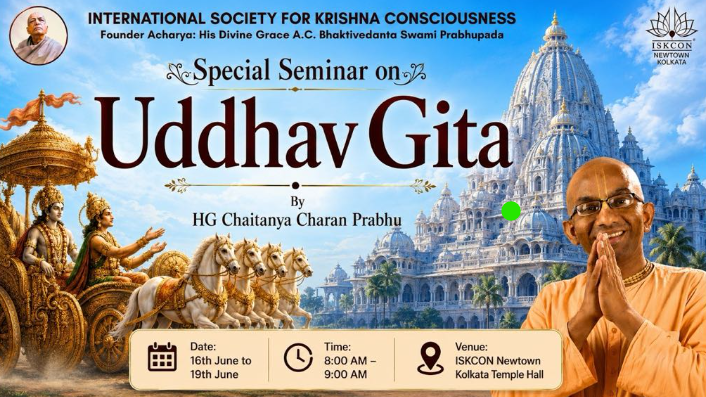
HG Chaitanya Charan Prabhu is giving four-day seminar on Uddhava Gita at Iskcon Newtown Kolkata from 16th June 2026 – 9th June 2026.
On the first day prabhuji gave overview of Uddhava Gita, its significance, distinctive features and compared it with Bhagavad Gita.
Below article is based on the class given by HG Chaitanya Charan Prabhu.
Overview of Uddhava Gita
Today I will discuss an overview of the Uddhava Gita.
The Uddhava Gita appears in the Eleventh Canto of Śrīmad-Bhāgavatam, spanning Chapters 7–29. It is the longest philosophical discussion spoken by Lord Krishna in the Bhāgavatam.
The Tenth Canto is the longest canto of Śrīmad-Bhāgavatam, comprising approximately one-third of the entire text with ninety chapters. However, the most extensive philosophical discourse is found in the Eleventh Canto in the form of the Uddhava Gita.
To understand the Uddhava Gita, we can use the acronym S.E.A.T.
- S – Situation
- E – Emotion
- A – Approach
- T – Theme
S – Situation
The Bhagavad-gita (BG) consists of approximately 700 verses, whereas the Uddhava Gita (UG) contains about 1,040 verses.
Both were spoken just before a major catastrophe.
The Bhagavad-gita was spoken on the battlefield of Kurukṣetra before the devastating fratricidal war among the Kuru dynasty. It was spoken in a public setting.
The Uddhava Gita was spoken between Dvārakā and Prabhāsa, in a more private setting. It was also spoken before a fratricidal conflict—this time among the Yadus themselves.
The Eleventh Canto begins with descriptions of ominous signs indicating the impending destruction of the Yadu dynasty. Uddhava senses that Krishna is preparing to leave this world and therefore approaches Him for guidance.
The Uddhava Gita extends from Chapters 7 to 29. In Chapter 29, the Yadus begin fighting among themselves, and in Chapter 31, Krishna concludes His earthly pastimes. Thus, the Uddhava Gita represents the Lord’s final and most comprehensive instructions before His departure.
E – Emotion
Wisdom rarely comes easily. It is often born from pain.
If we wish to gain deeper knowledge, some form of austerity is generally required. Philosophical understanding often emerges through adversity. One way I describe this while speaking around the world is:
“The world is a university of adversity.”
Through adversity we learn what truly matters—what we should hold on to and what we should let go of.
Consider a child. Initially he is attached to toys. As he grows older, he gives up toys to spend time with friends. Later he gives up those activities to focus on studies. Growth involves consciously choosing what to release and what to embrace.
The primary emotion experienced by both Arjuna and Uddhava was pain.
Arjuna’s Pain
A question is sometimes asked: Why did Krishna speak the Bhagavad-gita to Arjuna and not to Yudhiṣṭhira?
One reason is that Arjuna was experiencing the deepest emotional crisis.
It was Arjuna who had to fight and ultimately kill Bhīṣma and Droṇa—his elders, teachers, and mentors. Bhīma had vowed to kill Duryodhana and Duḥśāsana, but he had no affection for them. Although Bhīma preferred peace and even encouraged Krishna to seek a peaceful resolution, he did not face the same emotional dilemma.
Similarly, Yudhiṣṭhira did not have to directly confront and kill those to whom he was deeply attached in the same way that Arjuna did.
Thus, Arjuna’s pain was unique.
Different Levels of Pain
There are different forms of suffering:
1. Adversity – difficulties that arise naturally.
For example, if there is a major program and the electricity suddenly fails, that is adversity.
2. Atrocity – suffering intentionally caused by others.
If someone deliberately cuts the power supply to sabotage the event, that is atrocity.
In Sanskrit terms:
- Kaṣṭa refers to adversity.
- Anyāya refers to injustice or atrocity.
Atrocity is generally more painful because another person intentionally causes the suffering.
3. Agony – suffering caused by one’s own actions, when one is forced to do something deeply painful.
This was Arjuna’s condition.
The Mahābhārata presents a realistic picture of life. Sometimes good people are not given good choices. The only options available may be a bad choice or a worse choice.
For Arjuna, Bhīṣma and Droṇa were not merely relatives. They were respected elders, teachers, and mentors. He had not simply learned archery from them; he had learned it partly to please them. Now he was expected to fight against and kill those very individuals.
Once, after I spoke on this topic in America, a disciple of Śrīla Prabhupāda shared a similar experience. He explained that a senior devotee who had been his śikṣā-guru had deviated. Because he was close to that devotee, it was extremely painful when the GBC asked him to inform others—especially the guru’s disciples—about the deviation. He understood Arjuna’s dilemma at a personal level.
Uddhava’s Pain
Uddhava’s pain was different.
In one sense it was less severe because he was not required to engage in violent action. Yet in another sense it was even greater because he faced separation from Krishna Himself.
He understood that Krishna was preparing to leave the world, and he would be left behind.
We get a glimpse of Uddhava’s anguish in the First Canto when he tells Vidura that the sun of Krishna has set.
“Śrī Uddhava said: My dear Vidura, the sun of the world, Lord Kṛṣṇa, has set, and our house has now been swallowed by the great snake of time. What can I say to you about our welfare?” Srimad Bhagavatam 3.2.7
One of the deepest forms of suffering is loneliness—the feeling that no one around us can understand what we are experiencing.
I once met a devotee in Australia who had been caught up in the Russia–Ukraine conflict. He was imprisoned and later released before receiving asylum in Australia. He explained that when he was arrested, his bead bag was confiscated. As a devotee, he felt completely isolated because nobody around him understood his spiritual life. He described that loneliness as one of the most difficult experiences he had ever faced.
Similarly, Uddhava faced the prospect of continuing without Krishna’s visible presence.
In Chapter 29, Krishna instructs Uddhava to leave and go to Badarikāśrama, thereby protecting him from the impending destruction of the Yadu dynasty.
A – Approach
The Bhagavad-gita and Uddhava Gita differ significantly in their teaching style.
In the Bhagavad-gita, principles are primarily explained.
In the Uddhava Gita, principles are both explained and illustrated through stories and examples.
Śrīmad-Bhāgavatam generally combines philosophy with narrative.
We may broadly say:
- Bhagavad-gita: almost entirely philosophical instruction.
- Śrīmad-Bhāgavatam: philosophy interwoven with stories.
- Uddhava Gita: a synthesis of philosophical teachings and illustrative narratives.
The Uddhava Gita includes famous accounts such as:
- The Avadhūta Brāhmaṇa
- The Avanti Brāhmaṇa
- King Purūravā
- Piṅgalā
These stories help demonstrate the philosophical principles being taught.
Another difference is urgency.
The Bhagavad-gita is an emergency conversation. Arjuna is standing on a battlefield and must immediately decide how to act.
The Uddhava Gita, while urgent, is less immediate. Therefore Krishna has more time to elaborate on various philosophical topics.
T – Theme
The central themes of the Bhagavad-gita and Uddhava Gita differ in emphasis.
Bhagavad-gita: World-Transforming
The Bhagavad-gita teaches us how to act within the world while remaining connected to Krishna.
Arjuna is instructed to fight—not for personal gain, but as an act of devotion.
The Gita shows how spiritual consciousness can transform worldly engagement.
Uddhava Gita: World-Transcending
The Uddhava Gita focuses more on detachment and transcendence.
Its overall message is how to rise above worldly entanglement and deepen one’s absorption in Krishna.
This reflects the context in which it was spoken. Krishna is preparing to depart, and Uddhava is being prepared for a life of renunciation and spiritual absorption.
Context-Sensitive Teaching
An important lesson from both texts is that spiritual instruction must be appropriate to the listener’s situation.
Wrong instruction can create serious problems.
When someone is in distress, we should offer wisdom that provides comfort, guidance, and practical direction.
Similarly, Śukadeva Gosvāmī speaks to Mahārāja Parīkṣit, who has already decided to leave the world. Therefore, the Bhāgavatam strongly emphasizes world-transcending spirituality.
Bhakti in Both Gitas
Both the Bhagavad-gita and the Uddhava Gita establish bhakti as the highest path.
However, they differ in what they present as the next best alternative.
Bhagavad-gita
- Bhakti-yoga
- Karma-yoga
- Jñāna-yoga
Uddhava Gita
- Bhakti-yoga
- Jñāna-yoga
Because the Uddhava Gita is addressed to a highly advanced devotee who is approaching renunciation, it places greater emphasis on knowledge and detachment.
Overview of Uddhava Gita : Summary
Significance of the Uddhava Gita
- The longest philosophical discussion in Śrīmad-Bhāgavatam.
- Krishna’s final instructions before His departure.
- One of the most comprehensive presentations of spiritual wisdom.
- Covers a wide range of philosophical and practical topics.
Bhagavad gita (BG) vs Uddhava Gita (UG) – S.E.A.T.
Situation
- BG: Spoken at Kurukṣetra before the Kurukṣetra war; public setting.
- UG: Spoken between Dvārakā and Prabhāsa before the destruction of the Yadus; private setting.
Emotion
- Arjuna’s pain was agony—he had to fight and kill his revered mentors.
- Uddhava’s pain was separation—he faced life without Krishna’s visible presence.
Approach
- BG: Primarily philosophical principles.
- UG: Philosophical principles illustrated through stories and examples.
Theme
- BG: World-transforming—serve Krishna through action in the world.
- UG: World-transcending—rise above worldly attachment and deepen absorption in Krishna.
Search
Recent Posts
-
Srimad Bhagavatam at ISKCON Newtown...
September 1, 2026
-
Janmashtami: Celebrating Krishna’s Appearance Through...
August 17, 2026
-
Gopinatha Pattanayaka: 6 Lessons for...
August 16, 2026
-
What Does Krishna Say About...
August 11, 2026
-
Are you ready to choose...
August 2, 2026
Why Spiritual Planning Is More Important Than Material Planning for Success in Krishna Consciousness
Succes in any field requires meticulous planning. Top notch professionals of MNCs spend days brainstorming different plans to expand their business. Sportspersons plan their day from dawn to dusk – what time to wake up, what exercises to do, how to relax during and after workout, what to eat, what not to eat, when to eat and finally when to go to bed.
They follow their routines not for a few days or weeks but for years and decades which helps them to attain great success and also retain it.
Like material success, spiritual success too requires proper planning. A spiritual seeker cannot live whimsically and expect to advance in spiritual life.
If we study lives of great spiritual personalities, we will see that they planned so well. Srila Prabhupada would not waste even a moment. Srila Bhaktivinod Thakura had a strict daily routine. He was a householder, was working as a magistrate, had a wife and children but still he wrote around 100 books and preached to thousands of people. He had fixed time for chanting japa, reading scriptures, writing books, going to court, taking food and taking rest.
Through their conduct they are teaching us the importance of proper planning and execution so that we can gradually make progress in our spiritual journey. Krishna too in Gita says that regulation saves one from many sufferings.
“He who is regulated in his habits of eating, sleeping, recreation and work can mitigate all material pains by practicing the yoga system.” Bhagavad Gita 6.17
Just as for material success there are do’s and don’ts, similarly for spiritual success there are do’s and don’ts.
Do’s and Don’ts for success
For example, famous Indian cricketer, Virat Kohli, loved Chole Bhature but he gave it up to have a healthy and fit body. Similarly, in our spiritual journey too, we have to give up things which are prohibited by the scriptures. For attaining Krishna, following four things have to be given up – meat eating, gambling, intoxication and illicit sex.
If we are currently used to these habits, then we should make proper plan to give it up. Initially it may look difficult but if we try then gradually, we will succeed. We will then experience joy and satisfaction.
Best way to give up anything bad is by replacing it with something good. For example, if one is eating non vegetarian food like fish, egg, meat then one should start taking prasadam in the temple. There are Govindas restaurant of Iskcon in different parts of the world famous for mouth savouring delicacies. Once we start taking the sanctified vegetarian food then soon, we will will lose taste for not just non vegetarian food but also for food which has onion and garlic.
Personal Example
In my earlier days, I was fond of eating fast foods like samosa, burger, patties, manchurian, fried rice etc. Giving it up was not so easy. But then I started eating these foods from Govindas, and eventually I lost desire to eat outside. Not just that, I even lost interest in such food as they are not good for health. Simple prasadam in temple or at home is more relishing and satisfying and nutritious too.
Chanting is important
In our spiritual life, we have a great advantage that Krishna is always there to help us. If we want to give up something and pray to Krishna, then the Supreme Lord merciful removes that bad habit from our life. But it does not happen automatically, we have to plan for it.
Along with giving up prohibited things it is equally and even more important to engage in devotional activities like chanting the Hare Krishna Mahamantra, reading scriptures like Bhagavad Gita and Bhagavatam, and associating with sincere devotees of Krishna.
It is recommended that we should daily chant 16 rounds of Hare Krishna Mahamantra on our beads which takes around 2 hours.
If we do so, then only we can advance in our spiritual life else attaining Krishna will be a challenge.
Material success is temporary but spiritual success is permanent
Be it material success or spiritual success, careful planning is required. But spiritual planning is more important than material planning. Why?
Because material success will be with us till the time, we are alive but spiritual success will remain with us forever.
We vie for material success and work so hard for it because we assume that success in this world will guarantee happiness. But material endeavour has its limitation – it won’t save us from old age, disease and death.
If we turn the pages of history we will see that great emperors, business magnates, famous personalities were helpless in front of death. And whatever name, fame and money they earned, they could not take it with them when they were knocked down by death.
But the spiritual practices we do like the chanting of the Hare Krishna Mahamantra, taking darshan of Krishna deity, reading scriptures like Bhagavad Gita and Srimad Bhagavatam remains retained in our spiritual bank account forever. We reap its benefit life after life.
Not just that if by sincerely practicing devotion to Krishna, we are able to perfect our lives then we can even go back to the spiritual world, where we will live forever without any suffering.
Spiritual planning also ensures material success
So better than material planning is spiritual planning. Spiritual planning entails doing things keeping Krishna in the centre. This ensures not just spiritual success but material success too. Bhaktivinod Thakura was not just a great spiritual leader, but he was respected as a very efficient magistrate. Arjuna not just attained Krishna, but he won the great Mahabharat war.
We too can win all the battles of life if we always seek shelter of Krishna.
This is what the concluding verse of Gita says,
“Wherever there is Kṛṣṇa, the master of all mystics, and wherever there is Arjuna, the supreme archer, there will also certainly be opulence, victory, extraordinary power, and morality. That is my opinion.” Bhagavad Gita 18.78
A devotee of Krishna lives happily in this world too and attains Krishna too.
We too can win all the battles of life if we always seek shelter of Krishna.
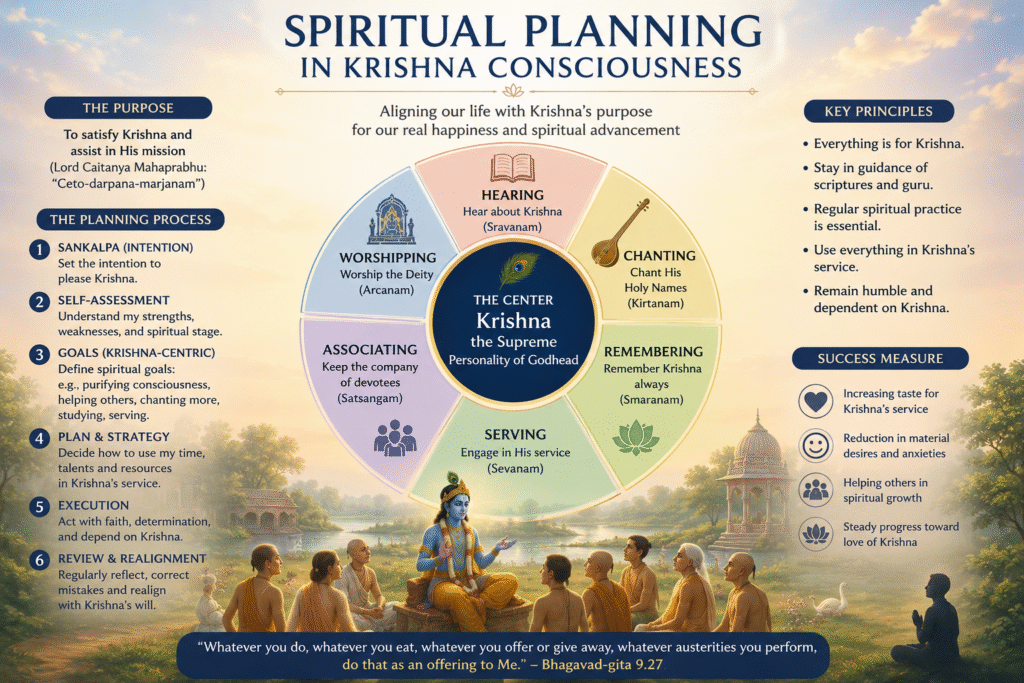
Search
Recent Posts
-
Srimad Bhagavatam at ISKCON Newtown...
September 1, 2026
-
Janmashtami: Celebrating Krishna’s Appearance Through...
August 17, 2026
-
Gopinatha Pattanayaka: 6 Lessons for...
August 16, 2026
-
What Does Krishna Say About...
August 11, 2026
-
Are you ready to choose...
August 2, 2026