Srimad Bhagavatam at ISKCON Newtown Kolkata – September 2026 | Srimad Bhagavatam 11.13
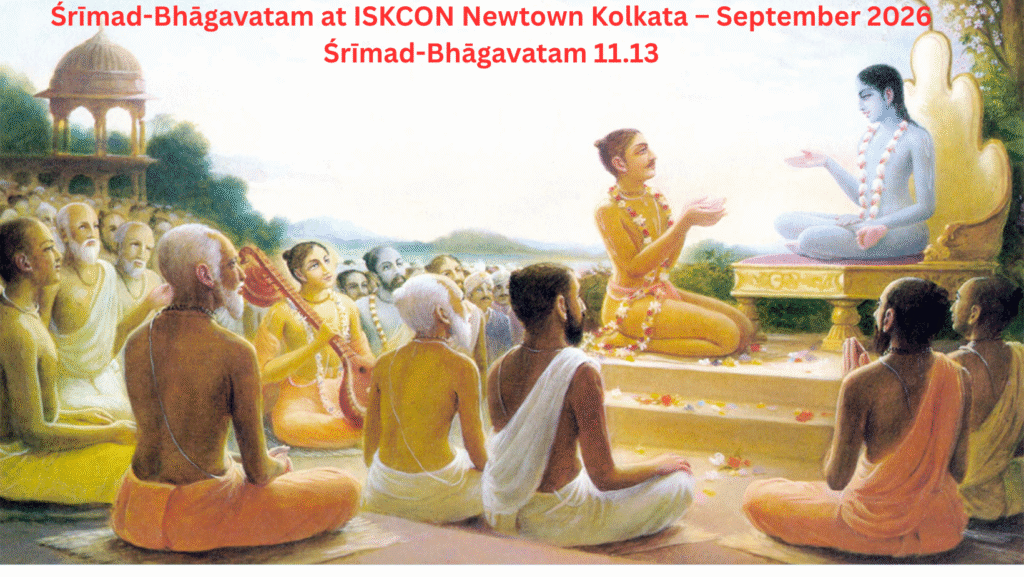
Below are the important points from the morning Śrīmad-Bhāgavatam classes at ISKCON Newtown Temple, Kolkata, during September 2026. The classes cover Canto 11, Chapter 13 of Śrīmad-Bhāgavatam, “The Haṁsa-avatāra Answers the Questions of the Sons of Brahmā.”
Srimad Bhagavatam Class by HG Sri Narasimha Prabhu on 1 September 2026
- Verse Number: SB 11.13.31
- Chapter Name: The Haṁsa-avatāra Answers the Questions of the Sons of Brahmā
Important Points from Translation & Purport
- Those states of existence that are conceived of as separate from the Supreme Personality of Godhead have no actual existence.
- Since this world is the Lord’s creation, one cannot deny that its existence is also real; yet the living entity who identifies the creations of this world as belonging to himself is certainly in illusion.
- A liberated soul in Krishna consciousness does not see anything substantial in even the most exalted rewards offered by the Vedas, such as promotion to the heavenly planets.
- Lord Krishna advised Arjuna in Bhagavad-gita to remain fixed in self-realization, without being deviated by fruitive rituals performed in the name of religion.
Important Points from Class
- In one lecture on Balarama Jayanti HH Radhanath Swami Maharaja says to kill the demon of doubt.
- Maharaja said that Pralambasura who was killed by Balarama was the original terrorist.
- Just as terrorist do recce before attacking a target, Pralambasura did recce of Vrindavan.
- The demon thought that Krishna is extremely powerful so let me kill Balarama. If Balarama dies, then Krishna will automatically die and when Krishna and Balarama are not there then everyone in Vrindavan will die.
- Pralambasura studied the cowherd boys and figured out which cowherd boy did not come on that day. He took the form of that cowherd boy.
- During the game between the cowherd boys, Pralambasura was on the side of Krishna. Krishna’s team lost and as per the games rule, he lifted Balarama on his shoulders.
- Lord Balarama eventually understood that he was a demon and so he became as heavy as Mandara mountain. Unable to bear the load, Pralambasura came to his original form. With a single fist attack, Balarama killed the demon.
- There are atheists in the guise of scientists who systematically try to destroy the faith of people in the Lord. If the faith is uprooted, then no matter how many pastimes people hear of Krishna their devotion for the Lord will not develop. Just like if the root of the plant is uprooted, then no matter how much we water it, the plant will not grow.
- So, if there is no faith then no matter how much we hear the pastime of Krishna, it does not work.
- Acharyas make sure that the root of the faith is taken care of.
- People may go to temple, but they do not have conviction and confidence that Lord is there.
- Srila Prabhupada challenged the atheistic scientists and defeated them.
- Krishna means different austerities such as of speech, mind and body but the purpose is to attain the absolute truth.
- Balarama has a club with which he smashes the false ego or foolish ego of the living entities and with the plough he makes the heart fertile.
- Six children of Devaki killed by Kamsa is compared to six anarthas. After the anarthas are destroyed, we get mercy of Balarama who is guru tattva. For us it is the instruction of Srila Prabhupada and his disciples.
- We do not know how much time we have in this body, so we have to be sincere and serious in following instructions of the scriptures.
- If there is no time of maya then no maya. We should make schedule of 28 years in a day so that we do not have time for maya. We have to do so many things – chanting, reading, preaching and so on.
- Main purpose of all service is to experience presence of Krishna in the holy name.
- When one prepares for competitive examinations, one is very much focused on completing things on time. For bhakti too we should do the same.
- When Krishna appears in his self-same form then everything one gets attracted to him, not just human beings, even birds and animals are attracted to him.
- Capitalism is destroying varnasrama and secularism is nothing but communism.
Previous Month’s Śrīmad-Bhāgavatam Class Notes
Search
Recent Posts
-
Srimad Bhagavatam at ISKCON Newtown...
September 1, 2026
-
Janmashtami: Celebrating Krishna’s Appearance Through...
August 17, 2026
-

Gopinatha Pattanayaka: 6 Lessons for...
August 16, 2026
-
What Does Krishna Say About...
August 11, 2026
-
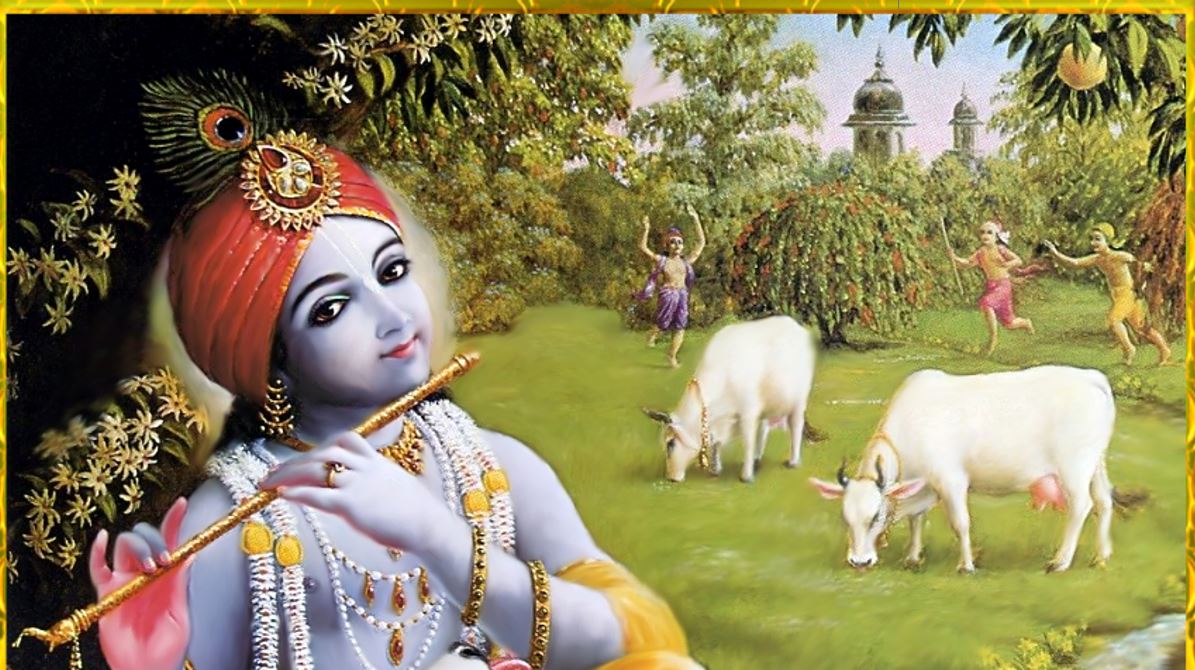
Are you ready to choose...
August 2, 2026
Janmashtami: Celebrating Krishna’s Appearance Through the Life of Srila Prabhupada | Srila Prabhupada | Iskcon Newtown Kolkata
It is because of Srila Prabhupada that today Janmashtami is celebrated in many countries of the world. The story of Srila Prabhupada’s Janmashtami celebrations reminds us of his deep devotion to Krishna and his determination to spread Krishna Consciousness throughout the world.
In this creation, there are so many universes. Just as it is extremely difficult to count how many mustard seeds there are in a bowl, similarly, it is impossible to say how many universes there are in Krishna’s creation. In spite of there being countless universes, Krishna chose to appear in this universe, and in this universe, He appeared in India.
Krishna: The Supreme Personality of Godhead
Common people say that Krishna is an avatar of Lord Vishnu. But Śrīmad-Bhāgavatam says that Krishna is avatari, i.e., from Him different avatars come. Lord Vamana, Lord Varaha, Lord Narasimha, Kurmadeva, and other avatars come from Krishna. Just as we cannot count the number of waves in the ocean, similarly, we cannot count the number of incarnations of Krishna.
Brahma-saṁhitā says – īśvaraḥ paramaḥ kṛṣṇaḥ. We refer to Krishna as Lila Purushottam or Purna Purushottam.
This year, 2026, we are celebrating Janmashtami on 4th September. Let us discuss this festival in four different ways.
Srila Prabhupada’s Mission to Spread Krishna Consciousness
Srila Prabhupada came into this world with a single purpose, and that was to spread the name and teachings of Krishna. Out of many associates of Krishna, the Lord sent Srila Prabhupada. Prabhupada appeared in Kolkata.
In 1922, he received an instruction from Srila Bhaktisiddhanta Saraswati Thakura to spread the teachings of Krishna in the Western world. “You are young, educated, so why don’t you preach about Krishna Consciousness in the Western world?”
At that time, Prabhupada was a grihasta, so had many responsibilities. He struggled hard to take care of his family but was also trying to fulfil the order of his spiritual master. He left India on 13th August 1965 for the USA on the Jaladuta, a cargo ship.
In 1964, a year before departing for the USA, Prabhupada celebrated Janmashtami in Vrindavan in 1964.
Srila Prabhupada’s Janmashtami Celebration in Vrindavan in 1964
At that time, he was staying at Radha-Damodara Temple in Vrindavan. Here, he had translated Śrīmad-Bhāgavatam from Sanskrit to English.
Prabhupada always had connections with great people. In 1964, he invited the Governor of Uttar Pradesh, Shri Vishwanath Das, for Janmashtami. Prabhupada always said that if leaders become devotees, then common people will follow them. This is said by Krishna in Bhagavad-gita 3.21 – yad yad ācarati śreṣṭhas/tat tad evetaro janaḥ.
The governor was a devotee of Krishna. Prabhupada organized the program very systematically. He printed a booklet in which it was mentioned which song was to be sung during the festival, and other schedules were mentioned. Many people came for the program.
As a grihasta, he was trying to fulfil the instruction of his guru, Srila Bhaktisiddhanta Saraswati Thakura.
Srila Prabhupada’s Janmashtami Journey on the Jaladuta
With lots of effort, he finally got a ticket to travel to the USA on the Jaladuta, a cargo ship, in 1965. Right now, going to the USA is not a big thing, but during that time, it was considered a great achievement. Also, Prabhupada was going at an advanced age.
Such a great event was happening, but very few people came to see him off. A small news item came in a newspaper about Prabhupada’s departure to the USA to preach the message of Krishna. He had just Rs 40 with him.
Prabhupada had great faith in the holy name and in the order of his guru. The ship went from Kolkata Port to Sri Lanka and from Sri Lanka to Cochin. At Cochin, Śrīmad-Bhāgavatam, which was translated by Prabhupada, was loaded.
These books, which were difficult to sell in India, he was taking them to the USA. Prabhupada would say that I am not going to the USA, but Śrīmad-Bhāgavatam is going, and I am accompanying the books. Prabhupada left on 13th August, and on 20th August there was Janmashtami. He was never discouraged.
On the day of Janmashtami, he called everyone on the ship – the captain, his wife, and the workers. He cooked prasadam and distributed it to all. He even gave katha for one hour. Prabhupada wrote in his diary that today is Janmashtami and I am all alone.
But still, he was happy and satisfied. He never felt discouraged. The next day was his birthday, which went unnoticed. Prabhupada reached the USA on 17th September 1965, after travelling for around 35 days.
In the USA, he initially stayed in Butler, Pennsylvania, which was a small city. Prabhupada had a big dream, so he wanted to go to New York. New York is Maya’s den. In India, people knew who a sadhu was and even helped them. But no one knew how to deal with a sadhu in the USA.
In New York, he knew Dr. Misra, with whom he had some correspondence. Gopal Agarwal, with whom he was staying in Butler, put him on a bus to New York. He told him that in New York, you can stay at the bus stand and even take a bath if required until you find where Dr. Misra lives.
In New York, Prabhupada tried his best to spread Krishna Consciousness. He was staying here and there. With the help of Michael Grant (Mukunda Goswami), he got to stay at 26 Second Avenue.
There, he started Bhagavad-gita classes three days a week – Monday, Wednesday, and Friday.
Initially, only hippies would come, and many times they would be drunk. But Prabhupada was always positive and enthusiastic. He would write in his diary – Today three people came. It shows that Americans are interested in Krishna Consciousness. We can see his spirit.
Srila Prabhupada’s First Janmashtami in the USA
In the USA, Prabhupada celebrated his first Janmashtami on September 8, 1966. Devotees at that time did not know how to celebrate the festival. But under the guidance of Prabhupada, they chanted, fasted, read, and did kirtan until 12 midnight.
Prabhupada also revealed his heart for the first time to the devotees about how, in 1922, he had received an instruction from his spiritual master to come to the West to preach Krishna Consciousness.
He then revealed to the devotees who Srila Bhaktisiddhanta Saraswati Thakura was. Prabhupada further said that around 500 years ago, Lord Chaitanya had predicted that His name would be chanted all over the world – pṛthivīte āche yata nagarādi-grāma/ sarvatra pracāra haibe mora nāma.
The American devotees came to know that Prabhupada had not come to the West for any personal motive; he had come to fulfil the order of his guru and Chaitanya Mahaprabhu.
In India, people think that Janmashtami is for Hindus. But Krishna says aham bija-pradah pita. So, we can celebrate Janmashtami in any part of the world. Srila Prabhupada showed the devotees that real happiness comes when we take to the path of Krishna Consciousness.
Gradually, these devotees got trained, and then they began celebrating Janmashtami in a grand way.
Today, Janmashtami is celebrated in several countries. This all happened because of Prabhupada; he was a one-man army.
HH Radhanath Swami’s First Janmashtami
Richard Slavin was searching for the highest truth. He wanted to come to India but did not have money. So, he came by hitchhiking. After coming to India, he met many yogis, sannyasis, and spiritual leaders.
Once, he wanted to go to Amarnath. He boarded a train with his friend. At that time, in India, trains had only 3 classes – 1st class, 2nd class, and 3rd class. People without tickets would travel in 3rd class.
Richard was in 3rd class. The bogey was packed with people; it was even difficult to breathe. At one place, because of rain, the train stopped for 8 hours. Richard and his friend came out through the window. As they came out, the train left. It was 5 am in the morning.
A local sadhu told him that this was Mathura and that today was Janmashtami.
He stayed there, associated with the Brajvasis, and developed love for Krishna. Rchard later took initiation from Srila Prabhupada. He is none other than HH Radhanath Swami Maharaja. He was always a devotee of Krishna. This was also revealed to him when he was in Patna.
In Patna, there was a great devotee of Lord Rama. His name was Ramsevak Swami. He was more than 80 years old. He would tell Ram katha in Hindi, which Richard could not understand. But Ramsevak’s assistant, while translating the story of Lord Rama, would tell him the story of Lord Krishna.
Richard would protest, saying that he could at least understand that the story was of Lord Rama. Then the assistant revealed to him that Lord Rama had appeared in the dream of Ramsevak Swami and had told him that Richard was a devotee of Krishna, so he should tell him only about Krishna.
Reading Krishna Book on Janmashtami in New Vrindavan
In New Vrindavan, USA, Prabhupada was attending the Janmashtami celebration. Many devotees, including several sannyasis and senior devotees, were present. On the day of Janmashtami, Srila Prabhupada said, “Let us read from Krishna Book.”
Devotees were fasting and were tired too because of many services. One devotee began reading the first chapter of Krishna Book – “The Advent of Lord Krishna.” Prabhupada was listening attentively.
But devotees, including sannyasis, were falling asleep. As the devotee completed the first chapter, everyone was relieved. But Prabhupada said, “Read the next chapter,” and it went on.
Prabhupada taught how to remain absorbed in Krishna on the day of Janmashtami.
What We Can Learn from Srila Prabhupada’s Janmashtami Celebrations
From these stories of Janmashtami celebrations, we learn how we should celebrate this glorious festival. Krishna appeared around 5,000 years ago for us. If we celebrate the festival as Prabhupada wanted us to celebrate, then we can experience Krishna.
We should take a vow that at least in this life, we will not accept the false promise of Maya. Real happiness is at Krishna’s lotus feet. So, let us try to serve Krishna. Let us give this life to Krishna.
(This article is based on the Sunday Satsang class given by HG Dwarkadhish Prabhu & HG Visakha Priya Mataji on 16th August 2026 at ISKCON Newtown Kolkata.)
Search
Recent Posts
-
Srimad Bhagavatam at ISKCON Newtown...
September 1, 2026
-
Janmashtami: Celebrating Krishna’s Appearance Through...
August 17, 2026
-
Gopinatha Pattanayaka: 6 Lessons for...
August 16, 2026
-
What Does Krishna Say About...
August 11, 2026
-
Are you ready to choose...
August 2, 2026
Gopinatha Pattanayaka: 6 Lessons for Devotee Leaders | Chaitanya Charitamrita | ISKCON Newtown Kolkata
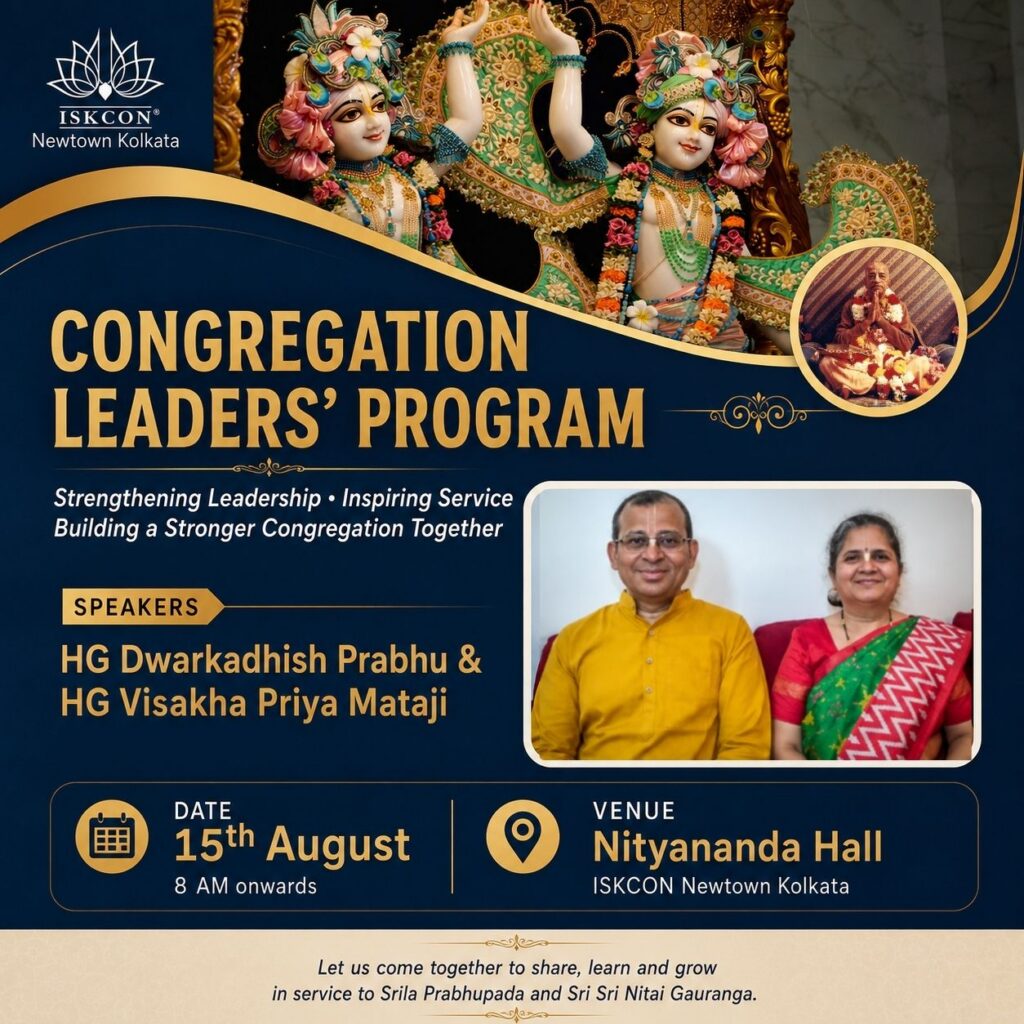
HG Dwarkadhish Prabhu & HG Visakha Priya Mataji gave a Congregation Program for the leaders at ISKCON Newtown Kolkata on 15th August 2026. In the class, they discussed the story of Gopinatha Pattanayaka from Chaitanya Charitamrita, Antya Lila – The Deliverance of Gopinatha Pattanayaka
While discussing the story, Prabhuji and Mataji shared many important lessons that devotees, especially senior devotees who are in leadership positions, can learn from it.
Following lessons were discussed:
A Devotee Leader Should Be Accountable
In Jagannath Puri, Chaitanya Mahaprabhu was staying at the house of Kashi Misra.
Many visitors would come to see Him, not only from nearby places of Puri or Bengal but also from different planets. Gandharvas, Kinnaras, and residents of Patala Loka like Vasuki would come. But they would come disguised in different forms. After meeting with Mahaprabhu, their hearts would be flooded with Krishna prema.
Mahaprabhu was living in Puri but was influencing people not only in this world but throughout the entire universe.
Once in Puri, a group of devotees came running to Mahaprabhu. They informed the Lord that Gopinatha Pattanayaka had been raised on canga by the king’s son and was going to be executed. (Note: Canga was a device for killing a convicted person.)
Gopinatha Pattanayaka was the brother of Ramananda Raya and son of Bhavananda Raya. He had misappropriated the king’s funds and had also behaved improperly with the prince.
When we become senior devotees, we think that we can do anything and can get away with it. Gopinatha Pattanayaka thought that I am the brother of Ramananda Raya and son of Bhavananda Raya, so I am above any law. And he suffered because of this mindset.
From this incident, we learn an important lesson. When we become senior devotees, then we should not think that we can do anything and get away with it. Also, being connected to advanced devotees does not mean that if I do something wrong, then I will not incur material reaction. The son of the king knew who Bhavananda Raya was, but he still put him on canga.
Higher Responsibility Means Higher Accountability
When we become senior, we have to be careful. We should understand that we can never be independent. We are always answerable to the parampara. Gopinath Pattanayak took liberty of his position and did not pay money to the king. He thought, I am above the law; no one can touch me.
Srila Prabhupada would say, “Sometimes my devotees are not sufficiently afraid of maya.” It is like committing offenses on the strength of the holy names of the Lord. We can also suffer like Gopinath Pattanayak if we are not careful. A leader should always be a humble leader, so in ISKCON, leaders are called “servant leaders.”
Once in the court of Hastinapur, four people who had committed the same crime were brought. One was a Shudra, one a Vaisya, one a Kshatriya, and one a Brahmana.
At that time, a discussion was going on about whether Yudhisthira should be the king or Duryodhana. Before deciding the quantum of punishment for the convicts, Bhisma asked the opinion of Yudhisthira and Duryodhana. Duryodhana immediately said that all four should be hanged. But Yudhisthira suggested a different punishment for each one.
To the Shudra, he suggested x punishment, to the Vaisya 2x, to the Kshatriya 3x, and to the Brahmana 4x. Maximum punishment was for the Brahmana because he was qualified, knew what was right and wrong, and people looked up to him for guidance.
If one knows what is good and bad and commits offenses, then the reaction is stronger as compared to one who is not aware. Higher responsibility means higher caution. People are always observing senior devotees, so we have to set the highest standard.
Whatever may be our role and position, we should be accountable. Accountability keeps us grounded.
HG Radha Gopinath Prabhu says, “Our head should be in the sky but leg should be on the ground.”
A Devotee Leader Should Be Especially Careful
Leaders are always more visible than non-leaders. How they are talking, dealing, behaving, and chanting is observed by others. People will see their activities with magnified eyes. Whether you are at home or in the temple, you are observed with a microscope.
We should always behave in an ethical way.
Grihastas earn money, and they should do it in an ethical way.
Leaders get more respect.
When a senior devotee does something wrong, then it challenges the faith of new devotees. It is said that when a devotee leader do the right thing, then it is pro-preaching. But when a devotee leader do the wrong thing, then it is anti-preaching.
For preaching to be effective, it is important that people perceive us correctly.
Importance Of Guru-Vani
Maharaja Prataparudra would daily go and take association of Kashi Misra. Kashi Misra was like a guru of the king. The king would daily hear from Kashi Misra. Guru Vani was the guiding light for the king. He would hear valuable instructions from him. As per the instruction of Kashi Misra, the king forgave Gopinatha Pattanayaka.
Regular hearing shows our sincerity. Service is important, but with what attitude we do service is more important. Right attitude comes when we hear from the guru. When we hear from the guru, then we are grateful for his divine instructions.
To materialistic people, maya says, “Do not surrender to Krishna,” but to devotees, maya says, “Postpone surrender to Krishna.” Sometimes, after spending quite a number of years in Krishna Consciousness, we are not eager to hear from the guru, thinking that now we know everything. Thinking that we may get to hear something new, we become more interested in hearing from other speakers, or we begin hearing someone from Vraja.
But your guru knows you more than others. He is speaking for us; he knows our situation. Regular spiritual nutrition comes from guru seva and guru Vani.
Krishna Is Always Watching Us
How did the devotee community react? Different devotees came to Mahaprabhu, pleading with the Lord to protect Gopinath Pattanayak. A great amount of concern was shown by the devotees. We should ask ourselves how we react when anything happens to a devotee or even to a leader in our community. If we are envious, then we may think that it is nice that something bad happened to him. But Krishna is always watching us.
When the Twin Towers were attacked in the USA, around 5,000 people died. Some thought that it was because of their karma that they suffered. Since they were killing animals and breaking the four regulative principles, they suffered. They burned animals and ate them, so they also got burned and died. Some of us felt the same way.
But HH Radhanath Swami Maharaja said that a devotee’s heart should cry when they see such things happening. During the Twin Tower blast, fire brigade personnel saved many people; some of them even sacrificed their lives. They became the heroes.
Maharaja said that devotees should be like them. Whatever may be the situation, devotees should try to save others. A doctor cannot say to a patient that you are having this disease because of drinking alcohol, so it is nice that you are suffering.
We always have to react in a positive way. How we react to any event in the world shows our mindset and also shows how much we are Krishna Conscious. Our purification is not only by sadhana bhakti, but it is also by how we deal with others. When we behave improperly with others then Krishna is displeased.
We should always help devotees in all situations. We should be with them during their health crisis, financial crisis, relationship crisis, or any crisis.
Respect Local Leaders And Authority
A proud person thinks that he will go to the highest person to solve his problem. He thinks that only the guru can handle his problem. But we should not bypass the local authority. Chaitanya Mahaprabhu taught us this important lesson.
When Gopinatha Pattanayaka was being punished, Mahaprabhu was internally concerned but externally, He wanted to teach that during difficulties, we should take help from the concerned authorities.
Conclusion
From the story of Gopinatha Pattanayaka, we learn the lesson of responsibility and accountability. Being a senior devotee or being in a leadership role does not mean that we can act against established law and norms and get away with it.
A devotee leader should always be careful, cautious, responsible, ethical, guided by guru-vani and should respect his immediate authority. This is what pleases the Lord.
- [This article is based on the notes I took during the class of HG Dwarkadhish Prabhu & HG Visakha Priya Mataji.]
Search
Recent Posts
-
Srimad Bhagavatam at ISKCON Newtown...
September 1, 2026
-
Janmashtami: Celebrating Krishna’s Appearance Through...
August 17, 2026
-
Gopinatha Pattanayaka: 6 Lessons for...
August 16, 2026
-
What Does Krishna Say About...
August 11, 2026
-
Are you ready to choose...
August 2, 2026
What Does Krishna Say About Lust? | Bhagavad Gita 3.37–43
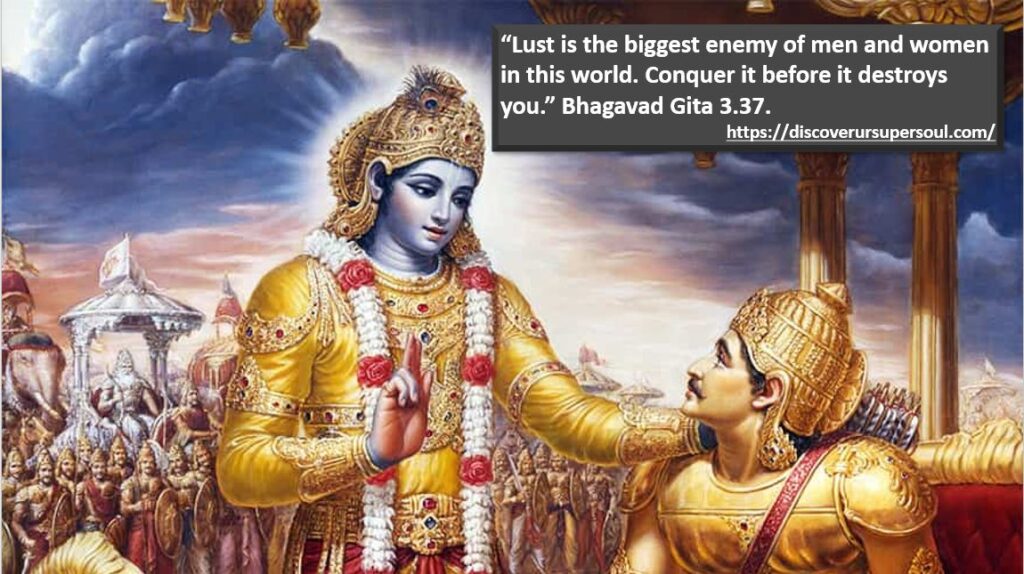
Whether you are a man or a woman, student or a working professional, young or old, you might have indulged in some activities for which you would have regretted later. You may have not wanted to do it but still some force from within forced you to do it.
Like you and me, Arjuna had the same doubt. So, he asked Krishna, “Why is it that one ends up committing sins even if he is unwilling to do it?” Bhagavad Gita 3.36.
Krishna, the Supreme Personality of Godhead, says to Arjuna, “That irresistible force which compels us to do things even against our wishes is lust.”
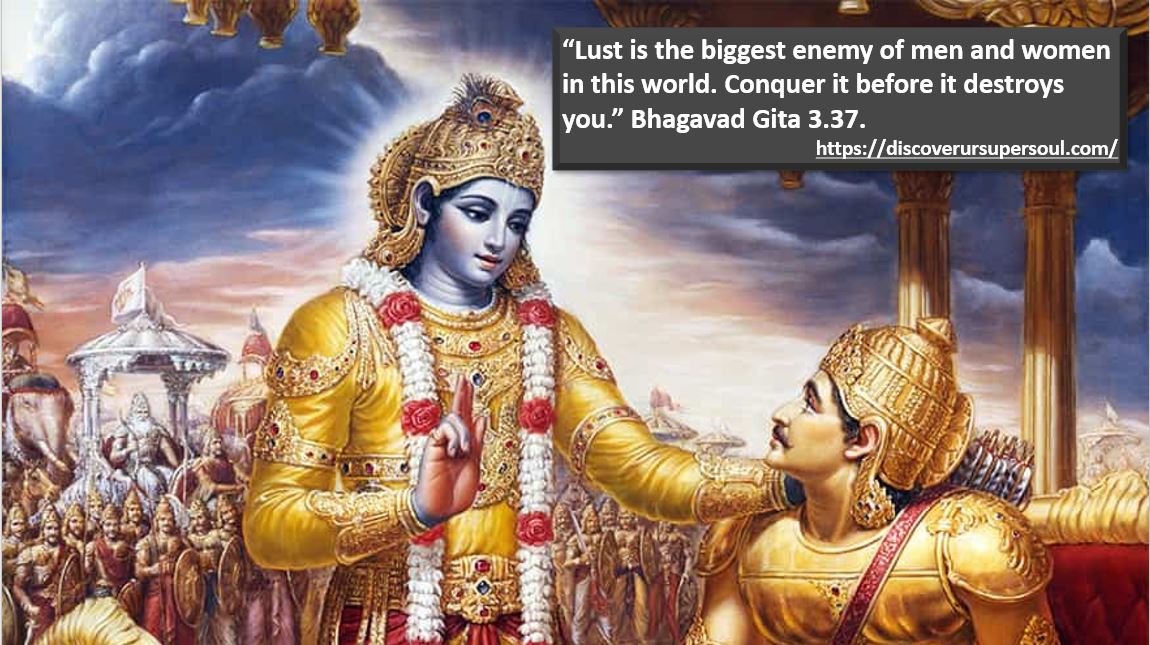
“It is lust only, Arjuna, which is born of contact with the material mode of passion and later transformed into wrath, and which is the all-devouring sinful enemy of this world.” Bhagavad Gita 3.37.
Lust forces a person to do things which he does not want to do. This is why Krishna compares it to an enemy. Just as an enemy tries to destroy, similarly, lust too tries to destroy us.
But how lust originates. Let us try to understand.
What is the origin of lust?
In the spiritual world everyone has love for Krishna. But when one wants to enjoy in this material world away from Krishna then love transforms into lust.
Srila Prabhupada explains, “When a living entity comes in contact with the material creation, his eternal love for Kṛṣṇa is transformed into lust, in association with the mode of passion. Or, in other words, the sense of love of God becomes transformed into lust, as milk in contact with sour tamarind is transformed into yogurt.” Bhagavad Gita 3.37 purport.
Can lust be satisfied?
No matter how best we try we cannot satisfy lust. This is confirmed by Krishna in Bhagavad Gita. “Thus, the wise living entity’s pure consciousness becomes covered by his eternal enemy in the form of lust, which is never satisfied and which burns like fire.” Bhagavad Gita 3.39.
For example, Ravana had many queens and one of his queens was Mandodari who was very beautiful and chaste. But still impelled by lust, Ravana also wanted to enjoy with Mother Sita. Desire to enjoy with opposite sex is very strong in material life.
As prisoners are bound by shackles in a prison. Similarly in this material world everyone including you and me are bound by the shackles of lust.
Srila Prabhupada explains, “Therefore, this lust is the symbol of ignorance by which the living entity is kept within the material world. While one enjoys sense gratification, it may be that there is some feeling of happiness, but actually that so-called feeling of happiness is the ultimate enemy of the sense enjoyer.” Bhagavad Gita 3.39.
Lust is not just the desire to enjoy with the opposite sex. Any form of sense gratification is lust. “Sense gratification” means any desire to satisfy our senses rather than Krishna’s senses. As long as we are affected by lust, we will remain miserable.
Trying to satisfy lust is like pouring ghee in the fire. The more we try to satisfy lust, the more it becomes stronger. When lust is not satisfied then it gives rise to anger. Many times, it makes a person insane. So, we should do our best to give up lust.
At what stage we should control lust?
This human life is special. In this life it is possible for us to free ourselves from lust. And transform our lust into love for Krishna. Lust covers our real knowledge. We forget that we are parts and parcels of Krishna. We start thinking that we are material beings, and the purpose of our life is to enjoy our material senses.
But lust has to be controlled, and the good news is that it can be controlled. Krishna explains that we should try our best to control our lust. It is always better to control the lust in the beginning. Krishna says to Arjuna, “Therefore, O Arjuna, best of the Bhāratas, in the very beginning curb this great symbol of sin [lust] by regulating the senses, and slay this destroyer of knowledge and self-realization.” Bhagavad Gita 3.41
To control lust, we should control our senses. The first step is that we should not allow our senses to engage in any form of activities which will aggravate lust. Also, it is important that we should not contemplate on the objects of the senses. For this, we should flood our mind with Krishna Conscious thoughts and activities. By doing this our mind will get busy with Krishna Conscious subject matters. And it won’t have time to think about lusty subject matters.
As of now our understanding is that we will become happy if we satisfy our material desires. But the truth is that we will become happy if we do not engage our senses in fulfilling our material desires. And we will become supremely happy if we start engaging our senses in serving Krishna.
Personal experience with lust
In my personal life also, I have observed that many activities I do not want to do but many times I end up doing it. It seems as if someone is compelling me do it. When I was not into Krishna Consciousness then I did not know what is good for me and what is bad for me. But after coming to Krishna consciousness, I understood what is harmful for my life. But in spite of knowing that sense gratification is harmful it is not always easy to give it up.
Many times, I took a vow to give up sense gratification. I succeeded for few days then I found that there is some force within me which is forcing me to indulge in those activities. For example, I find very challenging to give up internet addiction especially reading online news. Although I try to restrain myself, but I fail quite a number of times.
However, the best thing about Krishna Consciousness is that although initially it may look that giving up certain non-Krishna Conscious activities are difficult but if we pray to Krishna and try to work on it then gradually, we are able to give it up. I won’t be right to say that I have been able to completely give up addiction for internet. But I can confidently say that it is reducing day by day.
And I am hopeful that if I follow Krishna’s advice and Srila Prabhupada’s teachings then I will be able to give up internet addiction one day.
What is the best way to control lust according to Krishna in Bhagavad Gita?
To give up lust, it is important that we do not surrender to the demands of our senses and mind. But instead using our intelligence we should educate our mind about the harmful effects of lust which is sense gratification. To strengthen the intelligence, it is important that we do sincere spiritual practice. And read life transforming books like Bhagavad Gita.
Krishna gives us a formula by which we can control lust. He says, “O mighty-armed Arjuna, one should steady the mind by deliberate spiritual intelligence [Krishna consciousness] and thus – by spiritual strength – conquer this insatiable enemy known as lust.” Bhagavad Gita 3.43
So, control lust before it controls you. Destroy lust before it destroys you.
Three Reflections
- That irresistible force which compels us to do things even against our wishes is lust.
- Curb this great symbol of sin [lust] in the beginning only by regulating the senses.
- By spiritual strength – conquer this insatiable enemy known as lust.
Ask Yourself
- Do I end up doing things which you do not want to do?
Apply this teaching
- Identify one habit which you want to give it up. Then pray to Krishna sincerely for guidance and take steps to get rid of it.
Search
Recent Posts
-
Srimad Bhagavatam at ISKCON Newtown...
September 1, 2026
-
Janmashtami: Celebrating Krishna’s Appearance Through...
August 17, 2026
-
Gopinatha Pattanayaka: 6 Lessons for...
August 16, 2026
-
What Does Krishna Say About...
August 11, 2026
-
Are you ready to choose...
August 2, 2026
Are you ready to choose Krishna in all circumstances?

Let us honestly ask ourselves, “If given an option to choose between Krishna and His material energy, what are we going to choose?” Are we going to select Krishna, or are we going to opt for His energy so that we can enjoy disproportionately in this world?
Krishna has given us the free will to exercise our choice. He never interferes with our free will. But the Supreme Lord always tests us to check if you and I really love Him or if we love to live without Him.
For example, before the start of the Mahabharata war, Krishna gave both Arjuna and Duryodhana the opportunity to exercise their free will. Both had to choose either Krishna or Krishna’s Narayani Sena (army). Before they expressed their desire, Krishna also made it clear that He would not be fighting during the war, but His powerful army, the Narayani Sena, would be fighting.
Arjuna had made up his mind, and Duryodhana was also not confused. Arjuna, without any hesitation, chose Krishna, and Duryodhana was jubilant because he got the mighty Narayani Sena. In the end, both were happy because they got what they wanted.
Like Arjuna and Duryodhana, in our life too, you and I get opportunities to exercise our free will. Whether we choose Krishna or Krishna’s material energy shows what our heart longs for.
Krishna Knows the Real Desire of Our Heart
Most of us are still addicted to material life. We just want to live and enjoy without Krishna. Even when we approach Krishna, we mostly ask Him to satisfy our material desires. We never desire to satisfy Krishna’s desire. Krishna is the Supreme Lord; He resides in everyone’s heart, so He knows what is there in our heart.
Īśvaraḥ sarva-bhūtānāṁ hṛd-deśe ’rjuna tiṣṭhati — “The Supreme Lord is situated in everyone’s heart, O Arjuna.” (Bhagavad-gītā 18.61)
We can fool the world, but not Krishna. We can show the world that we are great devotees of the Lord, but the Lord knows what kind of devotees we are.
Caitanya-caritāmṛta tells the story of Rāmadāsa Viśvāsa, who chanted the holy name of Lord Rama twenty-four hours a day. Seeing his devotion to Lord Rama, Raghunatha Bhatta Goswami was impressed. But Chaitanya Mahaprabhu was not. The Lord could understand that he was chanting the name of Lord Rama not because he had love for Rama, but because he wanted to become Lord Rama.
“Within his heart, Rāmadāsa Viśvāsa was an impersonalist who desired to merge into the existence of the Lord, and he was very proud of his learning. Since Śrī Caitanya Mahāprabhu is the omniscient Supreme Personality of Godhead, He can understand the heart of everyone, and thus He knew all these things.” Caitanya-caritāmṛta, Antya-līlā 13.110
The Supreme Lord does not see how we behave externally, but He sees what is there in our heart.
Material Desires Never Bring Lasting Happiness
We nurture material desires or the desire to enjoy like the Lord or become like the Lord because we think they will give us happiness.
But if we turn the pages of history, or even if we reflect upon our own life, we will see that all material desires ultimately become the cause of great suffering. Material desires can never satisfy us because we are spiritual and not material.
Krishna comes to remind us of this again and again. In the Bhagavad-gītā, He repeatedly tells us that we are not the material body, mind, or senses, but pure spirit souls. As souls, we are eternal and are meant to live in peace and bliss. This is possible only when we shun the desire to enjoy this temporary world and turn towards Krishna.
Those who do so never regret it, but those who foolishly think that they can be happy without Krishna voluntarily choose a life of stress, anxiety, and suffering.
Duryodhana chose the mighty Narayani Sena, thinking that it would help him win the war. But without Krishna, victory is phantasmagoria, just as without the sun, quelling darkness is impossible.
Duryodhana ultimately lost the war and his dignity. And whoever was on his side also met the same destiny. In fact, in this world everyone is always defeated.
When We Choose Krishna, Victory Is Guaranteed
Only the Lord is always victorious, and those who are with Him never face defeat. Arjuna was on Krishna’s side, so he too tasted victory.
In the last verse of the Bhagavad-gītā, Sanjaya confirms that those who are on the side of Krishna attain all success and get everything in life.
“Wherever there is Kṛṣṇa, the master of all mystics, and wherever there is Arjuna, the supreme archer, there will also certainly be opulence, victory, extraordinary power, and morality. That is my opinion.” Bhagavad-gītā 18.78
Such a wonderful future awaits us. The only thing we have to do is always choose Krishna in all situations and circumstances. At present, it may look difficult because we are still addicted to material life. Spiritual life does not attract us; it seems boring and unnatural.
We experience this because we have been disconnected from Krishna for several lifetimes. But if we connect with Krishna, then we will begin seeing how pleasurable spiritual life is. We read in the scriptures about the devotees of the Lord who were always in bliss. Even today, we see devotees who have been practising devotion to Krishna for several decades and who enjoy every moment of their lives.
Experiencing the Joy of Choosing Krishna Every Day
We need to put in some endeavour, and Krishna’s love will begin blossoming in our hearts. According to our dedication and commitment, we will experience joy and contentment in our hearts.
For example, if we sit before the Lord in the temple and chant sixteen rounds of the Hare Krishna Mahamantra, which takes around two hours, then after finishing our chanting, we feel great happiness. But suppose we spend two hours watching movies or YouTube videos. In that case, we do not feel that joy; in fact, most of the time we feel frustrated afterwards.
This is why it is said that material life appears to be nectar in the beginning but becomes poisonous in the end, whereas spiritual life may appear poisonous in the beginning but is nectar in the end.
If we continue choosing Krishna and practising Krishna consciousness, then we will gradually start experiencing pleasure in devotional service too.
But that is not true for material activities. No matter how much we try to seek happiness from material things, we will not get it. Duryodhana, after getting the Narayani Sena, thought he would be victorious and become happy, but the result was just the opposite.
So, let us be like Arjuna and always choose Krishna—victory and happiness are guaranteed.
Whenever we get to choose in our life, let us always choose Krishna.
Three Reflections
- Krishna always tests us to check if we really love him or we love to live without him.
- Only the Lord is always victorious and those who are with him too never face defeat; Arjuna was on the side of Krishna, so he too tasted victory.
- Let us be like Arjuna and choose always Krishna – victory and happiness is guaranteed.
Ask Yourself
- Given an option to attend a program in the temple or watch a movie or a cricket match or a soccer match what do I choose?
Apply this Teaching
- Once in every week go to temple and chant the Hare Krishna Mahamantra in front of the Lord with full absorption.

Search
Recent Posts
-
Srimad Bhagavatam at ISKCON Newtown...
September 1, 2026
-
Janmashtami: Celebrating Krishna’s Appearance Through...
August 17, 2026
-
Gopinatha Pattanayaka: 6 Lessons for...
August 16, 2026
-
What Does Krishna Say About...
August 11, 2026
-
Are you ready to choose...
August 2, 2026
55th Kolkata Ulta Rath Yatra 2026 (Bahuda Yatra): My Divine Experience at Gundicha Temple

Devotees were happy yet overwhelmed with emotion during the 55th Kolkata Ulta Rath Yatra, also known as Bahuda Yatra, which was celebrated on 24th July. They were happy because Lord Jagannath, Lord Baladeva, and Subhadra Devi were now returning to the 3C Albert Road Temple, and a little emotional too because the Lord was leaving the Gundicha Temple, where He had stayed for seven days, giving great pleasure to the devotees.
Ulta Rath Yatra, also known as Bahuda Yatra, marks the return journey of Lord Jagannath, Lord Baladeva, and Subhadra Devi from the Gundicha Temple to Their main temple.
At Gundicha, which is compared to Vrindavan, devotees had many opportunities to serve Lord Jagannath.
Seven Blissful Days at Gundicha Temple
On 16th July 2026, They came from the 3C Albert Road, Minto Park Temple, riding majestically on chariots to the Gundicha Temple. From the evening of 16th July to the morning of 24th July, They stayed at the Gundicha Temple. During Their stay, They daily gave Their divine darshan and blessings to the devotees.
It was a festive atmosphere at the Gundicha Temple. Thousands of Jagannath’s lovers came daily and felt blessed. Several devotees were engaged in serving the Lord.
Serving Lord Jagannath as a Pujari
This year too, I was fortunate to get pujari (temple priest) service at the Gundicha Temple. It was possible only because of the mercy of Lord Jagannath, Lord Baladeva, Subhadra Devi, Srila Prabhupada, my spiritual master, HH Radhanath Swami Guru Maharaja, and the devotees.
My service was from 10 a.m. till the Rajbhoga offering, i.e., till noon. The service provided me with an opportunity to be near the altar. From there, I could see the beautiful faces of Lord Jagannath, Lord Baladeva, and Subhadra Devi closely and touch Their lotus feet.
During the service, I realized how much devotion people have for Lord Jagannath.
From early morning onwards, devotees were bringing many items to offer to the Lord. Some had cooked bhoga for the Lord at their homes and were carrying it in utensils and tiffin boxes; some had brought sweets; some were carrying fresh fruits; many were bringing flowers, flower garlands, and tulasi leaves for Lord Jagannath, Lord Baladeva, and Subhadra Devi.
By the time I offered the food items brought by one group of devotees, another group would already be waiting with their bhoga offerings.
Many congregation devotees had prepared 56 bhoga offerings for the Lord. The altar would be filled with bhoga items. As soon as one set of 56 bhoga offerings was offered, another set would arrive. Devotees were standing in a queue to make their offerings to the Lord.
At 12 noon, we were supposed to offer Rajbhoga to the Lord. I was asked to finish the offerings quickly and clean the altar so that Rajbhoga could be offered. Since so many devotees were coming to offer food and other sacred items to the Lord, Rajbhoga could not be offered exactly at 12 noon on any of the seven days. But no one complained. The Lord looked happy to see so many devotees with so many offerings.
One day, there were so many Rajbhoga items in large quantities that huge sets of utensils containing food were placed directly on the altar. After Rajbhoga, there was arati of the Lord, in which everyone reverentially participated. Throughout the day, devotees took darshan of the Lord and chanted the Hare Krishna Mahamantra.
Daily Festival Programmes at Gundicha Temple
Apart from the worship inside the temple, many devotional activities were organized throughout the festival. Many attractive Krishna conscious stalls were put up for children, youths, and congregation devotees. There was a prasadam stall and the Gauranga Food Court too. In the evening, there were many cultural programmes.
Every day, the programme would begin at 5 a.m. with Mangala Arati. After Mangala Arati, devotees would sit and chant the Hare Krishna Mahamantra. At 8 a.m., there was Guru Puja and Darshan Arati, followed by the Srimad Bhagavatam class from 8:30 a.m. to 9:30 a.m. At 9:30 a.m., breakfast prasadam was served to everyone.
From 11 a.m. to 2 p.m., there was Bhagavata Kathamrita, in which devotees heard the pastimes of Krishna, Lord Jagannath, and Srila Prabhupada from different distinguished speakers, followed by lunch prasadam. The evening programme began at 4 p.m. Thousands of people visited the pandal daily, especially during the evening hours.
The Beginning of the 55th Kolkata Ulta Rath Yatra (Bahuda Yatra)

After seven wonderful days of serving and taking darshan of the Lord at Gundicha Temple, the time finally came for His return journey. Devotees felt a little sad when the day came for the Lord to leave the Gundicha Temple. But there was also eagerness to see the Lord again on the chariot and pull the divine ropes of the chariot.
On 24th July morning, a large number of devotees congregated to participate in the 55th Kolkata Ulta Rath Yatra 2026 festival.
The three Lords were brought from the altar of the Gundicha Temple and seated on Their chariots. Before the start of the procession, many cultural programmes were organized, and the Lord’s arati was performed. With the chants of “Jai Jagannath,” “Jai Baladeva,” “Jai Subhadra,” and the Hare Krishna Mahamantra, the 55th Kolkata Ulta Rath Yatra (Bahuda Yatra) procession began.
The road was filled with devotees, all eager to see Lord Jagannath, Lord Baladeva, and Subhadra Devi returning to the temple. Everyone was eager to pull the transcendental ropes of the chariot.

There were kirtan parties in front of each of the chariots. Devotees were joyfully singing the Hare Krishna Mahamantra and dancing gracefully. Seeing them, many onlookers also joined in singing and dancing. The Hare Krishna Mahamantra and the chants of “Jai Jagannath,” “Jai Baladeva,” “Jai Subhadra,” “Suswagatam Jagannath,” “Suswagatam Baladeva,” and “Suswagatam Subhadra” reverberated everywhere.
After seeing the Lord on the chariot, pulling the ropes of the chariot, and chanting the holy names of the Lord, devotees had big smiles on their faces.
Inspiring Experiences During the Rath Yatra Procession
During the procession, I had touching and inspiring experiences. Devotees from all walks of life were present during the Rath Yatra procession.
I saw one devotee in a wheelchair. There was another devotee who was limping but enthusiastically singing and chanting the holy names of the Lord. He was carrying Back to Godhead magazines in his hand, urging people to buy them.
Initially, I thought he might be having pain in his legs because of walking for hours, so he was limping. Later, when I saw him again after some time, I realized that he was physically disabled. This time, when I saw him, he was holding copies of the Bhagavad-gītā in his hands for distribution. He had a wonderful smile on his face.
One elderly female devotee was making a swastika symbol on the road from where the chariot was about to pass. She did not have any colour or paint. She was simply drawing the sacred symbol with her fingers.
Many people came out of their offices to pull the chariot. People were also standing on terraces and balconies to see the Lord. I also saw some Muslim men and women coming out of their offices and homes to see the Rath Yatra procession.
The Lord’s chariot also passed by a hospital that had a paediatric ward and a casualty ward. I saw some patients and nurses standing near the windows with folded hands, praying to the Lord. Lord Jagannath is so merciful that He gives His divine darshan and blessings even to those who cannot come to His temple because of illness.
At different places, the chariots stopped so that devotees could offer 56 bhoga and arati to the Lord. People showered flowers on the Lord’s chariots. They also offered money and other sacred items to the Lord. Jagannath prasadam was distributed profusely. To serve the devotees participating in the Rath Yatra procession, people constantly distributed water bottles, juices, milkshakes, chocolates, biscuits, and other food items.
Although thousands of people participated in the Ulta Rath Yatra procession, there was no chaos or pushing and pulling. The police personnel had a peaceful time; they hardly had to control the crowd.
As the Rath was passing, the traffic was stopped. Buses, cars, bikes, scooters, and pedestrians had to wait for the Rath to pass. But no one complained. People were not honking their vehicles, quarrelling with the traffic police, or looking upset. In fact, they were admiring the Rath Yatra procession, clicking photographs, and recording videos.
Lord Jagannath’s Return to ISKCON Kolkata
The 55th Kolkata Ulta Rath Yatra (Bahuda Yatra), which started at around 1:30 p.m. from TAI Brigade Ground, reached the 3C Albert Road, Minto Park ISKCON Temple at around 6 p.m. Lord Jagannath, Lord Baladeva, and Subhadra Devi were taken from the chariots and seated on the altar of the temple, where They will stay until the next Rath Yatra festival.

At the temple, prasadam was arranged for the devotees. After walking for hours with the Lord and chanting His names and glories, devotees honoured delicious prasadam and felt blessed and satisfied.
After the Deities had been seated on the altar of the 3C Albert Road ISKCON Kolkata Temple, the three chariots were taken back to the ISKCON Newtown Temple, where they will remain until next year’s Rath Yatra festival. A huge shed has been built to house these chariots. Many people perform parikrama of the chariots when they visit the ISKCON Newtown Temple to take darshan of Sri Sri Nitai Gauranga.
Watch the Complete Ulta Rath Yatra Live Stream
Watch the official live stream of the 55th Kolkata Ulta Rath Yatra (Bahuda Yatra) 2026 by ISKCON Kolkata and relive the divine return journey of Lord Jagannath, Lord Baladeva, and Subhadra Devi.
55th Kolkata Rath Yatra 2026 – Śrīmad-Bhāgavatam Class Series
- Day 1 – HG Atul Krishna Prabhu (17 July 2026)
- Day 2 – HH Subhag Swami Maharaja (18th July 2026)
- Day 3 – HH Bhakti Purushottam Swami Maharaja (19th July 2026)
- Day 4 – HG Acharya Ratna Prabhu (20th July 2026)
- Day 5 – HG Vallabh Chaitanya Prabhu (21st July 2026)
- Day 6 – HG Atul Krishna Prabhu (22nd July 2026)
- Day 7 – HG Maharaas Prabhu (23rd July 2026)
Search
Recent Posts
-
Srimad Bhagavatam at ISKCON Newtown...
September 1, 2026
-
Janmashtami: Celebrating Krishna’s Appearance Through...
August 17, 2026
-
Gopinatha Pattanayaka: 6 Lessons for...
August 16, 2026
-
What Does Krishna Say About...
August 11, 2026
-
Are you ready to choose...
August 2, 2026
55th Kolkata Rath Yatra – Srimad Bhagavatam Class by HG Maharaas Prabhu (23rd July 2026)

Without the association of Krishna’s devotees, it is difficult to make spiritual progress. The beginning of spiritual life is śravaṇam (hearing), and śravaṇam becomes easier in devotee association. Srila Prabhupada established Iskcon so that devotees can come together, chant the names of Krishna, hear about Krishna, discuss the topics related to Krishna, honour Krishna prasadam and remain engaged in the service of Krishna.
Hearing Develops the Desire to Attain Krishna
The more we hear about Krishna, the more we develop a desire to attain Krishna.
When we hear about something, we get motivated and put in the effort to attain it. For example, students first hear that IIT is a good college and then get inspired to gain admission to it. In Kolkata, many businessmen are not Bengalis, but they came here because they heard that there is good scope for doing business here.
Hearing helps us understand the importance of things.
For example, when we hear about the glories of Vrindavan, we develop a desire to go to Vrindavan.
The pastime discussed in relations to the verse Srimad Bhagavatam 1.15.11, shows how Krishna always protects His devotees.
In the purport to SB 1.15.11, Srila Prabhupada introduces Durvasa Muni. Most Indians know about Durvasa Muni, so why does Prabhupada introduce him? It is because Prabhupada wanted to spread Krishna consciousness throughout the world. His audience was not only Indians but the entire world.
Durvasa Muni was a mystic brahmana. He would become pleased or angry very quickly. Duryodhana wanted to take advantage of Durvasa Muni’s unpredictable nature to execute his wicked plan against the Pandavas.
He once requested Durvasa Muni to accept prasadam at the Pandavas’ place while they were living in the forest. He specifically requested him to go for prasadam after Draupadi had eaten her meal. Duryodhana was so envious of the Pandavas that he always wanted to harm them. Envious people can go to any extent to inflict suffering upon others.
HH Radha Govind Swami Maharaja once narrated an interesting story.
A man was going to a forest. A person asked, “Don’t you know that a man-eating tiger lives there?” The man said, “I know about it, and I want the tiger to eat me. Once he tastes my blood, he will come to know that a village is nearby, and he will come and eat the other villagers.” The person, surprised, asked, “Are you mad? Why are you doing this?” He answered, “Because I hate the villagers.”
This is the nature of a person burning with the disease of envy.
The Deadly Disease of Envy
We have to free ourselves from this deadly disease of envy. Although we can hide it from the world, Krishna knows what is in our hearts. In bhakti, both intent and action are important. The Lord knows our intentions.
We see that Durvasa Muni accepted Duryodhana’s food, but Krishna did not. Instead, He accepted food at the house of Vidura.
Duryodhana thought that when the Pandavas would not be able to provide food to Durvasa Muni, who was accompanied by his 10,000 disciples, he would curse them. According to grihastha-dharma, a householder should offer food and water to anyone who comes to the house, even an enemy.
When Durvasa Muni came with his disciples to the Pandavas’ forest dwelling, Draupadi had already eaten her meal. Draupadi had the Akshaya Patra, which could produce an unlimited amount of food until she had eaten.
Pandavas feared that they would not be able to serve Durvasa Muni. At that moment of distress, Draupadi remembered Krishna, and Krishna, who was with Rukmini in Dvaraka, immediately appeared. He ate one morsel of food, and everyone in the three worlds became satisfied. Durvasa Muni and his thousands of disciples felt so full that they quietly left the place.
When we satisfy Krishna, everyone becomes satisfied, and we too become satisfied. For example, when we chant the holy names of Krishna, we feel happy and fulfilled. We no longer feel that we need anything else.
Great devotees, by their personal examples, show how all material achievements becomes insignificant once one starts relishing chanting the holy names of Krishna.
Hearing Leads to the Goal of Life
Sanatana Goswami was an important minister of Bengal during the reign of Sultan Husain Shah, but he left everything because he had the holy name of Krishna with him. He teaches us that life’s purpose is to always satisfy Krishna.
This verse, SB 1.15.11, is part of the chapter “The Pāṇḍavas Retire Timely.” We too should plan our lives in such a way that we do not remain engaged in work our whole lives.
At least the last twenty years of our lives should be dedicated to the service of Krishna.
But how to develop attachment to Krishna? It is by śravaṇam (hearing).
Bhakti begins with śravaṇam. By hearing, we develop a strong desire to attain Krishna. Krishna cannot be attained through jñāna, karma, pious activities, wealth, power, or position.
He is attained through pure bhakti. Initially, we may have some desire; we should fan that desire.
And how to fan that desire is explained very systematically by Srila Rupa Goswami, younger brother of Srila Sanatana Goswami, in Nectar of Instruction. This book has eleven verses. If we carefully follow its instructions, it will gradually lead us to Krishna-prema.
In the first verse of The Nectar of Instruction, Rupa Goswami explains the six urges. The first urge is the urge to speak. Anyone who knows how to use the tongue properly can attain Krishna. We should speak about Krishna or about service to Krishna, and we should honor food that has been offered to Krishna. When we control the tongue, the other senses gradually come under control.
Verse 2 of The Nectar of Instruction explains how bhakti is destroyed.
If we want to protect our bhakti, then we have to have right kind of association. Jiva Goswami says, “To advance rapidly in spiritual life, chant sincerely and deal nicely with others.”
Give up the association of materialistic people. If you associate with them, you will become afflicted by the viruses of lust, anger, and greed.
We should associate with devotees. Devotee association protects us from many dangers. The importance of good association can be understood through a simple example from nature.
Why Association of Devotees are Important
Tigers are generally stronger than lions. A tiger can kill a lion. However, lions live in groups, so together they can overpower and even kill a tiger. The association of other lions protects each lion.
But association also brings some challenges, and we have to tolerate them.
For example, some porcupines huddle together to keep warm during cold weather. However, when they come close, their sharp quills can sometimes prick one another.
Srila Prabhupada always cautioned the devotees that when they live in association, they will have to face some challenges.
HH Niranjan Swami Maharaja once said that Prabhupada had instructed him, “Never leave bhakti under any circumstances.” Once, while staying in a temple, he faced a difficult situation. One morning, he was woken up in a very rude manner, which deeply hurt him. While taking his bath, he thought, “Today I will leave the temple.” Then he remembered Srila Prabhupada’s instruction never to leave bhakti under any circumstances, so he decided to stay.
Rupa Goswami’s teachings help us to cultivate these qualities which help us to properly deal with devotees.
The first three verses of The Nectar of Instruction are about self-improvement.
The next three verses are about interpersonal relationships.
Verse 4 of The Nectar of Instruction explains how to live in satsanga. We should give gifts to others and render service to others, but we should not expect anything in return. If someone serves us, we should accept it gratefully but should not expect others to serve us.
Satsanga means discussing Hari-katha.
There are three benefits of satsanga – Devotees develop a taste for Hari-katha, friendship develops among them, and the desire for sense gratification gradually goes away.
In satsang, relationship is important. Services come and go, but relationships with devotees are very important. And for relationship tolerance is required.
The topmost devotee is one who does not criticize anyone and does not look for faults in others.
Verse 6 of The Nectar of Instruction teaches us to overlook the minor faults of devotees. In Verse 7, Rupa Goswami explains the importance of chanting the holy names of Krishna, and in the later verses he discusses bhava-bhakti and prema-bhakti.
Thus, we see that spiritual life begins with hearing and grows through the association of devotees. If we follow the instructions of great acharyas like Sanatana Goswami and Rupa Goswami, then gradually we can purify our hearts of all impurities and ultimately attain Krishna-prem.
These were some of the important points from the Srimad Bhagavatam Class by HG Maharaas Prabhu on 23rd July 2026 at 55th Kolkata Rath Yatra Pandal.
55th Kolkata Rath Yatra 2026 – Śrīmad-Bhāgavatam Class Series
Search
Recent Posts
-
Srimad Bhagavatam at ISKCON Newtown...
September 1, 2026
-
Janmashtami: Celebrating Krishna’s Appearance Through...
August 17, 2026
-
Gopinatha Pattanayaka: 6 Lessons for...
August 16, 2026
-
What Does Krishna Say About...
August 11, 2026
-
Are you ready to choose...
August 2, 2026
55th Kolkata Rath Yatra – Srimad Bhagavatam Class by HG Atul Krishna Prabhu (22nd July 2026)

Vaiṣṇava Aparādha is too dangerous. Even Lord Chaitanya who is the most merciful incarnation of the Lord does not forgive one who offends his devotee. This was very logically explained by HG Atul Krishna Prabhu in his Srimad Bhagavatam Class at 55th Kolkata Rath Yatra Pandal. Speaking on the verse SB 1.15.10, Prabhuji discussed the serious consequences of Vaiṣṇava Aparādha through the examples of Durvasa Muni, Ambarish Maharaja, Gopala Capala, and Srivasa Thakura.
Below article is based on Prabhuji’s Srimad Bhagavatam Class.
The class began with the devotional song Suddha Bhakata Carana Renu by Srila Bhaktivinoda Thakura
If you offend the Lord, then by chanting the Holy Name you can be saved. However, if you commit an offense at the lotus feet of a Vaiṣṇava, then no one can save you. Even the Lord does not forgive those who offend His devotees.
For example, Durvasa Muni was not saved by the Lord when he offended His devotee, Ambarish Maharaja.
Durvasa Muni’s offense
Once, Durvasa Muni came to the palace of Ambarish Maharaja, who was observing a fast. Durvasa Muni went to take a bath. Since the time to break the fast was about to end, the brahmanas suggested that Ambarish Maharaja break his fast; otherwise, he would not receive the fruits of observing it. However, Ambarish Maharaja did not want to take any food before serving Durvasa Muni.
The brahmanas therefore suggested that he break his fast by drinking water. Durvasa Muni, who was taking a bath, understood that the king had drunk water before honoring him with food. With his mystic power, he created a demon, but Lord Vishnu’s Sudarshana Chakra came, killed the demon, and then began chasing Durvasa Muni.
He ran to save his life. He went to Lord Shiva seeking help, but Lord Shiva said that he could not protect him. Even Lord Vishnu said that He was helpless. Finally, Durvasa Muni begged Ambarish Maharaja for forgiveness, and the king forgave him, thus saving his life.
A man can tolerate the burning sun that falls on his head, but he cannot tolerate the hot sand beneath his feet. Similarly, devotees always surrender at the lotus feet of the Lord, so the Lord does not tolerate any offense committed against His devotees.
We see that Arjuna was prepared to forgive the Kauravas. He was ready to go and live in the forest too. But Krishna was not ready to forgive them. He said to Arjuna, “Become My devotee and fight.”
Lord Chaitanya is Patita-pavana; He delivers the most fallen. Srila Bhaktivinoda Thakura says that the qualification for receiving the mercy of the Pañca-tattva is “no qualification.”
Lord Chaitanya too does not forgive
There is no qualification required to see the deity of the Lord. Just by seeing the deity one gets purified.
In India, I see everything is delayed. But surprisingly, deity worship is always on time.
Two important things in Deity worship are cleanliness and punctuality. In ISKCON, ārati is always on time. I remember that in the Radha Govinda Temple, at 4:15 a.m., only a few devotees would be there, but by 4:29 a.m., a tsunami of devotees would come, and the ārati would start exactly at 4:30 a.m.
The scriptures say that if you see Lord Jagannath on the chariot during Rath Yatra, you will not take birth again in this material world but will attain Vaikuntha. Now, what qualification is required to come onto the street and see the Lord? No qualification is required.
Srila Prabhupada began Rath Yatra in Kolkata. Those devotees who are organizing the Rath Yatra festival are directly assisting Srila Prabhupada and pleasing him.
Devotees are very merciful. For example, I had no interest in spiritual life, but I was reclaimed by devotees. They convinced me to become a devotee of Krishna. Although we are not interested in spiritual life, the Lord comes to drag us back—”Ami bina bandhu, ke ache Tomara.”
When I was in college, I was eating in a restaurant. While I was eating, devotees were preaching. They said, “Whatever you do, ultimately you will become old and die.” Hearing this, I lost all interest in material life and became a devotee.
The Pañca-tattva do not see patra and apatra, whether one is qualified or not. They simply bestow Their mercy upon everyone. Although Lord Chaitanya is Patita-pavana, He does not forgive those who offends his devotees.
The Offense of Gopala Capala Against Srivasa Thakura
Lord Chaitanya did not forgive Gopala Capala, who offended Srivasa Thakura.
In Srivasa Angan, Lord Chaitanya was performing kirtana. The kirtana was extraordinary. All the emotions of the Lord would manifest during the kirtana. It was a spectacle to witness. He would dance and sing and become so ecstatic that He would fall to the ground. Saci Mata prayed to Lord Vishnu, “Whatever service I have rendered unto You since childhood, please give me the fruits of that service. I pray that when Nimai falls on the ground, He does not feel any pain.”
Non-devotees also wanted to see the kirtana, but the doors were closed to them. Srila Prabhupada says, “During kirtana, the doors are generally open. Since Mahaprabhu wanted to dance with His confidential devotees, the doors were closed.”
The atheists who were not allowed to enter were burning with envy. They said, “Why can’t we see the kirtana?” So, they decided to assassinate the character of Srivasa Thakura, in whose house the kirtana was taking place.
One night, they placed items used in the worship of Durga, such as red sandalwood paste, a pot of wine, etc., in front of the house of Srivasa Thakura.
In the morning, when Srivasa Thakura saw these items, he immediately called all the brahmana sajjanas (respectable and learned brahmanas).
In Vedic times, brahmana sajjanas, i.e., exalted and qualified people who knew the scriptures, were called to resolve disputes. People had respect and faith in one another. However, today people are becoming impersonal. There is now almost no interaction among people. We have ATMs, internet banking, web check-in at airports, and so on. People are forgetting how to interact.
So, Srivasa Thakura said to the brahmana sajjanas, “See how fallen I am. I drink wine. I indulge in these activities while externally showing that I am a devotee of Krishna.”
This is the quality of a Vaiṣṇava. He is not interested in receiving respect. He wants to be neglected by society.
The Consequences of Offending a Vaiṣṇava
For example, Pundarik Vidyanidhi looked like a materialistic person. He lived luxuriously, and no one could understand that he was a great devotee. However, once Mukunda Datta recited a verse related to Krishna, Pundarik Vidyanidhi immediately went into ecstasy and remained in that state for six hours. Seeing his devotion, Gadadhara Pandita accepted him as his spiritual master.
Later, it was discovered that Gopala Capala had planted those items to tarnish the image of Srivasa Thakura. After a few days, he was afflicted with leprosy. Because of his disease, he was rejected by society and had to wander here and there.
Once, he saw Lord Chaitanya on the bank of the Ganges and said to Mahaprabhu, “I am like Your uncle. I am suffering terribly. Please deliver me.” Mahaprabhu responded angrily and said, “You are an offender. You will suffer for millions of births in hell.”
How dangerous it is to commit an offense at the lotus feet of a Vaiṣṇava! Lord Krishna does not forgive such offenses, and even Chaitanya Mahaprabhu, who is Patita-pavana, does not forgive them.
Therefore, we should never speak harshly to devotees, blaspheme them, or attack them physically. Such offenses destroy our pious results.
The Glory of Serving the Lord’s Devotees
Jada Bharata told King Rahugana that unless one smears one’s body with the dust of the lotus feet of the devotees, the Lord is not satisfied.
Prahlada Maharaja told Hiranyakashipu that because he had not pleased the devotees, he could not understand Lord Vishnu.
We are fortunate to have the association of devotees and the eternal association of Srila Prabhupada. We have a precious opportunity to dedicate our lives to Srila Prabhupada.
Krishna also says in the Adi Purana, “One who worships Me is not necessarily My devotee, but one who worships My devotee is truly My devotee.”
Question & Answer
Prabhuji also answered questions from the devotees.
Q: What is the meaning of the dust of the lotus feet of pure devotees?
Answer: The literal meaning is to actually take the dust from the feet of pure devotees and smear it on one’s body. However, it also means serving the instructions of the pure devotees. Personal association is powerful. If we remain in good association, we will be protected.
Srila Prabhupada was always with his spiritual master, although he met him directly only a few times. He met Srila Bhaktisiddhanta Sarasvati Thakura about 10–12 times. Yet Srila Prabhupada was completely dedicated to following guru-vani. The easiest way is to become attached to the order and words of the spiritual master.
Q: How can we ensure that we do not commit offenses?
Answer: There are different types of offenses—some very serious and others less serious. We should be careful not to offend anyone, even non-devotees. We should live by the principle of anudvega-karam vakyam. Insulting people outside the devotional community is also wrong.
These were some of the important points from the Srimad Bhagavatam Class by HG Atul Krishna Prabhu on 22nd July 2026 at 55th Kolkata Rath Yatra Pandal.
55th Kolkata Rath Yātrā 2026 – Śrīmad-Bhāgavatam Class Series
Search
Recent Posts
-
Srimad Bhagavatam at ISKCON Newtown...
September 1, 2026
-
Janmashtami: Celebrating Krishna’s Appearance Through...
August 17, 2026
-
Gopinatha Pattanayaka: 6 Lessons for...
August 16, 2026
-
What Does Krishna Say About...
August 11, 2026
-
Are you ready to choose...
August 2, 2026
55th Kolkata Rath Yatra 2026 – Srimad Bhagavatam Class by HG Vallabh Chaitanya Prabhu (21st July 2026)

Nabakalebara, the sacred ceremony in which Lord Jagannath, Lord Baladeva and Subhadra Devi accept a new bodies was discussed by HG Vallabh Chaitanya Prabhu in his Srimad Bhagavatam Class today. Prabhuji also explained how Daru Brahma is searched and how the Brahma Padartha is transferred. All this was explained using a PowerPoint presentation.
Below article is based on the class which he gave on 21st July 2026 at the 55th Kolkata Rath Yatra Pandal.
In Kolkata, we are now sitting in Gundicha Temple, this is Vrindavan only. In Jagannath Puri there is Gupta Vrindavan and that is Tota Gopinath temple.
There are many types of worship of Lord Jagannath, and such worship is Nabakalebara.
Nabakalebara means “accepting a new body”. Naba means “new” and kalebara means “body”.
Nabakalebara is generally performed after 12 years or 19 years. It is generally performed when there are two Āṣāḍha months (Adhika Āṣāḍha) in the lunar calendar. It was performed in 2015 and next will be in 2034 after 19 years.
The deities are made of neem wood. In Puri, sandalwood paste is applied to the Lord six times daily. The Lord’s body becomes so soft that one’s hand can go inside it; therefore, during Nabakalebara, the Lord accepts a new body.
The Nabakalebara festival begins about three weeks before Snana Yatra.
Anavasara period, the Lord does not give public darshan, as He is said to be resting after Snana Yatra.
Srila Prabhupada explains, “The word anavasara is used when Śrī Jagannāthajī cannot be seen in the temple. After the bathing ceremony (snāna-yātrā), Lord Jagannātha apparently becomes sick. He is therefore removed to His private apartment, where no one can see Him. Actually, during this period renovations are made on the body of the Jagannātha Deity. This is called nava-yauvana. During the Ratha-yātrā ceremony, Lord Jagannātha once again comes before the public. Thus for fifteen days after the bathing ceremony, Lord Jagannātha is not visible to any visitors.” Chaitanya Charitamrita Madhya 1.122
During anavasara, Lord Chaitanya would feel so much separation from Lord Jagannath that He would leave Puri and go to Ālālanātha.
Vidyapati had two wives—one a brāhmaṇa lady and the other from the Śabara community.
Nabakalebara is performed by the Daitapatis i.e descendants of Sabara.
Lord Jagannath is worshipped beyond the boundaries of any one sampradāya or sect.
Madala Panjika is the traditional chronicle of Lord Jagannath that describes Nabakalebara.
It contains the temple’s history, festivals, rituals, annual records, and detailed instructions for Nabakalebara. It is traditionally written on palm leaves and kept securely inside the temple.
Lord Jagannath has been worshipped as Vishnu, Shiva, Durga (by the Shaktas), and Buddha by some traditions.
Nabakalebara of Lord Jagannath:
Nabakalebara begins about three weeks before Snana Purnima.
Three Daitapatis stay in the temple of Goddess Bimala, enter deep meditation, fast, and pray for guidance to locate the sacred Daru Brahma. Goddess Bimala gives them direction.
Once they receive indications, they immediately begin searching. The sacred trees may be found anywhere and are not necessarily limited to Odisha.
One tree is for Lord Jagannath (along with Sudarshana Chakra), while the other two are for Lord Baladeva and Subhadra Devi.
Characteristics of Lord Baladeva’s tree:
- Neem tree
- No bird’s nest
- No flowers
- A cobra appears on the tree when the Daitapatis arrive
If the tree does not meet the required characteristics, the Daitapatis return to meditation.
Characteristics of Subhadra Devi’s tree:
- Neem tree
- Located in the middle of a river or surrounded by water
Characteristics of Lord Jagannath’s tree:
- Neem tree
- Large enough for carving the deity
- Bears a sacred mark resembling the Sudarshana Chakra
If the appropriate trees are not found, the Daitapatis continue searching and again return to meditation for further guidance.
Before 1947, the Daitapatis reportedly searched for 18 days without finding Lord Jagannath’s tree. Eventually, they reached a Muslim family’s house in present-day Madhya Pradesh. The owner initially refused permission to cut the tree, and the search party waited outside for two days.
According to the narration, all six children in the family had the same miraculous dream. An elderly lady advised the owner to offer the tree for the Lord’s service. Although he initially suspected black magic, he eventually agreed. These sacred trees are generally very old.
The selected trees are worshipped, ceremonially cut, transported in a grand procession, and finally brought to the Jagannath Temple.
Carving the Deities and the Transfer of Brahma Padartha
The new deities are secretly carved by sacred craftsmen.
The deities are carved from a single piece of wood. The hands and legs are not carved separately and attached later.
After the new deities are completed, the old deities are brought before them.
Transfer of Brahma Padartha
According to some traditions, the Brahma Padartha is believed to be the Lord’s original sacred essence, sometimes described as a sacred substance or Shaligrama.
An elderly sacred priest is blindfolded while transferring the Brahma Padartha from the old deities to the new deities.
After completing the transfer, he asks only for prasadam. It is traditionally believed that he often leaves his body within a few days. Devotees do not lament, believing that he attains Vaikuntha.
After the transfer, public darshan of the new deities begins.
The old deities are buried in Koili Vaikuntha.
Some traditional Daitapati families observe a period of mourning, perform funeral rites, and later visit Kashi.
The Daitapatis say that the deities are like children. After eating, They regain Their health, and even the Lord’s clothes gradually become shorter.
Every year, new chariots are constructed from Akshaya Tritiya until Rath Yatra. No iron nails are used in their construction.
These were some of the important points from the Srimad Bhagavatam Class by HG Vallabh Chaitanya Prabhu on 21st July 2026 at Kolkata Rath Yatra Pandal.
55th Kolkata Rath Yātrā 2026 – Śrīmad-Bhāgavatam Class Series
Search
Recent Posts
-
Srimad Bhagavatam at ISKCON Newtown...
September 1, 2026
-
Janmashtami: Celebrating Krishna’s Appearance Through...
August 17, 2026
-
Gopinatha Pattanayaka: 6 Lessons for...
August 16, 2026
-
What Does Krishna Say About...
August 11, 2026
-
Are you ready to choose...
August 2, 2026
55th Kolkata Rath Yatra 2026 – Srimad Bhagavatam Class by HG Acharya Ratna Prabhu SB 1.15.8 (20th July 2026)
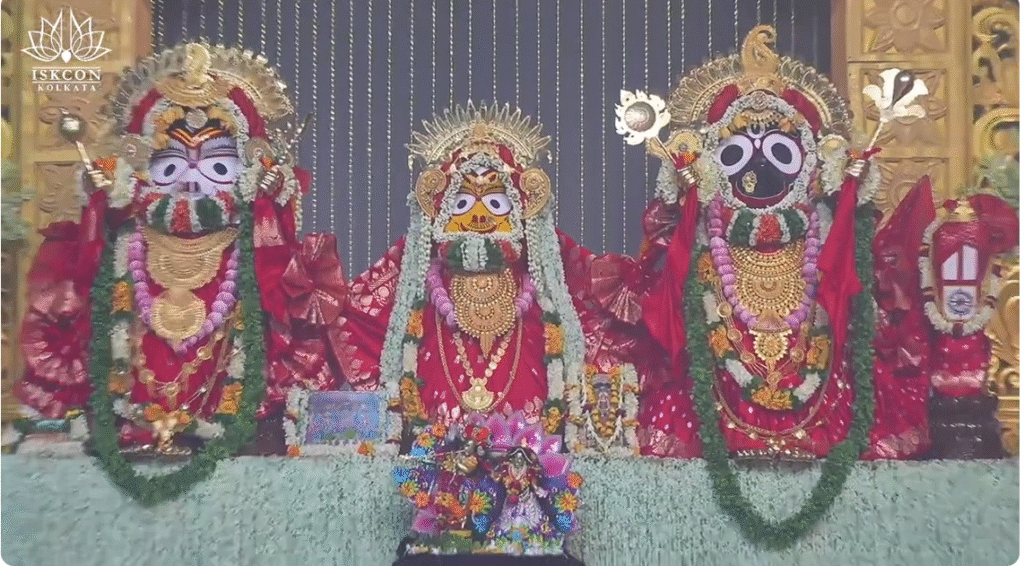
While speaking on Śrīmad-Bhāgavatam 1.15.8, HG Acharya Ratna Prabhu explained how all achievement becomes possible only by the grace of Krishna. Arjuna too acknowledges Krishna’s mercy in this verse. But prabhuji cautioned that depending on Krishna’s mercy does not mean that we should become lazy and stop endeavouring.
Below article is based on the class which he gave on 20 July 2026 at the Kolkata Rath Yatra Pandal.
Krishna’s Mercy Behind Every Achievement
Krishna, after accomplishing His mission, departed to Goloka Vrindavan.
Being separated from Krishna, Arjuna was morose. When he reached Hastinapur, Yudhisthira was surprised to see Arjuna. He could sense that something terrible had happened. So, he asked Arjuna, “Has Krishna completed His pastimes and left for the spiritual world?”
Arjuna, who could not control his tears, said, “I have just lost Him whose separation for a moment would render all the universes unfavourable and void, like bodies without life.” Srimad Bhagavatam 1.15.6
Arjuna then remembers his accomplishments and says that whatever he achieved, it was only because of Krishna.
In today’s verse, SB 1.15.8, he is saying that it was only because of Krishna’s grace that he could conquer Indra and that Maya Danava’s life was also saved.
In our life, whatever we achieve, we receive only by Krishna’s mercy. We might have cracked the IIT JEE exam, learnt music, or cooked a nice feast. All this is because of the grace of Lord Krishna.
Today, sitting in front of Lord Jagannath in the Rath Yatra Pandal, we should reflect on our achievements and should loudly say in our mind,
“O Krishna, O Jagannath, whatever I have achieved, it is only because of Your mercy.”
Even the name that we remember is because of Krishna. If Krishna does not give permission, we cannot even raise our hand. If Krishna does not sanction it, then we cannot do anything; we cannot even blink our eyes.
So, again close your eyes and say in your heart,
“My dear Krishna, whatever I have achieved is because of Your mercy.”
Sometimes, in difficulty, we remember Krishna, but later, after help is provided, we forget Krishna. During an exam we remember Krishna, but if we get a good result, we forget to thank Krishna.
But here we see that Arjuna has not forgotten Krishna. He loves Krishna so much and is now feeling separation from Him. In separation, love intensifies. This is why, sometimes, to increase the devotees’ love for Him, Krishna disappears.
Human Effort & Krishna’s Mercy
For any success, two things are required—our effort and Krishna’s mercy. We learn this in the Damodar Lila.
Many people endeavour hard, but not all are successful. Only when one gets Krishna’s mercy does one get the result. But there are also people who do not put in any effort and think Krishna will give the result.
One is Karmavada: one only works and does not believe in Krishna’s mercy.
Another is Daivavada: one only depends on Krishna’s mercy and does not put in any effort.
But both are required—hard work and Krishna’s mercy.
The Khandava Forest Pastime Begins
Here we see Arjuna defeated Indra, but he gives all the credit to Krishna. Indra is the king of heaven, and defeating him is not possible for any human being. Indra is so powerful that he can send rain and submerge the entire world. No human can stop him. But there are some foolish people who think they can counteract nature.
There are several demigods who oversee the functioning of this world, and these demigods are very powerful.
Arjuna knows that by his own effort, he cannot defeat Indra, so he thanks Krishna.
When Dhritarashtra gave Indraprastha to the Pandavas, one day Arjuna and Krishna were sitting near a dense forest called the Khandava Forest. All of a sudden, an effulgent and beautiful brahmana of golden complexion, having lotus-like eyes, appeared there. Both Krishna and Arjuna stood and offered him respect.
The brahmana said, “I know both of you. You are Nara-Narayana Rishi. I have come here to beg food from you so that I can be satisfied.”
Krishna and Arjuna agreed to give him food.
Aginidev reveals why he wants to consume Khandava Forest
The brahmana then said, “I am the fire-god, Agni, and I want fire as food. I want to devour this Khandava Forest. I have been trying to consume the forest, but Indra is not letting me do so. Since his friend Takshaka lives here, whenever I try to devour the forest, Indra sends rain and the fire gets extinguished. If you help me, then I can consume the forest.”
Surprised, Krishna and Arjuna asked, “Why do you want to consume the forest?”
Agnideva said, “Once, at a feast, I overate ghee, and because of that I developed a stomach problem. Brahma told me that in the Khandava Forest there are many herbs that can help cure my stomach. Since I was not able to consume the forest, Brahma asked me to approach you both because you are Nara-Narayana Rishi. Brahma also said that in this forest there are many sinful people and demons. They will be killed when I consume the forest. So, my desire is sanctioned by higher authority.”
Arjuna thought that these demons might create problems for Indraprastha in the future, so it would be better to destroy them.
But Arjuna had a problem. He said to Agnideva, “I have many celestial weapons, but I do not have an appropriate bow to hold those celestial arrows. If you can give me a bow and an inexhaustible quiver, I can help.”
Hearing Arjuna’s request, Agnideva began meditating on Varunadeva, and he appeared. Agnideva requested him to help Arjuna. Varunadeva gave the Gandiva bow, an inexhaustible quiver, and the chariot of Soma to Arjuna.
The chariot had a flag bearing Hanuman’s image. It could move at the speed of the wind and the mind and could go anywhere. In the celestial chariot there were divine weapons and armour.
Varunadeva also offered a club to Krishna. Agnideva too offered the Sudarshana Chakra to Krishna. Agnideva offering the Sudarshana Chakra to Krishna is like people taking water from the Ganges and offering it back to the Ganges.
The Battle with Indra and the Saving of Maya Danava
Once everything was in place, Agnideva began devouring the Khandava Forest. Krishna became Arjuna’s chariot driver, and He drove the chariot around the forest. Whoever tried to flee the forest was slain by Arjuna.
Those who were slain in front of Krishna, and that too by a devotee like Arjuna, attained the spiritual world.
As Agnideva was consuming the forest, the fire rose high into the sky, rocks began melting, rivers and oceans began boiling, and the crackling sound of the fire spread everywhere. Everyone, including the celestial beings, became fearful. They approached Indra, asking about the fire. Indra understood what was happening. He began sending rain; the raindrops were as thick as pillars. But before the rainwater could fall on the forest, it evaporated.
Seeing the rain, Arjuna shot several arrows into the sky and created an umbrella over the forest, preventing the rain from falling on it. Takshaka was not there, but his wife and son were. Takshaka’s wife was killed by Arjuna, but his son escaped with the help of Indra.
A fierce battle broke out between Indra and Arjuna. Riding on Airavata, Indra wanted to kill Arjuna. Yamaraja, Kuvera, Varuna, Kartikeya, Surya, the Maruts, and many other demigods charged toward Krishna and Arjuna. Arjuna neutralized all their weapons and defeated the demigods single-handedly.
Although Indra was defeated, he was still pleased because he knew that Arjuna was his son and Krishna was his master.
No one can defeat a person who is supported by Krishna.
Brahma said to Indra:
“Your friend Takshaka is not in the forest, so do not worry. Also, it is impossible to defeat Arjuna because Krishna is with him. They are Nara-Narayana Rishi and worthy of worship. The burning of the forest has been ordained by fate.”
Indra understood and left along with all the demigods.
For fifteen days, Agni burned the forest, and many demons and rakshasas were killed.
Maya Danava Saved
While the forest was being burned, Maya Danava, who was staying underground, came out to escape. Agni charged towards him, and Krishna released His Sudarshana Chakra. Maya Danava immediately surrendered to Arjuna, and Arjuna begged Krishna to spare him.
After fifteen days, Indra returned and, along with Agnideva, glorified Krishna and Arjuna. They requested Krishna and Arjuna to ask for any benediction.
Arjuna asked Indra for all the celestial weapons. Indra replied, “After Lord Shiva gives you the Pashupata weapon, I will give you the celestial weapons.”
When Indra asked Krishna, “How can I serve You?” Krishna replied:
“Let My friendship with Arjuna always remain.”
Agnideva then blessed Arjuna:
“Just as I pervade the universe, similarly you can go anywhere in the universe.”
Maya Danava builds assembly hall for Pandavas
Later, Maya Danava approached Arjuna and said, “Tell me how I can serve you.” Arjuna replied, “Better ask Krishna.”
Knowing that Maya Danava was a great architect, Krishna asked him to build an assembly hall for Yudhisthira. Maya Danava travelled to the Himalayas to bring precious gems such as gold and diamonds, which he used in constructing the hall. He also gave a mighty club to Bhima, one hundred thousand times stronger than an ordinary club, and presented the conch shell Devadatta to Arjuna.
He then built the magnificent Maya Sabha. Later, when Duryodhana entered the palace, he became bewildered by its mystical architecture, and Draupadi laughed on seeing his confusion.
The Ultimate Goal Is Krishna-prema
After Krishna departed from this world, Arjuna remembered all these pastimes. His extraordinary power also departed along with Krishna.
Srila Prabhupada explains:
“Since the powers are not needed to go back to Godhead, his powers were taken away by Krishna.”
Nothing material is required to go back to Godhead. We see that Kolaveca Sridhara possessed practically nothing materially, yet he had immense love for the Lord.
Simply by hearing, chanting, and serving, we can attain Krishna-prema.
Lord Chaitanya explains that the nine processes of devotional service are the means to attain love of Godhead. Pure devotees do not even desire to return to Godhead if there is no opportunity to serve Krishna there. They simply want to serve Krishna—even if that service is in hell.
The ultimate goal of life is Krishna-prema, and it is awakened through hearing and chanting.
Using Technology in Krishna’s Service
Today, atheistic scientists create destructive inventions such as atomic bombs, which are harmful to humanity.
Maya Danava wanted to offer Arjuna technical and material knowledge, but Krishna indicated that such knowledge is meant for the people of Kali-yuga.
Today, AI is trying to do everything, which can be harmful if misused. AI can write, create pictures, and perform many other tasks. If people become excessively dependent on AI, they may gradually forget how to write, paint, and think logically.
We should not misuse technology but use it intelligently in Krishna’s service.
These were some of the important points from the Srimad Bhagavatam Class by HG Acharya Ratna Prabhu on 20th July 2026 at Kolkata Rath Yatra Pandal.
55th Kolkata Rath Yātrā 2026 – Śrīmad-Bhāgavatam Class Series
Search
Recent Posts
-
Srimad Bhagavatam at ISKCON Newtown...
September 1, 2026
-
Janmashtami: Celebrating Krishna’s Appearance Through...
August 17, 2026
-
Gopinatha Pattanayaka: 6 Lessons for...
August 16, 2026
-
What Does Krishna Say About...
August 11, 2026
-
Are you ready to choose...
August 2, 2026