Overview of Uddhava Gita: Krishna’s Final Instructions to Uddhava|HG Chaitanya Charan Prabhu | Iskcon Newtown Kolkata
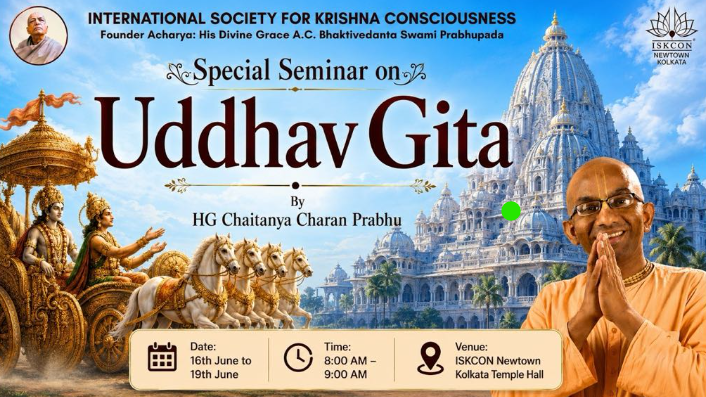
HG Chaitanya Charan Prabhu is giving four-day seminar on Uddhava Gita at Iskcon Newtown Kolkata from 16th June 2026 – 9th June 2026.
On the first day prabhuji gave overview of Uddhava Gita, its significance, distinctive features and compared it with Bhagavad Gita.
Below article is based on the class given by HG Chaitanya Charan Prabhu.
Overview of Uddhava Gita
Today I will discuss an overview of the Uddhava Gita.
The Uddhava Gita appears in the Eleventh Canto of Śrīmad-Bhāgavatam, spanning Chapters 7–29. It is the longest philosophical discussion spoken by Lord Krishna in the Bhāgavatam.
The Tenth Canto is the longest canto of Śrīmad-Bhāgavatam, comprising approximately one-third of the entire text with ninety chapters. However, the most extensive philosophical discourse is found in the Eleventh Canto in the form of the Uddhava Gita.
To understand the Uddhava Gita, we can use the acronym S.E.A.T.
- S – Situation
- E – Emotion
- A – Approach
- T – Theme
S – Situation
The Bhagavad-gita (BG) consists of approximately 700 verses, whereas the Uddhava Gita (UG) contains about 1,040 verses.
Both were spoken just before a major catastrophe.
The Bhagavad-gita was spoken on the battlefield of Kurukṣetra before the devastating fratricidal war among the Kuru dynasty. It was spoken in a public setting.
The Uddhava Gita was spoken between Dvārakā and Prabhāsa, in a more private setting. It was also spoken before a fratricidal conflict—this time among the Yadus themselves.
The Eleventh Canto begins with descriptions of ominous signs indicating the impending destruction of the Yadu dynasty. Uddhava senses that Krishna is preparing to leave this world and therefore approaches Him for guidance.
The Uddhava Gita extends from Chapters 7 to 29. In Chapter 29, the Yadus begin fighting among themselves, and in Chapter 31, Krishna concludes His earthly pastimes. Thus, the Uddhava Gita represents the Lord’s final and most comprehensive instructions before His departure.
E – Emotion
Wisdom rarely comes easily. It is often born from pain.
If we wish to gain deeper knowledge, some form of austerity is generally required. Philosophical understanding often emerges through adversity. One way I describe this while speaking around the world is:
“The world is a university of adversity.”
Through adversity we learn what truly matters—what we should hold on to and what we should let go of.
Consider a child. Initially he is attached to toys. As he grows older, he gives up toys to spend time with friends. Later he gives up those activities to focus on studies. Growth involves consciously choosing what to release and what to embrace.
The primary emotion experienced by both Arjuna and Uddhava was pain.
Arjuna’s Pain
A question is sometimes asked: Why did Krishna speak the Bhagavad-gita to Arjuna and not to Yudhiṣṭhira?
One reason is that Arjuna was experiencing the deepest emotional crisis.
It was Arjuna who had to fight and ultimately kill Bhīṣma and Droṇa—his elders, teachers, and mentors. Bhīma had vowed to kill Duryodhana and Duḥśāsana, but he had no affection for them. Although Bhīma preferred peace and even encouraged Krishna to seek a peaceful resolution, he did not face the same emotional dilemma.
Similarly, Yudhiṣṭhira did not have to directly confront and kill those to whom he was deeply attached in the same way that Arjuna did.
Thus, Arjuna’s pain was unique.
Different Levels of Pain
There are different forms of suffering:
1. Adversity – difficulties that arise naturally.
For example, if there is a major program and the electricity suddenly fails, that is adversity.
2. Atrocity – suffering intentionally caused by others.
If someone deliberately cuts the power supply to sabotage the event, that is atrocity.
In Sanskrit terms:
- Kaṣṭa refers to adversity.
- Anyāya refers to injustice or atrocity.
Atrocity is generally more painful because another person intentionally causes the suffering.
3. Agony – suffering caused by one’s own actions, when one is forced to do something deeply painful.
This was Arjuna’s condition.
The Mahābhārata presents a realistic picture of life. Sometimes good people are not given good choices. The only options available may be a bad choice or a worse choice.
For Arjuna, Bhīṣma and Droṇa were not merely relatives. They were respected elders, teachers, and mentors. He had not simply learned archery from them; he had learned it partly to please them. Now he was expected to fight against and kill those very individuals.
Once, after I spoke on this topic in America, a disciple of Śrīla Prabhupāda shared a similar experience. He explained that a senior devotee who had been his śikṣā-guru had deviated. Because he was close to that devotee, it was extremely painful when the GBC asked him to inform others—especially the guru’s disciples—about the deviation. He understood Arjuna’s dilemma at a personal level.
Uddhava’s Pain
Uddhava’s pain was different.
In one sense it was less severe because he was not required to engage in violent action. Yet in another sense it was even greater because he faced separation from Krishna Himself.
He understood that Krishna was preparing to leave the world, and he would be left behind.
We get a glimpse of Uddhava’s anguish in the First Canto when he tells Vidura that the sun of Krishna has set.
“Śrī Uddhava said: My dear Vidura, the sun of the world, Lord Kṛṣṇa, has set, and our house has now been swallowed by the great snake of time. What can I say to you about our welfare?” Srimad Bhagavatam 3.2.7
One of the deepest forms of suffering is loneliness—the feeling that no one around us can understand what we are experiencing.
I once met a devotee in Australia who had been caught up in the Russia–Ukraine conflict. He was imprisoned and later released before receiving asylum in Australia. He explained that when he was arrested, his bead bag was confiscated. As a devotee, he felt completely isolated because nobody around him understood his spiritual life. He described that loneliness as one of the most difficult experiences he had ever faced.
Similarly, Uddhava faced the prospect of continuing without Krishna’s visible presence.
In Chapter 29, Krishna instructs Uddhava to leave and go to Badarikāśrama, thereby protecting him from the impending destruction of the Yadu dynasty.
A – Approach
The Bhagavad-gita and Uddhava Gita differ significantly in their teaching style.
In the Bhagavad-gita, principles are primarily explained.
In the Uddhava Gita, principles are both explained and illustrated through stories and examples.
Śrīmad-Bhāgavatam generally combines philosophy with narrative.
We may broadly say:
- Bhagavad-gita: almost entirely philosophical instruction.
- Śrīmad-Bhāgavatam: philosophy interwoven with stories.
- Uddhava Gita: a synthesis of philosophical teachings and illustrative narratives.
The Uddhava Gita includes famous accounts such as:
- The Avadhūta Brāhmaṇa
- The Avanti Brāhmaṇa
- King Purūravā
- Piṅgalā
These stories help demonstrate the philosophical principles being taught.
Another difference is urgency.
The Bhagavad-gita is an emergency conversation. Arjuna is standing on a battlefield and must immediately decide how to act.
The Uddhava Gita, while urgent, is less immediate. Therefore Krishna has more time to elaborate on various philosophical topics.
T – Theme
The central themes of the Bhagavad-gita and Uddhava Gita differ in emphasis.
Bhagavad-gita: World-Transforming
The Bhagavad-gita teaches us how to act within the world while remaining connected to Krishna.
Arjuna is instructed to fight—not for personal gain, but as an act of devotion.
The Gita shows how spiritual consciousness can transform worldly engagement.
Uddhava Gita: World-Transcending
The Uddhava Gita focuses more on detachment and transcendence.
Its overall message is how to rise above worldly entanglement and deepen one’s absorption in Krishna.
This reflects the context in which it was spoken. Krishna is preparing to depart, and Uddhava is being prepared for a life of renunciation and spiritual absorption.
Context-Sensitive Teaching
An important lesson from both texts is that spiritual instruction must be appropriate to the listener’s situation.
Wrong instruction can create serious problems.
When someone is in distress, we should offer wisdom that provides comfort, guidance, and practical direction.
Similarly, Śukadeva Gosvāmī speaks to Mahārāja Parīkṣit, who has already decided to leave the world. Therefore, the Bhāgavatam strongly emphasizes world-transcending spirituality.
Bhakti in Both Gitas
Both the Bhagavad-gita and the Uddhava Gita establish bhakti as the highest path.
However, they differ in what they present as the next best alternative.
Bhagavad-gita
- Bhakti-yoga
- Karma-yoga
- Jñāna-yoga
Uddhava Gita
- Bhakti-yoga
- Jñāna-yoga
Because the Uddhava Gita is addressed to a highly advanced devotee who is approaching renunciation, it places greater emphasis on knowledge and detachment.
Overview of Uddhava Gita : Summary
Significance of the Uddhava Gita
- The longest philosophical discussion in Śrīmad-Bhāgavatam.
- Krishna’s final instructions before His departure.
- One of the most comprehensive presentations of spiritual wisdom.
- Covers a wide range of philosophical and practical topics.
Bhagavad gita (BG) vs Uddhava Gita (UG) – S.E.A.T.
Situation
- BG: Spoken at Kurukṣetra before the Kurukṣetra war; public setting.
- UG: Spoken between Dvārakā and Prabhāsa before the destruction of the Yadus; private setting.
Emotion
- Arjuna’s pain was agony—he had to fight and kill his revered mentors.
- Uddhava’s pain was separation—he faced life without Krishna’s visible presence.
Approach
- BG: Primarily philosophical principles.
- UG: Philosophical principles illustrated through stories and examples.
Theme
- BG: World-transforming—serve Krishna through action in the world.
- UG: World-transcending—rise above worldly attachment and deepen absorption in Krishna.




Search
Recent Posts
-
Srimad Bhagavatam at ISKCON Newtown...
October 2, 2026
-
Haridas Thakura: The Foremost Devotee...
September 28, 2026
-
Overcoming Obstacles in Our Spiritual...
September 24, 2026
-
Krishna Katha and Memories of...
September 22, 2026
-
Choose Krishna in All Circumstances...
September 20, 2026