Aila Gita: Lessons on Responsibility and Self-Control
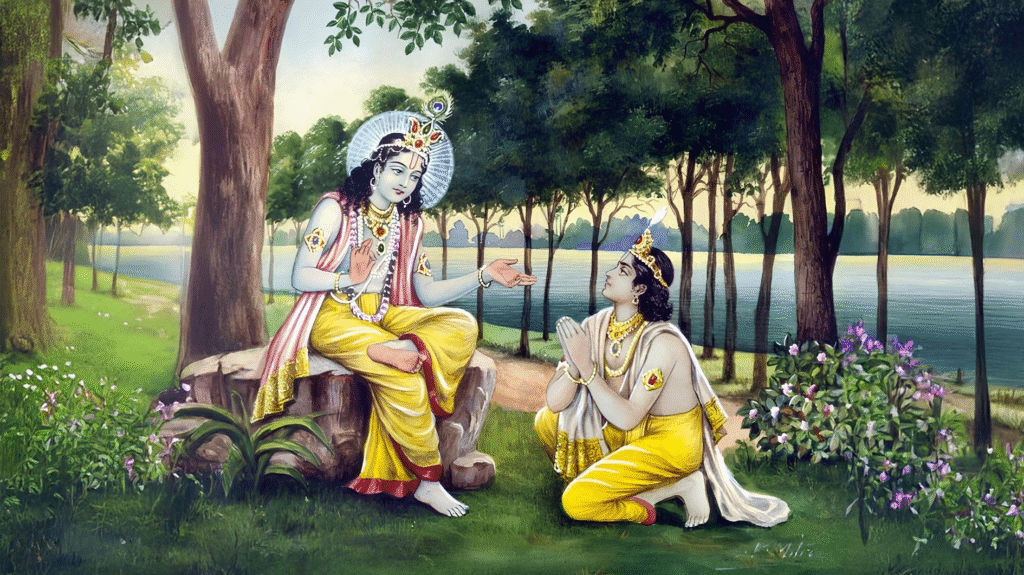
In 11th Canto of Srimad Bhagavatam, the last story which Krishna says to Uddhava is Aila Gita. Krishna through different perspectives and pastime, gives knowledge to Uddhava.
Krishna is giving knowledge to Uddhava so that he becomes detached from the world.
In 9th canto, it is mentioned that how Puruva was a great king, but when he saw Urvasi, he got attracted to her. But later Urvasi left him.
Pururva laments and then does yajna to get her. He is able to get her too but again Urvasi leaves.
When Urvasi leaves Pururva then Pururva goes through different stages of transformation. This is discussed in the chapter Aila Gita of Bhagavatam.
First Stage
Puruva is angry with her. He thinks, “I have given her so many things, I gave her love but still she left.”
Second Stage
He thinks I wasted my time with her. When someone leaves a person, then the person thinks before she left me I should have left her.
Third Stage
He thinks about his own “responsibility.” He thinks, “What is her fault? It was I who thought a rope to be a snake. I could not understand who I was and I could not control my mind.”
Fourth Stage
He becomes detached, he leaves kingdom and wanders.
Finally, devotion for the Lord comes.
Fifth Stage
From Aila Gita, we understand the importance of taking responsbilty in one’s life.
Let us will discuss taking responsibility in one’s life with the abbreviation – APT: A (Analyze) P(Protect) T(Transcend)
Analyze(A) The Cause
In Aila Gita, we see how Puruva, critically analyses the cause of his suffering.
A person gets angry and may blame others for that. May be the other person might have said something, but we are responsible for our action.
Let us see how responsible circumstances are and how responsible we are.
If someone does something wrong then we have to analyze why this happened. There is soul, which is now covered by mind, and mind gets influenced by circumstances (i.e. with the world around us). Mind has different conditionings. Soul has intention.
There are 3 reasons why people do something.
Circumstances
For e.g. a person may drink alcohol at a party and say that his friends forced him to drink. But his friends did not open his mouth and poured liquor in it. Circumstances can be one cause for behaving in a particular way, then there is conditioning.
Conditioning
Conditioning means one has certain samskara based on which one does things. Samskara ca be positive or negative. Someone may have bad experiences in his childhood which may create bad impression in his mind. So, we can say samskara is “some scar.” Based on samskara, one does certain things. Then there is intention.
Intention
One chooses to do certain things. For eg. no one called a person to drink but he chooses to drink alcohol. There was one rich person who was addicted to alcohol. His family members asked the neighborhood shops to not give him alcohol. So, he would fill the petrol tank of his vehicle with alcohol and drink it using a straw. This is intentional.
These are three contributors – circumstances, conditioning and intention (choice).
Understanding circumstances, conditioning and intention (choice) through example
We see examples of Ravana and Ajamila. Both are afflicted by lust, but there situations are different. Ajamila had gone for service and got distracted when he saw a prostitute and a man. His cause for distraction was circumstances. Ajamila’s situation starts with circumstances.
For Ravana, circumstances did not come to him, he created the circumstance. He thought when Sita will be alone, he would force her to come with me. His action was intentional. When we intend to do something, we create circumstances.
For eg, when we open app, something obscene pops up, then that is circumstantial but when we go and open a particular site with obscene content then that is intentional. In Australia, social media is banned for teenagers. But teenagers are using VPN to bypass the ban.
If someone wants to correct oneself then one has to see what factors are contributing more.
Ajamila – first sight – 100% circumstantial. He came back from that place, but mind did not come back. He kept thinking about it.
When he went first time to the lady, we can say 80%-90% circumstantial. We can this is conditioning, so he did something.
For Ajamila, one thing was “To be with her” and second was “She be with me.” Now, for “She be with me”, he had to give up his wife, parents, job. He was a brahmana but when he started living with the prostitute then no one invited him for yajna or for other sacred sacrifices. When he decides that “she be with me” then this was not conditioning but this was intentional.
For eg. A fort has walls around. Enemies may attack it from outside and walls may break down. These are circumstances. Sometimes there can be attack on the fort from inside too, this is conditioning. But if someone is breaking the wall from inside to bring it down then this is intentional.
While fighting against anarthas, sometimes we may fail. This is sign of weakness.
For Ravana it was not weakness, but it was his wickedness. Ravana was not fighting against the anarthas, but he was fighting for it. This is the characteristic of a demon. A demon does not fight against anarthas like lust but fights for it to get it.
So, first we have to analyse why we are behaving in a particular way.
Till the time we blame circumstances, we cannot grow.
In Aila Gita, we see Pururva after analysing his situation stops blaming circumstances.
Protect(P)
For protecting anything, we need boundaries.
From Aila Gita, we learn the importance of boundaries, if we do not have it then we are bound to suffer like Pururva.
Boundaries are two types – Internal & External
One Bollywood actor who is taking interest in devotional life was angry with Iskcon when he heard one prominent Iskcon speaker blaming Bollywood for rise in rape cases in India. He said movies do not glorify rapes. People are indulging in it because they are animals.
Suppose that in shop nice things are displayed, it does not mean that one goes and steal things from there and blame shop for that.
External boundaries are two – Law & Culture
Law
Law will punish you if you are wrong. For e.g. drink and drive is a big crime.
Culture
It is based on the environment where we live. Using abusive words in public, smoking are part of the culture where we grew up.
Internal boundaries are two – Intelligence & Conscience
Intelligence
It tells us that this action will result in bad outcomes, will create problem. For e.g. someone with diabetes will use his intelligence and will not indulge in sweets. Even Ravana had that much intelligence that I should not force myself upon Site because he had been cursed.
No one can say that I cannot control my conditioning. For e.g. someone is saying that I can’t give up meat but if doctor says that if you do not give up you will die then that person will give it up.
Conscience
Not just this will lead to bad, but this is bad. For e.g. if a new person comes to temple and we behave badly with him. But later come to know that he is a senior disciple of a prominent guru then we will immediately go a seek forgiveness from him fearing that our action will be reported by him to his guru. But if a young devotee comes to temple and I do not behave badly with him thinking that he is a guest to the temple then this is conscience.
Even if there is no boundary then some boundary is required.
Transcend(T)
It is going beyond conditioning. Best example is Haridas Thakura. Even though the prostitute came, he was not at all affected by it.
Aila Gita too teaches about transcedence. When one achieves it one becomes satisfied and free from all material attachments and entanglements.
“Thus losing his desire to be on the same planet as Urvaśī, Mahārāja Purūravā began to wander the earth free of all material association and completely satisfied within the self.” Srimad Bhagavatam 11.26.35
By bhakti we can transcend the conditioning. But it will take time. So we have to also focus on boundaries. Whatever boundaries work, we should go for it.
Law: If law is favorable then this is good, but law is not in our control.
Culture: this is also partly in our control not completely. We cannot change the culture, but we can choose the culture. Choose which culture you want to belong to. If we are with devotees, then we get a devotional culture. By culture, controlling our conditioning is easy. For e.g. in temple people come wearing decent dress, not to agitate others.
Intelligence: This is mostly in our control. With our intelligence, we can understand if we do this then this will happen. So, hearing lectures and reading scriptures are very important to develop intelligence. Whatever anarthas is troubling us, we should hear those lectures which will help us to deal with those anarthas.
Conscience: This is best. But it is gradual and happens through purification. If we develop proper conscience then we do not do certain things because we know this will displease Krishna. And our life’s purpose is to please Krishna and not displease him – anukulyasya sankalpah, pratikulyasya varjanam.
Key takeaways
Self-control: For self-control, we cannot blame circumstances and also, we cannot rely completely on will power. If we just blame circumstances and think that we can control everything by will power then this is not possible.
For self-control, first we have to through intelligence and then to transcendence.
With intelligence we protect ourselves from circumstances and strengthen our will power.
Till the time we do not have love for Krishna, then till the time with buddhi, intelligence, we should do bhakti.
Summary
- Context: Aila Gita. It teaches us that instead of blaming circumstances for our suffering, we should take responsibility for our actions, become detached from things which causes sufferings and ultiamtely develop devotion for the Lord.
- We see Pururva is 1st blaming, 2nd he takes responsibility, 3rd he develops detachment and fianlly develops devotion.
- Taking responsibility
Analyse – Circumstances, Conditioning, Intention (choice). Intention – Ravana’s action. Ajamila’s start was based on circumstances then intentional. All three are contributors.
Protect: To protect ourselves we need boundaries.
1. External Boundary: Culture & Law
2. Internal Boundary: Intelligence & Conscience
Choose whichever boundary works is best boundary.
Safest boundary is conscience. But most controllable is intelligence.
- For Self-control – Increase intelligence
Different people have different levels or types of anarthas – Some people have more lust, less anger, less greed. Some may have less lust, more anger, less greed and so on.
- Srila Prabhupada instruction
Responsibility in our spiritual life is upon us. Srila Prabhupada says every individual has to fly his own plane.
(The above article is based on the Srimad Bhagavatam Class given by HG Chaitanya Charan Prabhu at Iskcon Kolkata on 20th June 2026)




Search
Recent Posts
-
Srimad Bhagavatam at ISKCON Newtown...
October 2, 2026
-
Haridas Thakura: The Foremost Devotee...
September 28, 2026
-
Overcoming Obstacles in Our Spiritual...
September 24, 2026
-
Krishna Katha and Memories of...
September 22, 2026
-
Choose Krishna in All Circumstances...
September 20, 2026