Uddhava Gita: Learning from Life Through the 24 Gurus
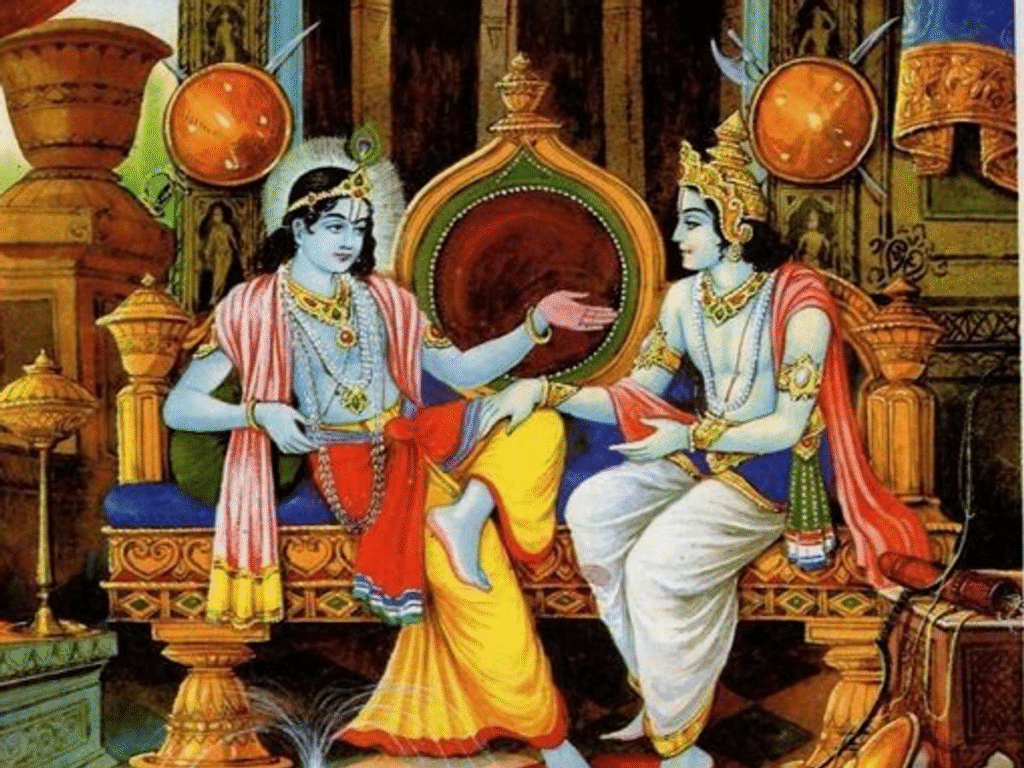
One of the central themes of the Uddhava Gita is that we learn from life itself. We learn from our experiences, from pain, from love, from success, and from failure. Ultimately, all learning culminates in one lesson: where and how to direct our love.
As Krishna decided to conclude His earthly pastimes, Uddhava wanted to go with Him. But Krishna wanted Uddhava to remain in this world and guide others. Krishna instructed him and prepared him to continue his spiritual journey and be a teacher to others.
This verse, Srimad Bhagavatam 11.7.20, is the starting point from where the description of 24 gurus starts in Uddhava Gita.
“An intelligent person, expert in perceiving the world around him and in applying sound logic, can achieve real benefit through his own intelligence. Thus sometimes one acts as one’s own instructing spiritual master.” Srimad Bhagavatam 11.7.20
It teaches us that one can become one’s own teacher when guru is not there. The teachings of 24 gurus in Uddhava Gita shows how one learns from one’s observation.
We can understand this subject through three dimensions:
- Principle
- Process
- Purpose
Krishna Teaches Through the Word and the World
We say, “Krishnam Vande Jagadgurum.”
One meaning of Jagat-Guru is that Krishna is the guru of everyone in the universe. Another meaning is that Krishna teaches through the jagat itself—the world around us.
The universe is a university in which Krishna teaches us.
He teaches us through:
- Scriptures – Word.
- Nature – World.
Scripture is the Word. Nature is the World.
God does not communicate wisdom only through sacred texts. The same Lord also teaches through the experiences He arranges within this world. After all, the world itself functions under His supervision:
mayādhyakṣeṇa prakṛtiḥ sūyate sa-carācaram
(Bhagavad-gita 9.10)
Material nature acts under Krishna’s direction.
Yet there is an important challenge.
The world can be seen either as Krishna’s world or as Maya’s world.
If we simply look at the world through material consciousness, we will primarily see objects for sense enjoyment. The world then becomes a source of distraction. To perceive Krishna’s presence within the world requires spiritual training.
This is where the guru becomes indispensable.
The guru-disciple relationship is eternal because the guru teaches us how to see.
The spiritual master does not merely provide information. He provides vision.
Therefore Narottama Dasa Thakura prays:
cakṣu-dāna dila yei, janme janme prabhu sei
“He who has given me spiritual vision is my master life after life.”
Through the guru we learn scripture. Through scripture we learn how to interpret the world.
Without this foundation, our observations may simply reinforce illusion.
Proper Dependence on Guru
The necessity of guru does not mean unhealthy dependence.
Dependence on guru should not be primarily physical, financial, or emotional.
Physical dependence means unnecessarily burdening the guru instead of helping carry forward his mission.
Emotional dependence occurs when a disciple’s spiritual stability becomes dependent on receiving a particular amount of personal attention, recognition, or affirmation.
One senior devotee recalled receiving a message from a disciple who felt neglected because he had not received enough attention from his spiritual authority and therefore wanted to leave spiritual life. Such situations demonstrate how emotional dependence can sometimes masquerade as spiritual dependence.
As spiritual practitioners mature, they should become spiritually dependent rather than emotionally needy.
Spiritual dependence means drawing strength from the guru’s teachings, example, and connection to Krishna.
We serve the spiritual master through:
- His life
- His teachings (vani)
- His legacy
Guru’s life teaches us how to practice devotional service. His teachings guide our understanding. His legacy provides practical systems through which people can remember Krishna.
Srila Prabhupada emphasized that a genuine spiritual master should provide practical means by which people can remember Krishna and advance spiritually.
Developing Independent Thoughtfulness
One of Srila Prabhupada’s most important instructions was that devotees should become “independently thoughtful.”
A disciple should not outsource all decision-making to the spiritual master.
The guru provides principles, values, and vision, but the disciple must learn how to apply them.
Krishna Himself demonstrated this approach with Arjuna.
Throughout the Bhagavad-gita, Krishna educates Arjuna, answers his questions, removes his confusion, and reveals profound spiritual truths. Yet at the conclusion He does not force Arjuna. Instead He says:
vimṛśyaitad aśeṣeṇa yathecchasi tathā kuru – Thus I have explained to you knowledge still more confidential. Deliberate on this fully, and then do what you wish to do. Bhagavad-gita 18.63
Krishna wanted Arjuna to think.
A significant example appears after the war when Aśvatthāmā was captured. Krishna was physically present, yet He did not simply dictate every detail of what Arjuna should do. Arjuna had to weigh competing principles and make a thoughtful decision. Krishna ultimately approved Arjuna’s judgment.
The purpose of spiritual education is not merely to provide answers. It is to develop mature spiritual intelligence.
Similarly, after Krishna departed from this world, Arjuna continued making decisions based on the wisdom Krishna had imparted. Krishna had prepared him to face life independently.
The goal of the guru-disciple relationship is therefore not chronic dependency but spiritual maturity.
Avoiding Blind Following and Cult Mentality
There is a significant difference between surrender and thoughtlessness.
Independent thinking must always function within the framework of guru, sadhu, and śāstra.
Blind following can become dangerous.
A genuine spiritual tradition encourages thoughtful understanding, not mechanical conformity.
Researchers who study radicalization have observed that many people become attracted to extremist movements because such groups simplify life. Complex moral questions are replaced with simple instructions: “Do not think. Simply obey.”
This pattern was evident in the growth of organizations such as ISIS. Some recruits, including educated individuals from developed countries, were attracted not merely by ideology but by the promise of certainty and simplicity. By surrendering their capacity for independent judgment, many became victims of manipulation and tragedy.
The lesson applies far beyond political extremism.
Whenever people stop thinking and simply surrender their intelligence to another person or institution, they become vulnerable to being misled.
For this reason, spiritual life should strengthen intelligence, not weaken it.
Srila Prabhupada strongly opposed any tendency toward blind following. He wanted devotees to understand philosophy deeply and apply it intelligently.
Unthinking people are easier to control, but thoughtful people are better equipped to serve Krishna responsibly.
Understanding the Letter and Spirit
As devotees mature, they learn to understand both the letter and the spirit of instructions.
We may broadly think of three levels:
| Level | Understanding |
| Kanistha | Follows neither the letter nor the spirit |
| Madhyama | Follows the letter but misses the spirit |
| Uttama | Understands and follows both the letter and the spirit |
The highest level is not merely following instructions mechanically but understanding the purpose behind them.
This is why spiritual traditions remain dynamic and relevant across generations.
For example, Sri Chaitanya Mahaprabhu avoided meeting kings because of the social circumstances of His time. Srila Prabhupada, however, actively met political leaders, scholars, and influential people because different circumstances required different applications of the same spiritual principles.
Similarly, Srila Prabhupada strongly criticized certain aspects of modern education, yet he also encouraged engagement with educated people and intellectual communities.
The principle remained the same. The application varied according to circumstance.
The 24 Gurus in Uddhava Gita: Learning from Nature
Krishna then explains how learning from life works.
The Avadhuta Brahmana describes twenty-four gurus.
Interestingly, none of these 24 gurus formally preach in Uddhava Gita,
They are simply elements of nature and ordinary features of life.
The earth, air, sky, water, mountain, python, moth, honeybee, and many others become teachers.
The Avadhuta learns through observation.
The mountain teaches steadiness and service.
The earth teaches tolerance.
The sky teaches detachment.
Learning is not restricted to formal classrooms.
Life itself becomes a classroom.
Three Sources of Knowledge – Pratyaksa, Anumana and Sabda
Vedic philosophy describes three important means of acquiring knowledge:
Pratyakṣa — Direct Observation
Knowledge obtained through our senses.
Anumana — Inference and Reasoning
Knowledge obtained through analysis and logical conclusions.
Śabda — Revealed Knowledge
Knowledge received from scripture and spiritual authorities.
Pratyakṣa and anumāna are valuable but incomplete.
Our senses are limited.
We do not always perceive reality accurately.
Inference can lead to correct conclusions, but it can also become speculation.
Therefore observation and reasoning require guidance.
That guidance comes from śabda.
How Realization Develops Through Expereince
Śabda provides the framework through which we interpret experience.
Whatever we learn through observation and reasoning should harmonize with scriptural wisdom.
When this happens, realization develops.
Realization means that truths heard from scripture become confirmed through personal experience.
For example, scripture teaches that material wealth cannot guarantee happiness.
Initially we may accept this on faith.
Later we may observe wealthy people suffering from anxiety, loneliness, or dissatisfaction.
Our experience then confirms what scripture already taught.
This is realization.
Pratyakṣa and anumāna have now become aligned with śabda.
The same world that once distracted us from Krishna now reminds us of Krishna.
Srila Prabhupada demonstrated such vision. When he arrived in America, many people saw unprecedented prosperity. Yet Prabhupada also saw widespread anxiety, dissatisfaction, and spiritual emptiness. He famously described modern industrial civilization as ugra-sthāna—a place of intense materialistic activity.
Prabhupada was not seeing merely with material eyes. He was seeing through the lens of scripture.
The 24 gurus in Uddhava Gita teach us how to cultivate this kind of vision.
Learning from the World to Serve Krishna
The purpose of learning from the world is not merely intellectual enrichment.
The purpose is to deepen our relationship with Krishna and improve our service to Him.
If śabda is absent, observation and reasoning can easily become servants of Maya.
When guided by scripture, they become servants of Krishna.
This principle is especially important in preaching and outreach.
The world is constantly changing.
Technology changes.
Communication changes.
Social realities change.
Methods of outreach may therefore need to evolve.
During the pandemic, for example, devotees rapidly adopted online platforms such as Zoom to continue sharing Krishna consciousness.
The principles remained unchanged.
The methods adapted.
Relevance and Potency in spiritual outreach
Srila Prabhupada explains that effective preaching requires realization.
To communicate effectively, we must understand people.
One useful framework is NICE:
- Needs
- Interests
- Concerns
- Expectations
We understand these through observation and inference.
This gives relevance.
Scripture provides potency.
If we only understand people but neglect scripture, our message loses spiritual power.
If we know scripture but fail to understand people, our message may become difficult for others to relate to.
Successful outreach combines both.
Relevance comes from understanding the audience.
Potency comes from understanding scripture.
Conclusion – Life becomes a Teacher
The theme of this section of the Uddhava Gita is simple yet profound: learn from life. Through the 24 gurus in Uddhava Gita, Krishna teaches how every experience can help us grow in our spiritual life.
Krishna teaches through both the Word and the World.
The guru teaches us how to understand the Word.
The Word teaches us how to interpret the World.
Through observation (pratyakṣa) and inference (anumāna), guided by revealed knowledge (śabda), we gradually develop realization.
The purpose is not merely to become knowledgeable.
The purpose is to see Krishna everywhere, learn from every experience, and use everything in His service.
In this way, life itself becomes a teacher, the world becomes a classroom, and every experience becomes an opportunity to move closer to Krishna.
(Above article is based on the lecture given by HG Chaitanya Charan Prabhu at Iskcon Newtown Kolkata on 17th June 2026)
Read Series of articles on Uddhava Gita:




Search
Recent Posts
-
Srimad Bhagavatam at ISKCON Newtown...
October 2, 2026
-
Haridas Thakura: The Foremost Devotee...
September 28, 2026
-
Overcoming Obstacles in Our Spiritual...
September 24, 2026
-
Krishna Katha and Memories of...
September 22, 2026
-
Choose Krishna in All Circumstances...
September 20, 2026