Krishna’s Love: Attachment vs Affection in Srimad Bhagavatam 11.20.8
Insights from Srimad Bhagavatam 11.20.8, Dhruva Maharaja’s Life, and the Journey from Artha to Paramartha
It is important to understand love of this world and Krishna’s love. Love what we get in this world may be real but it cannot fully satsify us, only Krishna’s love can completely satisfy us. This is beautifully expalined in Srimad Bhagavatam.
A central theme in Śrīmad-Bhāgavatam 11.20.8 is that a devotee should be “na nirviṇṇo nāti-saktaḥ”—neither too detached nor too attached. This verse appears in the section where Krishna explains how bhakti is superior to mere jñāna and vairāgya.
“If somehow or other by good fortune one develops faith in hearing and chanting My glories, such a person, being neither disgusted with nor very much attached to material life, should achieve perfection through the path of loving devotion to Me.” Śrīmad-Bhāgavatam 11.20.8
Everything attractive in this world ultimately comes from Krishna. Whatever beauty, strength, intelligence, fame, wealth, or opulence we see is a reflection of Krishna’s opulence. Krishna says in Bhagavad Gita 10.41: “Know that all opulent, beautiful and glorious creations spring from but a spark of My splendor.”
We may call these attractions artha. They are like drops of water, while Krishna is the ocean. All drops come from the ocean, but not all drops take us back to the ocean. In this world we are attracted to many things, but we need to ask: Is this drop taking me toward Krishna or away from Krishna? If it takes me toward Krishna, it is anukūla (favourable). If it takes me away from Krishna, it is pratikūla (unfavourable).
Unless we become pure, we may not immediately become attracted to Krishna directly. In bhakti, different people are attracted by different aspects. Some are attracted to kirtan, some to philosophical presentations, some to deity worship, and almost everyone is attracted to prasadam. The ocean may seem far away, but the drops are close to us. Therefore, we should learn how to use the drops to reach the ocean.
Devotion: The Education and Elevation of Emotion
Many people think devotion is emotion. Those who think devotion is merely emotion often create commotion. Devotion is actually the education and elevation of emotion. At present our emotions flow in many different directions. Without education and elevation, our feelings can lead to failings.
A child may want to eat chocolates all day. If parents simply satisfy every emotional desire of the child, they will ruin the child’s health. Therefore, we should not simply be carried away by emotions. This principle applies in both material and spiritual life.
This universe can be called a “University of Adversity.” We are meant to learn from our experiences. One of the lessons we learn is how to apply the principle of not being too attached and not being too adverse, as taught in Śrīmad-Bhāgavatam 11.20.8.
Krishna does not ask us to become emotionless. Rather, He teaches us how to refine our emotions and direct them toward Him. Bhakti is not the rejection of emotion; it is the purification of emotion.
Dhruva Maharaja and the Power of a Drop of Love
The story of Dhruva Maharaja illustrates this principle beautifully.
In my own childhood, I contracted polio. Once a relative sympathetically remarked how unfortunate it was. My mother replied, “Whatever he lacks physically, God will provide intellectually.” Her love and care shaped my life. She never considered me a burden.
Later, when I came to Krishna consciousness and heard statements that all love in this world is maya, I found it difficult to relate to them. Had I not received a deeper understanding, my spiritual journey could have become difficult.
I received that understanding through Dhruva’s story. While reading Dhruva’s pastime, one statement by his mother struck me deeply. She told him that Lord Vishnu could offer him more love than many mothers combined.
At that moment I realized that Dhruva’s mother’s love was not false. It was real. But it was a drop, whereas Vishnu’s love is an ocean.
In this world, we are so hungry for love that even a drop can transform a person’s life. For example, if someone is contemplating suicide, a few kind words may be enough to save that person’s life. Such love is not false.
If Dhruva had not loved and trusted his mother, he would never have accepted her instruction to go to the forest in search of Vishnu. Although his father neglected him, his mother’s love was genuine. It was a drop that led him toward the ocean.
Only Krishna’s Love Is Complete
Love has two aspects: taking care and letting go. We should do whatever we can to care for others. At the same time, we should not think that we are the ocean. Whether we are receiving love or giving love, we should understand that we are all drops connected to the ocean of Krishna’s love.
When we become too attached, we mistake the drop for the ocean. That is why Krishna advises us to avoid both extremes: na nirviṇṇo nāti-saktaḥ.
The love found in this world is not false, but it cannot completely satisfy the heart. Sometimes, especially when we are new to bhakti, we develop unrealistic expectations and swing to extremes.
For example, some devotees quote Citraketu Maharaja’s pastime and conclude that one should not be attached to parents because the soul has had many fathers and mothers in many lifetimes. However, we should remember the context. The soul spoke those words after leaving the body and being temporarily brought back by Narada Muni.
Contrast this with Krishna’s own behavior. After killing Kamsa, Krishna met Vasudeva and Devaki and told them that because of Him they had suffered greatly, and He desired to serve them. Clearly, Krishna did not teach neglect of relationships.
The point is that we must move from artha to paramārtha. If a drop points us toward the ocean, we value it. If it takes us away from the ocean, we let it go.
Even when Dhruva Maharaja was returning to Godhead, he remembered his mother. Thus, neither extreme is correct. To see only the ocean and reject every drop is an error. To see only the drop and forget the ocean is also an error.
We should not be attached, but we should have affection.
Attachment, Affection, and the Complexity of Relationships
We need to understand that attachment and affection are not the same. Attachment binds and blinds. Dhritarashtra’s attachment to Duryodhana prevented him from doing what was right. He could not say no to his son even when he knew that Duryodhana was acting wrongly.
Many people think education means making complicated things simple. That is certainly one aspect of education. However, education also means revealing complexity in what appears simple. Human relationships are one such area.
Abandonment of responsibility is not spirituality. Krishna teaches in the Bhagavad Gita that not all renunciation is true renunciation.
The opposite of attachment is not necessarily detachment.
In the mode of passion, attachment often turns into aversion. Aversion is a strong negative reaction. Even though we dislike someone or something, our mind remains absorbed in it.
In the mode of ignorance, attachment often turns into apathy. Apathy is emotional numbness. It is extremely dangerous because it destroys concern, responsibility, and compassion.
Apathy is not detachment. Apathy often arises from frustration, whereas detachment arises from spiritual understanding.
Frustration is like starving. The desire to eat is there, but the ability is absent.
Renunciation is like fasting. The ability to eat is present, but the desire is willingly restrained for a higher purpose.
Therefore, frustration should never be mistaken for renunciation.
Commitment with Detachment
The sattvic alternative is commitment with detachment.
Commitment means understanding that we are souls playing particular roles in Krishna’s arrangement. If we are playing a role, we should play it responsibly. A parent should act as a responsible parent. A teacher should act as a responsible teacher. A leader should act as a responsible leader.
At the same time, commitment does not mean clinging. A parent cares for a five-year-old differently than for a twenty-five-year-old. Wisdom lies in knowing when to step in and when to step back.
Vidura demonstrated this principle perfectly. He sincerely tried to guide Dhritarashtra. When Dhritarashtra repeatedly rejected his guidance, Vidura stepped away from that role. He remained committed to doing his duty but detached from controlling the outcome.
Thus, commitment means doing our part, while detachment means not becoming obsessed with the results.
The same principle applies in spiritual life. We should be grateful to everyone who has helped us move closer to Krishna. However, if a particular association is no longer helping us advance spiritually, we must thoughtfully evaluate that association.
What to hold and what to let go is a decision each of us must make. No one can make that decision for us. We cannot outsource our responsibility. Spiritual training is meant to help us become responsible decision-makers.
Protective Love Versus Possessive Love
His Holiness Radhanath Swami Maharaja often says that even if we cannot get along with someone, we should at least avoid spoiling the relationship.
This brings us to another important distinction: protective versus possessive love.
Protective love focuses on a person’s well-being. Through association, encouragement, inspiration, education, and guidance, we try to help that person move closer to Krishna.
Possessive love focuses on control. It makes us feel threatened by others. It often expresses itself through guilt-inducing statements such as, “I have done so much for you.”
Protective love helps others reach the ocean.
Possessive love wants to keep them attached to the drop.
We should never think that we are the only drop capable of taking someone to the ocean.
Similarly, there is a difference between gratitude and indebtedness.
Gratitude is positive and natural. It arises from appreciation.
Indebtedness feels burdensome. Duryodhana exploited Karna’s sense of indebtedness and used it to bind him.
Therefore, we should be grateful to every drop that has helped us move toward Krishna, but we should not become trapped by unhealthy indebtedness.
Becoming a Drop That Leads Others to Krishna
Ultimately, the goal of life is neither to reject all drops nor to mistake any drop for the ocean.
The goal is to appreciate every drop that directs us toward Krishna and to become such a drop for others.
We move from artha to paramārtha, from temporary attractions to the supreme purpose of life. We learn that love is not maya. Love is real. But the love we experience in this world is a drop, whereas Krishna’s love is the ocean.
Devotion is not merely emotion; it is the education and elevation of emotion.
Attachment can degrade into aversion or apathy. The higher alternative is commitment with detachment.
We should be protective, not possessive; grateful, not burdened by indebtedness.
Inspiration can come from many people, but our role models should be chosen carefully. The scriptures contain extraordinary examples, and while drawing inspiration from them, we should seek proper guidance in applying those teachings to our own lives.
In this way, we learn to love Krishna—the ocean from whom all drops arise and to whom all drops ultimately belong.
Note: Above article is based on Srimad Bhagavatam Class given by HG Chaitanya Charan Prabhu at Iskcon Newtown Kolkata on 21st June 2026.
Read Series of articles on Uddhava Gita:




Search
Recent Posts
-
Srimad Bhagavatam at ISKCON Newtown...
October 2, 2026
-
Haridas Thakura: The Foremost Devotee...
September 28, 2026
-
Overcoming Obstacles in Our Spiritual...
September 24, 2026
-
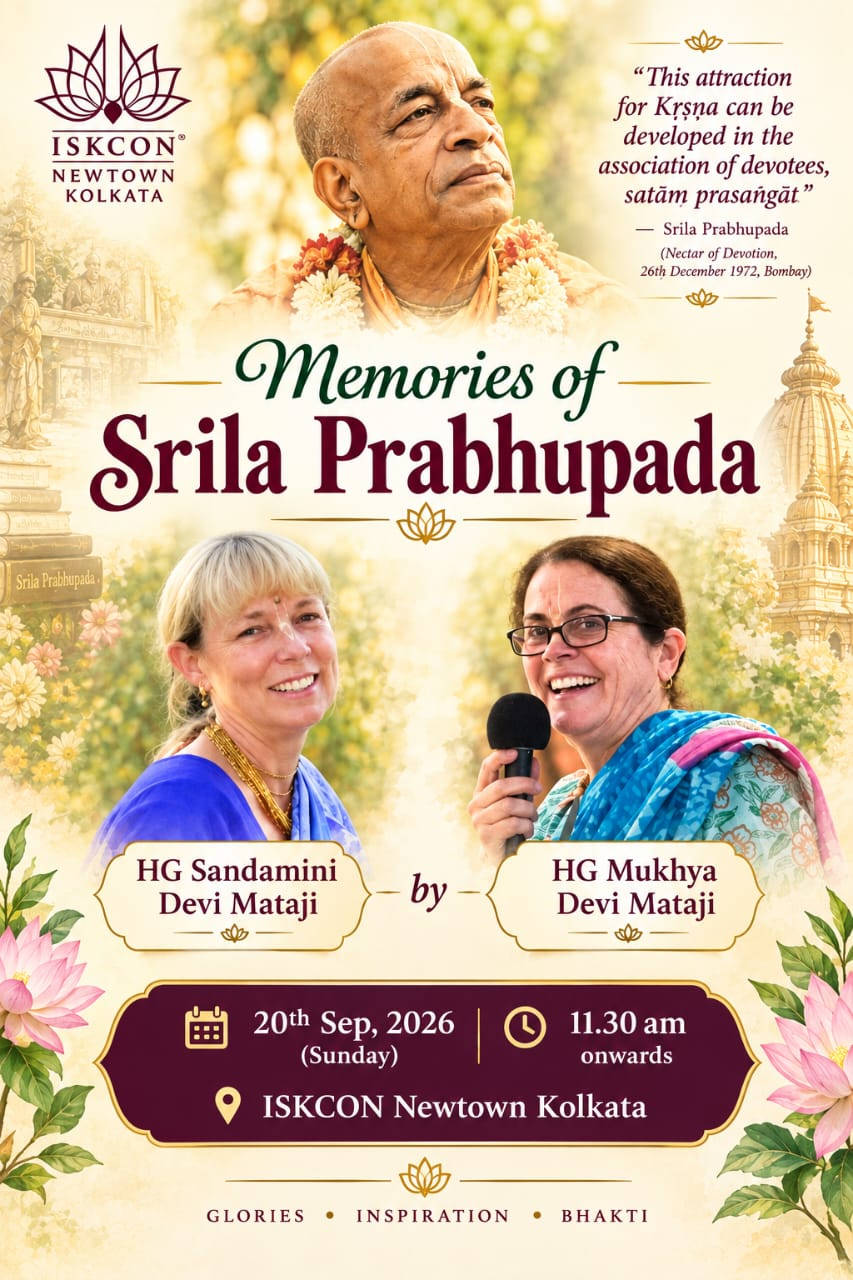
Krishna Katha and Memories of...
September 22, 2026
-
Choose Krishna in All Circumstances...
September 20, 2026