55th Kolkata Rath Yatra 2026 – Srimad Bhagavatam Class by HH Subhag Swami Maharaja (18th July)
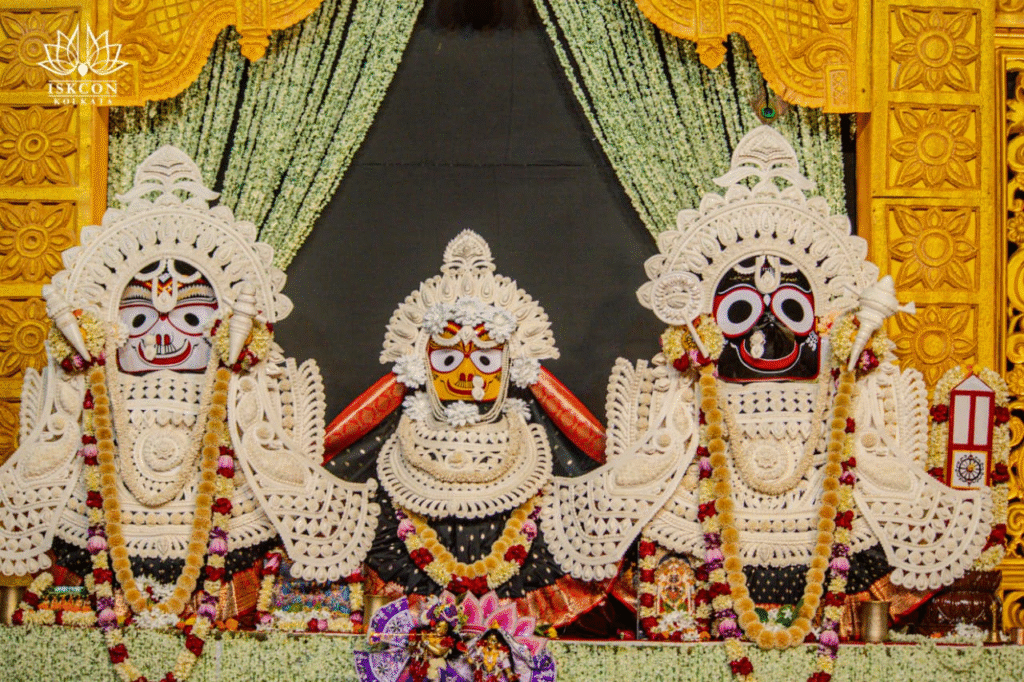
Following are the important points from the Srimad Bhagavatam Class given by HH Subhag Swami Maharaja at the 55th Kolkata Rath Yatra Pandal on 18 July 2026. Maharaja spoke on the verse SB 1.15.6
Yoga, Viyoga and Our Constitutional Position
One is called viyoga and the other is yoga. Chanting connects us to Krishna, which is yoga. Viyoga means feeling separation from Krishna.
We suffer because we forget Krishna. It is said, “Kṛṣṇa bhuli’ sei jīva…” Another place it is said, “Anādi bahirmukha jīva…” We are forgetting Krishna because we are trying to enjoy this material world.
We are taṭastha-śakti, i.e., the marginal energy of the Lord, situated between His external and internal energies. When we render service to Krishna, we are under His internal energy. When we forget Him, we come under bahiraṅga-śakti (the external energy).
Since we wanted to enjoy like Krishna, we have been sent to this material world. Thus, sometimes we become Brahmā, sometimes Indra, sometimes ghosts, animals, birds, trees, and so on.
When we are fortunate enough to attain a human birth, we get the opportunity to come out of the cycle of birth and death. Human life is very rare. We transmigrate through 8.4 million species, and by surrendering to Krishna, serving Him, and taking guidance from devotees, we become free from the clutches of māyā.
Śrīmad-Bhāgavatam and Krishna – The Source of Everything
Śrīmad-Bhāgavatam is the essence of all Vedic literature. It begins with “janmādy asya yataḥ…”, where the Vedānta-sūtra begins its explanation. The opening verse concludes with “satyaṁ paraṁ dhīmahi”—meditating upon the Absolute Truth.
Krishna says in the Bhagavad-gītā, “ahaṁ sarvasya prabhavo”—”I am the source of everything.” Both the spiritual and material worlds emanate from Him. Those who are truly wise surrender unto Him.
The symptoms of those who serve Krishna are described in the verse “mac-cittā mad-gata-prāṇāḥ…”
Lord Chaitanya and the Mood of Separation
To enjoy loving exchanges, Krishna expands Himself as Rādhā and Krishna, and later appears as Śrī Krishna Chaitanya: “Śrī-kṛṣṇa-caitanya rādhā-kṛṣṇa nahe anya.”
As Lord Chaitanya, He shows how Śrīmatī Rādhārāṇī feels separation from Krishna, just as Arjuna also experienced separation from Krishna.
By accepting the mood of Śrīmatī Rādhārāṇī, Lord Chaitanya teaches us the highest way of serving Krishna. Feeling separation from Krishna actually means remaining united with Him—externally there is separation, but internally there is union. The symptom of this stage is ecstasy.
Since we are fallen and under the influence of māyā, our ācāryas teach us how to gradually come to this elevated stage. Just as Mahāprabhu instructed the Six Goswāmīs, and the Goswāmīs instructed our ācāryas, we should follow in their footsteps.
When Krishna went to Mathurā, Śrīmatī Rādhārāṇī felt intense separation. She prayed, “He Mathurānātha! He Dīna-dayāla!” “I cannot see You. When will I see You again? My heart is restless, not knowing what to do.”
The Need for Qualification
We are currently at the lower stage of devotional service. At present, we cannot fully appreciate the mood of Śrīmatī Rādhārāṇī and Lord Chaitanya Mahāprabhu.
Just as a child in kindergarten cannot understand a master’s degree, spiritual advancement happens gradually. A child progresses from kindergarten to primary school and then to higher levels. Similarly, one must become qualified before advancing in devotional life.
As we progress higher, many do not continue the journey. Advancement requires sincerity and qualification.
In our organization, there were around 10,000 disciples of Śrīla Prabhupāda. After fifty years, only a small percentage remained. Some devotees had left their bodies, but many others also did not remain steady in devotional service.
Remaining Steady in Bhakti
Devotional service is like walking on the edge of a razor. One has to be very careful in bhakti.
Krishna says, “daivī hy eṣā guṇamayī mama māyā duratyayā.” Māyā tests us at every moment. As we advance in devotional life, the tests become more difficult.
But Krishna also assures us:
“mām eva ye prapadyante māyām etāṁ taranti te.”
Those who surrender unto Him cross beyond māyā.
It is not easy to come to devotional life. The scriptures say: “bahūnāṁ janmanām ante…”
To come to the conclusion that Krishna is everything is su-durlabha—very rare.
Again it is said: “manuṣyāṇāṁ sahasreṣu…”
Out of thousands of people, only one or two attain perfection.
Spiritual Happiness and Transformation of Consciousness
It is also said, “brahma-bhūtaḥ prasannātmā…” Only in spiritual life can one experience real happiness. People outside spiritual life are generally full of anxiety.
Krishna is sat-cit-ānanda—eternal, full of knowledge, and full of bliss. You will notice a difference in your consciousness before practicing Krishna consciousness and after sincerely practicing Krishna consciousness.
The smile of a devotee is different from the smile of people absorbed in material life.
When you are hungry and you eat, you experience tuṣṭi (satisfaction) and puṣṭi (strength). As you continue eating, your hunger gradually disappears. Similarly, as you practice Krishna consciousness, you will notice a transformation in your consciousness. Earlier there may have been tension and anxiety. In spiritual life there may still be problems, but there is no anxiety. You live in Vaikuṇṭha, and in Vaikuṇṭha there is no kuṇṭha (anxiety).
Temporary Happiness vs Eternal Happiness
Many people name their child Gopal and affectionately say, “This is my Gopal.” Such attachment keeps them in this material world, and they return again to their “Gopal.” But devotees aspire to go to the spiritual world to serve the real Gopal—Lord Krishna.
People become joyful on seeing their grandson or other family members. But we should understand that these relationships are temporary. Except for bhakti and Krishna, everything in this material world is temporary. Therefore, we should not become attached to temporary things.
People experience great sadness when their son, wife, husband, father, or other loved ones pass away. That is material misery. However, the separation experienced by devotees from Krishna is completely different. This is what Lord Chaitanya Mahaprabhu and Śrīmatī Rādhārāṇī teach us—the highest love is love in separation.
Just as one must become qualified to pursue a PhD, similarly, one must become spiritually qualified to understand the mood of Lord Chaitanya Mahaprabhu and Śrīmatī Rādhārāṇī.
The Beginning of Devotional Life
We first begin with vaidhi-bhakti.
Associate with devotees.
Chant the Hare Krishna mahā-mantra.
Rise early in the morning, take bath, decorate the body with tilaka, attend maṅgala-ārati, and chant Hare Krishna.
Hear from senior devotees regularly. By hearing for a long time, the heart becomes purified.
As stated in Śrīmad-Bhāgavatam: “naṣṭa-prāyeṣv abhadreṣu…”
Gradually, one becomes free from the modes of passion and ignorance and comes to the platform of goodness.
Purification of the Heart
What are the symptoms of passion and ignorance? They are lust, greed, anger, pride, and envy. By practicing bhakti, these unwanted qualities gradually disappear.
The mode of goodness means prakāśa (illumination). Divine knowledge (divya-jñāna) awakens.
Krishna says: “bhaktyā mām abhijānāti.”
Through devotional service, we understand our eternal relationship with God. This process cleanses the dust accumulated within the heart.
Freedom from Bodily Identification
We identify ourselves with temporary bodily designations: “I am Indian,” “I am fair,” “I am a doctor,” “I am a dog,” “I am a tiger.” All these are bodily designations.
When we become free from false ego, we rise above these temporary identities.
Material desires gradually disappear.
We engage our mind and senses in the service of Krishna.
We begin to understand, “I am not this body. I am an eternal part and parcel of Krishna. My only duty is to serve Him.”
This advancement happens gradually, stage by stage.
The Nine Stages of Bhakti
The scriptures describe the gradual development of devotional service through nine stages:
- Ādau Śraddhā – One develops initial faith and comes to ISKCON to hear Krishna-kathā.
- Sādhu-saṅga – One associates with devotees.
- Bhajana-kriyā – Under the guidance of the spiritual master, one rises early, engages in devotional practices until around 10 a.m., and spends the rest of the day rendering service assigned by the authorities. One feels as though one is no longer living in Kolkata but in Vaikuṇṭha.
- Anartha-nivṛtti – One gradually becomes free from unwanted desires, such as eating outside food, watching movies, and other material habits. One also begins to follow the four regulative principles.
- Niṣṭhā – Steadiness in devotional service.
- Ruci – Developing genuine taste for hari-kathā and devotional practices.
- Āsakti – Deep attachment to Krishna and devotional service. One cannot remain without practicing bhakti.
- Bhāva – One naturally and spontaneously thinks of Krishna.
- Prema – Pure love of Godhead, the ultimate goal of devotional life.
Arjuna is on the platform of bhāva-bhakti. We are presently below that stage and must gradually progress along the same path. Eventually, some devotees attain spontaneous attraction for Krishna.
Questions & Answers with Maharaja
Before concluding his Srimad-Bhagavatam class, HH Subhag Swami Maharaja invited questions from the devotees and answered them to their satisfaction.
Q1. How can we quickly attain anartha-nivṛtti?
If we sincerely follow the instructions of the spiritual master, anartha-nivṛtti will come quickly. Otherwise, it may take many lifetimes.
We should honestly ask ourselves whether we still have attachment to sense gratification.
We have to develop a higher taste, as explained by Śrī Yāmunācārya.
For example, if we develop a taste for Krishna-prasāda, we naturally give up the bad habit of eating outside food.
The highest material pleasure is the attraction between a man and a woman. Yāmunācārya says that after experiencing the higher taste of devotional service, he spits at the very thought of such material enjoyment. We may not be able to say this now, but by sincerely following the process of bhakti, we can gradually come to that stage.
Q2. Bhakti gives a higher taste, but why do devotees still fall down?
Just as not every student reaches the highest class, not everyone advances to higher stages of devotional life. One has to sincerely study and practice.
The two strongest attractions in this material world are wealth and the opposite sex.
Since we have been attached to these things for countless lifetimes, is it easy to give them up? No.
However, by associating with devotees, rendering service, and faithfully following the instructions of the spiritual master, we receive the spiritual strength to protect ourselves.
Q3. How do we develop the strength to follow the instructions of the spiritual master?
Associate with devotees who are firmly fixed in spiritual life.
For example, waking up early every day may seem difficult. But when we see other devotees rising early and enthusiastically engaging in devotional service, we become inspired to do the same.
As the saying goes: “Jaise saṅga, vaise raṅga.” We become influenced by the association we keep.
Q4. How can we save ourselves from prayāsa (over-endeavour for material success or fame)?
Use common sense. Ask yourself, “How much can I realistically do?” Do whatever is practical according to your capacity.
For example, I should not think that I can immediately become Śrīla Prabhupāda. We should honestly assess our own level and proceed accordingly.
Q5. What is the secret of your selfless service for the last 55 years? Please guide us so that we can also render selfless service.
The scriptures say: “yasya deve parā bhaktir yathā deve tathā gurau…”
One who has equal faith in Krishna and the spiritual master receives all the confidential truths of the scriptures.
If we deeply reflect on this verse, we will find the answer. The secret of selfless service is contained within this śloka.
Q6. How can we completely surrender to Krishna and develop faith in Him when the mind is always fearful?
It is said: “Bhajo re mana…” If we take shelter of Krishna, we become fearless and free from lamentation.
By associating with God, we become happy and joyful.
The mind can become either our friend or our enemy—it depends on us.
Everyone’s mind is restless. Even Arjuna admitted this.
Krishna replied: “abhyāsena tu kaunteya vairāgyeṇa ca gṛhyate.”
Through constant practice and detachment, the mind can be controlled. We develop this higher taste by strictly following the instructions of the spiritual master.
We should make the mind our friend by training it to obey us. Otherwise, the mind becomes our enemy and drags us toward material life. When the mind tells us to do something wrong, we should firmly say, “No, I will not do it.”
By repeatedly practicing this, the mind gradually comes under control. Otherwise, impure thoughts enter the mind and eventually overpower us.
It is like a tug of war. If we become spiritually strong through chanting, hearing, association, and service, then whenever the mind proposes something improper, we will have the strength to say “No.” In this way, we gradually become victorious over the mind.
These were some of the important points from the Srimad Bhagavatam Class by HH Subhag Swami Maharaja on 18th July 2026 at 55th Kolkata Rath Yatra Pandal.
55th Kolkata Rath Yātrā 2026 – Śrīmad-Bhāgavatam Class Series




Search
Recent Posts
-
Srimad Bhagavatam at ISKCON Newtown...
September 1, 2026
-
Janmashtami: Celebrating Krishna’s Appearance Through...
August 17, 2026
-

Gopinatha Pattanayaka: 6 Lessons for...
August 16, 2026
-
What Does Krishna Say About...
August 11, 2026
-
Are you ready to choose...
August 2, 2026