Krishna expects us to work sincerely like Arjuna

Sometimes we have the tendency to justify our irresponsible behaviour using devotion as an excuse. Many a times working devotees (including me) develop deep renunciation immediately after entering the office premise. Why am I working? It’s a wastage of time.
It’s not going to help me to develop love of God as my work is not directly linked to Krishna conscious activities. We become extremely philosophical and wilfully start neglecting our work.
Our feeling of renunciation is not because of our love for Krishna but because of our laziness, lethargy and unwillingness to face challenges in life. This can be easily understood because in the evening after leaving our workplace and during weekends our feeling of renunciation is untraceable. It pops up the next time we enter our workplace.
Krishna expects sincerity from us
The pseudo renunciation which we develop as per our whims is not going to help us in our personal, professional and most importantly devotional life. When Arjuna wanted to run away from the battlefield and wanted to beg for living then Krishna did not glorify Arjuna but rather admonished him. Krishna told him that dying in the war would be more glorious & graceful than running away from there.
Krishna also expects us to work sincerely like Arjuna. Like Arjuna we should never give up our work which is given to us by Krishna only. In fact, we should be sincere in our work. Work helps in our devotional life too. The money which we earn helps us to maintain ourselves, our family members.
It also facilitates in practicing devotion to Krishna peacefully. We can even use our money in spreading Krishna Consciousness movement either by donating some amount to the temple or by organizing devotional programs in our house or in any other ways which we find suitable.
If we are doing our work properly keeping Krishna in the centre, then we will also attract people to Krishna Consciousness.
More than our words, our action inspires people. If we are sincere, serious, hardworking and honest in our work then others will not only admire us but will also develop a positive impression about the devotees. It will motivate them to practice devotional life.
When chanting just chant, when working just work
Bhaktivinod Thakura is an ideal example for all the devotees. Through his life he has taught us how to be productive in occupational duties, how to be caring and loving towards the family members and how to be extremely sincere in executing devotion to Krishna. Following his footsteps we too can lead a healthy devotional life.
So, next time when the feeling of renunciation arises in our heart as we enter the office premise or open our laptop to work then we should remember Srila Bhaktivinoda Thakura. And we should also understand that this is not renunciation, but this is laziness and irresponsible behaviour which Krishna does not like.
We should always do our office work honestly and also practice devotional to Krishna sincerely.
A simple formula to follow – be always in the moment. It means “When you chant the names of Krishna just chant” and “When you work just work.” Do not mix both. This is what Arjuna did, and this is what Krishna expects us to do.
Three Reflections
- Krishna admonished Arjuna when he wanted to run away from the battlefield.
- Like Arjuna we should never give up our work, in fact, we should work sincerely and honestly.
- When you chant the names of Krishna just chant & when you work just work.
Ask Yourself
- Am I doing my office work sincerely?
Action Item
- Do your work sincerely. Use a timer to track your activities during office hour to make sure that you are not wasting time.

Search
Recent Posts
-
Purify senses, mind and false...
April 19, 2026
-

Unflinching Faith in Lord Chaitanya...
April 15, 2026
-

Teachings on Grihastha Life, Chanting...
April 15, 2026
-

Offense to Krishna’s devotee brings...
April 15, 2026
-

Few examples of Vaishnava Etiquette
April 15, 2026
google ads
Arjuna asks Krishna, why should I fight the Mahabharat war?
When Krishna asks Arjuna to fight the Mahabharat war then Arjuna is perturbed. He thinks that Krishna has explained that I am not this body but a soul. And as a soul I am spiritual and eternally related to Krishna. This body and all the relationships pertaining to this body is temporary.
So, why does Krishna want me to engage in any activity in this material world? Even if I win the war then what is the gain? Because ultimately, I will have to leave this body, so why to waste my time in this mundane affair?
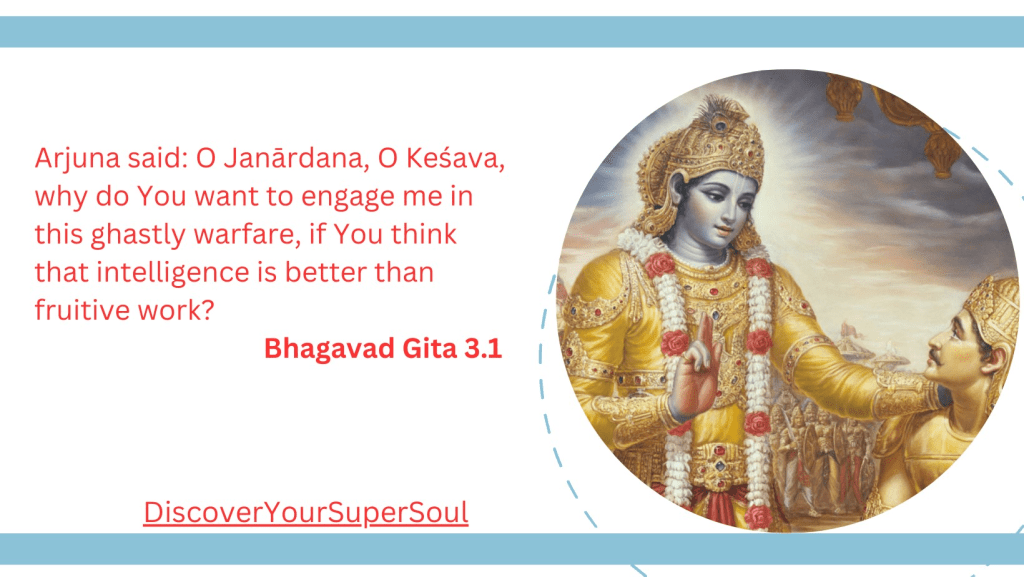
Arjuna said: O Janārdana, O Keśava, why do You want to engage me in this ghastly warfare, if You think that intelligence is better than fruitive work? Bhagavad Gita 3.1
This question confused Arjuna at the battlefield of Kurukshetra and this also confuses devotees who begin practicing Krishna Consciousness.
Like Arjuna we get confused about our prescribed duties
I remember in my college days when I got introduced to Krishna Consciousness then I also had the same question. Why should I study? What is the purpose of study? What is the benefit of getting good marks? And when I spoke to other devotee friends studying with me, they too had the same thoughts.
Before coming to Krishna consciousness, we want to work hard for success and for name and fame. But when we come to Krishna Consciousness, we start understanding how futile is mundane desire. Because nothing material is sustainable and most importantly, it never gives any pleasure to the soul.
So, we start thinking that better to refrain from all material duties. The same thought Arjuna had. Why to fight the Mahabharat war?
Never give up your prescribed duties
But Arjuna was fortunate that he had with him Krishna. And Krishna explained to Arjuna that the purpose of human life is to cleanse the heart of all the impurities and return back to the spiritual world. With impure heart we won’t attain the desired destination. Cleaning heart of all the dirt becomes easy when we engage in our prescribed duties. So, Krishna asks Arjuna to not give up his prescribed duty of fighting.
Arjuna was a kshatriya and so his duty was to fight the Mahabharat war to establish dharma. Similarly, we also have our prescribed duties as a student, as a working professional, as a housewife. So, we should not run away from our responsibilities.
But it does not mean that we should only be engaged in our prescribed duties. It is important that while doing our duty we should constantly remember Krishna. Because if we do so then we will always be in Krishna Consciousness.
How to work in this world?
Externally what we are doing and what the materialists are doing may look the same. But internally there will be an ocean of difference.
For example, Arjuna was fighting and also Duryodhana was fighting but Arjuna was fighting by keeping Krishna in the centre and Duryodhana was fighting for his selfish desire. So, we should follow the footsteps of Arjuna and not of Duryodhana.
If we do so, then like Arjuna we will also be victorious in our life. And Krishna will be pleased with us. Also, by doing our duty by keeping Krishna in our heart, our heart will get cleansed of all the impurities. Once our heart becomes pure, we will attain perfection and become eligible to return back to the kingdom of Krishna.
Search
Recent Posts
-
Purify senses, mind and false...
April 19, 2026
-
Unflinching Faith in Lord Chaitanya...
April 15, 2026
-
Teachings on Grihastha Life, Chanting...
April 15, 2026
-
Offense to Krishna’s devotee brings...
April 15, 2026
-
Few examples of Vaishnava Etiquette
April 15, 2026
google ads
Bhagavad Gita has solution for all our miseries
If you are tormented by miseries then do not worry, Bhagavad Gita has solution for all your miseries. None of us want suffering in our life but it comes knocking at our door. It not just knocks at our door but forcibly enters into our house, into our life.
From a rickshaw puller to a pilot flying high in the sky, from a government employee to a head of the government, from a beggar on the street to a business tycoon, from a baby in her cradle to an old man – all continuously search for happiness.
But in spite of our obsession with ‘happiness’, ‘miseries’ continuously accompany us like a shadow. Misery can be physical or can be psychological and it has a knack of appearing and disappearing at its own whims.
Types of miseries
Vedic scriptures tell us about the fourfold misery – birth, old age, disease and death. Till date since the dawn of creation there has not been a single being including non -humans who have not been affected by it. Who in this world would want to be diseased, grow old and ultimately die? But it happens to all of us.
In this world we are also subjected to three types of miseries:
- Miseries caused by nature such as excessive heat or cold, flood or famine, earthquake, tsunami etc. (adhidaivika-klesa)
- Miseries caused by the activities of fellow beings like terrorists or sometimes by our own near and dear ones. Even other species like mosquitoes, viruses too inflict on us sufferings in form of several diseases. (adhibhautika-klesa)
- Suffering caused by our own body and mind (adhyatmika-klesa). Bodily diseases, anxiety, depression, stress, fear of future etc. do not allow us to live in peace.
Scriptures are life’s manual
In spite of our repeated efforts, we are not able to defend ourselves against the onslaught of material miseries. The only approach which we consider effective is by increasing our worldly possessions and enhancing our material positions.
We think by filling our coffers with lots of money we can bribe misery when it knocks at our door and can change our destiny. But sadly, this rarely happens. Many times, we are caught off guard and suddenly we find ourselves in precarious situation.
One of the advantages of being a human being is that we have been gifted with intelligence. So, as an intelligent species shouldn’t we ask why in spite of all my efforts, irrespective of all the measures taken we are not able to free ourselves from the strong grip of grief and sorrow?
Are the precautionary measures taken by us aren’t sufficient or is it that the measures itself is erroneous and so outcome is always ineffective?
When we buy a new gadget such as an iPhone then along with it is given to us a manual which not just explains the functionalities of the device but also specifies dos and don’ts. And for effective functioning we are supposed to adhere to given guidelines.
But if we go against the advice then the device starts malfunctioning.
Similarly, we have also been given manuals by the creator of this world who is also our Supreme Father. These manuals are the sacred Vedic literatures which comprehensively give detail about this world, about our life and also delineate the process by which we can ward off all miseries and lead a peaceful life.
It will not just protect us from all dangers but will also guide us to a path which will open the door of perennial bliss.
How like Arjuna we can overcome misery
Arjuna was in abject misery and in tears just before the Mahabharat war. But after being thoroughly educated by Krishna in spiritual science he got enlightened and decided to work according to the directive of Krishna, the Supreme Lord.
By following the teachings of Bhagavad Gita which has solution to all the problems of life, Arjuna was able to come out of all miseries.
Krishna said, “Therefore, O Arjuna, surrendering all your works unto Me, with full knowledge of Me, without desires for profit, with no claims to proprietorship, and free from lethargy, fight.” Bhagavad Gita 3.30
Arjuna fought with grit without worrying about gain or loss. And since he was executing his given duties as per the laws of God, he was victorious. Krishna was always with him providing protection and guidance.
We suffer here because we go against the laws of God, we do not turn towards him, but we turn away from him. But like Arjuna, if we do all our activities as given in the scriptures and if we invite Krishna in our lives then we can protect ourselves from many unpleasant situations and circumstances.
Krishna saved Arjuna and he wants to save us too
After the Mahabharat war ended, Krishna asked Arjuna to get down from the chariot first. But Arjuna requested Krishna to get down first. Krishna advised Arjuna to do what he is being asked to do. So, Arjuna got down first and then Krishna followed.
And as soon as Krishna got down from the chariot, the chariot blew up and burned to ashes. Arjuna was horrified. Krishna explained that the weapons unleashed by Bhishma, Drona, Karna and other Kaurava warriors were extremely powerful but because of him the lethal weapons did not harm Arjuna a bit.
Arjuna always remained safe in Krishna’s hand. Krishna, the all-powerful and all merciful is our only saviour.
Yes, it is true that in this world a devotee of the Lord too undergoes through old age, disease, death and three types of miseries also affect him. But for devotees, Krishna is always there for him, just like he was for Arjuna.
Krishna shields his devotees from all dangers and provides him sufficient intelligence and inner strength which helps to nullify the miseries of this world. If we are in Krishna’s care, there is no fear and Krishna wipes all our tear.
Not just this after leaving this world we get an opportunity to return back to the kingdom of Krishna where there is no rebirth, no disease, no old age, no death, no adhidaivika-klesa, no adhibhautika-klesa and no adhyatmika-klesa.
“After attaining Me, the great souls, who are yogīs in devotion, never return to this temporary world, which is full of miseries, because they have attained the highest perfection.” Bhagavad Gita 8.15
Free from miseries we can live always happily
In Bhagavad Gita 3.10, Krishna says “Be thou happy by this yajna [sacrifice] because its performance will bestow upon you everything desirable for living happily and achieving liberation.” And the yajna in this world is chanting the names of Krishna, the Hare Krishna Mahamantra.
Chanting brings Krishna’s grace, and it opens the gateway to the spiritual world which is the abode of eternity and bliss. And so, Srila Prabhupada famously said, “Chant and be happy.”
Bhagavad Gita has solution for all our miseries, so if we live as per the guidelines of this great scripture we will never suffer and will live always happily.
Search
Recent Posts
-
Purify senses, mind and false...
April 19, 2026
-
Unflinching Faith in Lord Chaitanya...
April 15, 2026
-
Teachings on Grihastha Life, Chanting...
April 15, 2026
-
Offense to Krishna’s devotee brings...
April 15, 2026
-
Few examples of Vaishnava Etiquette
April 15, 2026
google ads
What Krishna says about lust in Bhagavad Gita? It destroys life.
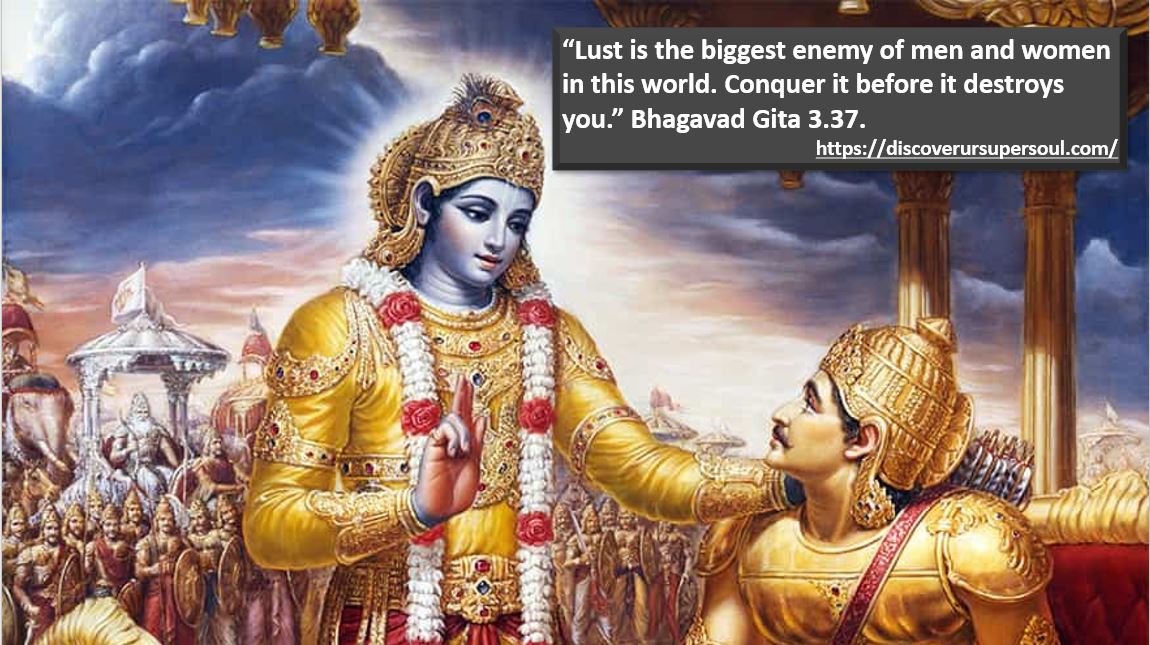
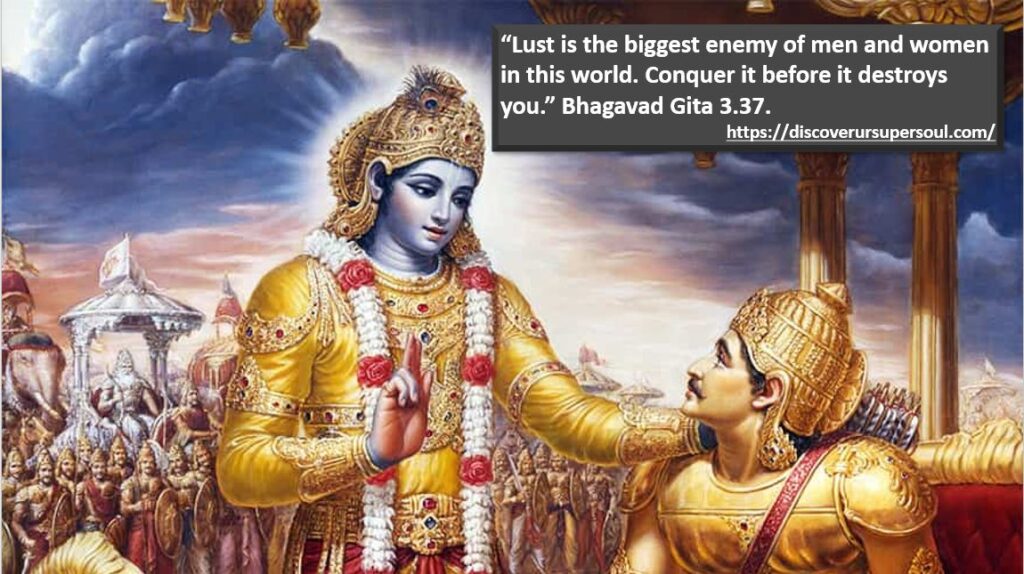
Krishna says in Bhagavad Gita that lust is the biggest enemy of men and women in this world. It destroys a person’s life completely.
In Bhagavad Gita 3.36, Arjuna has a question. He asks Krishna, “Why is it that one ends up committing sins even if he is unwilling to do it?” You might have this question too. Sometimes you do not want to do something sinful but ends up doing it. Let us see what Krishna says to Arjuna.
“The Supreme Personality of Godhead said: It is lust only, Arjuna, which is born of contact with the material mode of passion and later transformed into wrath, and which is the all-devouring sinful enemy of this world.” Bhagavad Gita 3.37.
Lust forces a person to do things even if he does not want to do it. So, Krishna says lust is the sinful enemy of this world.
What is the origin of lust?
In the spiritual world everyone has love for Krishna. But when one wants to enjoy in this material world away from Krishna then love transforms into lust.
Srila Prabhupada explains, “When a living entity comes in contact with the material creation, his eternal love for Kṛṣṇa is transformed into lust, in association with the mode of passion. Or, in other words, the sense of love of God becomes transformed into lust, as milk in contact with sour tamarind is transformed into yogurt.” Bhagavad Gita 3.37 purport.
Can lust be satisfied?
No matter how best we try we cannot satisfy lust. This is confirmed by Krishna in Bhagavad Gita. “Thus the wise living entity’s pure consciousness becomes covered by his eternal enemy in the form of lust, which is never satisfied and which burns like fire.” Bhagavad Gita 3.39.
For example, Ravana had many queens and one of his queens was Mandodari who was very beautiful and chaste. But still impelled by lust, Ravana also wanted to enjoy with mother Sita. Desire to enjoy with opposite sex is very strong in material life.
As prisoners are bound by shackles in a prison. Similarly in this material world everyone including you and me are bound by the shackles of lust.
Srila Prabhupada explains, “Therefore, this lust is the symbol of ignorance by which the living entity is kept within the material world. While one enjoys sense gratification, it may be that there is some feeling of happiness, but actually that so-called feeling of happiness is the ultimate enemy of the sense enjoyer.” Bhagavad Gita 3.39.
Lust is not just the desire to enjoy with the opposite sex. Any form of sense gratification is lust. “Sense gratification” means any desire to satisfy our senses rather than Krishna’s senses. As long as we are affected by lust, we will remain miserable.
Trying to satisfy lust is like pouring ghee in the fire. The more we try to satisfy lust, our lust becomes stronger. When lust is not satisfied then it gives rise to anger. Many times, it makes a person insane. So, at any cost we should give up lust.
At what stage we should control lust?
This human life is special. In this life it is possible for us to free ourselves from lust. And transform our lust into love for Krishna. Lust covers our real knowledge. We forget that we are parts and parcels of Krishna. We start thinking that we are material beings, and the purpose of our life is to enjoy our material senses.
But lust has to be controlled. And it can be controlled. Krishna explains that we should try our best to control our lust. It is always better to control the lust in the beginning. Krishna says to Arjuna, “Therefore, O Arjuna, best of the Bhāratas, in the very beginning curb this great symbol of sin [lust] by regulating the senses, and slay this destroyer of knowledge and self-realization.” Bhagavad Gita 3.41
To control lust, we should control our senses. The first step is that we should not allow our senses to engage in any form of activities which will aggravate lust. Also, it is important that we should not contemplate on the objects of the senses. For this, we should flood our mind with Krishna Conscious thoughts and activities. By doing this our mind will get busy with Krishna Conscious subject matters. And it won’t have time to think about lusty subject matters.
As of now our understanding is that we will become happy if we satisfy our material desires. But the truth is that we will become happy if we do not engage our senses in fulfilling our material desires. And we will become supremely happy if we start engaging our senses in serving Krishna.
Personal experience with lust
In my personal life also, I have observed that many activities I do not want to do but many times I end up doing it. It seems as if someone is compelling me do it. When I was not into Krishna Consciousness then I did not know what is good for me and what is bad for me. But after coming to Krishna consciousness, I understood what is harmful for my life. But in spite of knowing that sense gratification is harmful it is not always easy to give it up.
Many times, I took a vow to give up sense gratification. I succeeded for few days then I found that there is some force within me which is forcing me to indulge in those activities. For example, I find very challenging to give up internet addiction especially reading online news. Although I try to restrain myself, but I fail quite a number of times.
However, the best thing about Krishna Consciousness is that although initially it may look that giving up certain non-Krishna Conscious activities are difficult but if we pray to Krishna and try to work on it then gradually we are able to give it up. I won’t be right to say that I have been able to completely give up addiction for internet. But I can confidently say that it is reducing day by day.
And I am hopeful that if I follow Krishna’s advice and Srila Prabhupada’s teachings then I will be able to give my lust for material sense gratification one day. For me, internet addiction.
What is the best way to control lust according to Krishna in Bhagavad Gita?
To give up lust, it is important that we do not surrender to the demands of our senses and mind. But instead using our intelligence we should educate our mind about the harmful effects of lust which is sense gratification. To strengthen the intelligence, it is important that we do sincere spiritual practice. And read life transforming books like Bhagavad Gita.
Krishna gives us a formula by which we can control lust. He says, “O mighty-armed Arjuna, one should steady the mind by deliberate spiritual intelligence [Kṛṣṇa consciousness] and thus – by spiritual strength – conquer this insatiable enemy known as lust.” Bhagavad Gita 3.43
Control lust before it controls you. Destroy lust before it destroys you.
Search
Recent Posts
-
Purify senses, mind and false...
April 19, 2026
-
Unflinching Faith in Lord Chaitanya...
April 15, 2026
-
Teachings on Grihastha Life, Chanting...
April 15, 2026
-
Offense to Krishna’s devotee brings...
April 15, 2026
-
Few examples of Vaishnava Etiquette
April 15, 2026
google ads
What were Arjuna’s five reasons to not fight the Mahabharat war?
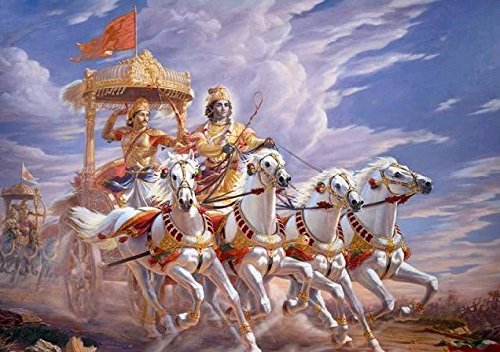
What were Arjuna’s five reasons to not fight the Mahabharat war at Kurukshetra? The Pandavas and the Kauravas had assembled at Kurukshetra for the epic war. Arjuna was one of the most formidable warriors. But just before the war, he felt that he should not fight. He was overwhelmed with the situation.
In fact, once he thought that it would be better if he flees the battlefield. At this moment of crisis he turned towards Krishna, the Supreme Lord, who was his charioteer, to share his feelings. He explained to Krishna why he did not want to fight.
Let us what were Arjuna’s five reasons to not fight the Mahabharat war:
1. Compassion
Arjuna was full of compassion. Although a fearsome warrior yet kind-hearted. A dear friend of Krishna and a well-wisher of all. He did not want war.
Krishna had tried his best to convince Duryodhana to not compel Pandavas for the war. But the evil son of the blind king, Dhritarashtra, was adamant. So Pandavas and Kauravas had assembled at Kurukshetra. Both the armies were facing each other.
But Arjuna shuddered at the thought that he will be fighting to kill his own family members. He will be shooting arrows towards Bhisma, his great grandfather, and Dronacharya, his guru.
He remembered his childhood days when he would sit on the lap of Bhisma and the great grandfather would caress him. Bhisma loved him so much. But today he was standing opposite to him to kill him. How can he do so?
Arjuna was one of the the greatest archer. Everyone accepted it. No one could face him in the battle. Even he pleased Lord Shiva with his archery skill. And all this was possible only because of Dronacharya, the great martial teacher. Dronacharya loved Arjuna like his own son. He put in his best efforts to make Arjuna the best archer of the world.
How can Arjuna fight against his guru, who was like his father?
The hundred Kauravas were his cousins. All were not bad. For example, Vikarna was a righteous person. Many were his younger brothers.
And then there were thousands of soldiers on both the sides. What were their crimes? Why to put their lives on risk? Why should they die?
Arjuna shares his feelings with Krishna
These thoughts filled Arjuna’s heart with compassion. He lost his composure. He was torn apart internally. At this hour of crisis, he turned towards Krishna, his friend, his ever well wisher and said,
- “My whole body is trembling, my hair is standing on end, my bow Gāṇḍīva is slipping from my hand, and my skin is burning.” Bhagavad Gita 1.29
- “I am now unable to stand here any longer. I am forgetting myself, and my mind is reeling. I see only causes of misfortune, O Kṛṣṇa, killer of the Keśī demon.” Bhagavad Gita 1.30
- “I do not see how any good can come from killing my own kinsmen in this battle, nor can I, my dear Kṛṣṇa, desire any subsequent victory, kingdom or happiness.” Bhagavad Gita 1.31
2. Enjoyment
Arjuna further said that even if I am victorious still, I won’t be able to enjoy the kingdom. To win the war I will have to kill my own family members. The kingdom will be soaked with the blood of my family members. My adorable grandfather, Bhisma, guru Drona who is like my father, my uncles, brothers, all will be killed. In their absence even if I win still I will be a loser. Fame and fortune cannot be enjoyed alone. To enjoy it we need to share it. But if they are killed then with whom I will share my joy.
Arjuna said, “O maintainer of all living entities, I am not prepared to fight with them even in exchange for the three worlds, let alone this earth. What pleasure will we derive from killing the sons of Dhṛtarāṣṭra?” Bhagavad Gita 1.32-35
3. Fear of sinful reactions
Killing is a sinful activity. If we kill others, we will incur sins. Sins will lead to suffering. I understand that Duryodhana and his ilks are aggressors, they are ruffians. So what? If they are acting impiously then should we also act irreligiously. What will be the difference between them and us? If like them we engage in this ghastly war and kill the enemies then we will be committing sins. So, it will be better Krishna if I do not fight.
“O Janārdana, although these men, their hearts overtaken by greed, see no fault in killing one’s family or quarreling with friends, why should we, who can see the crime in destroying a family, engage in these acts of sin?” Bhagavad Gita 37 – 38
4. Destruction of Dynasty
When all the assembled warriors will be killed then what will happen to their family? Who will give protection to the elders of the family? Children will become orphans. Women will be unprotected. If the elders of the family are not there, then who will guide the younger generation. In absence of proper guidance dynasty will be destroyed. And destruction of the dynasty will create chaos in the society and bring great disaster.
Consequences of destruction of the dynasty (Bhagavad Gita 1.39 – Bhagavad Gia 1.43)
- With the destruction of dynasty, family tradition is destroyed.
- When family tradition is destroyed then family members start practicing irreligion.
- And when irreligion increases then women of the family become polluted.
- When women become polluted then there is unwanted progeny.
- Unwanted progeny causes hellish life for the family and for those who are responsible for destroying family tradition. These unwanted population will not follow religious tradition because of which:
- Ancestors fall down because no one is there to offer them food and water i.e. pinda daan is stopped.
- Community projects and family welfare activities also stop.
Arjuna contemplated that destruction of the dynasty will bring calamity upon all. He said, “Kṛṣṇa, maintainer of the people, I have heard by disciplic succession that those whose family traditions are destroyed dwell always in hell.” Bhagavad Gita 1.43
Arjuna did not want hellish life for anyone. And he did not want to be the cause of hellish for others. Expressing his anguish, Arjuna said, “Better for me if the sons of Dhṛtarāṣṭra, weapons in hand, were to kill me unarmed and unresisting on the battlefield.” Bhagavad Gita 1.45
5. Indecision
Arjuna gave reasons as why he did not want to fight the Mahabharat war. But still he did not know if this was the right decision. He was confused. He was not convinced by his own argument. Bewildered and undecided he turned towards Krishna and expressed the feelings of his heart, “O Krishna, I do not know what is better for me. I see that the sons of Dhritarashtra are standing before me. But whether I should conquer them or be conquered by them, I do not know.” Bhagavad Gita 2.6
Arjuna was thinking why to be part of unnecessary violence. If Duryodhana was so adamant to be the king, let he be the king. I can live by begging. But he also knew that Duryodhana was cruel. He has committed so many sins.
Commenting on this verse Srila Prabhupada writes, “All these considerations by Arjuna definitely proved that not only was he a great devotee of the Lord but he was also highly enlightened and had complete control over his mind and senses.” Bhagavad Gita 2.6 purport
Finally Arjuna takes shelter of Krishna
Standing between both the armies the fearsome warrior was feeling helpless. Arjuna had given five reasons to Krishna as why he did not want war. But still he was not sure if not fighting was the right decision. He was not able to take the right decision. Arjuna the mightiest of the warrior on the battlefield of Kurukshetra decided to take shelter of Krishna. He beseeched Krishna to become his guru and guide him, who was now his surrendered disciple.
“Now I am confused about my duty and have lost all composure because of miserly weakness. In this condition I am asking You to tell me for certain what is best for me. Now I am Your disciple, and a soul surrendered unto You. Please instruct me.” Bhagavad Gita 2.7
Arjuna’s five reasons to not fight the Mahabharat war did not convince Krishna. Krishna ultimately persuaded Arjuna to not run away from Kurukshetra. The Supreme Lord made sure that his friend and devotee fight for the right cause and establish dharma.
To know the details, please read – Why Krishna wanted Arjuna to fight the Mahabharat war?
Search
Recent Posts
-
Purify senses, mind and false...
April 19, 2026
-
Unflinching Faith in Lord Chaitanya...
April 15, 2026
-
Teachings on Grihastha Life, Chanting...
April 15, 2026
-
Offense to Krishna’s devotee brings...
April 15, 2026
-
Few examples of Vaishnava Etiquette
April 15, 2026
google ads
Why Krishna wanted Arjuna to fight the Mahabharat war? To establish dharma.
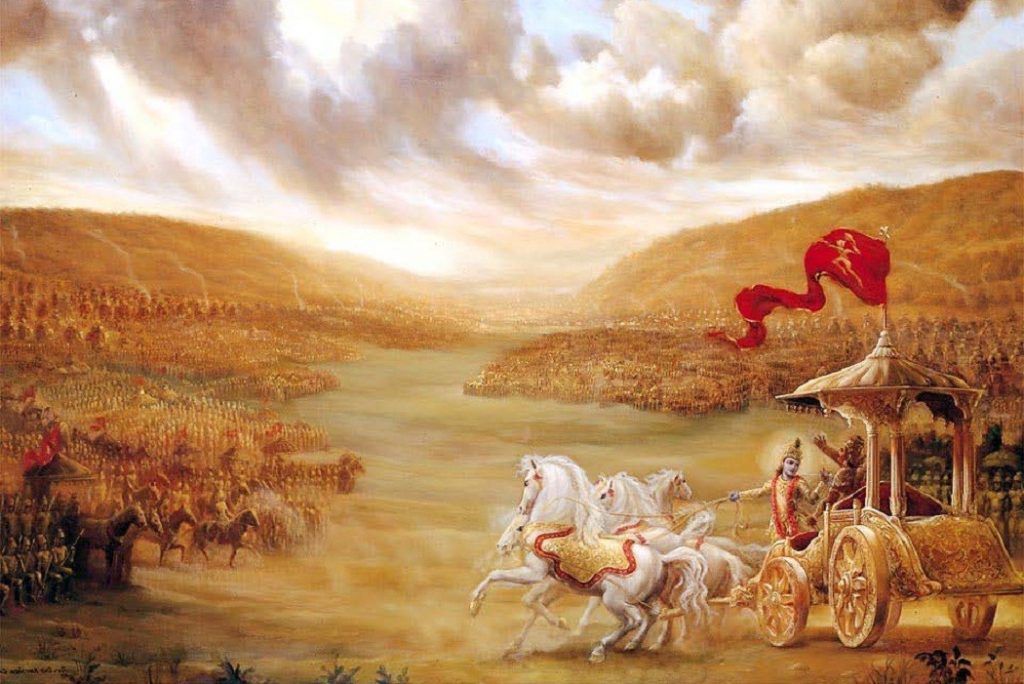
At the onset of Mahabharat war, Arjuna wanted to flee away from Kurukshetra, the battlefield. But Krishna wanted Arjuna to fight the Mahabharat war. You may wonder why Krishna wanted the war? War brings mayhem. So, no sane man wants war. But still Krishna, the Supreme Personality of Godhead, was unhappy when Arjuna was thinking not to fight.
You and I can list down many benefits if there was no Mahabharat war.
Tens and thousands of soldiers who died in the war would have been saved. Abhimanyu, Arjuna’s son, would have not lost his life. Bhisma and Drona would have not died. If Pandavas and Kauravas would have not fought there would have been no deaths, no widows, no orphaned children.
It appears to be a noble thought. Now picture a scenario. Group of terrorists have entered a city. Military comes to know about their hideout. They are about to ambush the terrorist camp. But the leader of the army develops cold feet. He does not want to attack the terrorists. Why should we kill them? They are our brothers; humans like us. Let us be non – violent. Let us let them live. The army aborts the mission. After few hours the terrorists create mayhem in the city. They kill hundreds of people – old, young, men, women, children none are spared.
What will you think about the leader of the army? A kind-hearted soldier? A generous leader or a coward? Will he be glorified or rebuked? Will he be punished or rewarded? The answer is obvious.
Duryodhana was not fit to become the king
Duryodhana was an atrocious person. Corrupt, cunning and cruel. To become the king of Hastinapur, he was ready to go to any extent. He had broken many religious principles to satisfy his wanton desires. Krishna knew Duryodhana’s demoniac mindset. He knew that if evil Duryodhana becomes the king, he will act against the religious principles. He will be an unjust ruler.
Duryodhana committed five major crimes. For these misdeeds, he should be punished and not rewarded.
Below we discuss the five major evil deeds of Duryodhana.
Five major crimes committed by Duryodhana which justifies the Mahabharat war:
1. Duryodhana tried to kill Pandavas deceitfully
Duryodhana was envious of his Pandava brothers since childhood. He envied them. Duryodhana especially disliked Bhima when they were kids. He tried to kill Bhima by mixing poison in his food. Later he threw unconscious Bhima into the water. But fortunately, Bhima did not die.
Later he tried to burn the Pandavas alive along with their mother, Kunti, in Lakshagriha. He did not have any hesitation in burning his aunt, Kunti, an old lady who was like his mother.
2. Duryodhana tries to disrobe Draupadi
In Kuru assembly, after the Pandavas lost the dice game, Duryodhana decided to insult Draupadi. Draupadi was his sister-in-law. It was his responsibility to protect her. But he was such a wicked person that he ordered his brother, Dushasana to bring Draupadi in the assembly hall. Karna supported him.
When Dushasana went to bring Draupadi, she was in her personal room. Dushasana dragged Draupadi, his sister-in-law, by her hair and brought her in the assembly. Draupadi was in shock. She was in tears. She feared for her honour and life. Duryodhana, Dushasana, Karna, Sakuni were laughing seeing the plight of Draupadi.
Laughing loudly, madly and arrogantly, Duryodhana gestured Draupadi to come and sit on his left thigh. While saying so, he was slapping his thigh.
None of the elders in the assembly could do anything or say anything. Dhritarashtra, the king, blindly attached to his son, Duryodhana, remained quiet. Elders like Bhisma, Vidura, Drona, Kripa all were helpless.
Duryodhana then asked Dushasana to strip Draupadi naked. Dushasana, Duryodhana’s younger puppet, started pulling Draupadi’s sari. Helpless Draupadi was tightly holding her sari begging everyone to save her. Duryodhana, Dushasana, Karna, Sakuni were laughing like mad men seeing the plight of Draupadi.
Duryodhana who wanted to be the king of Hastinapur was publicly shaming a woman. He wanted to preside the assembly where he was now shaming a woman.
Did Hastinapur deserve a king like Duryodhana who was abusing a woman publicly?
In the great Kuru assembly, surrounded by hundreds of great personalities, Draupadi found herself all alone. No one was there for her. She begged, pleaded, cried tears but no one came to help her.
Krishna saves Draupadi from Dushasana
Draupadi understood that other than the Lord there is no one who can help a mortal being. She left her sari which she was holding tightly, raised her both harms and helplessly cried Krishna’s names. Krishna was not there in the assembly hall. But Krishna is there in everyone’s heart. He heard Draupadi’s cry for help and immediately came for her help.
Dushasana was trying to pull the sari and Krishna provided unlimited sari to Draupadi. Dushasana tried hard to undress Draupadi but failed. He was exhausted and almost fainted. Krishna saved Draupadi. Evil four – Duryodhana, Dushasana, Karna, Sakuni – stopped laughing. Duryodhana failed to disrobe Draupadi.
Draupadi, seething with anger, took a vow in that assembly, “I will not tie my hair until it is bathed with the blood of Dushasana.”
Bhima who was somehow controlling his anger, stood up and took two vows:
Bhima’s vow in the Kuru assembly
Fuming with anger Bhima looked towards Duryodhana and Dushasana. He then looked towards everyone present in the assembly and took a vow:
I will kill Dushasana, rip apart his chest and will drink his blood. With that blood I will bathe Draupadi’s lose hair.
“O kings of the world,” he thundered, “listen to my words! I shall now make a vow unlike any that has been made before. Nor shall such a vow be made in future. If I do not forcefully tear open the breast of this sinful wretch on the battlefield and drink his blood, then may I not obtain the path of my ancestors.” – Draupadī Dragged to the Assembly
Although Duryodhana failed to disrobe Draupadi, but it shows his evil mindset.
3. Duryodhana abducts a Gandharva lady
Pandavas were exiled to the forest after they lost the dice game. Without any riches, they were living frugally in the forest. Duryodhana, Karna and Sakuni thought to go to the forest to humiliate the Pandavas. They decided to stay near the place where the five Pandavas were residing. Duryodhana wanted to display his opulence. This he felt will embarrass the five brothers.
In the forest Duryodhana committed another crime. He abducted a lady who was a Gandharva. Later the Gandharvas led by Chitrasena rescued the lady by defeating Duryodhana and Karna. Gandharvas even captured Duryodhana. Duryodhana and Karna thought they were great warriors, but they were defeated by the Gandharvas.
In fact, later Arjuna and Bhima went and rescued Duryodhana. Duryodhana had gone to humiliate the Pandavas but himself got shamed.
This again shows Duryodhana’s character. He had no respect for women.
4. Duryodhana disobeyed everyone including Bhisma, his great grandfather, and Dronacharya, his guru
Duryodhana never listened to anyone’s advice. He disrespected Bhisma, who was his great grandfather. Duryodhana disobeyed his guru, Dronacharya. He always rebuked Vidura, his uncle and one of the most noble souls in Hastinapur. And Dhritrashtra, his father, who was the king was Duryodhana’s puppet. Dhritarashtra was so attached to his son that he did not have the courage to say no to him.
A king should always be open to advice from the elders and the ministers. But Duryodhana was full of arrogance. He did not listen to anyone. Duryodhana always wanted to have his way. He only wanted to satisfy his ignoble desires.
5. Duryodhana tried to imprison Krishna, the Supreme Lord
Pandavas led by Krishna were very pious. Although Duryodhana had committed so many sins but still they were ready to forgive him and start afresh.
Krishna personally went to Hastinapur as a peace messenger. He wanted to convince Dhritarashtra and Duryodhana to give up all enmity. Yudhishthira, the eldest Pandava, was the heir of the throne of Hastinapur. But Krishna told Dhritarashtra and Duryodhana that the Pandavas are ready to give the throne of Hastinapur to Duryodhana. However in return Duryodhana should give 5 villages to Pandavas to rule.
But Duryodhana said that he will not give them a land even of the size of the tip of a needle.
Duryodhana did not stop there. He decided to imprison Krishna who had come as peace messenger. He asked the soldiers to attack Krishna and capture Krishna. Krishna is not an ordinary person. He is the Supreme Lord. So, how can he be imprisoned? But Duryodhana who was full of pride thought he can capture Krishna and put him in prison.
Krishna expanded himself. He showed his gigantic form. Everyone present there was stunned. Duryodhana’s soldiers were fearful to even go near Krishna.
Krishna left the palace. All attempt to make peace came to an end. The war was inevitable.
Conclusion: Krishna wanted Arjuna to fight Mahabharat war to establish dharma
Duryodhana as a king would have been a disaster. So, Krishna did not want him to become the king of Hastinapur. It is said – yathā rājā tathā prajā. It means “as is the king, so are the subjects.”
The general public follows the footsteps of the ruler. So, if the ruler is corrupt, immoral then people follow his path and become corrupt and sinful.
Krishna had appeared to eliminate wicked people like Duryodhana and his supporters like Karna. He wanted to establish dharma.
Yudhishthira was pious. He was Dharmaraj – upholder of religious values and principles. This is why, Yudhishthira was fit to rule Hastinapur. So, Krishna wanted Arjuna to fight the Mahabharata war and establish Dharma.
Search
Recent Posts
-
Purify senses, mind and false...
April 19, 2026
-
Unflinching Faith in Lord Chaitanya...
April 15, 2026
-
Teachings on Grihastha Life, Chanting...
April 15, 2026
-
Offense to Krishna’s devotee brings...
April 15, 2026
-
Few examples of Vaishnava Etiquette
April 15, 2026
google ads
7 unique features of Bhagavad Gita

Bhagavad Gita, one of the most celebrated literary masterpiece, contains pearls of wisdom which has served as a beacon light for humanity since ages.
Gita mahatmya 7 says, ekaṁ śāstraṁ devakī-putra-gītam: let there be one scripture only, one common scripture for the whole world – Bhagavad-gita. Eko devo devakī-putra eva: let there be one God for the whole world – Sri Krishna.
In Bhagavad Gita there is a conversation primarily between Krishna, the Supreme Lord, and Arjuna who represents the living entities and who is struggling in the midst of a battlefield with his emotions.
Arjuna’s Identity Crisis
Krishna in Bhagavad Gita teaches us that even a personality like Arjuna who was the greatest warrior of his time too became helpless when he was just about to fight the most important battle of his life at Kurushetra.
Arjuna had started giving his own reasons to not fight the war, “It’s true that I am a Kshatriya and I should not shy away from fighting but they are not my enemies they are my relatives. If I kill them I will incur sins.”
It is true that situations most of the time will not remain in our control but we can chose our responses by controlling our consciousness. Like Arjuna a situation may arise when we may have the skill to win but may lose the will to fight the battle of life.
Arjuna came to the battlefield as a warrior but upon seeing Bhsima and Drona he started identifying himself as a grandson, as a student and as a brother.
- As a warrior he was supposed to fight with Bhisma but as a grandson he was supposed to offer respects to Bhsima.
- As a warrior he was supposed to slay Dronacharya, one of the most formidable warriors on the side of the Kauravas, but as a student he started remembering his duty as a disciple.
- And as a brother he was supposed to shower love and affection on his siblings and was not supposed to destroy them.
This identity crisis made Arjuna helpless so much so that his famed weapon, Gandiva, started falling from his hand and he started quivering.
During this difficult phase of his life even a slightest mistake would have destroyed his reputation and the fate of the Pandavas during the epic battle.
Fighting in proper consciousness
Srila Visvanatha Chakravarti Thakura explains that when Arjuna was reluctant to fight the battle then Krishna, in a chastising mood, said to Arjuna, “Now you are not honoring my words, but later, because you are a great hero, your natural eagerness to fight will unavoidably manifest itself. Then, when you set out to kill Bhisma and others on your own accord, I will laugh at you.”
Although Arjuna is giving many reasons not to fight but Krishna knows that since he belongs to a warrior clan so he will ultimately fight.
So if Arjuna is anyway going to fight then why does Krishna speak the message of Bhagavad Gita to Arjuna?
It is because Krishna wanted that Arjuna fights in proper consciousness i.e. Krishna Consciousness. If Arjuna fights whimsically and is driven by modes of nature then he may commit sins and suffer. But if he fights as per the instructions of Krishna he will not just emerge victorious but he will not be subjected to any sinful reactions.
Arjuna being learned knew that in crisis it is better to seek guidance from one who is more knowledgeable, trustworthy and best well-wisher. So without hesitation he turned towards Krishna and petitioned him, “Now I am confused about my duty and have lost all composure because of miserly weakness. In this condition I am asking You to tell me for certain what is best for me. Now I am Your disciple, and a soul surrendered unto You. Please instruct me.”
If we also make friendship with Krishna then when confronted with difficulties we will know where to go and whose shelter to take.
Identifying the eternal identity
Krishna first establishes that when we are confronted with many identities then we should rise above all identities and focus on our spiritual identity which is eternal and never changing. All identities related to this ephemeral world has beginning and an end. Any identity in this world if it is preventing us to do our spiritual duty then we should reject it unconditionally.
If we are situated in our spiritual identity as an eternal parts and parcels of Krishna then situations of this world will not bewilder us. And Krishna like an expert captain of the ship will help us to navigate through the turbulent waves of material miseries.
Action in Krishna consciousness
The nature of this world is that sufferings will come, bewildering situations will arise. But if we purify our intelligence with message of Bhagavad Gita then we will get the strength to tolerate the provoking situations and expertly find a solution to the challenging situation.
As long as we are living in this world we have to act, none of us can remain idle and not do anything. But if we do our duties as per our own accord then we put ourselves under the jurisdiction of material laws. But if we do our duties by keeping Krishna in the centre then we will be acting for Krishna and Krishna will always guide us and protect us.
Through Arjuna Krishna is teaching two important lessons:
- Human life is meant for hard work and so we should put in our best efforts like Arjuna in any activity we are doing and which is not against religious principles.
- In spite of all our material credentials we should always take guidance of Krishna and not act as per our whims.
Unique features of Bhagavad Gita
- Bhagavad Gita also makes it clear that Krishna is not an ordinary living entity but he is the Supreme Personality of Godhead. B.G. 9.10, 10.12,10.13,10.8, 14.4. So, the teachings of Bhagavad Gita is perfect and timeless because it has been spoken by the Supreme Personality of Godhead.
- In Gita it is established that we the living entities are suffering because we have turned away from Krishna. So like Arjuna we should give the reins of our life to Krishna.
- In Gita, Krishna’s love for his devotees is established. Krishna assures that one who takes his shelter is always under his protection, gets delivered from all sins and he never suffers (B.G. 18.66).
- Like a loving father who takes all responsibility of his child, Krishna also takes all responsibility of his devotee and provides him everything which he requires in his life. B.G. 9.22
- In Gita Krishna glorifies bhakti, devotion, (B.G. 6.47) and also explains how practicing it practically is so easy and simple. B.G. 9.26,9.27.
- Those souls who surrender to Krishna finally reaches his eternal and imperishable abode by his grace. (B.G.15.6, 18.56)
- In Bhagavad Gita Krishna continuously establishes through logics and examples that as soon as the living beings who have forgotten his actual identity comes closer to him and start executing his responsibilities as per his guidelines then his life becomes successful. So the concluding verse of Bhagavad says, “Wherever there is Krishna, the master of all mystics, and wherever there is Arjuna, the supreme archer, there will also certainly be opulence, victory, extraordinary power, and morality.”
So, Gita mahatmya 1 says that Bhagavad Gita being a transcendental literature should be read carefully and if one follows its instructions wisely then he can free himself from all fears, miseries and anxieties of this world.
Search
Recent Posts
-
Purify senses, mind and false...
April 19, 2026
-
Unflinching Faith in Lord Chaitanya...
April 15, 2026
-
Teachings on Grihastha Life, Chanting...
April 15, 2026
-
Offense to Krishna’s devotee brings...
April 15, 2026
-
Few examples of Vaishnava Etiquette
April 15, 2026
google ads
Krishna’s devotees – Too busy To be lazy


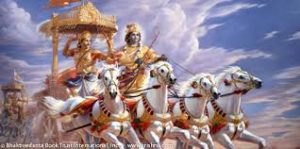
Once a person complained to Srila Prabhupada, “Your Krishna consciousness movement makes people dull.” Prabhupada immediately said, “The two most important wars which happened in Indian history was fought by Vaisnavas. One was the war between Lord Rama and Ravana and the other was the battle at Kurushetra.” Prabhupada further said we want Vaisnavas like Arjuna who have a spirit to fight and not some dull people who are lazy.
Arjuna was the best archer of the world and also a great devotee of Krishna. He is praised as Gudakesa because he conquered sleep. Once Arjuna was taking food in the night and suddenly the lamp blew off because of wind. Arjuna continued eating. After sometime he thought although it is dark but still my hand easily finds my mouth. It is happening because I have a desire to eat so even the darkness is not able to stop me. So if my hunger to become the best archer of the world is strong then I can even practice archery in the night. And so from that day onwards Arjuna started honing his archery skills in the night also while rest others enjoyed sleep.
But in spite of being the best warrior of the world Arjuna got bewildered when he was about to fight the most important battle of his life at Kurushetra. He started giving his own reasons to not fight the war, “It’s true that I am a Kshatriya and I should not shy away from fighting but they are not my enemies they are my relatives. If I kill them I will incur sins.”
Srila Visvanatha Chakravarti Thakura explains that in response Krishna, in a chastising mood, says to Arjuna, “Now you are not honoring my words, but later, because you are a great hero, your natural eagerness to fight will unavoidably manifest itself. Then, when you set out to kill Bhisma and others on your own accord, I will laugh at you.”
Although Arjuna is giving many reasons not to fight but Krishna knows that since he belongs to a warrior clan so he will ultimately fight.
So if Arjuna is anyway going to fight then why does Krishna speak the message of Bhagavad Gita to Arjuna?
It is because Krishna wanted that Arjuna fight in proper consciousness i.e. Krishna Consciousness. If Arjuna fights whimsically and is driven by modes of nature then he may commit sins and suffer. But if he fights as per the instructions of Krishna he will not just emerge victorious but he will not be subjected to any sinful reactions.
As long as we are living in this world we have to act, none of us can remain idle and not do anything. But if we do our duties as per our own accord then we put ourselves under the jurisdiction of material laws. But if we do our duties by keeping Krishna in the centre then we will be acting for Krishna and Krishna will always guide us and protect us.
Through Arjuna Krishna is teaching two important lessons:
- Human life is meant for hard work and so we should put in our best efforts like Arjuna in any activity we are doing.
- In spite of all our material credentials we should always take guidance of Krishna and not act as per our whims.
Search
Recent Posts
-
Purify senses, mind and false...
April 19, 2026
-
Unflinching Faith in Lord Chaitanya...
April 15, 2026
-
Teachings on Grihastha Life, Chanting...
April 15, 2026
-
Offense to Krishna’s devotee brings...
April 15, 2026
-
Few examples of Vaishnava Etiquette
April 15, 2026
google ads
Should a devotee give up his duty?
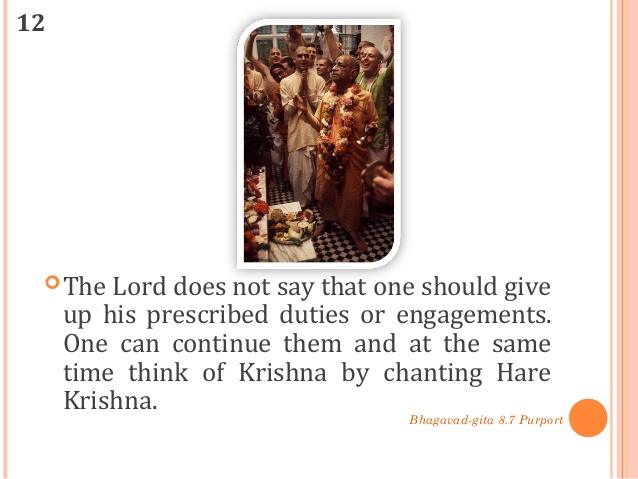
When Arjuna wanted to run away from the battlefield of Kurushetra, Krishna told him not to do so.
When Arjuna wanted to leave everything and go and beg, Krishna told him not to give up his prescribed duties.
When Arjuna overwhelmed with emotion was trembling and was not able to lift his Gandiva weapon Krishna wasn’t pleased. Why? Because Krishna wanted Arjuna to do his duty with all seriousness and sincerity.
Like Arjuna many times those of us who are practicing (or at least trying to practice) Krishna Consciousness try to run away from the field of action and justify it by saying that the action will entangle us in this material world. But how can we be sure that our non-action will not entangle us in this material world?
Scriptures never asks us to give up our prescribed duties which is not against the religious principles. If we study the lives of great devotees we would find that they were extremely hardworking and expert in their professional fields. Whether one is a monk or a householder, men or women one has to work. Materialists also work hard and devotees also work hard. The difference is that materialist work to gratify their senses, their aim is name, fame, money, power and positions. But a devotee works hard to satisfy the senses of Krishna, whatever he achieves he offers it to Krishna. A devotee tries to put in his best efforts and does not bother about success or failure. He knows that his sincere efforts will please Krishna and not its outcome. Whereas for materialists if the endeavor does not bring desired result he becomes miserable and he gets more entangled in this world.
Bhaktivinod Thakura was a high court judge and he was so expert in his work that when he wanted to take retirement then the government pleaded him not to do so. In fact when the authorities found that it is becoming difficult for him to go to office because his house was far from the court they constructed a railway line from his home to office because they did not want to lose such an expert professional. And while doing his duty he practiced and preached the teachings of Lord Chaitanya. He has set a standard which we all should try to follow.
But many times I have observed that in the garb of devotional life we become less enthusiastic in our occupational duties and family responsibility. This creates a negative impression not just about us but about the entire Krishna Conscious movement. And since this is not what Krishna wants us to do so eventually it starts affecting our devotional life too.
So as a devotee it is imperative that while practicing our devotion, while diligently following the principles of devotional life we should also sincerely execute our responsibilities in this world. This will help us to become stable in our devotional life and will also help in building a happy and productive Krishna Conscious society.
Search
Recent Posts
-
Purify senses, mind and false...
April 19, 2026
-
Unflinching Faith in Lord Chaitanya...
April 15, 2026
-
Teachings on Grihastha Life, Chanting...
April 15, 2026
-
Offense to Krishna’s devotee brings...
April 15, 2026
-
Few examples of Vaishnava Etiquette
April 15, 2026
google ads