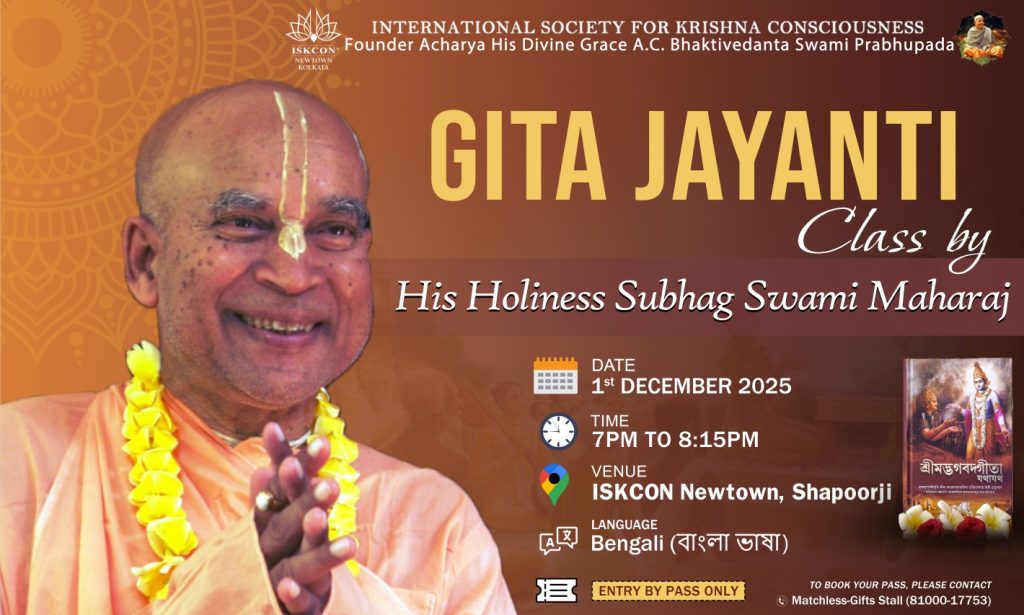
Gita Jayanti Celebration at Iskcon Newtown Kolkata on 1st Dec 2025


Gita Jayanti was celebrated on 1st Dec 2025 at Iskcon Newtown Kolkata. 1st Dec was also Mokshada Ekadasi. On this day Lord Krishna had spoken Bhagavad Gita to Arjuna at Kurukshetra around 5000 years ago.
On this special occasion morning Srimad Bhagavatam Class was given by HG Anant Bhagavan Prabhu. He spoke on Bhagavad Gita 2.7 verse. Prabhuji explained how this wonderful book offers highest knowledge to all i.e devotion to Krishna. He further said that we should always remember the verse – man mana bhav mad bhakto – so that we never forget Krishna.
As this month is Gita Marathon, so different devotees are going to different places to distribute Srila Prabhupada’s books. So, after Bhagavatam class, devotees share their realizations of distributing Bhagavad Gita. On the day of Gita Jayanti, Anshu Prabhu shared his experience of distributing Srila Prabhupada’s books in Sealdah.
Recitation of Bhagavad Gita verses
On Gita Jayanti, devotees like to recite all 700 verses of Bhagavad Gita. So, a special arrangement was made at Iskcon Newtown Kolkata to recite Bhagavad Gita verses in the temple hall.
A table was set up where Bhagavad Gita was kept. Flowers and flower garlands were offered to the book. Each devotee was given a small Gita which had all 700 verses to recite.
Devotees gathered in the temple hall at around 10 am to recite the verses. The recitation began at 10:10 am. During recitation each chapter was led by different devotees. It was a wonderful experience to recite the verses together with all the devotees in front of Sri Sri Nitai Gauranga. Recitation completed at around 12:30 pm.
Immediately after that HH Subhag Swami Maharaja came to temple hall to take darshan of Sri Sri Nitai Gauranga and to bless the devotees. Devotees were happy to get association of Maharaja; everyone began doing ecstatic kirtan. It was a wonderful way to conclude the recitation of Bhagavad Gita.
Gita Maha Yajna & special class by HH Subhag Swami Maharaj
In the evening there was Gita Maha Yajna which began at around 5 pm. Those devotees who had sponsored Bhagavad Gita participated in the yajna. Yajna kund was built in the kutir which is adjacent to temple hall. Devotees sat around the yajna kund and offered oblation to the fire while chanting the Vedic mantras and reciting Gita verses.
In the evening there was special class by HH Subhag Swami Maharaja from 7:00 PM – 8:30 PM.
At that end there was delicious prasadam for all.
Search
Recent Posts
-

Unflinching Faith in Lord Chaitanya...
April 15, 2026
-

Teachings on Grihastha Life, Chanting...
April 15, 2026
-

Offense to Krishna’s devotee brings...
April 15, 2026
-

Few examples of Vaishnava Etiquette
April 15, 2026
-

Srimad Bhagavatam @Iskcon Newtown Kolkata...
March 4, 2026
google ads
Bhagavad Gita’s transcendental wisdom helps to transcend all miseries


Just imagine what would have been the outcome of the Mahabharat war if Arjuna would have fled the battlefield. Cunning Duryodhana guided by Sakuni would have become the ruler and under his rein, we could easily understand what would have been the plight of common men and women.
But Arjuna was fortunate because he had chosen to be with Krishna. Not just that he was even willing to listen from Krishna without any prejudice. By hearing Gita directly from Krishna, the Supreme Lord, and by applying Bhagavad Gita’s transcendental wisdom in his life, Arjuna changed his future and the outcome of the ghastly war.
In our life too, we have to fight many battles. Our battles may not be as big as that of Arjuna but whatever challenges we face have the potential to change the direction of our life. It can either bring great glory or bring big misfortune.
It all depends upon the choices we make in our life. If like the heroic warrior, Arjuna, we decide to turn towards Krishna then we too will win the battles of our life.
When overwhelmed with confusion and despondency Arjuna approached Krishna then Krishna did not teach him the archery skill to fight the formidable warriors on the kuru side. Nor did he give any mundane motivational talk as how not to have doubt in his own ability.
But from the beginning Krishna helped Arjuna understand his real constitutional position that he is not the mundane body but spirit soul. And as spirit soul, he is eternally related to him.
Bhagavad Gita’s transcendental wisdom helps us understand that this material world and the perishable body are temporary dwelling place for us and we should not get too much attached to it. But instead, we should focus more on coming out of this entanglement of material existence.
Krishna’s important message for us
How to do so, is also told by Krishna in Bhagavad Gita. The Supreme Lord says that whatever we do, we should do it for him. We should never run away from our responsibilities and duties but whatever actions we perform its result should immediately be offered to him. He further says that we should never succumb to lust, greed and anger because these are gateways to hell.
If we abide by the principles of Bhagavad Gita and apply Gita’s transcendental wisdom in our life, then nothing of this material world will ever disturb us. Just like Arjuna gave the rein of his chariot to Krishna, we too should give the rein of our life to Krishna. We too will then always emerge victorious. That victory will also gradually take us towards Krishna and free us from material entanglement. While fighting the gruesome war at the battlefield of Kurukshetra, Arjuna always remembered Krishna.
We too should never forget Krishna but should always remember Krishna. This is what Krishna expects us to do.
“Always think of Me, become My devotee, worship Me and offer your homage unto Me. Thus you will come to Me without fail. I promise you this because you are My very dear friend.” Bhagavad Gita 18.65
Once Krishna becomes the centre of our life then nothing in this material world will ever bring tears in our eyes. Instead with Krishna we will celebrate every moment of our life.
Three reflections
- Our battles may not be as big as that of Arjuna but whatever challenges we face have the potential to change the direction of our life.
- Just like Arjuna gave the rein of his chariot to Krishna, we too should give the rein of our life to Krishna.
- While fighting the gruesome war at the battlefield of Kurukshetra, Arjuna always remembered Krishna.
Ask Yourself
- Do I remember Krishna while performing our duty?
Action Item
- List down 3 qualities of Arjuna which you like, and you want to apply in your life.

Search
Recent Posts
-
Unflinching Faith in Lord Chaitanya...
April 15, 2026
-
Teachings on Grihastha Life, Chanting...
April 15, 2026
-
Offense to Krishna’s devotee brings...
April 15, 2026
-
Few examples of Vaishnava Etiquette
April 15, 2026
-
Srimad Bhagavatam @Iskcon Newtown Kolkata...
March 4, 2026
google ads
Bhagavad Gita teaches us to “Win the battle within”

To win any battle in life, it is important to first “win the battle within.” If we are able to do so then we will always have the strenght and enthusiasm to face any challenges in life.
How to win the battle within is very logically and systematically explained in Bhagavad Gita by Krishna. Let us try to reflect upon the teachings of this great literature. This month we are celebrating Gita Jayanti.
Every year in the month of December on the day of Mokshada Ekadasi, we celebrate Gita Jayanti. Gita Jayanti is the day when Lord Krishna spoke the message of Bhagavad Gita to Arjuna.
The message was spoken 5000 years back at the battlefield of Kurukshetra to Arjuna who was on the mission to fight against the evil forces. But just before the onset of war Arjuna was completely confused and he thought to not fight the war.
He gave the reason that if I fight then I will have to kill, and I do not want to kill the Kauravas. This statement looks very appealing and gives the impression that Arjuna is a kind – hearted person who does not want to cause pain to others.
Why Krishna asks Arjuna to fight?
Now just imagine, there are tyrannical forces who are hell bent to unleash havoc on common masses but the commander in chief of the nation’s army develops compassion for the enemies of the humanity. So, will the action of the commander in chief be justified? The answer is obvious.
This is why Krishna says to Arjuna about the necessity of fighting the Mahabharat war. It is the duty of the righteous to eliminate the unrighteous. It was not that Krishna was advocating war since beginning. In fact, he was the first person to go as a peace messenger to convince Duryodhana to live amicably with the Pandavas.
But instead of appreciating the gesture of Krishna, Duryodhana tried to capture and imprison Krishna. Krishna is not an ordinary person; he is the Supreme Lord. So, how Duryodhana could have succeeded in doing any harm to Krishna.
Krishna hardly talks about the war in Gita
War was the only option left. Because if left unchecked, Duryodhana would have caused great disturbance in the society. He was the one who had asked his brother, Dushashana, to disrobe Draupadi in the Kuru assembly. So, he had to be punished and Arjuna as a soldier had the responsibility to protect the citizens of his kingdom.
Interestingly, if we read Bhagavad Gita, we do not see Krishna speaking to Arjuna much about fighting the war. When Arjuna becomes confused about his duty and is not able to decide whether to fight or not, he approaches Krishna for guidance.
Krishna could have immediately narrated the atrocities of Duryodhana and the Kauravas and would have convinced Arjuna to fight.
But instead he starts telling Arjuna about the importance of leading a virtuous life. He further talks about the necessity of controlling the mind and senses and engaging it in the service as ordained in the scriptures. The Supreme Lord speaks about different yoga processes – karma yoga, dhyana yoga, Jnana yoga and Bhakti Yoga. He speaks again and again how to uplift the consciousness so that one lead a sin free and happy life.
First win the battle win
To win the battle outside, it is important to win the battle within. Gita helps us to win the battle within. Once we are able to gain victory over ourselves it becomes easy to deal with the outside world. And for this it is necessary to rein in over our uncontrolled mind and senses.
Although Bhagavad Gita was spoken to a warrior, but its message is relevant to everyone. If we read Gita, we feel that Krishna is directly speaking to us.
Whether one is a student, a teacher, a working professional, a housewife, a politician, a businessman, young or old, everyone after reading Bhagavad Gita gets mantra which helps them to lead a better life.
Important principles given in Bhagavad Gita
Bhagavad Gita teaches us certain principles which helps to win the battle within
- We are not material beings, but we are spiritual beings i.e. we are spirit souls.
- As souls we never die. We only change our material bodies.
- As long as we are in this material world, we will have to accept new material bodies again and again. And what material body, we are going to get in future life, depends upon our karma. If we have done bad karma, we will get a body where we have to suffer immensely. For example, we may get body of an animal, a handicapped body or birth in a place where there is so much trouble. But if we have done good karma then we will get birth in a good family, we may even go to heavenly planets.
- Krishna says that whether we are on earth or in heaven there will always be suffering. He says that this material world is miserable and temporary. Here no matter how best we try we will have to suffer. This is why sometimes this world is compared to a prison house. In a prison house a prisoner is always subjected to different kinds of suffering. And finally in this world, everyone has to die i.e. quit his current material body.
- So, Krishna asks us to leave this misery giving world and come to his spiritual abode where life is eternal and free from all sufferings.
- This becomes possible when we get attached to Krishna, the Supreme Lord and gradually free our heart from all impurities. Once we become pure, we will start experiencing happiness and satisfaction in always serving Krishna.
- And why we should get attached only to Krishna. Because he is the Supreme Lord. In Gita, Krishna reveals that he is the Supreme Lord. And to convince us, he demonstrates it practically by showing his universal form.
Know Gita to win the battle within
Now once Arjuna understands who Krishna is and who he is, it becomes easy for him to figure out his mission and purpose of life.
Purpose of life is to please Krishna and mission of life is to execute the orders of Krishna. Krishna says that he appears in this world to annihilate the miscreants and to protect the devotees who are always righteous. So, by fighting against the Kauravas and eliminating the evil Duryodhana, Arjuna assists Krishna in his mission.
Like Arjuna, we should lead our life as per the teachings of Krishna and use our mind, senses, body, words and all talent in the service of Krishna.
This material world fails to satisfy us and give happiness to us. But as soon as we bring Krishna in the centre and use things of this world in the service of Krishan then everything becomes spiritual.
Search
Recent Posts
-
Unflinching Faith in Lord Chaitanya...
April 15, 2026
-
Teachings on Grihastha Life, Chanting...
April 15, 2026
-
Offense to Krishna’s devotee brings...
April 15, 2026
-
Few examples of Vaishnava Etiquette
April 15, 2026
-
Srimad Bhagavatam @Iskcon Newtown Kolkata...
March 4, 2026
google ads
Gita Jayanti Yajna organized by Iskcon Newtown, Kolkata Congregation devotees

Gita Jayanti Yajna was organized in Shapoorji (which is near Iskcon Newtown, Kolkata) on 15th Dec 2024 in which several devotees participated and offered oblations to the sacrificial fire while reciting the Vedic mantras. It was a divine and purifying experience for each one of us.
Although Gita Jayanti was on 13th Dec, but we decided to have it on weekend, Sunday 15th Dec, so that many devotees can participate.
Why Sankirtan Yajna was started?
Vedic Yajna requires elaborate preparations, so it is not possible to perform daily or even weekly. So, on special occasions like Gita Jayanti, Bhadra Purnima and many times on the day of ekadasi, yajna is performed.
This is the reason that Sri Chaitanya Mahaprabhu, started sankirtan yajna for us. Sankirtan Yajna means congregational chanting of the holy names of Krishna i.e the Hare Krishna Mahamantra.
And this yajna can be done at any time, at any place because there are no hard and fast rules for chanting the names of Krishna. The only requirement is that one should have a desire to chant the names of Krishna.
Yajna part of Vedic culture
However, whenever possible we should perform fire sacrifice as this is part of our Vedic culture and we should always remain rooted to it. If we begin leading our life as per the guidelines of Vedic scriptures, then we will be able to ward of any miseries from our life. This is the reason Lord gave scriptures to us, so that we can lead a happy life by living as per the wisdom words of Vedic books.
When we decided to have Gita Jayanti Yajna, then many devotees were excited and eager to participate. We planned to have it from 11 am onwards. We invited HG Abhiram Gopal Prabhu to perform yajna. Prabhuji is expert in this field as he has got training in Mayapur to perform Vedic sacrifices.
Preparation for Gita Jayanti Yajna
First Yajna kund was prepared using sacred items. Yajna kund was filled with sand, then mango woods were placed on it.
Around the yajna kund, 4 kalash was placed, which was wrapped with sacred thread. Kalash was filled with water till the neck and Ganges water was poured into it. Coconut (Daab with sikha) was placed on top of each kalash along with a towel. Around the yajna kund, many varieties of fruits and flowers were placed.
While the yajna kund was being prepared, some devotees were busy preparing bhoga for the Lord in the kitchen.
Meanwhile devotees were arriving to participate in the yajna. At it was Sunday morning, so devotees were little late to arrive. But as soon as the devotees arrived, the program started.
Yajna starts
First there was short kirtan starting with Jay Radha Madhav followed by Hare Krishna Kirtan.
After the kirtan, devotees chanted one round of Hare Krishna Mahamantra together on beads. It was important to prepare the consciousness and invoke the blessings of Krishna before starting the yajna. The purpose of Gita Jayanti yajna was to get the blessings of Lord Krishna and develop a desire to lead our life as per his teachings which he has given in Bhagavad Gita.
Yajna started with auspicious chanting of Vedic mantras. Devotees including children with rapt attention was hearing the sankrit verses and trying their best to follow it.
Sacrificial fire was lit amidst the chanting of the Vedic mantras. Pure ghee was continuously poured in the yajna kund.
Devotees were asked by Abhiram Gopal Prabhu to offer oblations into the fire. For the yajna some devotees had fasted since morning, this included even children.
Each of the devotee sitting in the yajna was given ingredients to offer in the yajna. Since everyone was not sitting close to fire, so devotees were given two bowls. In one bowl they had the ingredients and an empty bowl in which they were putting the ingredients after saying svaha. Those who were sitting near the yajna kund directly offered homa to the sacrificial fire.
Reciting Bhagavad Gita Verses
We also recited the selected Bhagavad Gita verses during Yajna and offered oblations. First, we all recited the first verse of Bhagavad Gita, then selected verses from Chapter 7 to Chapter 12, and then the last verse of Bhagavad Gita. After reciting each verse devotees offered homa to the sacrificial fire.
And during the purna ahuti, all the ingredients were poured into the sacrificial fire. While performing yajna, one may commit some mistake, so there were mantras (prayascitta homa) to seek forgiveness from the Lord.
At the end of the yajna there was visarjan. In Visarjan, we address the personalities who have been invited for the sacrifice and politely ask them to return to their abodes by requesting them to come back on the next occasion.
Short class, cake cutting & prasadam
After the yajna was completed, we had Hare Krishna kirtan, followed by small talk by HG Anant Bhagavan Prabhu on the importance of having and reading Bhagavad Gita. We had also put up a book table where we had kept Bhagavad Gita in English, Hindi and Bengali Language.
On this special day, there was also birthday of little Tungavidya, daughter of HG Madhusudan Prabhu and HG Rukmini Mataji. A special cake was arranged for birthday. Bhoga items along with cake was first offered to the Lord. Then there was cake cutting and kirtan.

It was getting late, and everyone was hungry too. So, we made sure that prasadam is distributed quickly. Devotees had prepared many items, and everyone relished prasadam to their hearts content.
Wonderful experience
It was a wonderful way to celebrate Gita Jayanti. Hope this yajna will inspire each one of us to read Bhagavad Gita daily or at least on a regular basis. And most importantly, we should start applying the teachings of Bhagavad Gita in our life.
We have a desire to celebrate Gita Jayanti yajna next year too. Let us pray to Lord Krishna and Srila Prabhupada, so that we can celebrate it next year too with great enthusiasm.
Gita Jayanti Yajna Sucipatrah
Below are the list of items/ingredients used during the Gita Jayanti Yajna
- Daab with sikha – 5 (green and clean)
- New cloth (Gamchas) – 5
- Cheri kapor – 1
- Cotton small roll (one can get from medical shop)
- Cow ghee: 2.25 lt
- Mango wood: 10 kg(It should be clean and to be made sure that there is no dust or insects)
- Sand: 1 kg
- Camphor: 100 gms
- Kusha: 3 bundle
- Dhan: 500 gms
- Govindabhog rice: 100 gms
- Turmeric powder: 1 small packet.
- Matchbox/ lighter
- Cardamom/clove/cinnamon/nutmeg/javitri. Small quantity
- Supari: 5 pcs
- Haritaki: 5 pcs
- Katali Banana: 4 pcs
- Good quality pure Chandan powder
- Red mauli thread: 1
- Sindur: 1 box
- Yellow Mustard seeds: 10 gm
- Dhoop (without stick)
- Dhuna (powdered): 50 gms
- Mango Leaves: 7 pcs for ghats and few bunches (as many possible) for the decoration around Kunda
- Seasonal Fruits as many possible
- Durva grass little.
- Tulasi little 1 bundle (to be washed and kept in a bowl)
- Yellow /orange marigold garlands for decoration around the Yajna Kunda : as many possible
- Garlands (Rajani Genda for the ghatas): 5
- Bhagavad Gita should be decorated on an aasan with garlands and flowers.
- Lotus: 2
- Loose Rajani flowers
- Loose flowers like rose, chandramallika (Chrysanthemum) etc
- 1 plate nice bhoga – either Puri, halva plate or plate full of sweets, laddus, savouries etc & with glass of water.
- Banana leaves: 6
- Supari plates medium size 2 each.
- For Yajna Participants (Depends on number of Yajmaan)
- Kush aasan for participantsAachaman patra: 3-4
- Barley 75 gms and Black til 75gms for each yajman.
Search
Recent Posts
-
Unflinching Faith in Lord Chaitanya...
April 15, 2026
-
Teachings on Grihastha Life, Chanting...
April 15, 2026
-
Offense to Krishna’s devotee brings...
April 15, 2026
-
Few examples of Vaishnava Etiquette
April 15, 2026
-
Srimad Bhagavatam @Iskcon Newtown Kolkata...
March 4, 2026
google ads
Bhagavad Gita teaches how to give up bad habit

Bhagavad Gita teaches us how to give up bad habit in an effective way. The holy books say it is by developing higher taste – paraṁ dṛṣṭvā nivartate
viṣayā vinivartante
nirāhārasya dehinaḥ
rasa-varjaṁ raso ’py asya
paraṁ dṛṣṭvā nivartate
Though the embodied soul may be restricted from sense enjoyment, the taste for sense objects remains. But, ceasing such engagements by experiencing a higher taste, he is fixed in consciousness.
Let us see how to apply it in life.
Do not focus on the bad habit which you want to give up
For example, if you have the habit of smoking cigarette daily then do not continuously think about giving up smoking. If you keep on thinking about giving up smoking, cursing yourself for this bad habit, then it means that your mind will be always flooded with the thoughts of smoking. And then your mind will force you to again smoke and you will end up smoking.
Similarly, if you have a habit of wasting time on internet watching movies then do not keep on thinking about giving up watching internet.
Solution
So, what is the Solution?
Cultivate higher taste:
But what does it mean? It means to choose a better alternative. For that you will have to set a goal in your life. Like, growing in your job or if you are a student then how to gain expertise in a subject which you like the most. And focus on that.
If you focus on these positive things, then automatically lower thoughts like smoking or wasting time on internet won’t trouble you.
Spiritualise your mind
Also, make a routine to read 5 verses of Bhagavad Gita daily. It won’t take more than 15 minutes. And chant one round of Hare Krishna Mahamantra which takes around 6-7 minutes.
Bhagavad Gita wisdom will enlighten you; chanting will purify your thoughts.
And all these steps will eventually help you to give up the bad habit which is making you unhappy daily.
Search
Recent Posts
-
Unflinching Faith in Lord Chaitanya...
April 15, 2026
-
Teachings on Grihastha Life, Chanting...
April 15, 2026
-
Offense to Krishna’s devotee brings...
April 15, 2026
-
Few examples of Vaishnava Etiquette
April 15, 2026
-
Srimad Bhagavatam @Iskcon Newtown Kolkata...
March 4, 2026
google ads
Ultimate goal of yoga as per Bhagavad Gita

Today yoga is quite a popular term not only in India but all over the world but do people know the ultimate goal of Yoga as given in Bhagavad Gita. World political leaders, business tycoons, sports personalities, famous celebrities of Hollywood and Bollywood have yoga in their daily routine.
But for majority of them yoga means to keep themselves physically and mentally fit, so that they can lead a better life. There is nothing wrong to have a good physical and mental health, but yoga is beyond this.
Meaning of yoga
The word yoga which has its origin in the sanskrit root word, yuj, means to unite, to add or to join. So, yoga means to get united with Krishna. It also means adding Krishna in our life and joining him in the spiritual world which is free from all physical suffering and mental anxiety and where there is no death.
In Bhagavad Gita, Krishna delineates the meaning of yoga to Arjuna and elaborately explains different types of yoga and most importantly the ultimate goal of yoga. But before going into detail about different yoga process, Krishna first explains to Arjuna that he is a soul and not the physical body. As a soul, he is never going to die.
Soul never dies, Krishna explains
The physical body dies but the soul never dies. In fact, even with the most powerful weapon of this world soul cannot be killed or even slightly harmed. Even the powerful time cannot deteriorate the soul.
To function in this material world, we are given temporary physical body, material senses and the mind.
As long as we identify ourselves with our body, senses and mind and desperately try to seek happiness in this world, we suffer. For example, Arjuna’s suffering began when he developed material consciousness and began seeing the perpetrators based on familial affiliation.
Why soul suffers?
The famous archer, Arjuna, who had overpowered fiercest warriors got overpowered by material emotions. In that disturbed stage he approaches Krishna. Krishna speaks Bhagavad Gita to uproot Arjuna’s ignorance and to elevate his consciousness which was the main cause of his suffering.
Also, Krishna revealed to Arjuna, his true eternal identity knowing which he can attain complete salvation.
Material consciousness is the cause of our perpetual suffering. Material consciousness means to have a strong craving to enjoy the material world and live happy here.
No one can be happy in this world. Even if someone claims that he is happy in this world but in reality, he is not knowing that he is unhappy. Lest others start lampooning me for being too pessimistic, let me clarify that the “happiness” one claims to experience in this world is just “absence of pain.” Let us understand this with an example.
An example to relate with
Sometimes a man buys a goat with the purpose of offering her in a sacrifice. When the goat is brought home, she is fed sumptuously and cared nicely. Goat feels happy.
On the day of sacrifice, the goat is bathed, a flower garland is put around her neck and her forehead is smeared with vermilion. In a procession accompanied with musical instruments she is taken to the arena of sacrifice.
While at stay at home and during the journey, the goat gloats on her great fortune little knowing that after few minutes her head will be severed from her body. And at that time when she will cry, no one will care.
The happiness which the material world gives us is similar to the happiness a butcher gives to the cattle. Here a man works day and night to make fortune but the ruthless material nature snatches everything from him.
The dying man clings to the death bed pleading doctor to save his life. With eyes filled with tears he begs his near and dear ones to not let him go. But everyone is helpless.
Final goal of all yoga
So, in Bhagavad Gita, Krishna does not give any false hope. With the desire to give topmost knowledge for the ultimate benefit of mankind, he speaks about different yoga process – karma yoga, jnana yoga, dhyana yoga and bhakti yoga.
By practicing yoga, one is able to gradually transfer one’s consciousness from material to spiritual. When we go little deeper and try to understand each of the yoga process, we will find that the final goal of all yoga is to come to the conclusion that we are souls, Krishna is the Supreme Lord and for our own good, we should develop lasting relationship with Krishna.
Ultimate goal of karma yoga is Bhakti Yoga
When we try to understand karma yoga, we find that Krishna eventually asks Arjuna to engage in activities in this world so that he finally comes to him.
Karma means action. None of us can live even without a moment without doing anything in this world. Even for our basic needs we have to work. But it is also important to know what kind of action to perform in this world. Actions sanctioned in the Vedic scriptures should only be performed.
Karma kanda
But actions can bind us in this world or liberate us. For example, there are people who practice karma kanda with a desire to enjoy in this world and after death they want to go to the heavenly planets and enjoy there.
Those following the path of karma kanda may not know the difference between demigod and the Supreme Lord. So, they approach demigods to get desired results. But the result one gets is temporary because life either on earth or in heavenly planet is not permanent. People who follow karma kanda remains bound in this world.
Sakama karma yoga
Above them are the those who follow the path of karma yoga. Yoga as discussed earlier is the process of connecting oneself to the absolute truth. Initially the practitioner of karma yoga may not completely know who is the Supreme Lord. He may not understand the difference between Brahman, Paramātmā and Bhagavan.
But he knows that whatever work he is going to do should be sanctioned by the scriptures and its fruits should be offered to the Supreme Lord. Initially a karma yogi may also have material desires and may work with that motive, so the process they are following is categorized as sakama karma yoga.
Niskama karma yoga
However, Krishna asks Arjuna to come to the stage of niskama karma yoga. In Niskama karma yoga one works diligently but without any desire or attachment for the fruits of his work and whatever results one gets he offers it to the Supreme Lord. Bhagavad Gita 5.10. If one works with this consciousness, then one will not be affected by any sins and will get liberated from this world.
And finally, Krishna clarifies that he is that Supreme Lord to whom all sacrifices should be offered. So, when one understands that Krishna is the Supreme Lord and one performs action (karma) in that consciousness and offers everything to him then it is Bhakti Yoga only.
“A person in full consciousness of Me, knowing Me to be the ultimate beneficiary of all sacrifices and austerities, the Supreme Lord of all planets and demigods, and the benefactor and well-wisher of all living entities, attains peace from the pangs of material miseries.” Bhagavad Gita 5.29
Final goal of ashtanga yoga
Similarly, Krishna explains in detail in the 6th Chapter of Bhagavad Gita about the process of ashtanga yoga. But at the end he says that the best yogi is he who always thinks about him and meditates upon him. So, the final goal of astanga is also to reunite with Krishna.
“And of all yogīs, the one with great faith who always abides in Me, thinks of Me within himself and renders transcendental loving service to Me – he is the most intimately united with Me in yoga and is the highest of all. That is My opinion.” Bhagavad Gita 6.47
Jnana yoga too takes us to Bhakti Yoga
Purpose of Jnana Yoga is also to come to the conclusion that Krishna is our life’s goal. In Jnana Yoga one studies the living entities (jiva), the prakriti (material nature) and the Supreme Lord (isvara). By practicing jnana yoga, one is able to understand what is temporary and what is permanent.
The material nature and material body are temporary and so one should be detached from them. But soul and Supersoul are eternal, so one should focus on them and try to develop attachment with the Supreme Lord.
The ultimate purpose of Vedic knowledge is to know Krishna, understand Krishna and finally conclude that Krishna is the Supreme Personality of Lord. And with this understanding one should engage in his devotional service.
“Whoever knows Me as the Supreme Personality of Godhead, without doubting, is the knower of everything. He therefore engages himself in full devotional service to Me, O son of Bharata.” Bhagavad Gita 15.19.
Bhakti Yoga is the ultimate goal of all yoga
Arjuna, the ever-inquisitive student asks many questions when Krishna explains various yoga process. And many times, he frankly says to Krishna that the yoga process what he is explaining is difficult to practice, so he wants to know more.
So, finally understanding Arjuna’s heart and his desire to know the complete truth, Krishna reveals the most confidential knowledge which he calls as rāja-vidyā, king of all knowledge. He says that amongst all yogas, bhakti yoga is topmost because by practicing bhakti yoga one can easily attain him.
As discussed earlier, this world is full of miseries and no matter how best we try we cannot live here forever. So, the only solution is to go beyond this material world and reach spiritual world which is free from all physical and mental sufferings and where there is no death.
Krishna assures that this is possible if we become his devotee and he further says that once we go his spiritual abode we will never come back to this material world. Bhagavad Gita 8.15-16.
Those who are intelligent understands that Krishna is cause of all causes, the creator and maintainer of both material and spiritual world, so without any doubt they engage in his devotional service. Bhagavad Gita 10.8.
Krishna personally takes care of those devotees who practice bhakti yoga and also gives him intelligence by which a devotee can easily attain him.
How to practice Bhakti yoga?
So, Krishna says to Arjuna and through Arjuna to each one of us that we should become his devotee and constantly think and meditate upon him. If we do so, then Krishna assures that we will come to him and reunite with him which is the ultimate and topmost goal of Yoga.
Because by practicing bhakti yoga, one attains complete perfection and goes to the spiritual world. Krishna says how to practice bhakti yoga.
“Engage your mind always in thinking of Me, become My devotee, offer obeisances to Me and worship Me. Being completely absorbed in Me, surely you will come to Me.” Bhagavad Gita 9.34
Conclusion
In a precarious situation, Arjuna had approached Krishna for guidance. Krishna not just shows Arjuna the right path but also reveals him the process to attain topmost perfection. Arjuna had different sets of problems in his life, and we have our own problems which is making us suffer in this world.
Krishna teaches the great knowledge of Gita to help us come out of this helpless situation. And the only way by which we can free ourselves from different types of material sufferings is by practicing Bhakti yoga. This is the topmost yoga and the ultimate goal of all yoga – karma yoga, astanga yoga and jnana yoga.
The aim of Bhagavad Gita is to not make us materially happy, but it is to make us eternally happy. So, Krishna gives us Bhakti Yoga.
And if we start practicing Bhakti Yoga, as per Bhagavad Gita then we will get reunited with Krishna and we will be happy in this life also and in next life we will return back to the kingdom of Krishna which is free of all physical pain, mental anxiety and most importantly full of peace and bliss.
Search
Recent Posts
-
Unflinching Faith in Lord Chaitanya...
April 15, 2026
-
Teachings on Grihastha Life, Chanting...
April 15, 2026
-
Offense to Krishna’s devotee brings...
April 15, 2026
-
Few examples of Vaishnava Etiquette
April 15, 2026
-
Srimad Bhagavatam @Iskcon Newtown Kolkata...
March 4, 2026
google ads
Bhagavad Gita establishes that Krishna is the Supreme Lord

Any serious student of Bhagavad Gita will come to the conclusion that Krishna is the Supreme Lord. But many people appreciate Gita and claim to read Gita but fail to accept that Krishna is the Supreme Lord.
Why is it so? It could be because they are not delving deep into Gita and reading it only superficially. Also, it is important that we study scriptures like Gita under the guidance of a bona fide guru.
A bona fide guru is one who has not just studied Bhagavad Gita but is also living his life as per the teachings of Bhagavad Gita.
Arjuna was fortunate because he had Krishna with him. He accepted Krishna as his guru and like a submissive student he studied under him. After hearing from Krishna, Arjuna understood that Krishna is the Supreme Lord.
Although Krishna did not have to prove that he is the Supreme Personality of Godhead, but he did it for our own benefit. In Bhagavad Gita, Krishna gives evidence that he is the Supreme Lord, and he also practically demonstrates while showing his universal form.
No truth superior to Krishna
For the first time in Bhagavad Gita Krishna reveals that he is the Supreme Lord when he says,
“O conqueror of wealth, there is no truth superior to Me. Everything rests upon Me, as pearls are strung on a thread.” Bhagavad Gita 7.7
So, here Krishna is saying that just like pearls are held together by a string, similarly the entire universe consisting of multitude of galaxies, planets, stars, suns and moons rest upon him. The entire universe is always in perfect order, so we are surviving. But this order is possible only because of Krishna.
Now what about the material nature. Sun rises every morning in the eastern horizon and sets in the west. We have different seasons, summer, monsoon and winter. We sow the seed, and the trees and plants grow which is vital for our survival. Every moment we are getting oxygen without which we would die in few seconds.
This material nature is one of the energies of Krishna and it works under his direction.
“This material nature, which is one of My energies, is working under My direction, O son of Kuntī, producing all moving and nonmoving beings. Under its rule this manifestation is created and annihilated again and again.” Bhagavad Gita 9.10
Krishna is the original father and mother
None of us suddenly appears in this world from nowhere. To take birth in this world, we need mother and father. And our mother and father also takes birth from their mother and father and so on. But the original father and mother of all living beings is Krishna.
“I am the father of this universe, the mother, the support and the grandsire.” Bhagavad Gita 9.17
But Krishna is unborn, ajanma. He does not have father and mother like us. Yes, to perform pastimes, he has mother and father like Yashoda and Nanda Maharaj.
Again, in Bhagavad Gita 14.4, Krishna confirms that he is the seed giving father of all species – ahaṁ bīja-pradaḥ pitā.
“It should be understood that all species of life, O son of Kuntī, are made possible by birth in this material nature, and that I am the seed-giving father.” Bhagavad Gita 14.4
Krishna is the source of all demigods
Vedic scriptures also talk about various demigods like Ganesha, Kartikeya, Indra, Chandra, Varun etc. There are millions of people who worship demigods because they consider them powerful and think that by pleasing them their desires will get fulfilled.
But in Bhagavad Gita 10.2, Krishna explains that there is no need to separately worship demigods because he is the source of the demigods.
What to speak of the demigods and ordinary beings like us, he says that he is the source of all the spiritual and material worlds, ahaṁ sarvasya prabhavo, mattaḥ sarvaṁ pravartate, BG 10.8.
Universal form proves Krishna is the Supreme Lord
Arjuna does not dispute this fact. He too accepts that Krishna is the Supreme Lord and ultimate abode of all. And according to Arjuna, this fact is even corroborated by great sages like Nārada, Asita, Devala and Vyāsa. BG 10.12-13.
Whatever magnificent we see and extraordinary we perceive has its root in Krishna only.
For example, Krishna says, “Of the Ādityas I am Viṣṇu, of lights I am the radiant sun, of the Maruts I am Marīci, and among the stars I am the moon. Of the Vedas I am the Sāma Veda; of the demigods I am Indra, the king of heaven; of the senses I am the mind; and in living beings I am the living force [consciousness].” BG 10.21-22
Although Arjuna has no doubt that Krishna is the Supreme Lord but still, he requests Krishna to show his universal form,virāṭ-rūpa, so that no one ever doubts Krishna’s claim that he is the Supreme.
When Krishna shows his gigantic universal form which was spread throughout the universe then Arjuna sees the entire creation within Krishna. He sees the planets, the sky, the stars, the moon. He also sees within Krishna creation and annihilation, birth and death.
In fact, he sees everything within Krishna, “My dear Lord Kṛṣṇa, I see assembled in Your body all the demigods and various other living entities. I see Brahmā sitting on the lotus flower, as well as Lord Śiva and all the sages and divine serpents.” BG 11.15
Arjuna sees in that universal form all powerful demigods and great sages are surrendering to Krishna and offering their prayers to him.
Demigods & sages surrender to Krishna
“All the hosts of demigods are surrendering before You and entering into You. Some of them, very much afraid, are offering prayers with folded hands. Hosts of great sages and perfected beings, crying “All peace!” are praying to You by singing the Vedic hymns.” Bhagavad Gita 11.21.
“All the various manifestations of Lord Śiva, the Ādityas, the Vasus, the Sādhyas, the Viśvedevas, the two Aśvīs, the Maruts, the forefathers, the Gandharvas, the Yakṣas, the Asuras and the perfected demigods are beholding You in wonder.” Bhagavad Gita 11.22
Now no other demigods have ever shown any universal form. Not just that many other religions of this world do not have any examples of their Gods showing any such universal form.
Conclusion
So, after studying Bhagavad Gita, we can conclude that Krishna indeed is the Supreme Lord. This great literature firmly establishes that Krishna is the Supreme Personality of Godhead.
So, Gita Mahatmya says, let there be only one scripture, Gītopaniṣad or Bhagavad Gita, in the entire world which was spoken by the son of Devaki because this scripture alone can save the entire humanity.
Search
Recent Posts
-
Unflinching Faith in Lord Chaitanya...
April 15, 2026
-
Teachings on Grihastha Life, Chanting...
April 15, 2026
-
Offense to Krishna’s devotee brings...
April 15, 2026
-
Few examples of Vaishnava Etiquette
April 15, 2026
-
Srimad Bhagavatam @Iskcon Newtown Kolkata...
March 4, 2026
google ads
What Bhagavad Gita say about material desires?


Scriptures such as Bhagavad Gita say that the biggest cause of our suffering in this world is our material desires. Material desire means desire to enjoy in this material world without Krishna. And as long as we have such independent desires we will suffer.
Why is it so? Let us discuss.
But first, it is important to understand difference between desires and needs. To fulfil desires, one has to work extremely hard but for needs one may not have to work too hard.
Our needs are not desires and are fulfilled by Krishna
For our needs Krishna has already provided everything. We just have to use it judiciously. If we look around, we will find that food, clothing and shelter are easily available. Water is available almost everywhere. These basic needs are provided by nature to us who works as per the wishes of Krishna.
However, these days, we have to struggle very hard to satisfy even our basic needs. Earlier food was not sold in the market. But today not just food but even water is sold in the market. To drink pure water, one has to pay money.
I heard that once few western devotees came to Vrindavan. They wanted to buy milk. They went to the vrajvasis and asked them, “We want milk. Please tell how much it costs per litre?” Vrajvasis started looking each other’s face.
One of them said to the devotees, “We do not sell milk in Vrindavan. You can take as much as you want and for that you do not have to pay anything.” This may have happened around 50-60 years ago. Selling milk, selling water was almost unheard-of. Because whatever is needed for our living has been provided by Krishna.
Today because of wanton greed people have exploited nature and have commercialised everything, so there are scarcity of resources and people are deprived of even basic needs.
This is why it is said that there are enough in this world for a man’s need but not for man’s greed.
Now let us see how material desires causes lots of suffering and heartburn.
Material Desires are difficult to fulfil
It is easy to desire big. In fact, anyone can desire big but to fulfil those desires it takes lots of efforts. One has to slog hard like an animal.
In Srimad Bhagavatam 4.30.30, it is mentioned, apavarga-gurur gatiḥ. Apavarga means liberation. Opposite of apavarga is pavarga which means material existence. In Sanskrit there are five vargas – ka-varga, ca – varga, ṭa-varga, ta-varga, pa-varga. Pa-varga has five letters – pa, pha, ba, bha, ma.
pa stands for parisrama (hard work), pha for fena ( foam), ba for vyartha (useless), bha for bhaya(fear) and ma for mrityu (death).
Pavarga as explained by Srila Prabhupada, founder acharya of Iskcon
Srila Prabhupada has very nicely explained the word pavarga. Let us discuss.
To fulfil any desire, one has to work extremely hard which is represented by the letter, pha, which stands for parisrama (hard work).
Now if one works very hard then one starts frothing from the mouth i.e. foam comes from the mouth which is represented by the letter, pha, which stands for fena (foam). Sometimes we might have seen horses, donkeys or oxen frothing because of hard labour.
But in spite of hard work, most of the time we may not be able to achieve what we want and even if we are successful in achieving what we want, we find that it does not satiate our heart which leads to frustration. So, all the hard work for material desires is useless which is represented by the letter, ba, which stands for vyartha (useless).
Also, in this world most of the time we live in bhaya(fear) which is represented by the letter, bha. We fear losing our money, our job, our loved ones and we also fear for our life.
And at the end there is always mrityu (death) which is represented by the letter, ma. Death will come for sure whether we want it or not. And whatever we may have accumulated, we are forced to leave here only when we die. We come empty handed in this world and leave empty handed from this world.
So, scriptures like Bhagavad Gita says that we should not waste our life in pursuing material desires.
Even if desires are fulfilled, it only gives temporary happiness
One devotee from the United States was saying that his father wanted to buy a big and beautiful sea facing bungalow. But he did not have sufficient money to buy it, so he decided to take loan from the bank. Now to pay the huge loan, he had to work extremely hard. For that he had to travel a lot.
So, most of the time he was out of the city for job, many times including Saturdays & Sundays. He had put a beautiful swing in the balcony of his big bungalow. He had a desire that in the morning and evening, he will sit on the swing and enjoy the sea view while sipping coffee and tea.
But since he was always out, he would hardly sit there. But he had a dog in his house. So, every day, the dog would sit on the swing and enjoy the sea view. And the man rarely was able to enjoy the sea view.
Although some of our material desires are fulfilled but the happiness, we get from it is very meagre.
Even if a person is able to earn lots of money, becomes very rich, very famous, so will he be happy forever?
We call Napoleon, the great, Alexander, the great, Akbar, the great, but where are these people now? They were great conquerors and had huge empires, but the waves of time swept them away. And in next life what they became no one knows.
In this lifetime whatever material positions and possessions one has will remain here only. It is not going to go with them in the next life.
The Cobbler and his previous life
Srila Prabhupada tells the story of a cobbler. Once there was a very rich man. He had lots of money and a huge house. In that beautiful house, he was living with his family members. One day the rich man died. As per his karma he was born in the house of a cobbler.
It so happened that the house of the cobbler was near the house in which he lived in his previous life. Not just that the cobbler could remember his past life.
So, he knew that in the previous life, he lived an aristocratic life, and he was the owner of this big house. Every day when he would pass from there, he would look at the house and would remember the days when he was living happily in that house with his wife, children and other family members.
Many times, he thought of going inside the house and tell the inmates that he is their father. But he was not able to muster courage. He would think, “Who is going to believe me?”
Cobbler’s insult
But his desire to get into the house kept growing every day. And one day, he could not resist himself. He decided to get inside the house. As soon as he reached near the gate, the security personnel stopped him. The cobbler told to the security about his past life and said that he had build this house and he is the actual owner. Security men started laughing.
Soon, the present owner of the house came out hearing the commotion and inquired the matter. The present owner was the son of the cobbler from previous birth. But when he heard that this cobbler is claiming to be his father in previous birth then he felt insulted. “How can a cobbler say that he is his father?” He picked up his shoes and beat the cobbler and threw him out of the house.
The story may be funny or may make us feel bad. But this is the reality. Even if we accumulate huge amount of wealth, power and other material stuffs but everything is going to remain here only. We won’t be allowed to carry them after we die.
The material aggrandizement will give us only temporary happiness.
Material desires gives rise to more material desires
Many times, we think that if our material desires are fulfilled then we will become happy. But the truth is that as soon as one of our desires are fulfilled it gives rise to another desire. If we turn the pages of history, we will see that desires never satiate a person’s heart.
Let us reflect on the life of Ravana, a lusty king. He had enjoyed with many beautiful young girls. It is said that in Ravana’s palace there were daughters of Gandharvas, great rsis and power demons. They were very beautiful. Mandodari’s beauty was beyond compare. She looked like a celestial woman. But still Ravana was not able to overpower his lusty desire. He wanted to marry Sita, chaste wife of Lord Rama.
We see that Pandavas were ready to hand over the entire kingdom to Duryodhana and in return they just wanted five villages. But Duryodhana wanted everything for himself and was not ready to give anything to Pandavas.
Desires like addiction
Material desires are like addiction – the more you try to enjoy it the more you get addicted to it. Just like if someone starts smoking then he smokes more and more because he gets addicted to smoking. During my school days, one of my hostel mates once revealed to me that he is addicted to smoking and he said that sometimes in a day he smokes around 44 cigarettes. We were in school at that time. Once we get addicted to wrong things, it is too difficult to give it up and it destroys our life.
Initially the desire may be small but if we keep on nurturing it then slowly it becomes too big. Just like initially someone may smoke only one cigarette but slowly because of addiction, he starts smoking dozens of cigarettes in a single day.
Material desires keeps on increasing and it keeps on troubling us and never allows us to be peaceful.
The beggar’s mysterious bowl
Once a king came out of his palace in the morning for a walk. He saw a beggar. The king was in good mood. He asked the beggar, “Tell me what you want, and I will provide you.” The beggar in a sarcastic tone said, “You are saying as if you can give me whatever I want.” King felt insulted. He said, “Do you know who I am? I am the king, and you think I cannot satisfy you. You ask and I will fulfil your wishes today.” The beggar extended his begging bowl and said, “I have one desire. Please fill my bowl.”
The king asked his minister to bring some gold coins and fill the beggar’s bowl. The minister hurried inside the palace, brought some gold coins and poured in the bowl. But to everyone’s surprise, as soon as the coins were poured inside the bowl it disappeared.
King said to the minster, “Bring more coins.” Again, the coins were poured into the bowl but all disappeared. It was a prestige issue for the king.
He ordered, “I do not mind losing all my wealth today, but the beggar’s bowl should be filled.” As per king’s instruction, many valuable items like gems, jewellery, diamonds, pearls etc were brought and put into the bowl but everything would disappear.
People gathered to see the miracle of the beggar and the helplessness of the king. King’s family members also came out. It started in the morning, and it was evening time and still the bowl was empty and the king’s treasury was also getting empty.
What is the begging bowl made of?
Now the king shunned his pride. He understood that the beggar is not an ordinary person. He fell at the feet of the beggar and sought forgiveness for his inability to fulfil his demand. The beggar smiled and started to leave. The king said, “Before you leave, can you please tell me what this begging bowl is made of that it is never filled.” The beggar stopped, looked at the king, smiled and said, “It is made of human mind. A human mind has the ability to absorb unlimited desires and still it remains unfulfilled. Similarly, no mater how much wealth you pour in this bowl, it will want more.”
A great lesson for all of us. Scriptures like Bhagavad Gita again and again say that material desires are insatiable and causes great suffering.
What to do with our material desires then?
So, now the question is, what to do with our material desires? Should we become desireless? But it is not possible to become desireless. Only a stone which is dead can be desireless. As sentient being we will have desires. So, the scriptures says that instead of trying to satisfy our material desires, we should cultivate spiritual desires. Because material desires are not just difficult to satisfy but such desires never satiate our heart.
So, a devotee of Krishna never wastes his time in satisfying his material desire. Material desires may come but a devotee tolerates those desires.
Bhagavad Gita on material desires
Lord Krishna says in Bhagavad Gita that one should not get disturbed by material desires.
“A person who is not disturbed by the incessant flow of desires – that enter like rivers into the ocean, which is ever being filled but is always still – can alone achieve peace, and not the man who strives to satisfy such desires.” Bhagavad Gita 2.70
Now our problem is that we are troubled by material desires. So, in that case what should we do? I heard one of the lectures of HH Candramauli Swami Maharaj in Iskcon Chowpatty, Mumbai. Maharaj said that even if you have material desires, you continue practicing Krishna Consciousness. Krishna will do two things with your material desires.
Two Results
- If Krishna thinks that the material desire is going to be helpful in your practice of Krishna Consciousness, then Krishna will fulfil that desire. For example, some one has a desire to have nice job and if Krishna thinks that having good job will help the devotee in his practice of devotional life then he will fulfil it.
- But if Krishna feels that the material desire is not going to help in bhakti then Krishna will not fulfil that material desire. But Krishna will give higher taste. And once we have higher taste, we will lose taste for lower material desire. As Krishna says in Bhagavad Gita 2.59 – paraṁ dṛṣṭvā nivartate
So, Krishna Consciousness is always a win-win situation.
Krishna will help us to get freedom from material desires
So, we should try our best to get rid of material desires. Even if now, we are having material desires, we should worship Krishna and beg Krishna to free us from unholy material desires which is causing great suffering. And simultaneously, we should cultivate spiritual desires i.e. the desire to serve Krishan selflessly like the devotees of Vrindavan.
One of the best ways to give up material desires is by chanting the names of Krishna and reading scriptures like Bhagavad Gita. We see that after hearing Bhagavad Gita, Arjuna had only spiritual desires and had no material desires, he just wanted to serve Krishna by following his instructions.
Slowly as we advance in our devotional life, we will be able to give up our material desires and will only have spiritual desires.
And when we attain that stage, we will become completely peaceful, and our life will be full of bliss.
Bhagavad Gita 2.71, explains the benefit of giving up material desires.
“A person who has given up all desires for sense gratification, who lives free from desires, who has given up all sense of proprietorship and is devoid of false ego – he alone can attain real peace.” Bhagavad Gita 2.71
Search
Recent Posts
-
Unflinching Faith in Lord Chaitanya...
April 15, 2026
-
Teachings on Grihastha Life, Chanting...
April 15, 2026
-
Offense to Krishna’s devotee brings...
April 15, 2026
-
Few examples of Vaishnava Etiquette
April 15, 2026
-
Srimad Bhagavatam @Iskcon Newtown Kolkata...
March 4, 2026
google ads
Why Bhagavad Gita is the best book in the entire world?
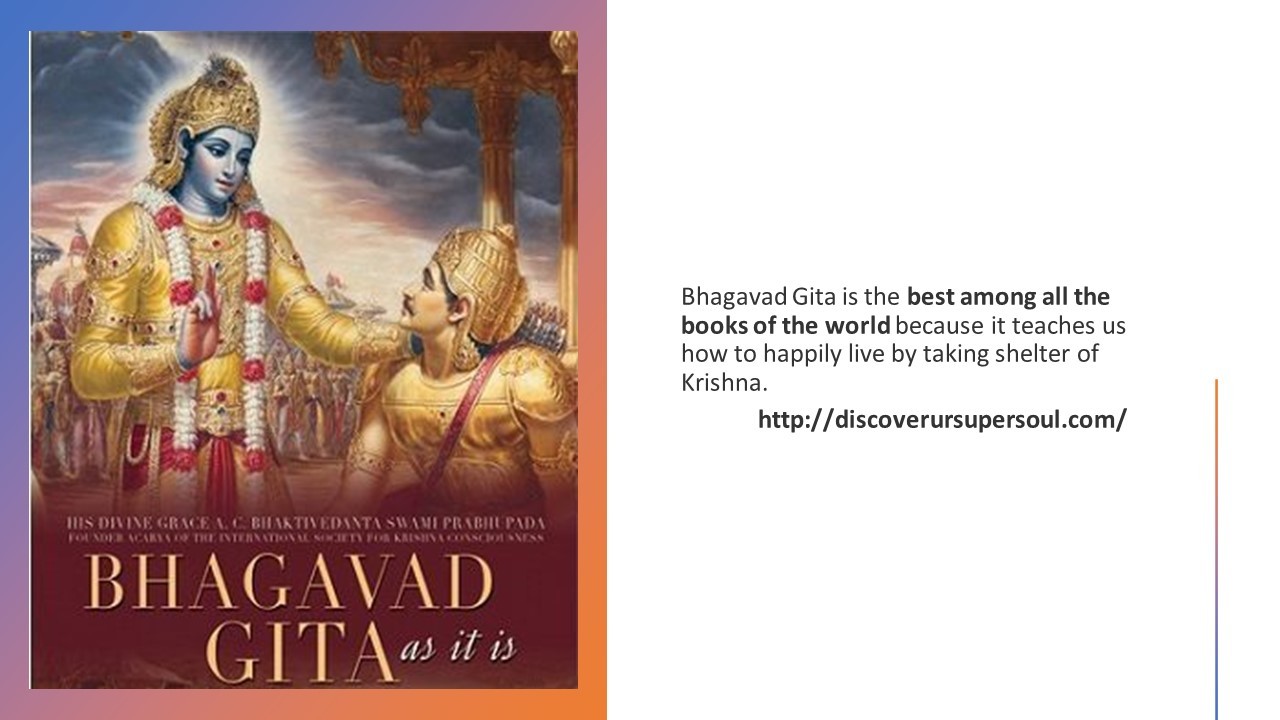

Bhagavad Gita is not just the oldest but also the best book of the world. The sublime message of Bhagavad Gita has been guiding humanity since ages. Bhagavad Gita was spoken by Lord Krishna to Arjuna. It was spoken around 5000 years ago just before the start of the Mahabharat war. It was spoken at Jyotisar, Kurukshetra.
Just before fighting the most important battle of his life, Arjuna got completely bewildered. He wanted to run away from the battlefield. At that time Lord Krishna came to Arjuna’s rescue. After hearing Bhagavad Gita, Arjuna’s consciousness completely changed. He understood who he was and the purpose of his life.
He picked up his bow and arrow and decided to do his prescribed duty of fighting. But after hearing Gita, he was not fighting for himself but he was fighting for Krishna to establish dharma. And since he was fighting for Krishna and Krishna was with him so Arjuna emerged victorious.
Bhagavad Gita is the best book, so is called king of all knowledge
The Gita is called Raja Vidya – the king of all knowledge. If all the Vedic literatures are cows then Bhagavad – Gita is the milk of the cow i.e. it is the essence of all the Vedic literatures. Krishna is the milkman, Arjuna is the calf who drinks the milk, and the same milk has been made available to us in the written form by the great sage, Vyasa – Dev.
This beautiful literature has impacted the conscience of humankind for ages. The glories of the Gita stems from the fact that it transcends all the artificial boundaries of caste, creed, religions, race, nation, gender etc.
Bhagavad Gita is not just 5000 years old
Bhagavad – Gita is not just 5000 years old. It has been in existence since the dawn of creation. Krishna informs Arjuna that “I instructed this imperishable science of yoga to the sun-god, Vivasvan, and Vivasvan instructed it to Manu, the father of mankind, and Manu in turn instructed it to Iksvaku” Bhagavad Gita. 4.1. Since the knowledge got lost by the influence of time so Krishna again spoke it to Arjuna for the benefit of all of us.
The Gita very vividly talks about Isavara (God), Jivatma (Soul), Kala (Time), Karma (actions) and Prakriti (Nature). It gives us spiritual intelligence to march towards the righteous path. The fundamental question of who am I, who is God, what is my relationship with Him and what is the purpose of this human life is very systematically, logically and pragmatically espoused.
Gita is for everyone
The Gita wasn’t spoken for Hindus or Indians. In fact, it is for the entire humanity. Great scholars throughout the ages have sought refuge in this transcendental literature when confronted with challenges. It has inspired the world fame leaders like Gandhi, Churchill, Einstein, Newton and several others.
After reading Bhagavad Gita a Hindu will become a better Hindu, a Muslim a better Muslim, a Christian a better Christian and a Jew a better Jew. This is why Bhagavad Gita is the best spiritual book because it makes the world a better place to live.
Why “Bhagavad Gita As it Is” is the best translation & commentary on Bhagavad Gita book today?
Unfortunately many mundane academic – scholars presented their own interpretation of Bhagavad – gita, thus misleading the masses. The most important message of the Gita is to know Krishna and to return back to the spiritual world. Srila Prabhupada was very much concerned about the misinterpretation of Krishna’s original message. He therefore decided to translate the original Sanskrit text into English language and named the book as Bhagavad Gita As It Is.
The word “As It Is” stresses the fact that the book is an unadulterated translation of the original Sanskrit text. In his translation there is meaning of each Sanskrit word, translation of entire verse and purport with various scriptural references like Srimad – Bhagavatam, Brahma Samhita, Isopanisad, Puranas etc.
At present this is the largest selling translation of the Gita all over the world. The book has been further translated into more than 70 languages. Bhagavad Gita As It Is has transformed the lives of millions of people all over the planet. This is why “Bhagavad Gita As it Is” is considered to be the best translation & commentary on Bhagavad Gita book today?
Gita teaches us to connect to Krishna
The main focus of the Gita is to make us understand that if we want to lead a happy life then we need to connect ourselves to Krishna. Krishna is not imposing his will but is trying to show us the right path. It’s like a father trying to persuade his unruly son to give up suicidal path and return back to his own home where he will get lots of love and care.
Krishna is too accommodative, every living being has different level of consciousness and so He suggests various paths through which one can perfect their life. He speaks about karma – yoga, jnana yoga, astanga yoga and bhakti yoga. Bhakti Yoga is the topmost but everyone may not be able to immediately practice Bhakti Yoga. So, Krishna also explains about Karma Yoga, Jnana Yoga and Astanga Yoga.
Conclusion of Bhagavad Gita
Arjuna was in utter confusion at the start of the war. But he got enlightened after hearing Gita. Arjuna reveals his heart to Krishna, “My dear Krishna, O infallible one, my illusion is now gone. I have regained my memory by Your mercy. I am now firm and free from doubt and am prepared to act according to Your instructions.” Bhagavad Gita 18.73
Like Arjuna we also face many challenges in our life. And like Arjuna, if we understand the teachings of Bhagavad Gita, we will also get knowledge to decide what is best for us. Knowledge itself is not sufficient. After gaining knowledge, with determination we should act as per that knowledge. We should say to Krishna, “I am prepared to act according to Your instructions”.
And once we act according to the instructions of Krishna as given in Bhagavad Gita then success is guaranteed.
The last verse of the Gita says, “Wherever there is Kṛṣṇa, the master of all mystics, and wherever there is Arjuna, the supreme archer, there will also certainly be opulence, victory, extraordinary power, and morality.” Bhagavad Gita 18.78
Like Arjuna if we befriend Krishna and always follow the instructions of Krishna then we will attain the same destiny as of Arjuna. It means that we will always be victorious in our life.
Once we take shelter of Krishna, Krishna takes charge of our life, and he protects us in all situations and circumstances. Lord Krishna, the Supreme Personality of godhead says, “Abandon all varieties of religion and just surrender unto Me. I shall deliver you from all sinful reactions. Do not fear.” Bhagavad Gita 18.66
Bhagavad Gita is the best among all the books of the world because it teaches us how to happily live by taking shelter of Krishna.
Search
Recent Posts
-
Unflinching Faith in Lord Chaitanya...
April 15, 2026
-
Teachings on Grihastha Life, Chanting...
April 15, 2026
-
Offense to Krishna’s devotee brings...
April 15, 2026
-
Few examples of Vaishnava Etiquette
April 15, 2026
-
Srimad Bhagavatam @Iskcon Newtown Kolkata...
March 4, 2026
google ads
The Bhagavad Gita verse which enhances my faith & conviction in Krishna Consciousness


All the verses of Bhagavad Gita enhance my faith and conviction in Krishna. But one verse which stand out is the verse from Bhagavad Gita 18.37. In this verse Krishna says, “That which in the beginning may be just like poison but at the end is just like nectar and which awakens one to self-realization is said to be happiness in the mode of goodness.”
I can relate with this verse and can say with full conviction that each word of this verse is true. Especially this one from the verse “which appears poisonous in the beginning but becomes nectar in the end.” I have applied it in my life. And have always got the same result which is Krishna is saying. In fact, I apply this verse almost daily in my life.
Because of past conditioning and ignorance, spiritual activities appear troublesome to me. In fact, as mentioned in this verse, poisonous, viṣam iva.
Spiritual activities appear poisonous in the beginning but becomes nectar in the end
For example, getting up early in the morning and doing mangal arati appears very difficult. Chanting sixteen rounds of Hare Krishna Mahamantra appears tedious. And I do not find much interest in reading literatures like Bhagavad Gita, Srimad Bhagavatam and other books of Srila Prabhupada. All these important spiritual activities are poisonous to me. Every day I have to struggle to complete these important spiritual activities.
So, every morning I remind myself of this verse. I contemplate on its meaning. I tell myself that these activities are now looking poisonous but if I exert myself, give up laziness and complete these spiritual duties I will experience “happiness in the end.” This is what Krishna is promising in this verse. So, I keep faith in the words of Krishna and I complete all these activities like mangala arati, chanting the names of Krishna, reading spiritual books. And almost every day, at the end of the day, I find that once I complete these spiritual activities, I feel so satisfied and happy from within.
Sense gratification appears nectar in the beginning but becomes poisonous in the end
But if I indulge in sense gratification like browsing internet, reading political news, doing prajalpa (mundane talks) then while doing these activities I feel some sort of so-called happiness. But after spending time in these non-Krishna Conscious activities, almost all the time I fret. I curse myself saying that what was the need for me to waste my time in this way. Sense gratification is a waste of time, and it takes us away from Krishna. So, Krishna has warned us in Bhagavad Gita 18.38 that sense gratification may appear like nectar in the beginning, but it becomes poison in the end.
“That happiness which is derived from contact of the senses with their objects and which appears like nectar at first but poison at the end is said to be of the nature of passion.” Bhagavad Gita 18.38.
Once we begin doing, we begin enjoying
One of the great things about spiritual activity is that before we start doing it, it appears troublesome. But as soon as we start doing it, we start experiencing pleasure. For example, getting up early in the morning, taking bath, making preparation for mangal arati appears unpleasant. But as soon as we start making preparation for mangal arati and start worshipping the deity, we start enjoying from within.
Similarly, once we begin chanting, we feel nice. And once we complete chanting 16 rounds of Hare Krishna Mahamantra, we feel so happy and so lucky. It gives us a sense of accomplishment. And also, once we have read few sentences from Bhagavad Gita and Srimad Bhagavatam then slowly we find ourselves getting absorbed in reading.
How Bhagavad Gita 18.37 verse helps me on the day of fasting?
On the day of fasting especially on the day of nirjala ekadasi this verse helps me a lot to successfully complete nirjala ekadasi. Nirjala ekadasi means fasting for 24 hours without water. On that day I keep on reciting this verse in my mind throughout the day and contemplate on its meaning. I keep on telling myself, “One day of trouble and sacrifice and the next day I will be on cloud nine, I will get lots of spiritual happiness.” And by remembering this verse I have been able to complete nirjala ekadasi for last many years.
Similarly on other days when I have to fast like during Janmashtami, Gaur Purnima, Narasimha Chaturdasi and other ekadasi days I keep on remembering this verse.
Spiritual life is full of nectar
Upon contemplation I come to the conclusion that we all have developed a wrong understanding that spiritual activities are troublesome. Because if spiritual activities would have been troublesome then I would have felt miserable after completing it. I have never seen any devotee in my entire life who felt miserable after chanting Hare Krishna Mahamantra or after attending managal arati.
When we go to Mayapur we get up in the morning to attend 4:30 am Managal arati. We feel so blissful and happy seeing the deities of Radha Madhav and asta sakshis, of Panchatattva and of Lord Narasimhadeva. It’s a divine experience. And when we look around, we find everyone – men, women, children, old people – happy. Even those who come for the first time to the temple are also blissful.
When we do Govardhan Parikrama on foot in Vrindavan, we feel so exhausted. The parikrama marg is around 21 km and it takes 6-7 hours to complete the parikrama. During the parikrama, we get completely exhausted. Legs become stiff. We have to exert a lot to move ahead. But devotees do not give up. With full faith in Krishna they continue the parikrama. And once we are able to successfully circumambulate Giriraj Govardhan we feel so satisfied and happy. I have never met any person in my life who regretted the decision of doing Govardhan Parikrama.
Conclusion
This is the reason that I strongly believe what Krishna says in this verse “that spiritual life appears like poison in the beginning but becomes nectar in the end.” It has increased my faith and conviction in Krishna’s words. Because I have personally experienced it.
In this verse Krishna also says that activities in the mode of goodness such as spiritual practices lead to “self-realization.” I cannot say much about self-realization because I have not attained it. But one thing I have realized that no matter how hard we try, we can never be happy by satisfying the unholy demands of our mind and senses. But if we engage our mind and senses in Krishna Consciousness then we will be happy.
To conclude, “Krishna Consciousness appears difficult initially, but if we practice it with determination and faith then the end result is extraordinary.”
Search
Recent Posts
-
Unflinching Faith in Lord Chaitanya...
April 15, 2026
-
Teachings on Grihastha Life, Chanting...
April 15, 2026
-
Offense to Krishna’s devotee brings...
April 15, 2026
-
Few examples of Vaishnava Etiquette
April 15, 2026
-
Srimad Bhagavatam @Iskcon Newtown Kolkata...
March 4, 2026
google ads