Why Kṛṣṇadāsa Kavirāja Gosvāmī was requested to write Śrī Caitanya-caritāmṛta?
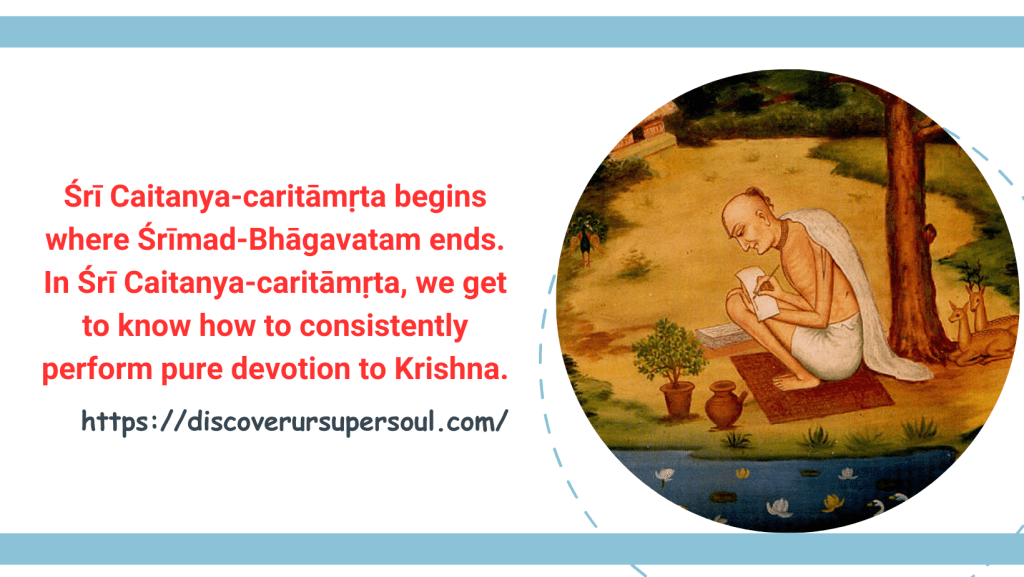
Within Gaudiya Sampradaya, Śrī Caitanya-caritāmṛta is considered post graduate study of Śrīmad-Bhāgavatam.
Śrīmad-Bhāgavatam is the essence of all Vedic literatures. It is the commentary on Vedanta sutra by Vedavyāsa.
Srimad Bhagavatam speaks highest truth
In the beginning of Śrīmad-Bhāgavatam, Vedavyāsa rejects all religious rituals which is for material gain, and he directly propagates pure devotion for the Supreme Lord.
“Completely rejecting all religious activities which are materially motivated, this Bhāgavata Purāṇa propounds the highest truth, which is understandable by those devotees who are fully pure in heart. The highest truth is reality distinguished from illusion for the welfare of all. Such truth uproots the threefold miseries. This beautiful Bhāgavatam, compiled by the great sage Vyāsadeva [in his maturity], is sufficient in itself for God realization. What is the need of any other scripture? As soon as one attentively and submissively hears the message of Bhāgavatam, by this culture of knowledge the Supreme Lord is established within his heart.” Śrīmad-Bhāgavatam 1.1.2
Śrī Caitanya-caritāmṛta begins where Śrīmad-Bhāgavatam ends. In Śrī Caitanya-caritāmṛta, we get to know how to consistently perform pure devotion to Krishna.
Devotees’ eagerness to know the pastimes of Lord Chaitanya after he took sannyas
500 years back devotees in Vrindavan requested Kṛṣṇadāsa Kavirāja Gosvāmī to write Śrī Caitanya-caritāmṛta. They wanted him to describe the life of Lord Chaitanya, his teachings, philosophy, activities and pastimes elaborately. When this was requested from Kṛṣṇadāsa Kavirāja Gosvāmī, he was very old.
Srila Vrindavana Dasa Thakur had already written Chaitanya Bhagavata, a biography of Lord Chaitanya.
Chaitanya Bhagavata was originally known as Chaitanya Mangala but later the book was renamed as Chaitanya Bhagavata by Srila Vrindavana Dasa Thakur.
Srila Prabhupada explained the reason behind this, “Śrī Vṛndāvana dāsa Ṭhākura’s Śrī Caitanya-bhāgavata was originally entitled Śrī Caitanya-maṅgala, but when Śrīla Locana dāsa Ṭhākura later wrote another book named Śrī Caitanya-maṅgala, Śrīla Vṛndāvana dāsa Ṭhākura changed the name of his own book, which is now therefore known as Śrī Caitanya-bhāgavata.” Śrī Caitanya-caritāmṛta, Ādi-līlā, 8.33 Purport
Chaitanya Bhagavata was highly revered. But fearing that the book will become voluminous, Srila Vrindavana Das Thakur did not describe much the latter life of Sri Chaitanya Mahaprabhu especially his life after he took sannyas. In Chaitanya Bhagavata, the pastimes of Lord Chaitanya in Jagannath Puri, his Vrindavan and South India Yatra was just summarised.
So, the request was made to Kṛṣṇadāsa Kavirāja Gosvāmī to write a book which describes the pastimes of Lord Chaitanya which was not in detail in Chaitanya Bhagavata.
At that time Kṛṣṇadāsa Kavirāja Gosvāmī was living in Vrindavan Dham. Out of humility, he considered himself unqualified to describe the pastimes of Lord Chaitanya.
What Kṛṣṇadāsa Kavirāja Gosvāmī says about describing the pastimes of Lord Chaitanya?
Kṛṣṇadāsa Kavirāja Gosvāmī had never met Lord Chaitanya or Lord Nityananda. His only connection with Lord Nityananda was that Lord Nityananda appeared in his dream and blessed him to go to Vrindavan.
Kṛṣṇadāsa Kavirāja Gosvāmī mentions about this in Śrī Caitanya-caritāmṛta.
“O my dear Kṛṣṇadāsa, do not be afraid. Go to Vṛndāvana, for there you will attain all things. After saying this, He directed me toward Vṛndāvana by waving His hand. Then He disappeared with His associates.” Śrī Caitanya-caritāmṛta, Ādi-līlā, 5.195 – 196
Kṛṣṇadāsa Kavirāja Gosvāmī was full of humility and had completely surrendered to the Lord.
He was a disciple of Srila Raghunatha Dasa Goswami. In Vrindavan, he would daily hear from his guru about the pastimes of Lord Chaitanya for hours.
Raghunath Dasa goswami was with Lord Chaitanya in Jagannath Puri. He was serving under Svarupa Damodara. Raghunath Dasa goswami was so humble that he hardly spoke to Lord Chaitanya directly because he thought himself to be unqualified.
He was in Jagannath Puri when Lord Chaitanya departed from this world. Soon after the departure of Lord Chaitanya, Lord Nityananda and Swarup Damodar left the world.
After their departure Raghunath Dasa goswami came to Vrindavan. In Vrindavan, he would narrate the pastimes of Lord Chaitanya for the pleasure of all the devotees.
Kṛṣṇadāsa Kavirāja Gosvāmī says that Lord Ananta, with his unlimited mouths cannot describe the pastimes of Lord Chaitanya which he performed in one day. And even Ganesha would not be able to write the pastimes of Lord Chaitanya in millions of years.
What is inconceivable to Krishna?
In this material world, everything is bound by the limitation of time and space but not in the spiritual world. In the spiritual world everything is inconceivable. Although Krishna is cause of all causes, everything comes from him but still love of Radha for him is inconceivable.
So, Krishna comes to this world to experience what is inconceivable to him i.e. to experience the love of Radha which she has for him. So, he comes in the mood of Radharani and as a devotee of Krishna.
Kṛṣṇadāsa Kavirāja Gosvāmī gets the permission of Madana-Mohan to write the book
Kṛṣṇadāsa Kavirāja Gosvāmī was asked to write philosophical truth about Lord Chaitanya’s life. Since it was the desire of the devotees so Kṛṣṇadāsa Kavirāja Gosvāmī thought let me try my best. In spiritual life success is proportional to how much we are dependent on Krishna and the mercy of the devotees.
So, before beginning the service of writing this book, he was going to every devotee to seek their blessings. He went to seek blessings of Gopala Bhatta Goswami. Gopala Bhatta Goswami said that I will give you my blessings but do not put my name in the book.
Kṛṣṇadāsa Kavirāja Gosvāmī went to Madana-Mohan temple to seek the blessing of the Supreme Lord. As he was praying to the Lord the garland of Madana-Mohan fell. All the prominent Vaisnavas were present in the temple at that time and when they saw garland falling, they loudly chanted “Haribol!.”
The pujari of the temple, Gosani dasa, immediately took the garland and put it around the neck of Kṛṣṇadāsa Kavirāja Gosvāmī. All the Vaisnavas said that Madana-Mohan has given the permission to write the book.
Kṛṣṇadāsa Kavirāja Gosvāmī mentions about this in his book, “When I visited the temple of Madana-mohana, the priest Gosāñi dāsa was serving the feet of the Lord, and I also prayed at the Lord’s lotus feet. When I prayed to the Lord for permission, a garland from His neck immediately slipped down. As soon as this happened, the Vaiṣṇavas standing there all loudly chanted, “Haribol!” and the priest, Gosāñi dāsa, brought me the garland and put it around my neck. I was greatly pleased to have the garland signifying the order of the Lord, and then and there I commenced to write this book.” Śrī Caitanya-caritāmṛta, Ādi-līlā, 8.74 – 77
What documents were used to write Śrī Caitanya-caritāmṛta?
While writing Śrī Caitanya-caritāmṛta, Kṛṣṇadāsa Kavirāja Gosvāmī, used the notes of Svarupa Damodar and the pastimes which he heard from Raghunath Das Goswami. Svarupa Damodar a personal associate of Lord Chaitanya Mahaprabhu had recorded the pastimes of Lord Chaitanya. Raghunath Dasa Goswami had memorized those notes of Svarupa Damodar.
“I have heard from the mouth of Raghunātha dāsa Gosvāmī all that Svarūpa Dāmodara Gosvāmī recorded in his notes about the pastimes of Śrī Caitanya Mahāprabhu. I have briefly described those pastimes. Whatever I have written is by the mercy of Śrī Caitanya Mahāprabhu, since I am an insignificant living being.” Śrī Caitanya-caritāmṛta, Antya-līlā, 3.269 – 270
The prolific writer completes the book but does not take the credit
Kṛṣṇadāsa Kavirāja Gosvāmī,a prlific writer, is an epitome of humility. He wrote such a great literature, but he does not take any credit for it. He thanks Madana – Mohana, Lord Chaitanya, Lord Nityananda, all the associates of Lord Chaitanya and Lord Nityananda and all the Vaisnvas for their mercy in writing Śrī Caitanya-caritāmṛta.
Not just that he even worships the readers who will be reading his books.
“I now worship the lotus feet of all my readers, for by the mercy of their lotus feet there is all good fortune. If one hears the pastimes of Lord Śrī Caitanya Mahāprabhu as described in Śrī Caitanya-caritāmṛta, I wash his lotus feet and drink the water. I decorate my head with the dust of the lotus feet of my audience. Now you have all drunk this nectar, and therefore my labor is successful. Praying at the lotus feet of Śrī Rūpa and Śrī Raghunātha, always desiring their mercy, I, Kṛṣṇadāsa, narrate Śrī Caitanya-caritāmṛta, following in their footsteps.” Śrī Caitanya-caritāmṛta, Antya-līlā, 20.150 – 153
Search
Recent Posts
-
Janmashtami: Celebrating Krishna’s Appearance Through...
August 17, 2026
-

Gopinatha Pattanayaka: 6 Lessons for...
August 16, 2026
-
What Does Krishna Say About...
August 11, 2026
-
Are you ready to choose...
August 2, 2026
-

55th Kolkata Ulta Rath Yatra...
July 25, 2026
12 names of Lord Chaitanya which gives complete perfection
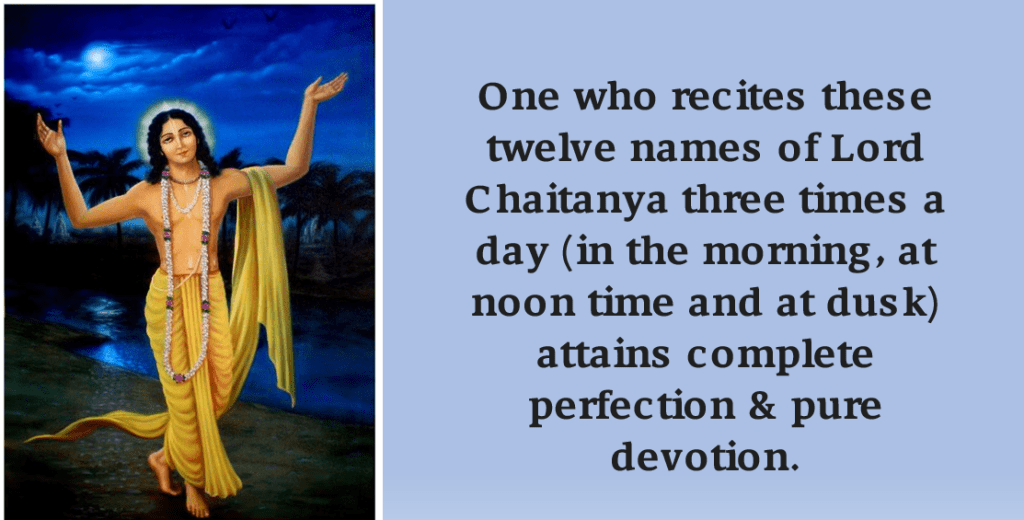
In Sri Krsna-Chaitanya-Dvadasa-Nama-Stotram, Sarvabhauma Bhattacharya writes about 12 important names of Lord Chaitanya. He further says that these glorious names of Chaitanya if chanted daily brings auspiciousness in life.
Twelve principal names of Lord Chaitanya Mahaprabhu are:
(1) caitanyah krsna-caitanyo gaurango dvija-nayakah
yatinam dandinam caiva nyasinam ca siromanih
(2) raktambara-dharah sriman navadvipa-sudhakarah
prema-bhakti-pradas caiva sri-saci-nandanas tatha.
Sri Krsna-Chaitanya-Dvadasa-Nama-Stotram by Sarvabhauma Bhattacharya:
Meaning of each of the 12 names of Lord Chaitanya are as follows:
- Chaitanya — The living force
- Krsna-Chaitanya — The all-attractive Supreme living force
- Gauranga — He of fair bodily complexion
- Dvija-Nayaka — The hero amongst the twice-born brahmanas
- Yatinam Siromani — The crest jewel of sannyasis (who wander freely)
- Dandinam Siromani – The crest jewel of sannyasis (who carry staffs)
- Nyasinam Siromani — The crest jewel of sannyasis (who renounce everything).
- Raktambara-Dhara — He who wears red cloth
- Sriman — The supreme opulent one
- Navadvipa-Sudhakara — The source of nectar in Navadvipa
- Prema-Bhakti-Prada — The bestower of ecstatic loving devotion
- Sri-Sachi-Nandana — The delightful son of mother Sachi.
One who recites these twelve holy names of the Lord three times a day (in the morning, at noon time and at dusk) will attain complete perfection in their life and will surely attain pure devotion unto the lotus feet of Lord Chaitanya which is the ultimate shelter of all living entities.
Re-established religious principles in true spirit
After Lord Krishna completed his pastime in this mortal world and left for his eternal world, religious principles started declining. In fact, before the advent of Chaitanya Mahaprabhu, there was almost no religion because no one was following the scriptures as it is. In fact, people had forgotten the purpose of scriptures. There was no scriptural discussion and hardly anyone chanted the names of Krishna.
If anyone chanted the names of Krishna, the general belief was that such people are either fool or because of poverty are hungry so are helplessly crying the name of God. Chaitanya Mahaprabhu re-established religious principles. His profound teachings dispelled all the misconception which people had regarding religion and the unscrupulous religious leaders who were misguiding people in the name of religion got exposed and defeated.
Living corpse to lively devotee
Chaitanya means living force. His advent brought life because people were able to forgo painful material life and joyfully started living happy Krishna Conscious life.
Material life is no life because God is not the centre of life, so it is full of suffering. If we fail to understand that we are parts and parcels of God then we are as dead and dull as stone. Just like stone has no life, similarly we are nothing but living corpse.
But Chaitanya Mahaprabhu taught us that for our own benefit, we should rise above material consciousness and situate ourselves into Krishna Consciousness. If we do so, then we can live happily forever in the association of Krishna who is source of all happiness.
Krishna who is not black
Chaitanya Mahaprabhu is Krishna who is not black. He has golden complexion. Also he is in the mood of the topmost gopi of Vrindavan. Many times experienced devotees do not put peacock feather on him because if we put peacock feather then it means that we are interfering with the mood of Chaitanya Mahaprabhu.
Most of the time Mahaprabhu is in the mood of Srimati Radharani, and we know that Radharani does not put peacock feather. He is always absorbed in the thoughts of Krishna. He is not stable; he is always agitated for Krishna prema.
Why he came here?
There are many reasons why Chaitanya Mahaprabhu came. One of the reasons is that he came to pay debt to the gopis. When Krishna left Vrindavan then gopis continuously cried for Krishna in separation. So, as Chaitanya Mahaprabhu he always cried like the gopis feeling separation from Krishna.
In Bhagavad Gita 4.11, Krishna says, ye yatha mam prapadayante, “As all surrender unto Me, I reward them accordingly.” So, Krishna is eager to give something to the devotees, but pure devotees of Krishna do not ask anything from him. They only want to give something to Krishna. They always want to serve him.
Sanatana Goswami says that when Krishna asks devotees to ask something from him then devotees say three times “no”. He explains that three times no means – in past no, in present no and in future no. So, to pay debt to such dear devotees who have no personal desire or motive, Krishna comes as Chaitanya Mahaprabhu to give them prema.
He is always keen to distribute prema, pure love of Godhead. But he gives prema to only those who are simple and not duplicitous and have no ulterior motives.
Advaita Acharya told to Chaitanya Mahaprabhu that do not give prema to those who are proud of wealth, power and beauty. Give prema to those who are simple and chant the names of Krishna.
He will award prema if our heart is free of prema for sense enjoyment
So, if we want to get prema of Lord Chaitanya Mahaprabhu then we should be simple hearted and have love for the holy names.
We see Haridas Thakura had no material opulence, but he got Chaitanya Mahaprabhu prema. He did not get any higher material education neither he possessed any wealth or wielded any power.
But he was simple, humble and had no ulterior motives, was not duplicitous in his behaviour and was always eager to chant the name so Krishna, so Chaitanya Mahaprabhu awarded him love for Krishna and he came to be known as Namacharya.
If with humility and simplicity, we accept the shelter of Chaitanya Mahaprabhu then all opulence of Chaitanya Mahaprabhu will manifest. .
We should not have any material desires. Even if the desires are there then we should ignore it and not try to think about it especially when we are chanting the names of Krishna. It is because whatever is in the mind when we chant will manifest. So, if we have material desires then those desires will get fulfilled but it will pull us way from Krishna.
We should always be humble. And many times, without humiliation, we don’t become humble. For eg Keshav Kashmiri was very proud of his scholarship but when he was defeated by Chaitanya Mahaprabhu he became humble and fell at his lotus feet. When we offer our obeisances, it shows our humility and it burns our pride.
Chaitanya Mahaprabhu appeared in this world to destroy our pride and our false attachment to this material world. So, let us all be under the shelter of Lord Chaitanya Mahaprabhu and continuously chant his holy names.
Note: This article is based on a Srimad Bhagavatam class given by His Holiness Bhakti Dhira Damodar Swami Maharaj at Iskcon Newtown Kolkata, India.
Search
Recent Posts
-
Janmashtami: Celebrating Krishna’s Appearance Through...
August 17, 2026
-
Gopinatha Pattanayaka: 6 Lessons for...
August 16, 2026
-
What Does Krishna Say About...
August 11, 2026
-
Are you ready to choose...
August 2, 2026
-
55th Kolkata Ulta Rath Yatra...
July 25, 2026
Prayer to Sri Chaitanya Mahaprabhu on the auspicious occasion of Gaur Purnima
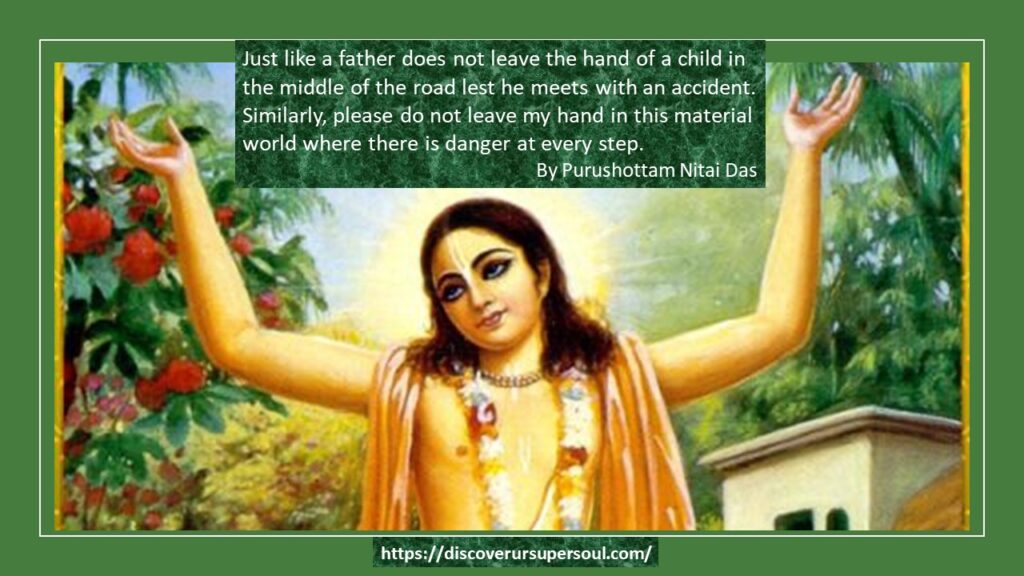
Dear Sri Chaitanya Mahaprabhu, Please forgive my audacity that I am daring to write a prayer in your glorification on the auspicious occasion of Gaur Purnima. But I know that you are extremely merciful that you will forgive me for my temerity.
A person becomes qualified to worship the deity of Krishna after second initiation, similarly a person free from all material impurities are qualified to say words in your glorification. Great devotees like Prahlad glorified you with beautiful prayers when you appeared as Lord Narasimhadeva to annihilate Hiranyakasipu. His glorious words were sung by another of your greater devotee, Sukhadeva Goswami, while narrating Srimad Bhagavatam to Parikshit Maharaj when he had just 7 days to live.
Hope
But in spite of all my short comings and my ignorance and my inability to use right words in your praise, I have firm believe that you will hear my cry at your mystical feet. If you will not hear my prayers, then who will hear my prayers. If a father abandons his son, then what is the hope for the son. But we see a father never abandons his son, no matter how mischievous or how foolish he is.
So, please do not abandon me. I am so mischievous that I left you to enjoy in this mortal world where miseries are at every step. I am foolish because in spite of knowing that miseries are everywhere around me, still I have a hope that I will be happy in this world without you.
Saviour of the helpless soul
It is not that I have not tried to be happy in this world by giving up your warm shelter. It is also a proven fact that I have always failed in my attempt of sense enjoyment. But unfortunately, I have never learnt my lessons. Sometimes I do try my best to not enjoy my senses, but my senses are so powerful that they drag me away from your lotus feet. What can I do? I am so helpless without you.
All the great saintly personalities say again and again that you are the saviour of the helpless and hapless souls. Srila Narottama Dasa Thakura in his wonderful prayer say that there is no one as merciful as you are. The acclaimed bhakti poet says that you have come in this world to reclaim the fallen souls and to take them back to the spiritual world.
śrī-kṛṣṇa-caitanya prabhu doyā koro more
tomā binā ke doyālu jagat-saḿsāre
“My dear Lord Caitanya, please be merciful to me, because who can be more merciful than Your Lordship within these three worlds?” Narottama Dasa Thakura
Transcendental touch
Although I am the most fallen, but I am ashamed to admit that I do not consider myself as fallen. My ego, my pride is not allowing me to accept that I have failed to be happy without you, away from you.
Dear Sri Chaitanya Mahaprabhu, my prayer at your lotus feet is to crush my ego, my pride. Through your transcendental touch please burn all the vices from my heart. I beseech you to purify my heart and fill it with transcendental mellow.
My confession
I want to confess to you that I do not like to be in this world anymore. I know somehow my mind tries to convince me to be here and gives me a hope that I can enjoy here. But when I contemplate and when I reflect on the past and when I try to see the future, I do not find any hope for me in this material world.
I know that I am not qualified to return to the spiritual world. Because in the spiritual kingdom only pure devotees reside. An impure soul like me will not get an entry to your kingdom. I am doomed to suffer here because of my impure desires. With my own effort I feel unable to purify my wrong desires.
So, dear Sri Chaitanya Mahaprabhu, can you please hear my prayer and purify my desires?
The free will
I know the reason for my impure desire is the misuse of my free will. I know the scriptures say that the Supreme Lord does not interfere with anyone’s free will. Although you gave me free will so that I will use it for my own benefit. But unfortunately, I have terribly misused my free will.
Please take away my free will. Please hold my hand tightly, so that I do not go astray. Just like a father does not leave the hand of a child in the middle of the road lest he meets with an accident. Similarly, please do not leave my hand in this material world where there is danger at every step.
Your Shelter
A child does not know what is right for him and what is dangerous for him. Similarly, I do not know what is good for me and what is not good for me. Being the Supreme Lord and the father of all the souls you know what is good for me.
So, please keep on guiding me in my life. Please give me shelter of your lotus feet. Please give me shelter of your sincere devotees so that in their association and guidance I purify my heart and march towards the spiritual sky.
You came for us
You appeared on the day of full moon to spread the transcendental ray of Krishna Consciousness. You appeared in this dark age of Kaliyuga to remove darkness of ignorance from our heart. You gave us to chant the Hare Krishna mahamantra – the mantra of deliverance from all miseries.
You came for us and gave us everything required to perfect our life. But unfortunately, unfortunate soul like me fail to take up your mercy seriously.
Most Merciful Lord
My dear most merciful Lord, please forgive me for my foolishness and stupidity. Again and again, I beg you to purify my heart of all nasty desires and give me intelligence so that I can understand the great value of practicing devotion to you. Please give me determination so that I can practice the process which you gave to us. And please grant me benediction so that I chant the Hare Krishna Mahamantra continuously and happily.
I, Purushottam Nitai Das, again beg forgiveness for my incoherent prayer at your lotus feet. Please give me your shelter.
O most merciful Lord, if you won’t accept a fallen soul like me then who will accept me in the entire universe.
Your insignificant aspiring servant
Purushottam Nitai Das
Search
Recent Posts
-
Janmashtami: Celebrating Krishna’s Appearance Through...
August 17, 2026
-
Gopinatha Pattanayaka: 6 Lessons for...
August 16, 2026
-
What Does Krishna Say About...
August 11, 2026
-
Are you ready to choose...
August 2, 2026
-
55th Kolkata Ulta Rath Yatra...
July 25, 2026
Chaitanya Mahaprabhu taught how to overcome our suffering?
Most of us do not know how not to suffer. So, Sri Chaitanya Mahaprabhu came and taught us how to overcome our suffering?
Who does not want freedom from suffering? Is it not true that none of us want to suffer in this world? Have you seen or met anyone who desperately want to become miserable? No sane man would even think of it. But we suffer. Whether we want it or not some unfortunate things happen in our life.
So, is there any way by which we can free ourselves from all suffering?
The answer is yes.
God does not want us to suffer. So, he gave us Vedic scriptures. This transcendental literature teaches us how to live happily in this world. But in spite of that we disregard the teachings of the scriptures. So, the Supreme Lord personally appears in this world to teach us how to lead a pure life so that we attain complete freedom from all suffering.
In this age of Kali Yuga the Supreme Lord appeared as Sri Chaitanya Mahaprabhu and he taught us how to overcome all our suffering. Before discussing further, let us know who Lord Chaitanya is?
Knowing Lord Chaitanya
Lord Chaitanya is the Supreme Lord. He is Lord Krishna and He is Lord Jagannath. So, Vasudeva Gosh while extolling the glories of Sri Chaitanya Mahaprabhu sings, “jei gaura sei kṛṣṇa sei jagannāth.” Lord Chaitanya appeared around 500 years ago in Mayapur.
Bhaktivinoda Thakura elaborately explains it, “Caitanya Mahāprabhu [Lord Chaitanya] was born in Māyāpur, in the town of Nadia, just after sunset on the evening of the 23rd Phālguna, 1407 Śakābda, answering to the 18th of February 1486, of the Christian Era.” Teachings of Lord Caitanya, Prologue by Śrīla Bhaktivinoda Ṭhākura
Chaitanya Mahaprabhu was unhappy when he saw his unfortunate children, you and me, suffering in this world.
Why you & me suffer?
We the people of Kali Yuga are unfortunate. We are unfortunate because we have chosen to be unfortunate. Intentionally, we disregard the teachings of the Vedic scriptures given to us by the Lord. Instead, we like to live independently or rather whimsically. We explore all means to enjoy in this ephemeral material world with our temporary material body and constantly flickering senses. In our pursuit of enjoyment, we fail again and again. In fact, instead of enjoyment we mostly get suffering, but the saddest part is that sometimes we do not even realize that we are suffering.
Even the greatest material accomplishment cannot satiate our heart and is taken away from us at the time of our death.
Sri Chaitanya Mahaprabhu, our creator, our father, was sorry to see the plight of his children. So, he came.
Most important reason for suffering
We have forgotten our true spiritual identity that we are parts and parcels of the Supreme Lord. We have forgotten that we are spiritual beings and not material beings. And because of this ignorance, we get entangled in this material world. We try our best to gratify our material body and material senses hoping that it will give us joy. We even indulge in sinful activities. Sinful activities mean those actions which are prohibited by the scriptures. Sin causes suffering.
Many times, we become so habituated to commit sinful activities that in spite of knowing that our action is bringing misery we continue committing it. It increases our suffering, we become helpless and slowly hopeless. Everything starts with ignorance, ignorance of not understanding our relationship with the Supreme Lord.
Attaining freedom from never ending suffering
Sri Chaitanya Mahaprabhu appeared in this age of downfall to deliver us, the unfortunate souls of Kaliyuga, from our never-ending suffering. He gave us the medicine of the holy names of Krishna, the Hare Krishna Mahamantra, which has the potency to give us freedom from all our suffering. He asked everyone to sincerely and attentively chant the Hare Krishna Mahamantra. Chanting the Mahamantra not just frees us from suffering, but it also fills our heart with unlimited bliss.
Glory of Hare Krishna Mahamantra
Sri Chaitanya Mahaprabhu extols the glories of the Hare Krishna Mahamantra beautifully in his Siksastakam Prayers, “Glory to the Sri-Krsna-Sankirtana, which cleanses the heart of all the dust accumulated for years and extinguishes the fire of conditional life, of repeated birth and death. This sankirtana movement is the prime benediction for humanity at large because it spreads the rays of the benediction moon.”
Just as sun appears darkness disappears. Similarly, as soon as the holy names of Krishna, appears in our heart by our sincere chanting, our ignorance disappears which is the root cause of our suffering. When our ignorance starts disappearing, we start understanding that we are souls eternally related to Lord Chaitanya. When this understanding dawns upon us, we start putting our best efforts to re-establish our relationship with the Lord.
With determination we try not to indulge in any sinful activities. Slowly because of the mercy of the holy name, our heart gets purified of all sinful desires and proclivities. And what about our past sins? It gets burnt to ashes. So, just by chanting the names of Krishna, our life becomes all auspicious. We attain love of Krishna and even become qualified to return back to the spiritual world, our original home. This is the greatest gift of Lord Chaitanya to us, to the entire human civilization.
Srila Rupa Goswami, a great Vaisnava acharya, glorifies Sri Chaitanya Mahaprabhu in these beautiful words, “I offer my respectful obeisances unto the Supreme Lord Śrī Kṛṣṇa Caitanya, who is more magnanimous than any other avatāra, even Kṛṣṇa Himself, because He is bestowing freely what no one else has ever given — pure love of Kṛṣṇa.” Sri Chaitanya Charitamrita, Madhya Lila 14.16”
Chaitanya Mahaprabhu’s greatest gift
Sri Chaitanya Mahaprabhu gifted us the holy name and taught us that just by chanting these transcendental names of Krishna we can overcome all suffering and can attain Krishna.
So, if we should sincerely take up this process of mantra meditation. Anyone can chant this great mantra – Hindus, Muslims, Sikhs, Christians, men, women, young, old, Indians, non- Indians. For chanting no qualification is required, we just need to have sincere desire to chant in our heart. We can chant at anytime and at any place.
Although best is to chant early in the morning and at a place where there is no distraction. But if we are not able to chant in the morning then we can chant at any time of the day which is suitable for us. And even if we do not find any quiet place still we can chant at public place quietly without disturbing others.
Whenever and wherever we are chanting we should sincerely try to absorb ourselves in holy name. This will make our life auspicious and as promised by the Supreme Lord, will grant us freedom from all suffering.
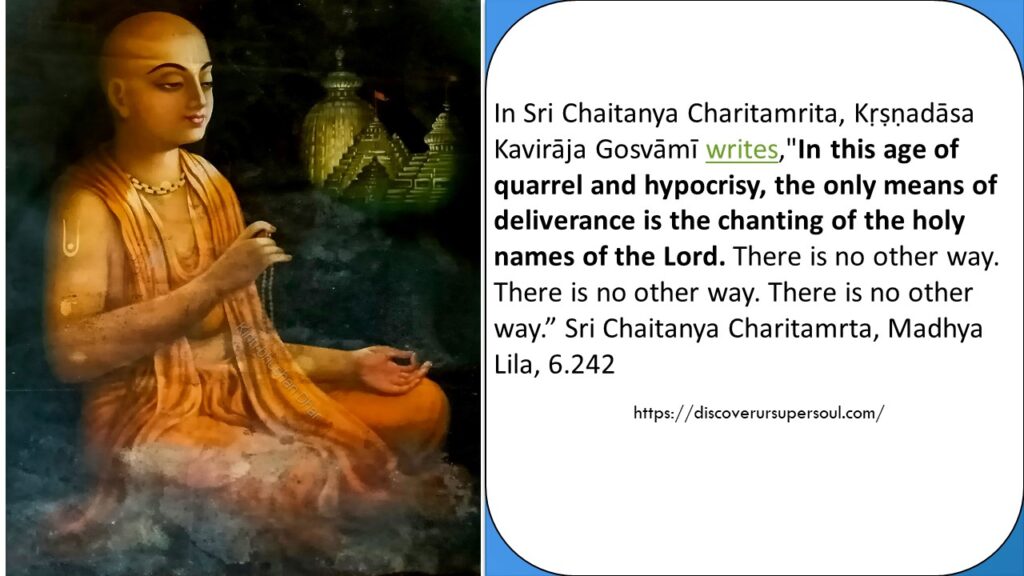
In Sri Chaitanya Charitamrita, Kṛṣṇadāsa Kavirāja Gosvāmī writes,”In this age of quarrel and hypocrisy, the only means of deliverance is the chanting of the holy names of the Lord. There is no other way. There is no other way. There is no other way.”
Search
Recent Posts
-
Janmashtami: Celebrating Krishna’s Appearance Through...
August 17, 2026
-
Gopinatha Pattanayaka: 6 Lessons for...
August 16, 2026
-
What Does Krishna Say About...
August 11, 2026
-
Are you ready to choose...
August 2, 2026
-
55th Kolkata Ulta Rath Yatra...
July 25, 2026
What did Chaitanya Mahaprabhu do to spread Krishna Consciousness?
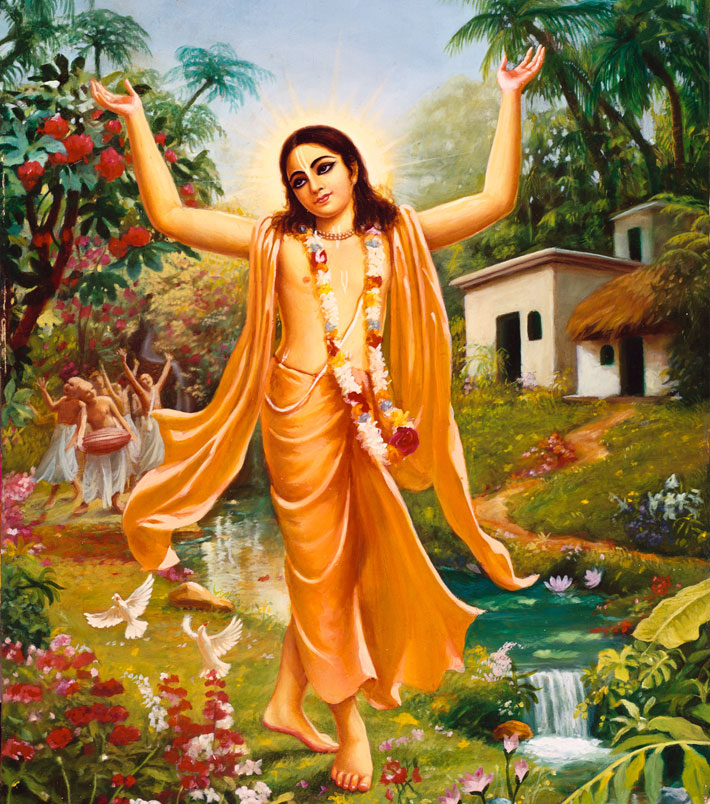
Chaitanya Mahaprabhu, a major proponent of Vaisnava philosophy, played a significant role in spreading Krishna Consciousness. He inundated entire India in the 16th century with the chanting of the Hare Krishna Mahamantra – Hare Krsna Hare Krishna Krishna Krishna Hare Hare/ Hare Rama Hare Rama Rama Rama Hare Hare.
Birth of Chaitanya Mahaprabhu
Caitanya Mahaprabhu was born in Mayapur, West Bengal, India on 18th Feb 1486. His father’s name was Jagannātha Miśra and mother’s name was Śacī-devī. During his childhood he was called as Gaurahari owing to his golden complexion. However, his mother called him Nimai because he was born near a neem tree. At the age of 5 he was admitted to a pathasala, school. By the age of 14 or 15 he became one of the most renowned and erudite scholars of Sanskrit and nyaya philosophy.
Chaitanya Mahaprabhu initiation
At the age of 16 or 17 he took spiritual initiation from a great Vaisnava Sannyasi, Isvara Puri. After initiation he became a religious preacher, his teachings transformed the hearts of many. Some of his intimate and sincere followers were Nityanand Prabhu, Haridas Thakura, Murari Gupta, Advaita Prabhu and Srivasa Pandita. In fact, numerous preachers of Vainavism started to flock to Nadia to meet Chaitanya Mahaprabhu.
Mahaprabhu’s teachings
Chaitanya Mahaprabhu wrote Siksastakam which comprises of eight verses. In the first verse he glorifies sankirtana i.e. the congregational chanting of the Hare Krishna Mahamantra.
“Glory to the Sri Krishna Sankirtana, which cleanses the heart of all the dust accumulated for years and extinguishes the fire of conditional life, of repeated birth and death. This sankirtana movement is the prime benediction for humanity at large because it spreads the rays of the benediction moon. It is the life of all transcendental knowledge. It increases the ocean of transcendental bliss, and it enables us to fully taste the nectar for which we are always anxious.” Sri Siksastakam
Through his life and teachings, he has underlined the importance of chanting the names of Krishna.
In Bhagavad Gita, Krishna says that the only reason why people like you and me suffer in this world is because we have disassociated ourselves with Krishna. And the only way by which we can free ourselves from all our miseries is by reassociating with Krishna.
So, Sri Chaitanya Mahaprabhu who is an incarnation of Krishna says that if we just chant the names of Krishna then we will be able to reunite with Krishna. Chanting will also cleanse our hearts of lust, greed, pride, anger, envy and illusion. These are the vices because of which we indulge in sins which eventually becomes the cause of our suffering. But once we chant then holy name of Krishna, we will get freedom from these vices. And once our heart becomes pure, it will automatically get attracted to Krishna. Just like a rust-free iron bar get attracted to a magnet.
Chaitanya Mahaprabhu spreads Krishna Consciousness
Mahaprabhu was full of compassion. So, he wanted to spread the holy name of Krishna in every nook and corner of the world. He instructed Prabhu Nityananda and Haridas to go to the streets, knock at every door and plead the inhabitants to chant the name of Lord Krishna.
suno suno nityananda, suno haridas sarvatra amar ajna koroho parkas
[Sri Caitanya-Bhagavata, Madhya-Khanda 13.8-10]
Denizens of Nadia were pleasantly surprised when Jagai and Madhai’s hearts were transformed. They were the most notorious and abominable figure of Nadia. But by the mercy of Chaitanya Mahaprabhu they became pure and devotees of Krishna. Mahaprabhu’s followers started increasing. Almost everyone in Nadia became devotees of Krishna, they all began chanting the names of Krishna.
When Chand Kazi, the chief magistrate of Navadvipa, tried to stop Mahaprabhu’s sankirtan movement then Mahaprabhu led a huge procession of the devotees to the residence of Chand Kazi. Mahaprabhu divided his Sankirtan into 14 groups; each devotee had a torch in his hand. Upon reaching Kazi’s house Mahaprabhu had a philosophical discussion with him. And finally Mahaprabhu was able to inculcate the Vaisnava philosophy in the heart of Kazi. Kazi lamented bitterly upon realizing his grave mistake and he himself decided to join the sankirtan party.
Why Chaitanya Mahaprabhu took sannyasa?
Mahaprabhu although a soft-hearted person was very strong in principles. Mahaprabhu’s preaching and his ever-increasing influence aroused jealously among some of the lowly minded brahmanas who decided to oppose Mahaprabhu. Mahaprabhu was of the belief that party feelings and sectarianism are the two biggest enemies of progress. He thought that as long as He will continue to identify Himself to a certain city (Nadia), and certain family His mission of spreading the message of Krishna will not succeed.
He no longer wanted to identify himself to certain city, certain family, caste and creed. Chaitanya Mahaprabhu thought that by taking sannyasa, he will be able to freely spread Krishna Consciousness. Therefore, at the age of 24 he decided to take sanyasa. After taking sanyasa Mahaprabhu travelled through entire India. He preached Vaisnavism and nama-sankirtan throughout the journey. On his way he preached pure bhakti and instilled Krishna Prema in the hearts of several people. And in this way thousands of people became devotees of Krishna.
Mahāprabhu’s spiritual ecstasy
Chaitanya Mahaprabhu would exhibit transcendental ecstasy remembering Krishna. These spiritual emotions are not of this material world. So, it cannot be understood by everyone. Only those who have love for Krishna and those who are trying to become devotees of Krishna can comprehend such spiritual ecstasies.
And this is the reason that mundane historians and scholars say that Chaitanya Mahaprabhu was suffering from epilepsy. Those who have never uttered the name of Krishna with love cannot understand someone who was madly in love with Krishna. It is their spiritual ignorance.
Kṛṣṇadāsa Kavirāja Gosvāmī, the author of Chaitanya Charitamrita, knew that the mundane scholar will fail miserably to understand Sri Chaitanya Mahaprabhu’s devotional ecstasies. So, writes, “When transcendental love of Kṛṣṇa awakens in someone’s heart, even a learned scholar cannot comprehend his activities. The activities and symptoms of that exalted personality in whose heart love of Godhead has awakened cannot be understood even by the most learned scholar.” Śrī Caitanya-caritāmṛta, Antya-līlā, 19.104 – 105
Chaitanya Mahaprabhu although Krishna appeared as a devotee of Krishna to spread Krishna Consciousness. And so to understand him one has to become a devotee of Krishna.
Mahaprabhu came to Puri at the age of 31. And he continued to live there till his disappearance at the age of 48.
Search
Recent Posts
-
Janmashtami: Celebrating Krishna’s Appearance Through...
August 17, 2026
-
Gopinatha Pattanayaka: 6 Lessons for...
August 16, 2026
-
What Does Krishna Say About...
August 11, 2026
-
Are you ready to choose...
August 2, 2026
-
55th Kolkata Ulta Rath Yatra...
July 25, 2026
Know the six glories of Hare Krishna Mahamantra
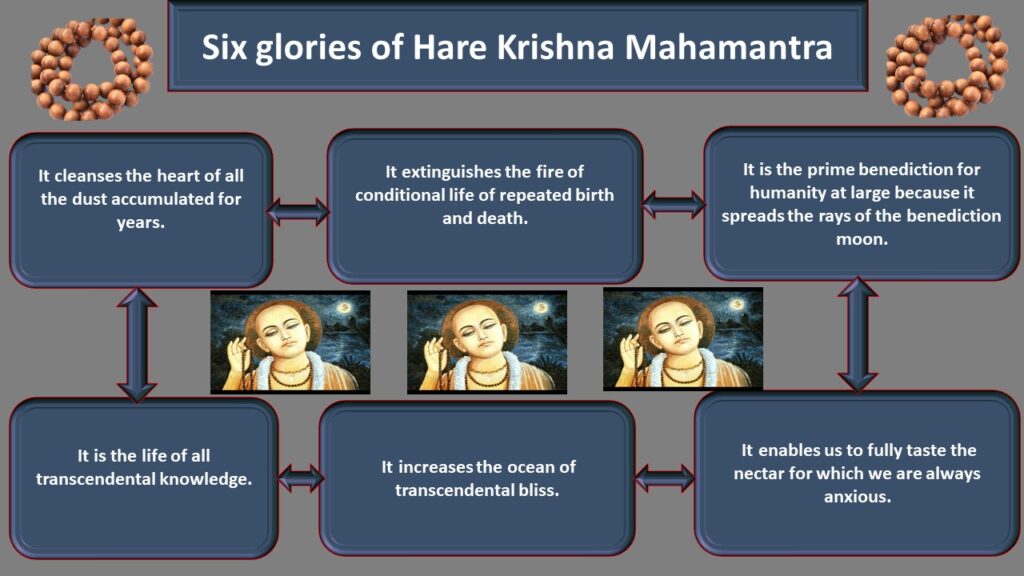
In Sri Siksastakam, Sri Chaitanya Mahaprabhu describes the glories of Hare Krishna Mahamantra which frees us from sufferings & gives us bliss.
Sri Chaitanya Mahaprabhu propagated the sankirtan movement in 15th century. Sankirtan means congregational chanting of the holy name of Krishna i.e. the Hare Krishna Mahamantra. Holy name of Krishna can be chanted publicly or individually, the benefit is the same.
In the first verse of Sri Siksastakam, Sri Chaitanya Mahaprabhu talks about the glories of performing śrī-kṛṣṇa-saṅkīrtanam i.e. chanting the names of Krishna – the Hare Krishna Mahamantra.
ceto-darpaṇa-mārjanaṁ bhava-mahā-dāvāgni-nirvāpaṇaṁ
śreyaḥ-kairava-candrikā-vitaraṇaṁ vidyā-vadhū-jīvanam
ānandāmbudhi-vardhanaṁ prati-padaṁ pūrṇāmṛtāsvādanaṁ
sarvātma-snapanaṁ paraṁ vijayate śrī-kṛṣṇa-saṅkīrtanam
“Glory to the sri-krsna-sankirtana, which cleanses the heart of all the dust accumulated for years and extinguishes the fire of conditional life, of repeated birth and death. This sankirtana movement is the prime benediction for humanity at large because it spreads the rays of the benediction moon. It is the life of all transcendental knowledge. It increases the ocean of transcendental bliss, and it enables us to fully taste the nectar for which we are always anxious.”
Let us discuss in detail the six glories of the holy name of Krishna i.e. the Hare Krishna Mahamantra from the first verse of Sri Siksastakam.
1. Cleanses the heart of all the dust accumulated for years
Dust of lust, greed, pride, anger, envy, illusion and false ego pollutes our heart and keeps us away from Krishna. It is because of these impurities that we suffer in this world. Unless we purify our heart of these contaminations, we won’t be able to lead a pure life of peace and bliss. There is no material pill in this world which can cure this disease of our heart. By our own efforts it is almost impossible.
But when we chant the holy names of Krishna then Krishna who is supremely pure purifies our heart of all the dust which is accumulated in our hearts for years. When sun shines darkness flees. Similarly, when Krishna’s name illuminates our hearts the vices which is polluting our hearts just disappears.
Sun is so powerful that it even cleanses the filthy places and remains unaffected. Krishna who is the source of the sun cleanses all the impurities from our hearts and remains completely pure.
In fact, we become pure like him when we remain under the shelter of his holy names.
2. Extinguishes the fire of conditional life of repeated birth and death
You do not want to die. I do not want to die. Ask a 90 year old person, he too does not want to die. We all fear death. We try our best not to die but the cruel laws of material nature do not allow us to live forever.
As long as we are in this material world we will have to die again and again and be born again and again. This is how this material world functions.
Krishna confirms this in Bhagavad Gita 8.16, “From the highest planet in the material world down to the lowest, all are places of misery wherein repeated birth and death take place.” But Krishna does not stop here. He further says in the same verse to Arjuna that “But one who attains to My abode, O son of Kuntī, never takes birth again.”
So, if you and I do not want to die then we have to go to the abode of Krishna, the spiritual world. Chanting the holy names of Krishna cleanses our hearts, helps to develop and deepen relationship with Krishna and ultimately helps us to attain kingdom of Krishna.
In that spiritual kingdom no one has to die again and again and be born again and again. So, Sri Chaitanya Mahaprabhu is saying that chanting the Hare Krishna Mahamantra extinguishes the fire of conditional life of repeated birth and death.
3. Holy name is the prime benediction for humanity at large because it spreads the rays of the benediction moon
We struggle hard for existence in this world. Our efforts to lead a happy and peaceful life again and again gets defeated. It leads to frustration and lamentation. Life’s uncertainty leads to fear. And fear causes stress and anxiety.
It appears as if we are caught in the midst of a forest fire. We find ourselves helpless and gradually become hopeless.
To save the humanity from this precarious situation the holy name of Krishna appeared. The holy name is like the soothing rays of the full moon. It calms our restless mind, pacifies our agitated heart and brings hope in our life.
So Sri Chaitanya Mahaprabhu says, “It is the prime benediction for humanity at large because it spreads the rays of the benediction moon.”
When Krishna plays flute in Vrindavan all the brajvasis spontaneously get mesmerized by the mystical music. Similarly, the holy name of Krishna which is non-different from Krishna automatically captivates the hearts of the suffering soul and fills their heart with transcendental melody. Holy name is a great benediction for us, we should be grateful to the holy name.
4. It is the life of all transcendental knowledge
The purpose of Vedas is to know Krishna. Krishna says, “By all the Vedas, I am to be known.” Bhagavad Gita 15.15. The final conclusion of all Vedic scriptures is that we are parts and parcel of Krishna. We are spirit souls currently in a material body made of bone and flesh. Our real identity is that we are spiritual beings and are meant to live with Krishna in Krishna’s kingdom.
In this material world because of material impurities our knowledge gets covered and we forget our relationship with Krishna. When we chant the holy name of Krishna then layers of material coverings gets removed and the ray of transcendental knowledge enlightens us. It reveals to us our real identity. We begin to realize that we belong to Krishna.
That is the ultimate goal of all transcendental knowledge. Holy name helps us to achieve that coveted goal. So, holy name is the life of all transcendental knowledge.
5. Holy name increases the ocean of transcendental bliss
As soon as we move closer to Krishna by chanting his names, we start experiencing drops of bliss pouring in our hearts.
Every being has been trying his best to enjoy the life of bliss in this world. But the material nature is not capable to satiate our heart. As the water of the ocean cannot quench our thirst, similarly things of this ephemeral world cannot bring joy to our heart. We are spiritual beings, so our soul longs for transcendental pleasures and not worldly pleasures.
Krishna is the source of all transcendental pleasures. When we connect to Krishna by chanting his names, Krishna who is ever eager to grace us with all happiness begins showering transcendental joy upon us. The more we become serious in our spiritual life, the more we become eager to chant the names of Krishna, our bliss too begins increasing.
We soon start floating in the ocean of transcendental bliss and start experiencing unlimited joy.
6. Holy name enables us to fully taste the nectar for which we are always anxious
The holy name is as sweet as sugar candy. Better to say sweeter than the sugar candy.
The holy name is full of nectar and has appeared to fill our life with nectar.
Due to ignorance, we may fail to comprehend the immense potency and purity of the holy name of Krishna. But once we get attached to the holy name, we forget all our misfortunes and just want to chant the names of Krishna. In fact, our misfortunes lose its relevance because it gets driven away by the holy name.
We delight in tasting the name of Krishna which is full of nectar.
Srila Rupa Goswami was so captivated by the holy name that he used to pray to the holy name to give him millions of mouths and millions of ears so that he could chant millions of times the holy name and hear it millions of times.
The holy name is the ambrosia for all sufferings. It helps us to taste the nectar for which we are always anxious and it bestows upon us complete perfection.
Conclusion
The glories of holy name discussed above should inspire us to chant the Hare Krishna Mahamantra. It will make our life auspicious. Sri Chaitanya Mahaprabbhu an incarnation of Krishna appeared in this world to make us understand the benefits of chanting the holy name of Krishna. So, we should take shelter of the holy name by regularly and sincerely chanting the Hare Krishna Mahamantra.
Search
Recent Posts
-
Janmashtami: Celebrating Krishna’s Appearance Through...
August 17, 2026
-
Gopinatha Pattanayaka: 6 Lessons for...
August 16, 2026
-
What Does Krishna Say About...
August 11, 2026
-
Are you ready to choose...
August 2, 2026
-
55th Kolkata Ulta Rath Yatra...
July 25, 2026
इस्कॉन न्यू टाउन कोलकाता में गौर पूर्णिमा उत्सव
भगवान कृष्ण के भक्त हमेशा आनंद में रहते हैं। वे साल में कई त्योहार मनाते हैं। सभी त्योहारों में, गौर पूर्णिमा यानी श्री चैतन्य महाप्रभु का प्रकट दिन ब्रह्म-माधव-गौड़ीय सम्प्रदाय के अनुयायियों के लिए सबसे महत्वपूर्ण है।
इस शुभ दिन पर, हमें भगवान चैतन्य के जीवन पर एक नाटक करने का अवसर मिला। प्रभु की सेवाओं में सक्रिय भागीदारी हमें भगवान के करीब ले जाती है। इसलिए, कुछ भक्तों के साथ मिलकर हमने नाटक प्रस्तुत करने के बारे में सोचा। हम में से किसी को भी नाटक में भाग लेने का पूर्व का कोई खास अनुभव नहीं था। लेकिन फिर भी हमने सोचा, ‘हम प्रयास करते हैं और भगवान श्री कृष्ण निश्चित रूप से हमारी मदद करेंगे। ‘
हमने चैतन्य महाप्रभु का वह लीला चुना जिसमे वो चाँद काज़ी का ह्रदय परिवर्तित करते हैं।
काजी ने नवद्वीप में संकीर्तन पर प्रतिबंध लगा दिया था और महाप्रभु ने इस फैसले के खिलाफ बड़े पैमाने पर विरोध प्रदर्शन किया था।
ऐसा कहा जाता है कि उस विरोध प्रदर्शन में लगभग 1 लाख लोगों ने भाग लिया था।
वास्तव में, यह भारत का पहला सविनय अवज्ञा आंदोलन था, यहाँ तक की यह दुनिया का पहला सविनय अवज्ञा आंदोलन भी हो सकता है।
हमने स्क्रिप्ट तैयार की। चैतन्य महाप्रभु, नवद्वीप के भक्त, चाँद काज़ी और काज़ी के सैनिकों के चरित्र का चुनाव किया। हमने गौर पूर्णिमा से एक दिन पहले कई बार अभ्यास किया। अगले दिन यानी गौर पूर्णिमा के दिन हमने जल्दी आकर और अभ्यास करने का फैसला किया।
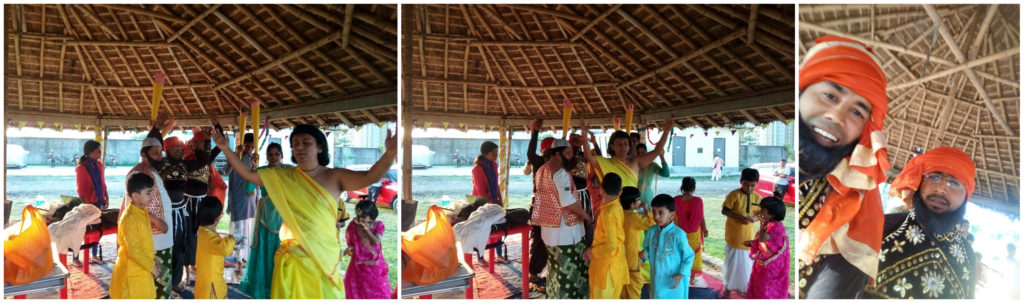
हमने बैकग्राउंड म्यूजिक और गानों की व्यवस्था की। हमें नाटक के लिए पोशाकें भी मिलीं। एक भक्त ने मशालें भी तैयार की। पहले हमने सोचा था कि हम मशाल जलाएंगे, लेकिन चूंकि कार्यक्रम मंदिर के हॉल के भीतर था, इसलिए मशाल जलाना खतरनाक होता, इसलिए हमने इस विचार को छोड़ दिया।
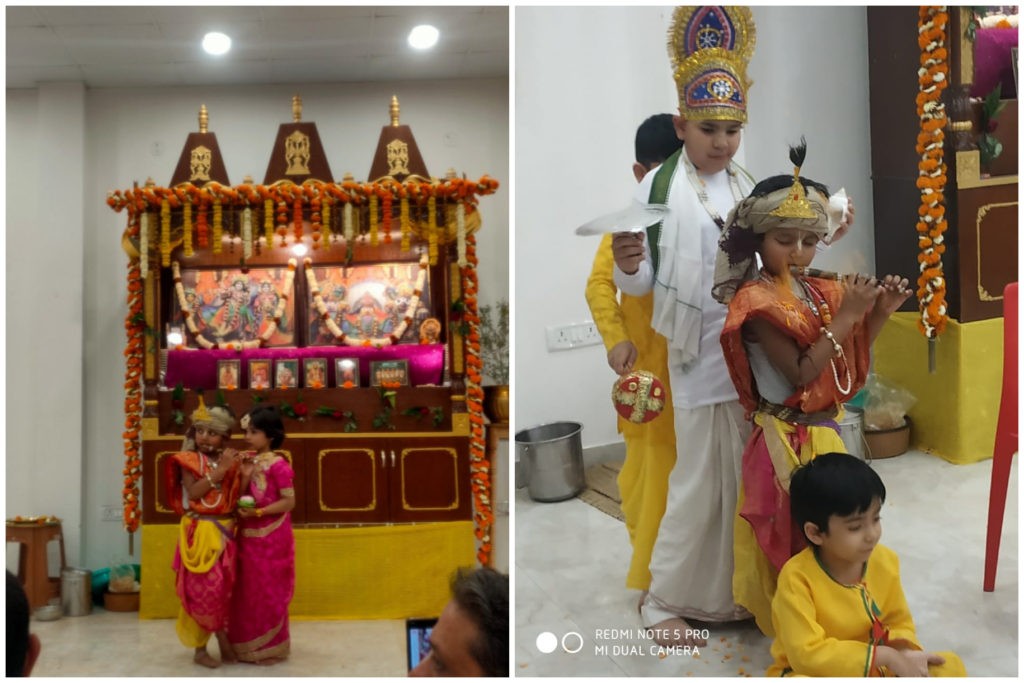
छोटे बच्चे भी महाप्रभु के जीवन पर नाटक कर रहे थे।
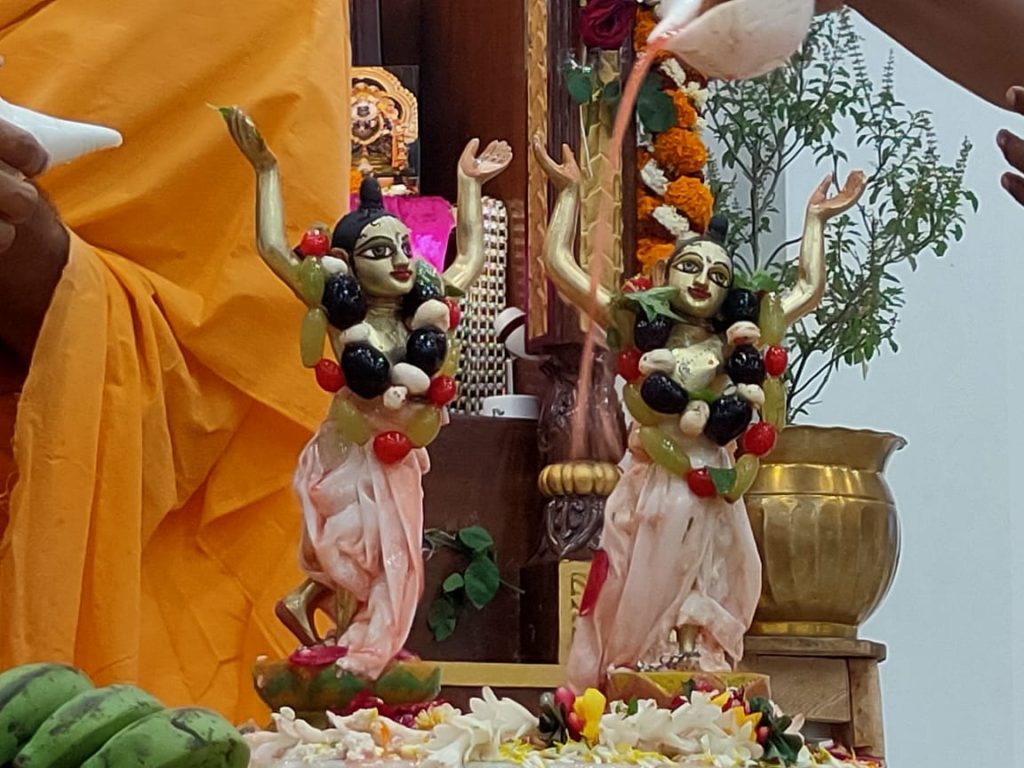
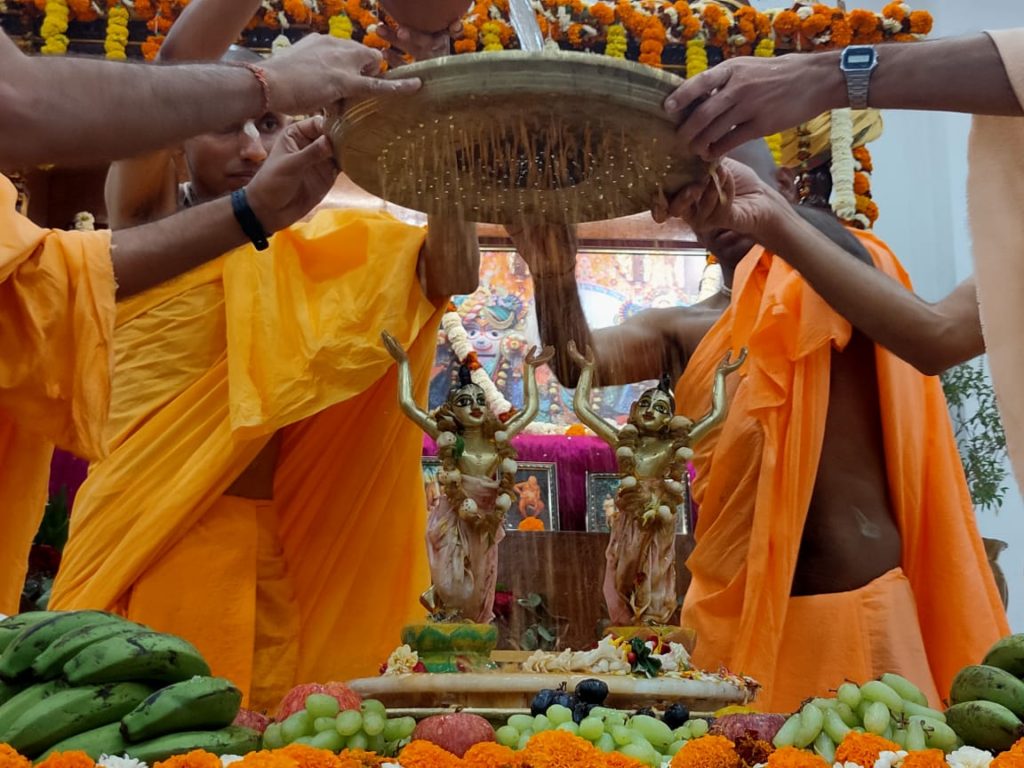
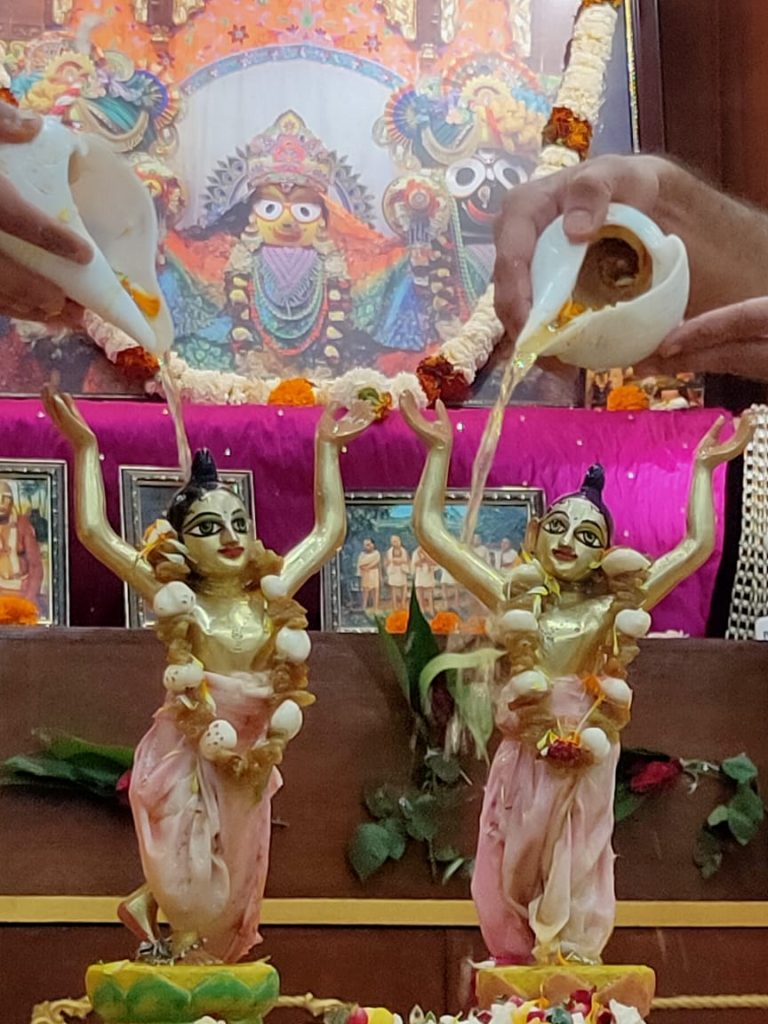
गौर पूर्णिमा कार्यक्रम की शुरुआत गौर निताई के सुंदर विग्रह के अभिषेक से हुई। श्री गौर निताई को गंगा जल, फलों के रस, फूल और अन्य पवित्र वस्तुओं से स्नान कराया गया। अभिषेक के समय सभी भक्त हरे कृष्ण महामंत्र का कीर्तन कर रहे थे।
अभिषेक के तुरंत बाद बच्चों का नाटक था। बच्चों ने शानदार प्रदर्शन किया। रंग–बिरंगे परिधान पहने, उन्होंने महाप्रभु के बचपन के लीलाओं पर नाटक प्रस्तुत किया जो सभी के दिलों को छू गए।
अब हमारी बारी थी।
हमने प्रार्थनाएँ कही और भगवान से आशीर्वाद मांगा ताकि हम भक्तों को निराश न करें।
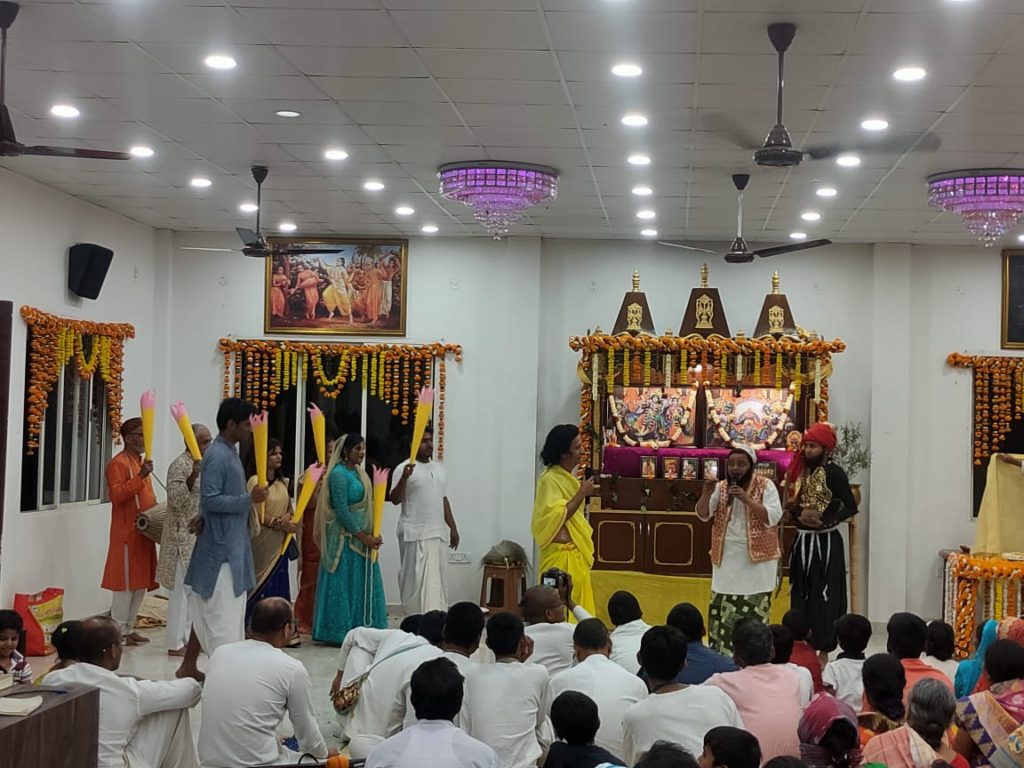
हमारे नाटक की शुरुआत उस दृस्य से हुई, जिसमें हमने दिखाया कि कैसे भक्त नवद्वीप में भगवान कृष्ण की भक्ति आनंद के साथ कर रहे थे। एक परिवार पवित्र नामों का जाप कर रहा था। महिलाओं का एक समूह प्रभु के लिए माला तैयार कर रहा था। कुछ भक्त शास्त्रों पर चर्चा कर रहे थे।
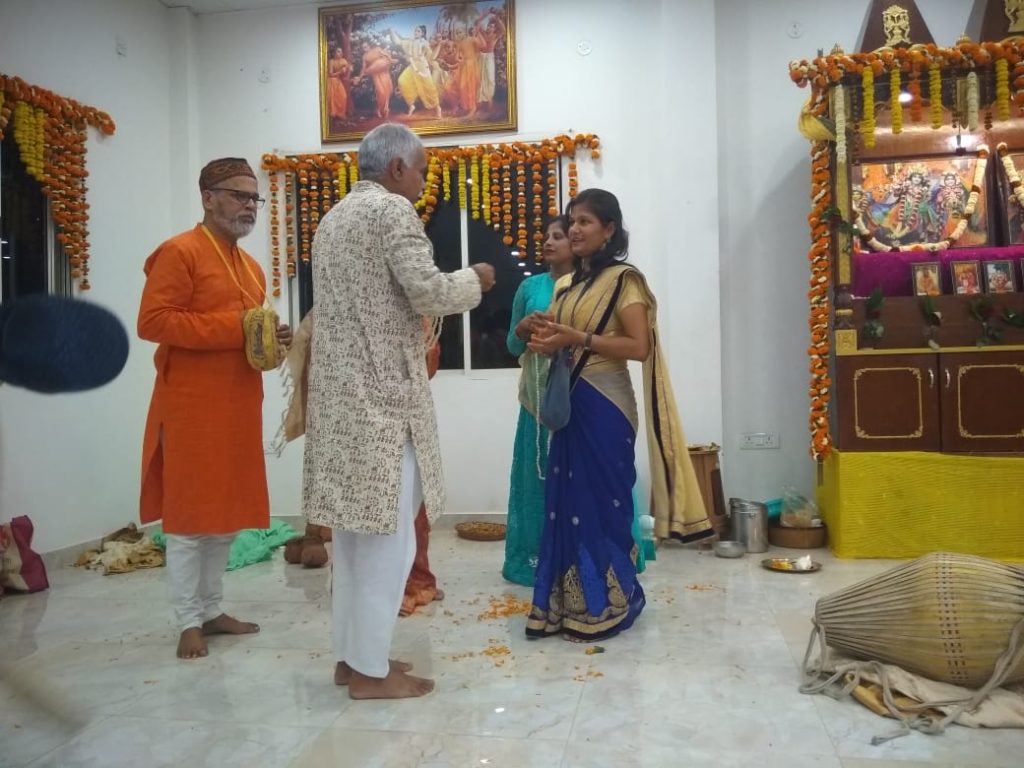
एक भक्त सभी को आरती के लिए आमंत्रित करने आता है। जब भक्त आरती कर रहे थे, चाँद काज़ी के दो सैनिक प्रवेश करते हैं। वे दर्शकों के पीछे से प्रवेश करते हैं।
ऊंची आवाज में सैनिक सभी को धमकी देते हैं कि वे कृष्ण के नामों का जाप न करें। वे भक्तों के पास आते हैं और उन्हें तुरंत आरती रोकने के लिए कहते हैं। उन्होंने उन्हें चेतावनी भी दी कि यदि वे आदेश की अवहेलना करते हैं तो उन्हें सलाखों के पीछे डाल दिया जाएगा और उन्हें कड़ी सजा दी जाएगी। जाने से पहले उन्होंने एक मृदंग भी तोड़ा।
हमने मृदंग का उपयोग नहीं किया बल्कि मिट्टी के बर्तन का उपयोग किया। मृदंग एक पवित्र वस्तु है और किसी भी परिस्थिति में उसका अनादर नहीं किया जाना चाहिए।
श्रद्धालु एकदम सदमे में थे। भक्तों ने आपस में चर्चा की और निष्कर्ष निकाला, “जीवन का उद्देश्य कृष्ण के पवित्र नामों का जप करना है। अगर हम ऐसा नहीं कर रहे हैं, तो हमारे शरीर का क्या फायदा। हमें अपना जीवन त्याग देना चाहीए। ” सभी दुखी थे।
फिर चैतन्य महाप्रभु प्रवेश करते हैं।
भक्तों को दुखी देखकर वह आश्चर्यचकित हैं। वह उनसे पूछतें हैं, “क्या हुआ? आप सभी इतने दुखी क्यों हैं? ” भक्त अपनी व्यथा सुनाते हैं। आंखों में आंसू के साथ वे कहते हैं, “चूंकि अब हम कृष्ण की भक्ति करने के लिए स्वतंत्र नहीं हैं, इसलिए हमें अनुमति दें ताकि हम खुद को गंगा में डुबाकर अपना जीवन समाप्त कर सकें।“
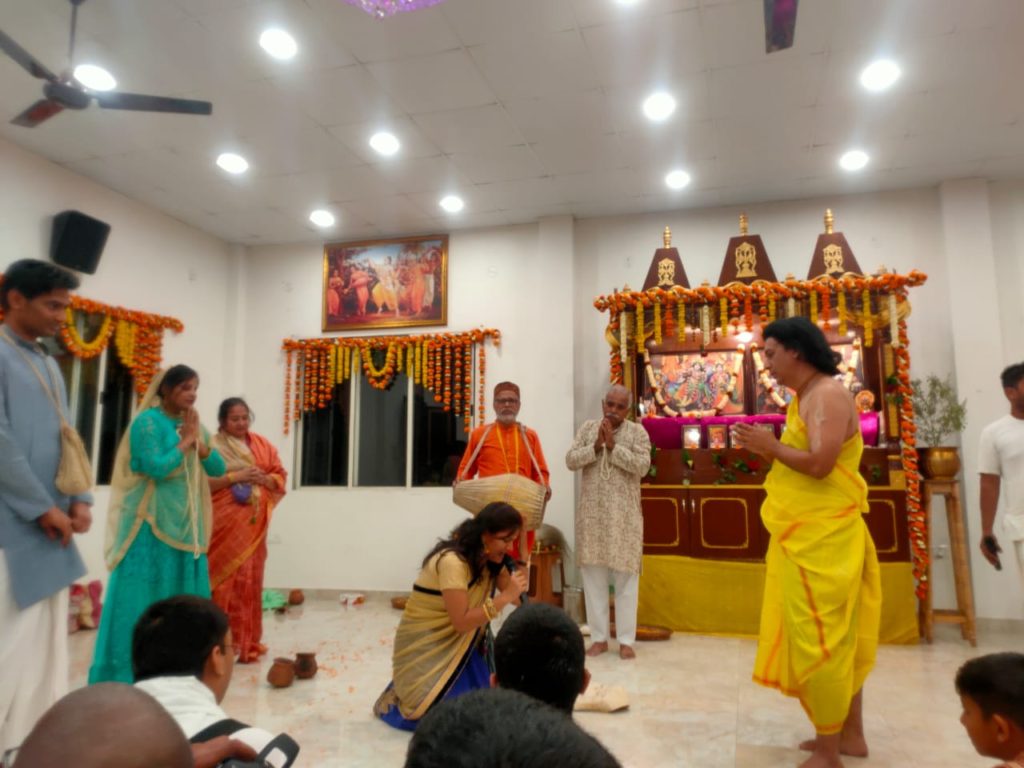
महाप्रभु भक्तों की विनती सुनकर भावुक हो जाते हैं।
फिर वो कहते हैं, “पूरे ब्रह्मांड में कोई नहीं है जो संकीर्तन को रोक सकता है। संकीर्तन जारी रहेगा। हम आदेश की अवहेलना करेंगे।”
भक्त हर्षित हो जाते हैं लेकिन कुछ भक्त फिर भी पूछते हैं, “क्या यह संभव हो सकता है?”
महाप्रभु कहते हैं, “क्या आपको मेरे शब्दों पर विश्वास नहीं है? क्या आपको मुझ पर भरोसा नहीं है?” सभी भक्त कहते हैं, “महाप्रभु आप हमारे उद्धारकर्ता हैं। आप हमारी जिंदगी हैं। हम आप पर विश्वास करते है। हमें आप पर पूरा भरोसा है।”
महाप्रभु ने उन्हें मशालें तैयार करने, मृदंगों और करताल की व्यवस्था करने को कहा। नवद्वीप के सभी भक्तों को विरोध मार्च में आमंत्रित करने को कहा।”
इसके बाद महाप्रभु जाते हैं। भक्त तैयारी शुरू करते हैं। और बैकग्राउंड में खूबसूरत भजन बजता है।
भज गौरांगा कह गौरांगा लाह गौरांगरा नाम रे
जे जना गौरांग भजे, सेई (होय) अमरा प्राण रे
भक्त फिर विरोध मार्च निकालते हैं। महाप्रभु के नेतृत्व में मशाल और मृदंग और करताल के साथ वे जोर–जोर से नवद्वीप की सड़कों पर संकीर्तन करते हैं और नृत्य करते हैं।
लोग चाँद काज़ी के घर की ओर जाते हैं।
चाँद काज़ी इस बात से अवगत नहीं था कि लोग, जिनमें से कुछ बेहद गुस्से में थे, उसकी घर की ओर मार्च कर रहे हैं।
एक सैनिक उसे खबर देने के लिए दौड़ता हुआ आता है। शुरू में काजी ने उस पर विश्वास नहीं किया। लेकिन फिर वह भारी भीड़ को संकीर्तन करते हुए देखता है। वह दौड़ता है और अपने घर के अंदर छिप जाता है। भक्त अब उसके दरवाजे पर हैं।
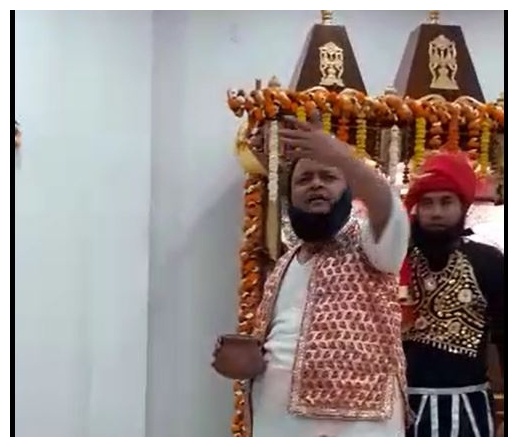
महाप्रभु एक भक्त को अंदर भेजते हैं। भक्त घर में प्रवेश करता है और काज़ी को बाहर आने के लिए मजबूर करता है। काजी बेहद भयभीत है। कुछ भक्त चिल्लाते हैं, “इसे दंड दो। इसे सजा दो।“
महाप्रभु उन्हें शांत करते हैं। और काजी से पूछतें हैं, “लगता है आप मुझे देखकर खुश नहीं हैं। आपने मेरा स्वागत नहीं किया। आप अपने घर के अंदर छिप गए।”
काजी लड़खड़ाती आवाज़ में कहता है, “नहीं। नहीं यह सत्य नहीं है। मैंने देखा आप गुस्से में हैं। आपके साथ आने वाले सभी लोग गुस्से में हैं। तो मैंने सोचा कि जब तक आपका गुस्सा कम न हो जाए, मुझे अंदर ही रहना चाहिए। जैसे ही मैंने देखा आप शांत हो गए हैं, मैं आपका स्वागत करने के लिए तुरंत बाहर आ गया।”
फिर काज़ी कहता है, “नीलाम्बर चक्रवर्ती, आपके नाना, मुझे बहुत प्यार करते थे। मैं उन्हें चाचा कहता था और वो मुझे अपने पुत्र की तरह स्नेह करते थे। उस रिश्ते से तो आप मेरे भांजा हुए। और मामा और भांजा आपस में झगड़ा नहीं करते। जब कभी मामा नाराज होता है तो भतीजा उसे शांत करता है। और जब भतीजा नाराज होता है तो मामा बुरा नहीं मानता बल्कि उसे शांत करता है।”
महाप्रभु तब पूछते हैं, “एक मुस्लिम शासक के रूप में आपने कल संकीर्तन को रोकने की कोशिश की थी। लेकिन आज जब लोग सड़कों पर जाप और नृत्य कर रहे थे तब आपने कुछ नहीं किया? “
काज़ी कुछ कहना चाहता है। वह महाप्रभु से पूछता है कि क्या हम अंदर जाकर बात सकते हैं। एक भक्त क्रोधित स्वर में कहता है, “नहीं। सारी चर्चा यहीं होगी।”
महाप्रभु कहते हैं, “ये भक्त अपने हैं। आप इनके सामने सब कुछ कह सकतें हैं।”
काज़ी कहता है, “कल, मेरे जीवन में कुछ अविश्वसनीय हुआ। सपने में मैंने एक अध्भुत जीव देखा। मैं समझ नहीं पा रहा था कि वह कौन है। वह आकार में बहुत बड़ा था। उसका आधा शरीर शेर का था और आधा आदमी का था। वो मेरे शरीर के ऊपर बैठा था और अपने बड़े और तीखे नाखूनों से मेरी छाती को चीरने की कोशिश कर रहा था। उसके बड़े नुकीले दांत थे। उसके मुँह से आग निकल रही थी। वह गर्जना कर रहा था और चिल्ला रहा था, ‘तुमने नवद्वीप में संकीर्तन को रोकने की हिम्मत की। तुम्हारी हिम्मत कैसे हुए एक मृदंग को तोड़ने की। यदि तुम ऐसा फिर से करते हो, तो मैं तुम्हें चीर दूंगा। मैं तुम्हें ही नहीं बल्कि तुम्हारे परिवार के सभी सदस्यों को भी मिटा दूंगा। ऐसा फिर कभी करने की कोशिश नहीं करना।’ उसके नाखूनों के निशान अभी भी मेरी छाती पर हैं। “
महाप्रभु फिर पूछते हैं, “इसके अलावा भी कुछ हुआ?” काज़ी कहता है, “हाँ। कल जब मेरा एक सैनिक संकीर्तन को रोकने के लिए एक घर में गया, तब कहीं से आग की लपटें आ गयी जिससे उसका दाढ़ी और चेहरा जल गया।”
काजी महाप्रभु से भक्तों को परेशान करने के लिए क्षमा मांगता है।
आंखों में आंसू के साथ वो कहता है, “वेद में भगवान नारायण की महिमा का गुणगान किया गया है। सभी हिंदू उस नारायण की पूजा करते हैं और उसे हरि भी कहते हैं। अब मैं समझ गया हूँ कि आप वही हरि हैं। आप परमपिता परमात्मा हैं। आप गौरहरि हैं।”
काजी गौरहरि के चरणों में गिर जाता है। गौरहरि प्यार से उसे उठातें हैं और कहतें हैं, “आप बहुत भाग्यशाली हैं। आपने हरि, कृष्ण और नारायण के नामों का जप किया। आपके सभी पाप समाप्त हो गए। अब आप शुद्ध हैं।”
महाप्रभु काज़ी से कहते हैं, “मैं एक निवेदन करना चाहता हूँ। आप वादा करें कि आप इस संकीर्तन को कभी नहीं रोकेंगे।”
अपने गलती के लिए माफी मांगते हुए काज़ी कहता है “अब से कोई भी नवद्वीप के इस पवित्र धाम में कभी भी संकीर्तन को नहीं रोकेगा। भविष्य में मेरे वंशज भी नहीं। हम सभी मिलकर संकीर्तन में भाग लेंगे।”
भक्त हर्षपूर्वक बोलते हैं, ‘हरिबोल! हरिबोल! जय गौरांगा’
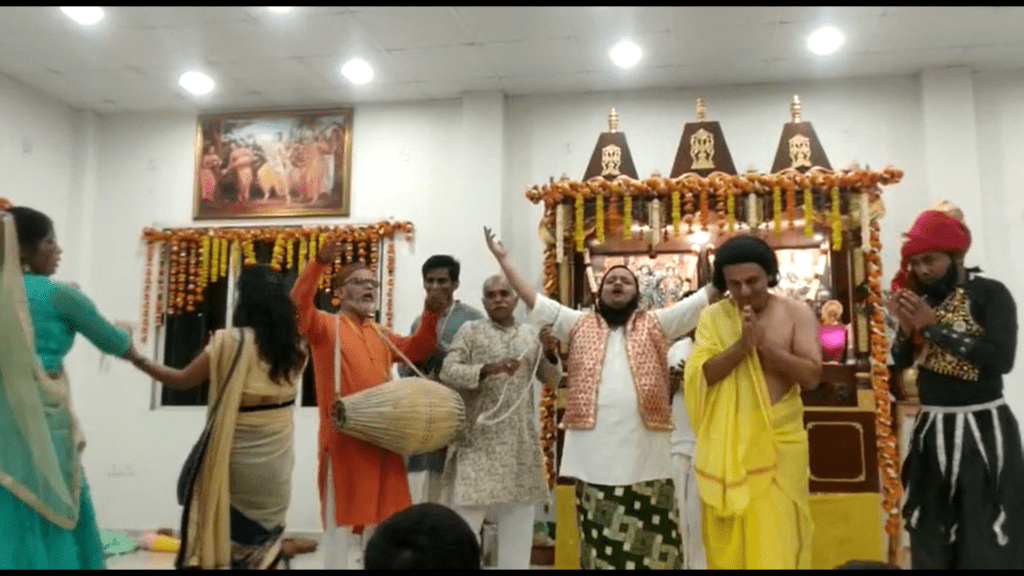
अंत में “हरी हराये नमः कृष्ण यादवया नमः यादवया माधवाय केसवाया नमः” का संगीत बजता है और सभी आनंद में नृत्य करते हैं ।
नाटक के बाद श्री चैतन्य महाप्रभु के जीवन और शिक्षाओं पर एक विशेष कथा होती है। कथा के बाद आरती और अंत में सभी भक्त प्रसाद का आनंद लेते हैं।
Search
Recent Posts
-
Janmashtami: Celebrating Krishna’s Appearance Through...
August 17, 2026
-
Gopinatha Pattanayaka: 6 Lessons for...
August 16, 2026
-
What Does Krishna Say About...
August 11, 2026
-
Are you ready to choose...
August 2, 2026
-
55th Kolkata Ulta Rath Yatra...
July 25, 2026
A Memorable Gaur Purnima Celebration at Iskcon New Town Kolkata
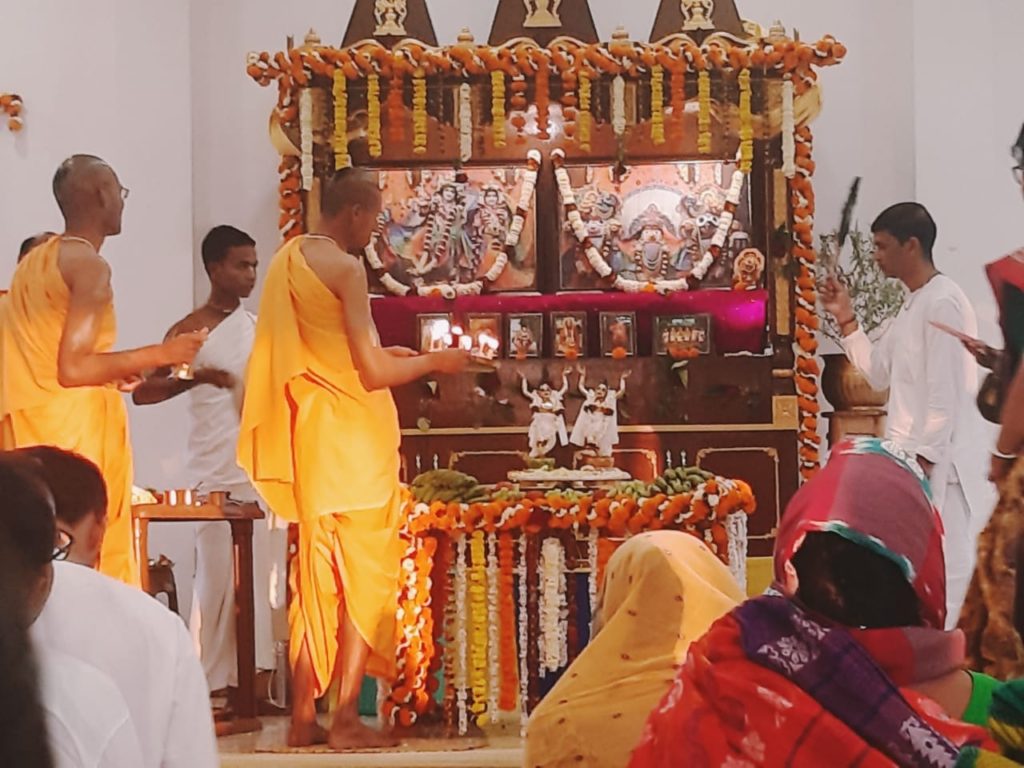
Devotees of Lord Krishna are always joyful. They always have reasons to celebrate. There are so many festivals and so many events. Amongst all the festivals, Gaur Purnima i.e. the appearance day of Sri Chaitanya Mahaprabhu is one of the most important festivals for the followers of Brahma-Madhva-Gaudiya sampradaya.
On this auspicious day, we had an opportunity to do a drama on one of the most important pastimes of Lord Chaitanya. Active involvement in the services of the Lord helps a lot in becoming serious in devotional life. So, with a group of few devotees, we thought of presenting the drama. Many had no previous experience in participating in any drama. But still, we thought, ‘Let us give it a try. Krishna will surely help us.’
We choose to do drama on the pastime of Chaitanya Mahaprabhu with Chand Kazi.
The Kazi had banned sankirtana in Navadwip (Navadvipa) and Mahaprabhu had organized a massive protest against this decision.
It is said that around 1 lakh people participated in that protest.
In fact, it is said to be the first Civil Disobedience movement of India or maybe of the world.
We prepared the script and devotees got their respective roles and dialogues. We decided on the character of Chaitanya Mahaprabhu, devotees of Navadwip (Navadvipa), Chand Kazi and Kazi’s soldiers. We practiced many times a day before the festival. The next day i.e. on the Gaur Purnima day we decided to come early to practice a few more times before the final performance.
We arranged for background music and songs. By the mercy of Krishna, we got costumes too. The costumes were perfect. Torches were also prepared. Initially, we thought that we will light the torches but since the program was within the temple hall so lighting the torch would have been dangerous, so we gave up the idea. We even practiced with costumes and music.
Small children were also performing drama on childhood pastimes of Mahaprabhu.
Gaur Purnima program began with the abhishek of beautiful deities of Gaur Nitai. Amidst the melodious chant of Hare Krishna Mahamantra, the deities were bathed with Ganges water, fruit juices, flowers, and other sanctified items.
Immediately after the abhishek was the drama of the kids. Children performed wonderfully. Wearing colorful costumes, they delivered dialogues in broken languages which touched the hearts of all.
Now it was our turn.
We said our prayers and sought the blessings of the lord so that we do not disappoint the assembled devotees.
Our drama started with the scene where we showed how the devotees were happily engaged in practicing devotion to Lord Krishna in Navadvipa. One family was chanting the holy names. One group of ladies were preparing garland for the Lord. Few devotees were discussing Krishna Conscious philosophy.
One devotee then comes to invite all for arati. While the devotees were performing arati, two soldiers of Chand Kazi enter. They enter from behind the audience.
In a loud voice, the soldiers come threatening all not to engage in chanting the names of Krishna. They come near the devotees who were doing arati and asked them to stop immediately. They even warned them that if they defy the order they will be put behind bars and will be severely punished. Before leaving they even broke a mridanga.
We did not use mridanga but a clay pot. Mridanga is sacred paraphernalia and in no circumstances should be disrespected.
The devotees were in utter shock. In the background played sad music. The devotees discussed amongst themselves and concluded, “The life’s purpose is to chant the holy names of Krishna. If we are not doing so then what is the use of our living and maintaining this body. Let this body rot and die.” All were sad.
And then enters Chaitanya Mahaprabhu.
Seeing the devotees sad he is surprised. He asks them, “What happened? Why you all are so sad?” Devotees narrate their ordeal. With tears in their eyes, they say, “Since we are now not free to practice devotion to Krishna so give us permission so that we can end our lives by drowning ourselves in the Ganges.”
Mahaprabhu is moved to hear the pleas of the devotees.
In an authoritative tone, he says, “There is no one in the entire universe who has the power to stop the sankirtana. Sankirtana will continue. We will defy the order.”
Devotees become joyful but some are doubtful. So some ask, “Can this be possible?”
Mahaprabhu says, “Don’t you have faith in my words. Don’t you trust me.” Devotees unanimously say, “Mahaprabhu you are our savior. You are our life. We believe in you. We trust in you.”
Mahaprabhu asks them to prepare torches, arrange for mridangas and kartals and inform all the devotees of Navadvipa to come for the protest march.”
After this Mahaprabhu leaves. Devotees begin the preparation. And in the background plays the beautiful song
bhaja gauranga kaha gauranga laha gaurangera nama re
je jan gauranga bhaje, sei (hoy) amara praṇa re
Devotees then take out the protest march. Carrying torchlights and mrindangas and kartals under the leadership of Mahaprabhu they loudly chant and dance on the streets of Navadvipa.
The scene now moves to the house of Chand Kazi.
He is not aware that tens of thousands of people, some of them extremely angry, are marching towards his house.
A soldier comes running to give him the news. Initially, the Kazi did not believe him. But then he sees the huge crowd doing sankirtana. He runs and hides inside his house. Thousands of devotees now are at his doorstep.
Mahaprabhu asks one devotee to go inside and inform Kazi about his arrival. A devotee enters the house and compels him to come out. Kazi is extremely fearful. Some devotees shout, “Punish him. Punish him.”
Mahaprabhu pacifies them. And asks the Kazi, “Seems you are not happy seeing me. You did not welcome me. You hid inside your house.”
Kazi in a faltering voice says, “No. No. It is not true. I saw you are angry. All the people coming with you are angry. So I thought let me be inside till your anger subsides. As soon as I saw you are in a good mood. I came out immediately to welcome you.”
He then says, “Nilambar Chakravarti, your maternal grandfather, loved me a lot. I called him uncle and he treated me like his son. With that relationship, you are my nephew. And maternal uncle and nephew do not quarrel with each other. Sometime when the uncle is angry, nephew calms him down. And when nephew is upset then uncle do not mind and pacifies him.”
Mahaprabhu then asks, “As a Muslim ruler, you tried to stop sankirtana yesterday. But today when thousands were chanting and dancing on the streets then you did nothing?”
Kazi wants to say something. He asks Mahaprabhu that can we go inside and speak. Immediately one of the devotees in angry tone says, “No. All discussion will happen here only.”
Mahaprabhu says, “These devotees are his own. He can say everything in front of them.”
Kazi then says, “Yesterday, something unbelievable happened in my life. In the dream came a being. I could not understand who he was. He was massive in size. Half his body was of a lion and the other half was of a man. He was sitting on top of my body and with his big and sharp nails was trying to tear apart my chest. He had sharp-pointed big teeth. Fire was emanating from his mouth. He was roaring and was shouting, ‘How dare you tried to stop sankirtana in Navadvipa. How dare you broke a mridanga. If you do it again, I will tear you apart. I will not just kill you but all your family members. Never try to do it again.’ See the marks of his fingernails are still on my chest.”
Mahaprabhu then asks, “Anything else happened?” Kazi says, “Yes. Yesterday when one of my soldiers went to a house to stop sankirtana then from nowhere flames appeared which burned his beard and half face.”
Kazi seeks forgiveness from Mahaprabhu for disturbing the devotees.
With tears in his eyes, he says, “The Vedas talk about the Supreme God, Narayana. Hindus worship that Narayana and also call him Hari. Now I have understood that you are the same, Hari. You are the Supreme Lord. You are Gaurhari.”
The Kazi falls at the feet of Gaurhari. Gaurhari lovingly picks him up and says, “You are so fortunate. You chanted the names of Hari, Krishna, and Narayana. Your all sins are nullified. You are supremely pure now.”
Mahaprabhu tells Kazi, “I have come to make one request. You must promise that you will never ever stop this sankirtana.”
Kazi seeking forgiveness for his deeds declares that “From now onwards no one will ever stop sankirtana in this holy Dham of Navadvipa. Not even my descendants in the future. We all will together participate in sankirtana.”
Devotees joyfully chant, “Haribol! Haribol! Jai Gauranga!.
In the end, everyone sings and dances on the song Hari Haraye Namah Krishna Yadavaya Namah…
After the drama was a special class on the pastimes and teachings of Sri Chaitanya Mahaprabhu which was followed by arati and delicious prasadam.
It was a wonderful way to celebrate the Gaur Purnima festival.
Search
Recent Posts
-
Janmashtami: Celebrating Krishna’s Appearance Through...
August 17, 2026
-
Gopinatha Pattanayaka: 6 Lessons for...
August 16, 2026
-
What Does Krishna Say About...
August 11, 2026
-
Are you ready to choose...
August 2, 2026
-
55th Kolkata Ulta Rath Yatra...
July 25, 2026
The most important places to see inside Jagannath Puri temple
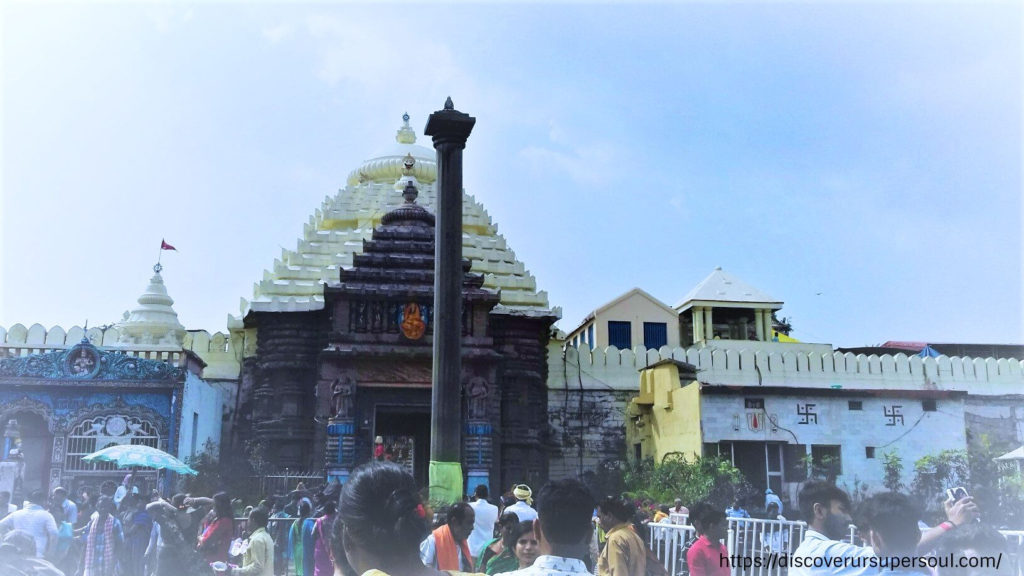
Jagannath Puri is the abode of Lord Jagannath, the Lord of the universe. It is one of the most important holy places. Whenever I get a chance, I always try to be in Puri. So, when devotees were planning to visit this sacred place then I was excited. I too wanted to go.
You can visit the temple an unlimited number of times but still, you want to be there again and again.
We decided to go by Howrah Puri express. We boarded the train from Kolkata on Friday night at 8:55 pm and reached Puri the next day, Saturday, at around 6 am. We had booked our accommodation in Sri Chaitanya Gaudiya Math.
The math is around 3 km from the railway station. We took a 10-seater vehicle to Sri Chaitanya Gaudiya Math. It cost us Rs 220. It was a prepaid auto.
We decided to stay there because of two reasons and both the reasons are equally important. This math is near to the Jagannath Temple and it is also the birthplace of Srila Bhaktisiddhanta Saraswati Thakura, spiritual master of Srila Prabhupada, the founder acharya of Iskcon. The Jagannath temple is just 5 minutes’ walking distance from the math. And from the terrace of the math, the famous Chakra of Lord Jagannath is clearly visible.
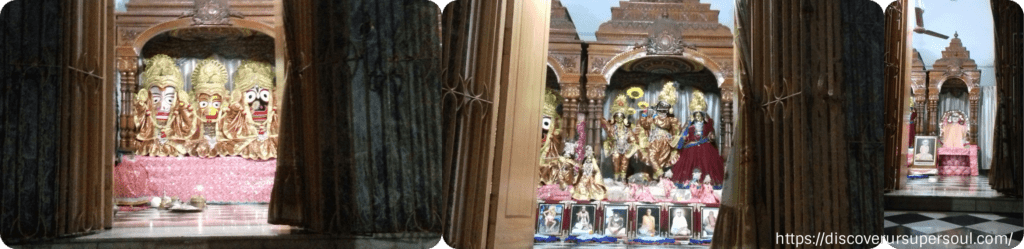
The temple has three altars. The middle altar has the deity of Lord Krishna and Srimati Radharani along with Sri Chaitanya Mahaprabhu. The deity name is Sri Sri Guru Gauranga Radha Nayanmani. The left altar has the deity of Lord Jagannath, Lord Baladeva, and Subhadra Devi. And in the right altar deity of Srila Bhaktisiddhanta Saraswati Thakura is present.
Once we reached the math, we decided to get ready as soon as possible so that we can immediately go to the temple.
As we were going to the temple, we saw a huge security arrangement. It looked like some important dignitary is present there or is going to come.
And soon we saw Amit Shah, the Home Minister of India, and other members of Narendra Modi Cabinet like Dharmendra Pradhan and few others.
Amit Shah was sitting in an SUV and we were standing very close to his vehicle. Some devotees greeted him, and he responded too.
Similarly, other cabinet ministers passed. It seems they all had come to take darshan of the Lord.
Entering the temple from Simha Dwara:
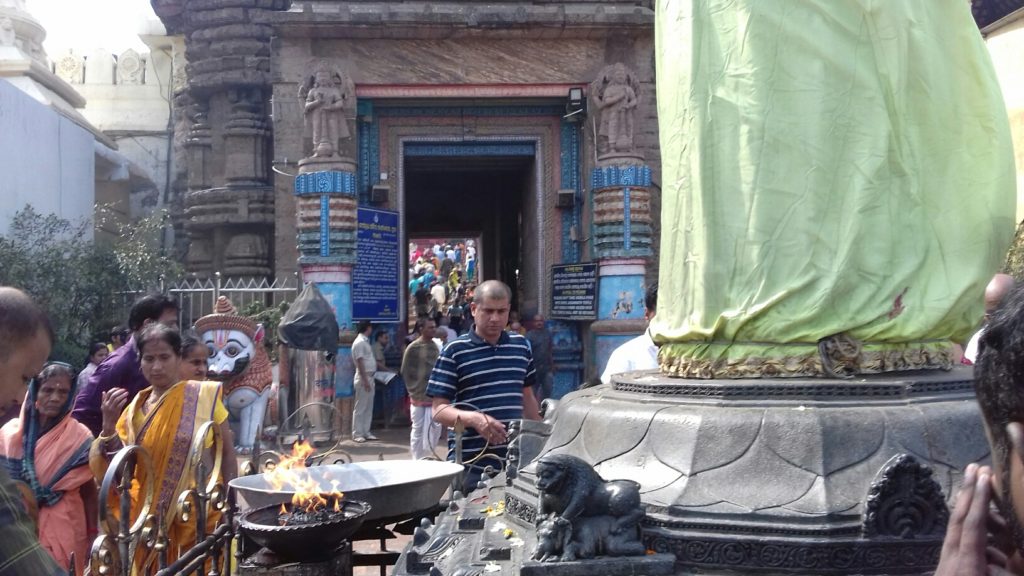
We entered the temple from Simha Dwara. It is also called Lion’s Gate or Eastern Gate. It was around 9 am when we went inside the temple. Already hundreds of devotees were there inside the temple hall. But the darshan was closed. Some said it will open at 9:30 am. We had to wait. I somehow managed to get near the Garuda stambh.
The Garuda stambh
Anyone who comes to take darshan of the Lord should bow to Garuda stambh first. If one stands near Garuda stambh then one can see the three Lord’s directly from there.
Sri Chaitanya Mahaprabhu would always take darshan of the Lord from Garuda stambh. He thought himself to be too fallen to go near the Lord. By his own example, the Lord is teaching us that we should never have any superiority complex. But we should think that we are unworthy, and it is because of the Lord’s causeless mercy he is giving us his darshan and in fact even allowing us to come inside his temple. So, Garuda stambh is very dear to the followers of Sri Chaitanya Mahaprabhu.
I bowed to Garuda Stambh and embraced it with both my hands. Other devotees were also reverentially touching it and embracing it.
The lamps at Garuda stambh is always lit. I saw Pujaris pouring ghee (or it could be oil) into the big lamp so that it continues to burn. Above the stamb are many metallic lamps. At that time, one lamp was lit. May be during the festival time all the lamps are lit.
Inside the temple hall of Lord Jagannath
I stood beside the Garuda stambh. The darshan was to open after 30 min. In between someone from the crowd would shout ‘Jay Jagannath’. And everyone would respond by chanting ‘Jay Jagannath.’ Sometime someone would say ‘Haribol’ and the entire crowd would say ‘Haribol.’ As soon as anyone heard ‘Jay Jagannath’ and ‘Haribol’ everyone would look expectedly thinking that the darshan has opened.
We waited for around 40 minutes and I liked it. Because this gave an opportunity to be in the temple hall of Lord Jagannath and chant the holy names of Krishna standing beside the Garuda stambh. Many people were standing, and many were sitting waiting for darshan to open.
Taking darshan of Lord Jagannath
And finally, the darshan opened. One young boy lifted one young girl (I am not sure about their relationship), so that she could see the Lord. And they both were asked not to do so. In fact, the Pujaris got angry too. It’s a traditional temple and the expectation is that everyone follows the traditional code of conduct and not the one which is shown in Bollywood movies.
Several hundred devotees were there. The crowd was moving slowly but steadily. Finally, I got near to the place where I could see the Lord. I was apprehensive that I may be pushed by the people and will not be able to properly see the Lord. So, I was praying to the Lord.
And finally, I saw a glimpse of Lord Jagannath, then Subhadra Devi and then Lord Baladeva.
I wanted to go near to the barricade so that I can closely see the Lord. Also, I wanted to offer some Lakshmi (money) to the three deities.
I came near the Pujari. Since he was in front of Lord Jagannath, so I believe he was the priest of Lord Jagannath. I offered Rs 100. And then I came to the Pujari who was in front of Subhadra Devi. I gave Rs 100.
And the Pujari started putting a yellow cloth of the Lord around my neck.
He asked me to give Rs 100 more which I happily gave. He gave me offered Tulasi of the Lord. I stood there for a few minutes. Then moved back in such a way that I continue taking darshan of the Lord. Fortunately, by Lord Jagannath’s grace even security was not asking me to move. I was able to take darshan for several minutes and then decided to come out. I thought I should not take undue advantage of the security personnel’s leniency. Then I came out of the Lord Jagannath temple hall.
Other devotees of our group had already taken darshan and were outside.
Lord Narasimhadeva temple
From there we went to the temple of Lord Narasimhadeva. One has to climb flights of stairs to reach the temple of Lord Narasimhadeva. Already many devotees were in queue. I also stood in the queue. When I was allowed to go, I was able to properly take darshan of the Lord.
Earlier times the pujari of Lord Narasimhadeva would not allow to touch the lotus feet of the Lord. This time the Pujari had come out. And I was the only person in front of the Lord.
I not just touched the lotus feet of the Lord but also put my head on the Lord’s lotus feet. I also touched the lotus feet of Prahlad Maharaj.
While standing in the queue and during taking the darshan of the Lord I sang Namaste Narasimhaya prayers.
Anand Bazar – the pleasure market
It was already 10 am. We had not taken breakfast. So, we decided to go to Anand Bazar to take breakfast and after breakfast we thought to return back to again take darshan of other deities within the temple premise.
In Anand Bazar the Mahaprasad of Lord Jagannath is always available. In this market you get only prasad and nothing else. No outside food is allowed.
We got full plate prasadam for Rs 50. Rice, Dal and three different sabzis were there. It was mixture of sweet and sour taste. Some also enjoyed Malpua. But it was night prasadam.
The morning prasadam which is offered to the Lord comes in Anand Bazaar around 12 noon. So those who want hot rice, hot dal and everything hot should try to take prasad around 12 or 1 pm.
But the prasad of the Lord is transcendental so we relished it.
Snana Bedi – The place where Snana Yatra is celebrated
We then went to Snana Bedi. It is the place where Snana Yatra of Lord Jagannath, Lord Baladeva and Subhadra Devi is performed. This is just beside Anand Bazaar. After Snana Yatra i.e. the bathing ceremony, the Lord gets sick and remains confined in sick room for 15 days. During this period there is no darshan of the Lord. The Lord is given special food preparation to cure his sickness. After Lord recuperates, we have the world-famous Rath Yatra festival.
Lord Chaitanya’s footprints
We came out of Anand Bazar. Little ahead from Anand Bazar is the temple where the footprints of Lord Chaitanya are present. We paid obeisances there. Lord Chaitanya during his stay in Puri would always visit Jagannath Puri temple.
Mahalakshmi Temple
From there we went to the temple of Goddess Lakshmi. Where the Supreme Lord Jagannath is there, there will be his eternal consort, Lakshmidevi. There is always a big queue in front of Lakshmidevi temple. Priests inside the temple generally ask for some donation to worship Goddess Lakshmi who provides wealth.
But if we serve the Supreme Lord Jagannath with love then it will automatically please Lakshmidevi and she will happily provide lots of wealth to the devotees of Lord Jagannath. We prayed to her and sought her blessings.
Pure devotees of the Lord teach us that we should not pray for wealth, but we should always pray to the Lord to always engage us in his service.
Bimala (Vimala) Devi Temple
Then we went to the temple of Bimala (Vimala) Devi.
Bimala Devi is another name of Parvati, the consort of Lord Shiva.
There is a famous pastime associate with her. Once Parvati had become extremely angry because she did not get Mahaprasad of Lord Vishnu. So, to pacify her Lord Vishnu declared that “In Jagannath Puri the bhoga which will be offered to me will first go to Bimala Devi and then only it will be distributed to others.”
This instruction of the Lord is still followed. The bhoga which is offered to Lord Jagannath first goes to Bimala Devi and then after being offered to Bimala Devi it goes to Anand Bazaar for distribution to the devotees.
Rohini Kund
Then we took darshan of Rohini Kund. This kund is near Bimala Devi temple. It’s a very small kund but it has great spiritual significance.
The Purushottama Kshetra Mahatmya of Skanda Purana tells the story of a crow who fell in the Rohini Kund and immediately got four-handed forms similar to Lord Vishnu and went to the spiritual world.
This kind of liberation is called sarupya mukti i.e. the devotees have form similar to Lord Narayana and live with the Lord in the Vaikuntha planets.
Kalpabata – The desire fulfilling tree
From there we went to take darshan of the famous Kalpabata – The desire fulfilling tree.
This banyan tree is existing since time immemorial.
It is a very sacred tree. It is said that during the devastation of the material universe this tree remains unaffected.
It was on the leaf of this Kalpabata tree that sage Markandeya saw the beautiful child form of Krishna.
Little Krishna was licking his own toe and relishing it. The tree fulfills all the desires if asked with a pure heart. But the devotees never ask for any material desire but they only desire to love and serve Krishna. We bowed to the tree and tried to embrace it. Many devotees were there praying to the tree for their desires.
Around this sacred tree are the deities of Bata Krishna, Bata Balamukunda, Bata Madhava, Bata Jagannath, Bateswar Mahadeva, Bata Ganesh, Bata Mangala, and Bata Markandeya.
There are many other small temples within the temple premise. We took darshan of Sakshi Gopal, Kshira Chor Gopinath, and Kanchi Ganesh. Deities of many demigods are also inside the temple. If one wants to take darshan of each one of them then it will take several hours, almost the entire day.
If one wants, then one can see all the places inside the temple complex but the places we visited are the most important places inside the temple and one must always visit these places.
The most important activity in the Jagannath temple is to pray to the Lord again and again to remove all impurities from our hearts so that we develop unmotivated and unconditional love for him.
We spent around 4-5 hours inside the temple. In fact, one can spend an entire day inside the temple. The temple is always crowded with thousands of devotees who are very eager to see the Lord.
They continuously pray to the Lord, sing devotional songs, chant his beautiful names, meditate on his beautiful form and enjoy discussing various pastimes of the Lord.
And when they feel hungry, they go to Anand Bazar to relish delicious prasad of Lord Jagannath!
One should visit this temple again and again.
Search
Recent Posts
-
Janmashtami: Celebrating Krishna’s Appearance Through...
August 17, 2026
-
Gopinatha Pattanayaka: 6 Lessons for...
August 16, 2026
-
What Does Krishna Say About...
August 11, 2026
-
Are you ready to choose...
August 2, 2026
-
55th Kolkata Ulta Rath Yatra...
July 25, 2026
Lord Chaitanya led India’s first Civil disobedience movement
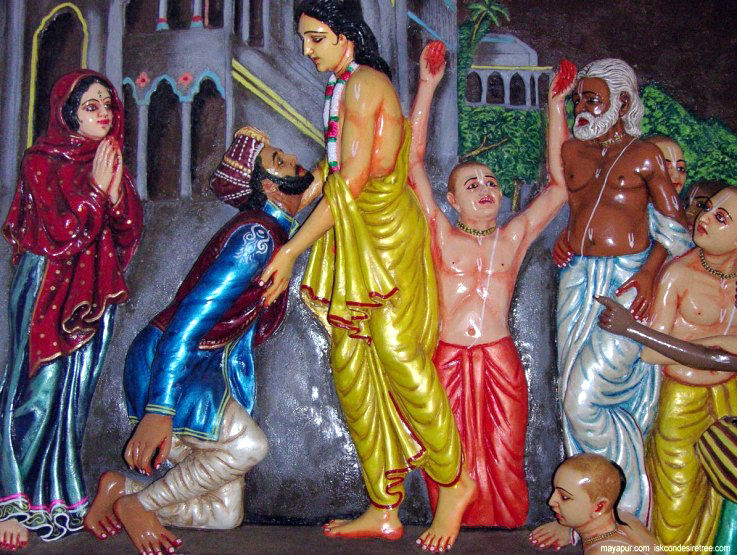
India has always been glorified as the land where the sacred rivers effortlessly flow to sanctify the places. The King of all the great mountains, the great Himalayas, as her crown brings her great glory.
It is the land where Lord Rama and Lord Krishna appeared to enjoy many pastimes – they walked, they danced, they sang, they played in this blessed land.
But sadly, this great land of ours slowly began to see the downfall. Scriptures tell that in the age of Kaliyuga, in which we are currently living, irreligion will gain prominence.
So, its not surprising that the Indian society which has its roots in spirituality began seeing the deterioration of spiritual culture and values.
As the society began to weaken from within many foreign invaders began attacking the country to loot her of the riches. Thousands of temples were desecrated, and thousands of people were forced to give up their religion.
People although carried on with their daily routine and religious practices but within their hearts remained petrified for fear of being persecuted.
It was not just the foreign invaders whom the people feared but even the brahmanas who had all the say in the religious life of a person had begun exploiting the common people.
Religious practices that uplift one’s consciousness and connect it to God had taken a backseat. Instead, rituals that were against the spirit of the Vedas gained prominence. People had become utterly materialistic.
A revolutionary reformer appears
Chaitanya Mahaprabhu appeared during this time when India was suffering from within and without. He appeared in 1486 in Mayapur,Navadvipa, West Bengal.
Through his teachings and life’s example, he singlehandedly ended the monopoly of the priestly class, the brahmanas, who had introduced rigid hereditary caste system to gain unparalleled control over day to day life of the people.
As per the laws of the caste brahmanas the general masses were forbidden to worship the deities, to read Vedic scriptures, perform any rituals and chant any mantra. They had appointed themselves as the blessed representatives of the Lord and it was through them only anyone can attain any favour from the Lord.
Scriptures never ask anyone to discriminate against others. The social divisions that Vedas talk about are meant for the smooth functioning of society. This division is not based on birth but on one’s work. (Bhagavad Gita 4.13)
Chaitanya Mahaprabhu had come to re-establish the true teachings of the spiritual books. He came to break the shackles of the unjust caste system and to give an equal opportunity to all to practice devotion to the Supreme Lord.
The sankirtana movement was born
He introduced the sankirtana movement i.e. the congregational chanting of the Hare Krishna Mahamantra.
Quoting the scripture, Srimad-Bhagavatam (12.3.51), he said that chanting is the only effective way by which one attains salvation in this age of Kaliyuga.
The Hare Krishna Mahamantra was not a new mantra. Chanting was not a new process. In fact, the chanting of Hare Krishna Mahamantra has been going on since eternity and not just on earth even on all the higher planets this mantra is chanted.
But unfortunately, people had forgotten this and had subjected themselves to a miserable state of life. Chanting can be done individually and when done together along with several people, it becomes congregational chanting.
All were eligible to chant the names of the Lord. So called upper caste and lower caste, men and women, rich and poor, Hindus and non-Hindus all were welcomed. First time in their life they began to experience a deep connection with the Lord.
Thousands of people began chanting.
From almost every house in Navadvipa one could hear the holy name of Krishna being chanted. And those unfortunate souls who refused to chant always heard the chant. It spread like wildfire.
This fire also began destroying the hegemony of the caste brahmanas, the priestly class. They were furious.
The Muslim rulers feared being overthrown by the united Hindus. Seeing many non-Hindus participating in congregational chanting was a cause of great concern.
The caste brahmanas approached the Muslim rulers. They together devised a plan to stop the sankirtan movement. Chand Kazi, the then magistrate of Navadvipa, issued an order.
‘Chanting had to stop immediately. Anyone who defied the order will be severely punished.’ His soldiers went to houses warning people against chanting. At the house of Srivas Thakur, who was one of the prominent followers of Chaitanya Mahaprbahu, a mridanga was even broken.
The common men and women who enjoyed chanting the Lord’s names were devastated. The limited freedom which they had to practice their faith was totally taken away.
They had only two choices now.
To live they had to give up chanting. To chant they had to give up their life.
Thousands come on the street to protest
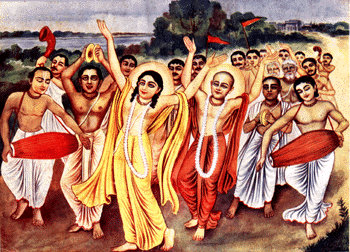
They approached Chaitanya Mahaprabhu, their leader, their saviour. He who had reinstated the true teachings of the holy Vedas had to now save the life of the followers of the Vedas.
‘No one is powerful enough to stop the chanting of the Lord’s name. None we must fear. We will defy the discriminatory order.’ Chaitanya Mahaprabhu’s clarion call brought great hope to all. They had complete faith in the leadership of Chaitanya Mahaprabhu.
Mahaprabhu along with thousands of followers launched the Civil disobedience movement, hundreds of years before Gandhiji used it as a weapon to overthrow the British regime.
One hundred thousand men carrying thousands of mridangas and kartals (hand cymbals) fearlessly sang and danced on the streets of Navadvipa.
The chant of the great mantra, the Hare Krishna Mahamantra, filled the entire atmosphere. They began marching to the house of the Kazi. The powerful soldiers were helpless, they fled.
Chaitanya Mahaprabhu decided to meet Kazi to challenge his order. Seeing the mammoth crowd which stretched for miles, the Kazi had hidden himself inside the inner chambers of his house. Reluctantly he came out.
Chaitanya Mahaprabhu had a long conversation with the unjust ruler.
Mahaprabhu wasn’t harsh with him. He was not there to harm him. He spoke politely but logically. His reasoning had a great impact. The Kazi understood his mistake. His heart was now transformed.
With tears in his eyes, he said, “To as many descendants as take birth in my dynasty in the future, I give this grave admonition: No one should check the sankirtana movement.” Chaitanya Charitamrita, Text 222.
The devotees were jubilant. They were now free to practice devotion to Krishna.
Chaitanya Mahaprabhu whose advent had been predicted in the Vedas – Srimad Bhagavatam 11.5.32, Mahabharata, Adi Purana, Narada Purana, Padma Purana – was a revolutionary social reformer. He laid the foundation of a worldwide sankirtana movement.
The sankirtana movement spreads all over the world
Srila Prabhupada, the founder acharya of Iskcon and one of the foremost followers of Sri Chaitanya Mahaprabhu, has played a significant role in carrying forward the sankirtana movement.
He worked tirelessly to make sure that millions of people of this world too become the recipient of the mercy of Chaitanya Mahaprabhu.
And so today be it the streets of London or New York, Moscow or Cape Town, Mumbai or Sydney one can find thousands of devotees joyfully singing and chanting the Hare Krishna Mahamantra.
The sankirtana movement which was started by Sri Chaitanya Mahaprabhu around 500 years ago in Navadvipa has spread all over the world and millions of people are now participating in it.
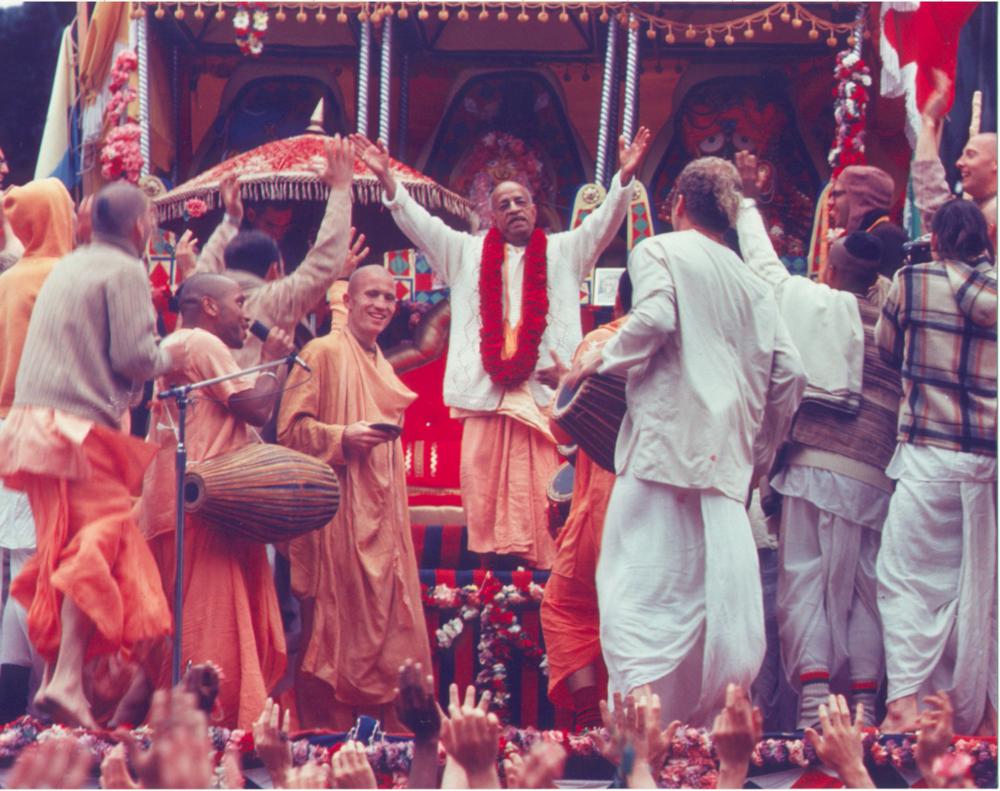
Sri Chaitanya Mahaprabhu came to teach us that we all are children of the same God and so no one should be discriminated on the basis of caste, creed, religion, gender or economic status.
Also, we the seekers should fearlessly practice devotion to Krishna having complete faith that Mahaprabhu will protect us in any difficult situation.
Search
Recent Posts
-
Janmashtami: Celebrating Krishna’s Appearance Through...
August 17, 2026
-
Gopinatha Pattanayaka: 6 Lessons for...
August 16, 2026
-
What Does Krishna Say About...
August 11, 2026
-
Are you ready to choose...
August 2, 2026
-
55th Kolkata Ulta Rath Yatra...
July 25, 2026