What are the six characteristics of pure devotional service?
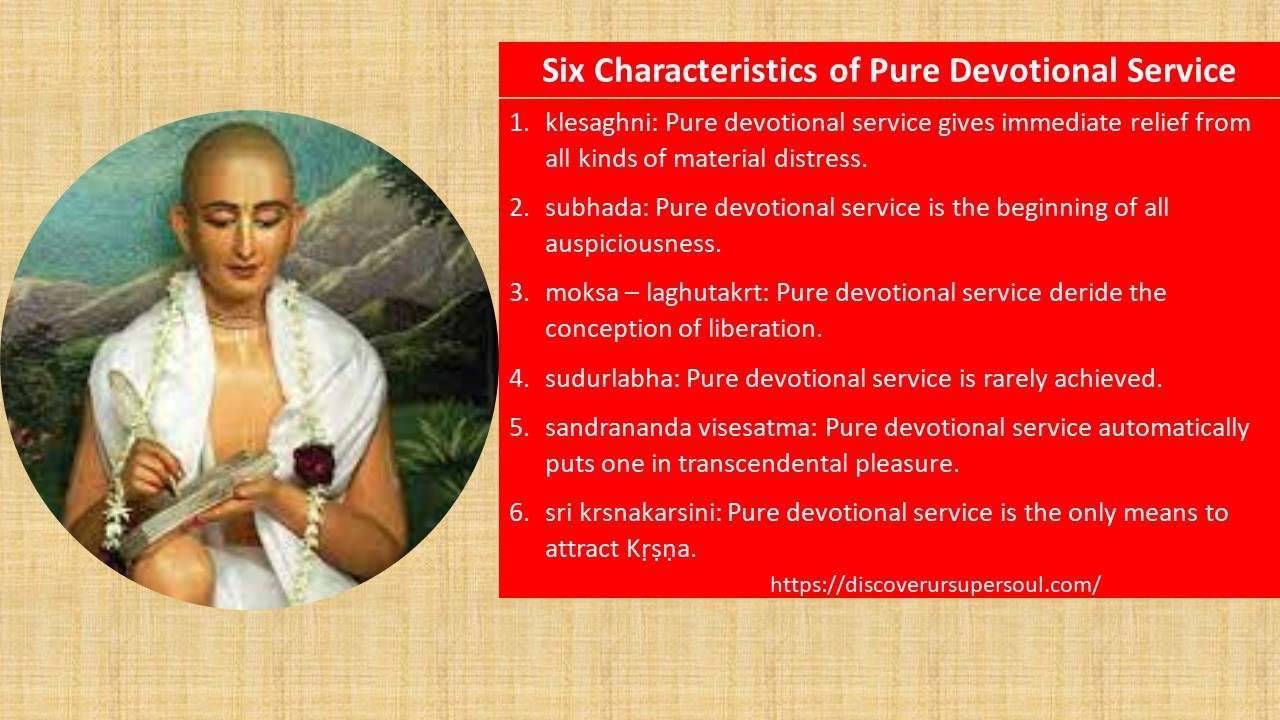

The six characteristics of pure devotional service are:
- klesaghni: Pure devotional service gives immediate relief from all kinds of material distress.
- subhada: Pure devotional service is the beginning of all auspiciousness.
- moksa – laghutakrt: Pure devotional service deride the conception of liberation.
- sudurlabha: Pure devotional service is rarely achieved.
- sandrananda visesatma: Pure devotional service automatically puts one in transcendental pleasure.
- sri krsnakarsini: Pure devotional service is the only means to attract Kṛṣṇa.
1) Klesaghni: Gives immediate relief from all distress.
The first characteristic of pure devotional service, Klesaghni, manifests at the stage of nistha, steadiness. Klesaghni means getting relief from all sufferings. We suffer because of the sins we committed in this life or in previous life.
Our sufferings have three causes:
- Papam: We suffer because of our sins.
- Bijam: We suffer because of our material desires. This is the secondary cause of our suffering.
- Avidya: Our material desires are because of our ignorance. We fail to understand that we are in reality spiritual beings, and our eternal identity is that we are eternal servants of Krishna. Ignorance is the root cause of our suffering.
Padma Purana explains that sinful activities causes four kinds of sinful reactions:
Four kinds of sinful reactions are:
- aprarabdha: The effect which is not yet fructified
- kutam: The effect which is lying as seed
- prarabdha: The effect which is already mature
- karma bijam: The effect which is almost mature
As of now we are suffering because of our prarabdha karma and in future we will suffer because of aprarabdha karma. However, we can get relief from all distress if we take shelter of Krishna. Devotion to Krishna is so powerful that it burns all our sinful reactions. In Srimad Bhagavatam, Lord Krishna says to Uddhava, “My dear Uddhava, devotional service unto Me is just like a blazing fire, which can burn into ashes unlimited fuel supplied to it.” Srimad Bhagavatam 11.14.19. So, the Supreme Personality of Godhead, Lord Krishna, is assuring that he will completely destroy all our aprarabdha karma, the unmanifest sinful reaction for which we had to suffer in future. He also completely destroys our present sins for which we are currently suffering.
Ignorance is the root cause of our suffering
It is said that ignorance is the root cause of all our suffering. It is because of ignorance we get entangled in this material world and get materially contaminated. Material contamination leads to material desire and to satisfy our material desires we indulge in sinful activity which brings unlimited suffering in our life.
There are different rituals given in the Vedic scriptures to counteract our suffering. However, it has been observed that a Vedic ritual may sometime give relief from sinful reaction but it does not destroy sinful proclivity. And because of sinful proclivity a person again commits sin for which he has to again suffer. However pure devotional service not just give relief from all distress but it completely purifies our heart of all material contamination, it totally destroys all our material desires and all our sinful proclivity. So, a sincere devotee of Krishna never again commits sins and so he never suffers again.
2) subhada: Pure devotional service is the beginning of all auspiciousness.
The second characteristic of pure devotional service, subhada, manifests at the stage of nistha, steadiness. Pure devotional service is all auspicious because it
- Benefits everyone
- Attracts everyone
- Produce good qualities
- Bestow superior happiness
Benefits and Attracts Everyone
Padma Puraṇa glorifies pure devotional service, “A person who is engaged in devotional service in full Kṛṣṇa consciousness is to be understood to be doing the best service to the whole world and to be pleasing everyone in the world. In addition to human society, he is pleasing even the trees and animals, because they also become attracted by such a movement.”
Lord Chaitanya practically showed that pure devotional service not just attract human beings, but it also attracts animals and trees. When Sri Chaitanya Mahaprabhu was passing through the forest of Jharikhanda then all the animals including tiger, elephant, deer began dancing and singing the Hare Krishna Mahamantra. We see that when Srila Prabhupada began worldwide preaching then many people who had earlier not even heard the name of Krishna became attracted to Krishna and became sincere devotees of Krishna.
Produce good qualities
Scriptures say that those who practice pure devotional service develop saintly qualities and it can be practically seen also. There were many hippies who were drug addict, animal flesh eater, would indulge in illicit sex and other abominable activities but once they began practicing devotion to Krishna they were able to give up all their sinful habits. They became sincere and serious devotees of Krishna. Many even became sannyasis and began preaching the message of Krishna all over the world.
In our life also we can see that once we have started practicing devotion to Krishna, we have been able to give up many bad habits. We see in this world that there are many highly materially educated people but they are addicted to sinful habits like intoxication and meat eating. But a devotee of Krishna may not be materially well educated but by practicing devotion to Krishna they become so pure that they are easily able to give up all the bad habits and is able to lead a happy life. In Srimad Bhagavatam 5.18.12 Sukhadeva Goswami says to King Parikshit that those who have unflinching faith in Krishna and are without any duplicity develop all the good qualities of demigods.
Superior Happiness
Srila Rupa Goswami explains in Bhakti Rasamrita Sindhu that there are three sources of happiness:
- Happiness from material enjoyment i.e. through sense gratification
- One derives happiness by identifying oneself with the Supreme Brahman i.e. by Brahman realization.
- Happiness derived from engaging in pure devotional service to Krishna.
Out of these three, happiness derived by practicing Krishna Consciousness is the topmost. There are two reasons for this
- Happiness achieved by pure devotional service is eternal whereas happiness derived from other process is temporary and flickering.
- Also, happiness which we experience by engaging in pure devotional service to Krishna includes the happiness derived from other sources and also excels it.
We practically see that there are Mayavadi (impersonalist) sannyasis who are highly educated and very much realized souls but indulge in political or social welfare activities. It is because the happiness which they get by identifying themselves with Supreme Brahman does not satiate their heart, so they look for some material means to find happiness. There are mystic yogis who attain siddhis but they too cannot experience supreme enjoyment. The highest enjoyment is only in Krishna Consciousness.
Two Examples
So, we see that devotees of Krishna maybe material impoverished but they experience so much pleasure in Krishna Consciousness that the want nothing but Krishna. Kholaveca Sridhara was extremely poor, he had almost no material possession, but he would always joyful chant the names of Krishna. When Lord Chaitanya wanted to give him material opulence, he refused, because the happiness which he derived by chanting the names of Krishna was so great that nothing could have replaced it.
Prahlada Maharaja, a great devotee of the Lord, offers prayer to Lord Narasimhadeva, “My dear Lord, I repeatedly pray unto Your lotus feet that I may simply be stronger in devotional service. I simply pray that my Kṛṣṇa consciousness may be more strong and steady, because happiness derived out of Kṛṣṇa consciousness and devotional service is so powerful that with it one can have all the other perfections of religiousness, economic development, sense gratification and even the attainment of liberation from material existence.” Hari-bhakti-sudhodaya
3) moksa – laghutakrt: Pure devotional service derides the conception of liberation
At the stage of bhava, the third characteristics of pure devotional service manifests – moksa – laghutakrt. Explaining how pure devotional service is superior to liberation, Srila Prabhupada explains, “Srila Rupa Gosvami says that if brahmananda, or the happiness of becoming one with the Supreme, is multiplied one trillionfold, it still cannot compare to an atomic fraction of the happiness derived from the ocean of devotional service.”
This is the reason that devotees of Krishna do not want anything from Krishna not even liberation. It is because the joy they experience in practicing devotion to Krishna is unlimited which cannot be expressed in words.
4) sudurlabha: pure devotional service is rarely achieved
The fourth characteristics of pure devotional service – sudurlabha – manifests at the stage of bhava. One cannot attain pure devotional service by one’s own effort and also Krishna is reluctant to give it. Krishna, the Supreme Personality of Godhead, can easily give material happiness and he can even give liberation. But he does not easily give pure devotional service. It is because pure devotional service is so potent that Krishna himself gets purchased by it. We see in Vrindavan that Krishna becomes a puppet of brajvasis.
Sometimes mother Yashoda punishes Krishna, sometimes Krishna carries the shoes of Nanda Maharaj on his head. And sometimes the gopis ask Krishna to dance and the Supreme Lord starts dancing. Similarly, Krishna becomes the messenger of Pandavas and charioteer of Arjuna. We see that Krishna, the Supreme Lord, becomes subservient to his devotees. Since pure devotional service has the power to conquer and control the Supreme Lord, so Krishna is very reluctant to give pure devotional service. However, Krishna can bestow his mercy upon a sincere devotee and give him pure devotional service. Also, by the mercy of a pure devotee one can also achieve pure devotional service.
5) sandrananda visesatma: Pure devotional service automatically puts one in transcendental pleasure.
The fifth characteristics of pure devotional service – sandrananda-visesatma – manifests at the stage of prema. It is explained that metal is so dense that nothing can penetrate it. Similarly pure devotional service is highly concentrated and dense and so no other thoughts and perception penetrates in the mind of a devotee. So, in pure devotional service, a devotee experiences condensed bliss.
6) sri krsnakarsini: Pure devotional service is the only means to attract Kṛṣṇa.
The sixth characteristics of pure devotional service – sri krsnakarsini – manifests at the stage of prema. Krishna attracts everyone but pure devotional service even attracts Krishna. Srimati Radharani is the highest symbol of pure devotional service. Krishna is called Madana-mohana because he attracts thousands of cupids, but Radharani is so attractive that she even attracts Krishna. By her devotion, she controls Krishna. So, Radharani is called, Madana-mohana-mohini.
Devotional service is directly under the control of Srimati Radharani. So, if we have to practice pure devotion then we should follow the footsteps of Srimati Radharani. The residents of Vrindavan and all the pure devotees of Krishna always serve Krishna under the guidance of Srimati Radharani.
Lord Krishna himself confirms that he gets attracted by pure devotional service, “My dear Uddhava, you may know it from Me that the attraction I feel for devotional service rendered by My devotees is not to be attained even by the performance of mystic yoga, philosophical speculation, ritualistic sacrifices, the study of Vedānta, the practice of severe austerities or the giving of everything in charity. These are, of course, very nice activities, but they are not as attractive to Me as the transcendental loving service rendered by My devotees.” Srimad Bhagavatam 11.14.20
Three categories of devotional service
Srila Rupa Goswami says that there are three categories of pure devotional service – sadhana bhakti, bhava bhakti and prema bhakti. In each of these categories, two characteristics of pure devotional service manifests as described below:
Sadhana bhakti
- klesaghni: Relief from all kinds of material distress.
- subhada: All auspiciousness.
Bhava bhakti (the previous two plus the following)
- moksa – laghutakrt: Happiness deriding conception of liberation.
- sudurlabha: Rarely achieved.
Prema bhakti (the previous four plus the following)
- sandrananda visesatma: Incalculable transcendental pleasure.
- sri krsnakarsini: Attracting Lord Krishna.
Search
Recent Posts
-

Unflinching Faith in Lord Chaitanya...
April 15, 2026
-

Teachings on Grihastha Life, Chanting...
April 15, 2026
-

Offense to Krishna’s devotee brings...
April 15, 2026
-

Few examples of Vaishnava Etiquette
April 15, 2026
-

Srimad Bhagavatam @Iskcon Newtown Kolkata...
March 4, 2026
google ads
What is pure devotional service & its two characteristics – Svarupa-Laksanam and Tatastha-Laksanam?
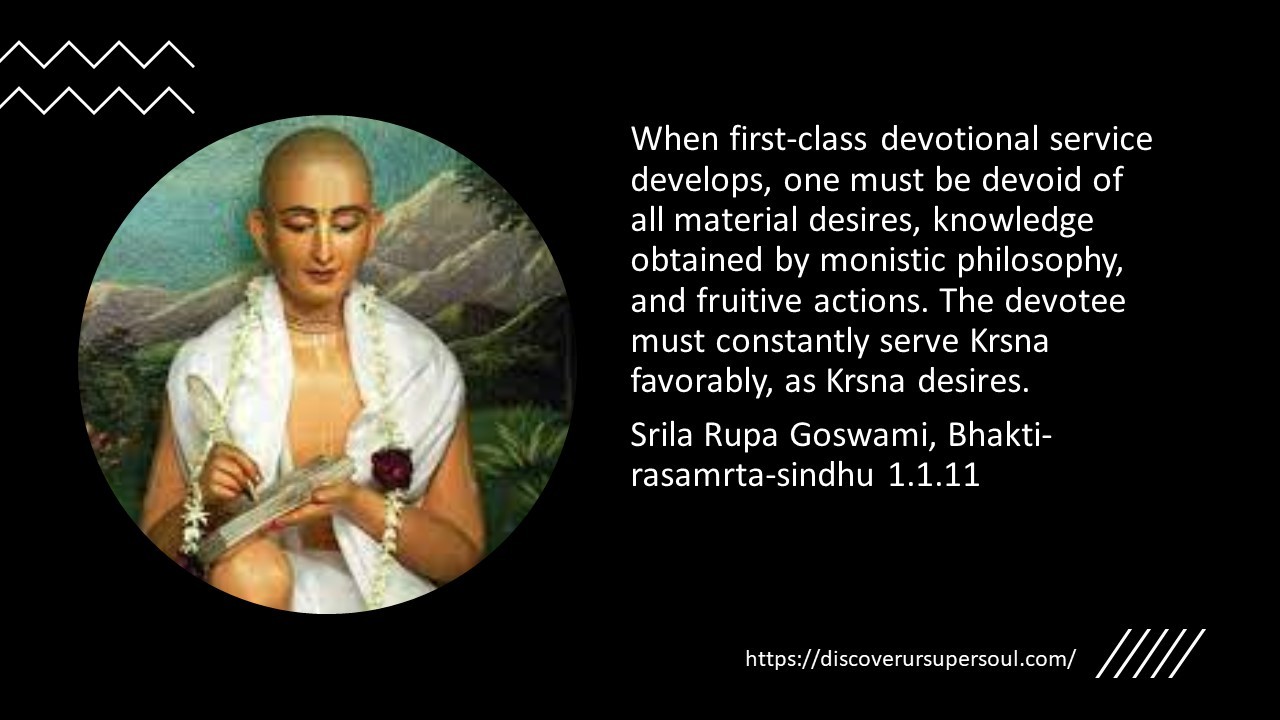

The definition of pure devotional service is given by Srila Rupa Goswami in Nectar of Devotion (Bhakti-rasamrta-sindhu) 1.1.11
anyabhilasita-sunyam
jnana-karmady-anavrtam
anukulyena krsnanu-
silanam bhaktir uttama
“When first-class devotional service develops, one must be devoid of all material desires, knowledge obtained by monistic philosophy, and fruitive actions. The devotee must constantly serve Krsna favorably, as Krsna desires.”
In pure devotional service one has no desire for personal enjoyment, one just wants to serve Krishna constantly. This is beautifully explained by Sri Chaitanya Mahaprabhu in Siksastakam Text 4, “O almighty Lord, I have no desire to accumulate wealth, nor do I desire beautiful women, nor do I want any number of followers. I only want Your causeless devotional service, birth after birth.”
Pure devotional service has two characteristics – Svarupa-Laksanam (Primary Characteristics) and Tatastha-Laksanam (Secondary Characteristics).
1) Svarupa-Laksanam — Primary Characteristics
Pure devotional service has three primary characteristics (Svarupa-Laksanam):
- It is for Krsna
- Devotion to Krishna is an active engagement
- It is executed with favourable intent.
1. Pure devotional Service is for Krsna
The first and the most important characteristic of pure devotional service is that it is for Krsna and not for anyone else.
Now when we say Krishna then it also includes:
- Krishna’s plenary parts and parcels like Baladeva, Sankarsana, Vasudeva, Aniruddha, Pradyumna, Rama, Nrsimha, Varaha etc.
- His differentiated parts and parcels which means the living entities
- His multifarious energies – the material and spiritual worlds
However, it does not mean that the pure devotional can be for anything and everything because Krishna is anything. The correct understanding is that we can love and serve Krishna directly or love and serve those things and persons who are explicitly connected to Krishna. For example, we can love and serve Krishna’s expansions, His pure devotees, His places of pastimes, His paraphernalia.
2. Anusilanam — Devotional Service is an Active Engagement
Pure devotion is not passive but it is an active engagement. When we love someone then we try to do anything to please that person. Similarly, if we love Krishna then we will put in our best efforts to please Krishna. Anusilanam has two aspects:
- Pravrtti or positive actions: Doing activities which are favourable to Krishna consciousness.
- Nivrtti or negative actions: Avoiding those activities which are unfavourable to Krishna consciousness.
To know the positive and negative activities, we should take guidance from our spiritual master who is coming in guru parampara, disciplic succession. These activities should be performed with our body, mind and words. For example, we should avoid breaking four regulative principles like meat eating, gambling, intoxication and illicit sex. But we should do activities which are favourable to Krishna Consciousness like chanting the names of Krishna, deity worship, reading Srimad Bhagavatam.
3. Anukulyena — Favourable Intention
While doing devotional service, it is also important that our intent should be to please Krishna. Sometimes demons like Kamsa, Ravana give pleasure to Krishna by giving Krishna an opportunity to fight and protect His devotees. But we cannot say that the demons are engaged in pure devotional service because the demon’s intention is not to please Krishna but to give pain to Krishna and pain to Krishna’s devotees.
On the other hand, some activities may apparently appear that it is displeasing to Krishna but it will fall in the category of pure devotional service if the intent is pure. For example, mother Yashoda punishing Krishna may appear displeasing to Krishna, but it is actually pure devotional service because mother Yashoda’s intention is to always love and care for Krishna.
2) Tatastha-Laksanam — Secondary Characteristics
The two secondary characteristics, Tatastha-Laksanam, of pure devotional service are:
1. anyabhilasita-sunyam — pure devotional service is free from all ulterior motives
A pure devotee engages in serving Krishna only to please Krishna and guru. He does not want anything in return. Sometimes some people may visit temple, bow down to the deity, give donation but they may have hidden motives. For example, they may think that if they come to temple and give donation then in return Krishna will grant them benediction and give them lots of wealth. This is not pure devotional service. Pure devotional service is free of all ulterior motives, the only motive should be to please Krishna.
2. jnana-karmady anavrttam — pure devotional service is not covered by philosophical or fruitive pursuits.
Philosophical speculation:
If philosophical speculation is taking one to voidism or impersonalism then it is dangerous because it takes one away from Krishna. So, Rupa Goswami is saying that pure devotional service should not be covered by philosophical speculation. But if philosophical speculation is taking one to Krishna then it is acceptable.
Srila Prabhupada explains, “The ultimate end of philosophical speculation, then, must be Kṛṣṇa, with the understanding that Kṛṣṇa is everything, the cause of all causes, and that one should therefore surrender unto Him. If this ultimate goal is reached, then philosophical advancement is favorable, but if the conclusion of philosophical speculation is voidism or impersonalism, that is not bhakti.” Nector of Devotion, Introduction
Fruitive pursuits:
Fruitive pursuits may cover our devotional service to Krishna, so we should be cautious. There are many ritualistic or fruitive activities described in the Vedas and if one becomes attracted to these fruitive activities without understanding Krishna then these activities are unfavourable to Krishna Consciousness. One may get caught up in fruitive activities and stop paying proper attention to pure devotional activities like hearing and chanting.
However, it does not mean that a devotee should not at all engage in ritualistic activities. Sometimes a devotee may perform some ritualistic activities out of social convention. Such activities do no cover devotional service. For example, Lord Chaitanya offered pinda when his father died.
But there are some activities that may cover devotional service. So, one should be very cautious about those activities. For example, putting faith in astrology. Astrology is a Vedic science, and it can serve some functional purpose. But if one gets too much caught up in astrology then he may start putting more faith in destiny then in bhakti. Srila Prabhupada explains, “Actually, Kṛṣṇa consciousness can be based simply on hearing, chanting, remembering, etc. Described in the Śrīmad-Bhāgavatam are nine different processes, besides which everything done is unfavorable to Kṛṣṇa consciousness.”
Srila Rupa Goswami has beautifully explained what constitutes pure devotional service. With this understanding we should try our best to engage in pure devotional service to Krishna.
Search
Recent Posts
-
Unflinching Faith in Lord Chaitanya...
April 15, 2026
-
Teachings on Grihastha Life, Chanting...
April 15, 2026
-
Offense to Krishna’s devotee brings...
April 15, 2026
-
Few examples of Vaishnava Etiquette
April 15, 2026
-
Srimad Bhagavatam @Iskcon Newtown Kolkata...
March 4, 2026
google ads
Nava Vidha Bhakti & the Examples of Devotees who Perfected Their Life by practicing Nava Vidha Bhakti

In Srimad Bhagvatam, Prahlad explains about the nine processes of pure devotional service which is called nava vidha bhakti.
śravaṇaṁ kīrtanaṁ viṣṇoḥ
smaraṇaṁ pāda-sevanam
arcanaṁ vandanaṁ dāsyaṁ
sakhyam ātma-nivedanam
“Hearing and chanting about the transcendental holy name, form, qualities, paraphernalia and pastimes of Lord Viṣṇu, remembering them, serving the lotus feet of the Lord, offering the Lord respectful worship with sixteen types of paraphernalia, offering prayers to the Lord, becoming His servant, considering the Lord one’s best friend, and surrendering everything unto Him (in other words, serving Him with the body, mind and words) — these nine processes are accepted as pure devotional service.” Srimad Bhagavatam 7.5.23-24
Scriptures explain that just by practicing one of the principles of nava vidha bhakti one can attain complete perfection and return back to the spiritual world. Srila Rupa Goswami in Bhakti-rasāmṛta-sindhu (1.2.265) gives the examples of devotees who attained salvation just by practicing one of the processes of nava vidha bhakti.
śrī-viṣṇoḥ śravaṇe parīkṣid abhavad vaiyāsakiḥ kīrtane
prahlādaḥ smaraṇe tad-aṅghri-bhajane lakṣmīḥ pṛthuḥ pūjane
akrūras tv abhivandane kapi-patir dāsye ’tha sakhye ’rjunaḥ
sarvasvātma-nivedane balir abhūt kṛṣṇāptir eṣāṁ param
Examples of nava vidha bhakti given by Srila Rupa Goswami
Let us understand in detail:
śravaṇaṁ (hearing):
śravaṇaṁ or hearing is one of the most important devotional activities. Parīkṣit Mahārāja attained complete perfection by hearing Srimad Bhagavatam continuously for seven days from Sukadeva Gosvāmī.
kīrtanaṁ (chanting):
Sukadeva Gosvāmī attained perfection by reciting i.e. by chanting(kīrtanaṁ) Srimad Bhagavatam for seven days to king Parikshit.
smaraṇaṁ (remembering):
Prahlāda Mahārāja always remembered (smaraṇaṁ) the Lord. He never forgot the Lord even for a moment.
pāda-sevanam (serving the feet of the Lord):
Lakṣmīdevī , the goddess of fortune, is always busy serving the lotus feet of the Lord.
arcanaṁ (offering worship):
Pṛthu Mahārāja worshipped the deity of the Lord and perfected his life.
vandanaṁ (offering prayers):
Akrūra while entering Vrindavan offered prayers to Lord Krishna. He thus pleased Krishna by his beautiful prayers and attained salvation.
dāsyaṁ (becoming the servant):
Hanumān, the great devotee of Lord Rama, was always eager to serve the orders of Lord Rama. Like a humble and loyal servant, he loved to serve the Lord and thus he attained mercy of Lord Rama and ultimate perfection.
Sakhyam (becoming the best friend):
Arjuna became a dear friend of Lord Krishna and attained salvation.
ātma-nivedanam(surrendering everything, whatever one has):
Bali Mahārāja surrendered everything including his own self to Lord Vamana and attained the mercy of Lord.
All the nine processes of nava vidha bhakti was practiced by King Ambarish.
Examples of nava vidha bhakti from Ramayana
The devotees who participated in the pastimes of Lord Rama also practiced nava vidha bhakti. This was revealed by HG Radha Gopinath Prabhu in one of his Srimad Bhagavatam class at Iskcon New Town Kolkata temple. Let us see the examples which he discussed from Ramayana of the devotees who perfected their life by practicing one of the processes of nava vidha bhakti.
Sravanam (hearing):
Hanuman is the best example of a devotee in Ramayana who perfected his life by sravanam. Wherever there is Rama Katha, Hanuman is present. He delights in hearing the glory of Lord Rama. He has attained complete perfection by being engaged in hearing the wonderful pastimes of Lord Rama. We also see that he is always engaged in serving the instructions of Lord Rama.
While comparing with different devotees Rupa Goswami has said that Hanuman perfected his life by being a humble and obedient servant of Lord Rama. But if we just focus on the devotees in Ramayana then it is said that Hanuman is the best among all the devotees who always liked to hear Rama Katha.
Hanuman is so great devotee that he does not want anything in return from the Lord. Once Lord Rama said to Hanuman, “You have served me so much, I will always be indebted to you. Let me know what you want, and I will grant you that benediction.” For few moments Hanuman did not say anything. He then folded his hands and with tears in his eyes, he humbly said, “My dear Lord I want nothing from you. I just want to be yours forever.” Lord Rama was overwhelmed with joy. He dd not say anything. He just embraced him.
kīrtanaṁ (chanting):
Sage Valmiki perfected his life by writing Ramayana. In Ramayana he has sung (kirtanam) the glories of Lord Rama and Mother Sita. He got boon from Brahma that he will be able to know all the minute details of the pastimes of Lord Rama and based on that he will be able to write in detail about Lord Rama’s different activities in this world. Ramayana is the only book sage Valmiki wrote and he attained eternal glory and eternal mercy of Lord Rama.
There have been many wonderful books written on the glorious pastimes of Lord Rama but Valmiki’s Ramayan standout amongst them. It is the first authoritative book on Lord Rama and any book which is written is based on Valmiki’s Ramayana. Sage Valmiki has captured each and every detail in his book. Lav Kush, the twin sons of Lord Rama and Mother Sita heard Ramayana from sage Valmiki and then recited it with great feeling of love and reverence.
An interesting pastime related to Ramayana
There is one interesting pastime related to Ramayana which is discussed amongst the devotees of Lord Rama. Once Valmiki was narrating Ramayana. So, Hanuman also came. Because wherever Lord Rama’s pastimes are discussed Hanuman is there. But he was sitting behind. Valmiki did not notice him. While narrating Ramayana, Valmiki said that when Hanuman entered Ashok Vatika in Lanka then there were white flowers in the garden.
From behind Hanuman said that the flowers were red in colour. Valmiki said that it was white. Again, Hanuman said that it was red. Valmiki who had not seen Hanuman said how can you say that the flowers were red. Hanuman then said because I am Hanuman and I was the one who entered Ashoka Vatika. Valmiki said I agree that you entered the Ashok Vatika but the flowers there were white and not red. You saw the flowers red because you were angry at that time.
smaraṇaṁ (remembering):
Mother Sita always remembered Lord Rama. This is the reason that while entering into fire she said that if even for a moment I have thought of anyone else other than Lord Rama then let me burn to ashes. She was completely absorbed thinking about Lord Rama.
pāda-sevanam (serving the feet of the Lord):
The best example is of Bharath. He is the personification of pada sevanam. For 14 years he served the paduka of Lord Rama.
arcanaṁ (offering worship):
Sabari is the best example. She offered half eaten berry to Lord Rama with great love. Rama, the Supreme Lord, was so pleased with her service, with her love that he ate the remnants of Sabari. Her purity, her humility, her sincerity and her great devotion attracted Lord Rama’s heart. She perfected her life by serving Lord Rama. In Bhagavad Gita, Lord Krishna says that he is hungry for our love and not for anything else. So, if someone offers him even the simplest thing with love, he accepts it.
“If one offers Me with love and devotion a leaf, a flower, a fruit or water, I will accept it.” Bhagavad Gita 9.26
vandanaṁ (offering prayers):
The sages of Dandakaranya offered beautiful prayers to Lord Rama when Lord Rama visited them in the forest. Because of their prayers they pleased the Lord. And when the Supreme Lord appeared as Lord Krishna in Vrindavan then these sages too appeared as gopis and got an opportunity to associate with Lord Krishna and serve Lord Krishna.
dāsyaṁ (becoming the servant):
In Ramayana Lakshman was the perfect servant of Lord Rama. He was the shadow of Lord Rama. It is said that when Lord Rama was in exile for 14 years then Lakshman did not sleep even for a moment because he was serving Lord Rama and Mother Sita each moment. Not just he served Rama and Sita in the forest but throughout his life he served Rama. He was given many thankless tasks but he did it because he always wanted to follow the instructions of Lord Rama.
Sakhyam (becoming the best friend):
In Ramayana Sugriva perfected his life by becoming the best friend of Lord Rama.
ātma-nivedanam(surrendering everything, whatever one has):
Vibhishana and Jatayu are the best examples of atma nivedanam in Ramayana. They both completely surrendered to Lord Rama. Jatayu sacrificed his life for the Lord and Vibhisan completely gave up everything to be with Lord Rama.
The devotee who practiced all the 9 processes of devotional life and perfected his life was Maharaj Guhu.
Search
Recent Posts
-
Unflinching Faith in Lord Chaitanya...
April 15, 2026
-
Teachings on Grihastha Life, Chanting...
April 15, 2026
-
Offense to Krishna’s devotee brings...
April 15, 2026
-
Few examples of Vaishnava Etiquette
April 15, 2026
-
Srimad Bhagavatam @Iskcon Newtown Kolkata...
March 4, 2026
google ads
How prayāsaḥ spoils bhakti i.e. devotion to Krishna?


In Text 2 of Nectar of Instruction (Upadeshamrita), Srila Rupa Goswami writes that prayāsaḥ (over-endeavoring ) spoils bhakti i.e. devotion to Krishna. Srila Prabhupada translates prayāsaḥ as “over-endeavoring for mundane things that are very difficult to obtain.”
Srila Prabhupada further writes in the purport of the verse, “The first step in human civilization consists of occupational engagements performed according to the scriptural injunctions.” And scriptures teach us not to get greedy for material gain but asks us to always work with proper consciousness.
How present-day society spoils our bhakti?
But sadly, present-day society teaches us to only focus on material achievement.
Since childhood we are taught to work extremely hard only for worldly success. “If you have a big bungalow, big car, big bank balance then you will enjoy unlimited happiness in this world.” Our mind is impregnated with this philosophy.
As soon as we see people who are rich or powerful or popular, we get attracted to them. Society calls them celebrities. They are called “celebrity” because everyone thinks that they are the ones who are celebrating their lives.
Since we too want to celebrate our lives, so we want to be like them. They become our role models. We think, “If we get name, fame, power, prestige, wealth like them we too can enjoy our lives.”
So, we spend all our time and energy in acquiring mundane things which spoils our bhakti. We become desperate for material success. We start putting our best efforts for it. But it is not guaranteed that our efforts will bring desired results. Because working hard is in our hands but whether we will get success is not in our hands.

Just like a farmer can plough his fields to the best of his ability but whether it will rain or not is not in his hands.
There are higher authorities in this material creation who oversee what we should get and what we should not get. Our result is not based on the actions we perform in this life, but it is also based on our past life’s actions as well.
Can we fulfill all our dreams in this world?
And suppose that even if we get the expected result then that success will not remain with us forever. There will be someone who will outdo us one day. And most importantly death will take away everything from us. Whatever we accumulate will remain here only. We do not carry it to our next life.
In fact, it is not even guaranteed that in next life we will get a human body. If entire life is spent in gratifying animalistic pleasure of eating, sleeping, mating and defending then in next life we will get an animal body. It will be so unfortunate.
We live for 70 -80 years in this world. And because of ignorance we only focus on this life. We put all our time, energy and efforts to make this life better. There is nothing wrong in that. But should we also not think what will happen to us when we leave this body? What is going to be our future destination? The undeniable reality is that each and every one of us has to leave this world one day. A child may work hard to build a castle of sand near a seashore, but one whiff of wind will destroy all his endeavor. Similarly, we try to actualize all our dreams in this world, but the ruthless time can knock at our door anytime and force us to leave this world. It is almost impossible to fulfill all our dreams in this world.
Have you thought about your future destination?
In this life too whatever little success we get, we need proper planning for that. If we fail to plan, we will have bleak future. Similarly, if we have not planned for our next life then our next destination could be too bad. The animals, the trees, the insects, the worms, the fish and other non-human species which we see in this world also once had human body but because of bad karma they are now having non-human bodies.
I do not think you will want to become an insect or worm or cockroach or crow or lizard or a hog or anything like that in next life. Neither will I want. Animal life means unlimited suffering.
In fact, all the efforts we do in this world is to ensure we lead a happy life. But if the actions which we are performing in this life is creating a bad destination in next life then we should be alarmed.
An intelligent person will not focus on things which are temporary and definitely not on activities which are sinful.
A wise man will focus on things which are permanent, and which will ensure better present and better future. Srila Prabhupada writes “Human life is meant for God realization, and the human being is given higher intelligence for this purpose.” Nectar of Instruction Text 2 Purport.
And what is that highest purpose. It is to free ourselves from material bondage and attain complete liberation. Complete liberation is only possible when we return back to the kingdom of God.
So the devotees of the lord do not waste their time in working hard for material things which are temporary and very difficult to obtain. But he works intelligently so that he has a better future destination.
Do devotees of Krishna do not work hard?
Does it mean that devotees do not work hard in this world? Definitely not. Once someone complained to Prabhupada that devotees of the Lord are lazy. Prabhupada immediately said that devotees are hard working. He said that two most famous war in the entire human civilization, Ramayana and Mahabharata, were fought by devotees. But they fought not for themselves but for the pleasure of the Lord.
The monkey warriors worked extremely hard for the pleasure of Lord Rama. They did not have any personal motive. Hanuman put his life on stake and went all alone to the enemy kingdom. He did it for Lord Rama. All the monkeys came together and worked extremely hard to build a bridge to Lanka. And without caring for themselves fought on behalf of Lord Rama.
Similarly, the Pandavas led by Arjuna fought for Lord Krishna. Lord Krishna wanted to establish dharma and Pandavas assisted Krishna in his mission. Pandavas as per the desire of Lord Krishna converted a barren land Khandavaprastha to Indraprastha which looked as beautiful as a paradise. Over endeavor to fulfill mission of the Lord brings glory and joy. But prayāsaḥ (over-endeavor) for material profit spoils bhakti i.e. devotion to Krishna.
How Srila Prabhupada was an ideal grihasta, householder?
If we study the lives of great devotees, we will find that they work harder than the materialistic people. Srila Prabhupada used to get up in the middle of the night and write books. Then in the morning he used to get into preaching activity. He hardly had time to sleep and he never cared for his own comfort. He was instructed by his spiritual master to spread the teachings of Lord Chaitanya all over the world. And he dedicated his entire life in fulfilling the instruction of his spiritual master.
Before taking sannyasa Srila Prabhupada was a householder, a grihasta. And as a grihasta, he did his work responsibly and intelligently. He owned a chemical factory. In today’s language we can say that he was an entrepreneur. He was quite well to do financially. He even owned a car. In pre-independence India to have a car is like having a helicopter today. But Srila Prabhupada worked in such a way that he had ample amount of time to practice devotional life. During his grihasta life also he used to regularly associate with the devotees. Whenever he got an opportunity he went and met Srila Bhaktisiddhanta Sarasvati Thakura, his spiritual master. And financially also he helped the devotees to establish temples and in other preaching activities.
Bhaktivinoda Thakura – a judge, a writer, a preacher, a loving father, an ideal husband
Similarly, there is the example of Srila Bhaktivinoda Thakura, a great devotee of Lord Krishna. He was judge by profession. And a great Vedic scholar. He used to do his duty efficiently. He used to go for his work on time and while in office he used to be completely focused on his work.
In the book “The Seventh Goswami” which is the biography of Srila Bhaktivinoda Thakura, it is mentioned that his other colleagues took hours to decide a case in the court, but he used to do it in matter of minutes. So, the other judges of the court may be working for more number of hours but their output was less than that of Bhaktivinod Thakura. His judgement was always perfect. Everyone would be satisfied. He did justice to his profession. His superior authorities were extremely happy with his work.
When he was posted in Jagannath Puri as magistrate he made sure that service to Lord Jagannath happens properly. There were complaints that proper bhoga (food) is not being offered to the Lord at right time. Bhaktivinod Thakura with the help of the temple priests set everything right as per the guidelines of the scriptures.
He handled sensitive cases intelligently. There were communal riots between Hindus and Muslims and the cases would come to him. He expertly handled such matters and tried his best to bring peace and communal harmony in the society.
Bhaktivinoda Thakura had ten children and a virtuous wife. He took care of his household responsibilities and made sure that at his home there is spiritual culture and everyone serves Krishna and worships Krishna with love. He made his home a temple of Lord Krishna.
Bhaktivinoda Thakura is the architect of present-day Krishna Consciousness movement
While taking care of his occupational duty and family responsibilities he made sure that he had sufficient time to practice devotion to Krishna. He wrote several spiritual literatures which were appreciated by many scholars. After the disappearance of great Vaisnava acharyas like Narottama Das Thakura, Shyamananda Pandit and Srinivas acharya there was no one to lead the Krishna Consciousness movement.
People had almost forgotten the teachings of Lord Chaitanya. Some unscrupulous people had misinterpreted the teachings of Lord Chaitanya and were misguiding people for their ulterior motives. Bhaktivinoda Thakura worked tirelessly to revive the original Krishna Consciousness movement started by Lord Chaitanya. He would actively and vigorously preach the teachings of Lord Chaitanya. In fact, he is the architect of the present-day Krishna Consciousness movement which has spread all over the world.
Devotees work hard without giving up spiritual duties
So, we see that devotees work extremely hard. But they never give up their spiritual duties. They never compromise with their spiritual life. There work is not for material positions and possessions and not for name, fame and money. They work as per the scriptural injunctions and most importantly for the pleasure of the Lord.
Our work should bring us closer to Krishna. But if we over endeavour (prayāsa) for mundane things we will always be miserable because material things are difficult to get. And even if we get after hard labour it won’t satisfy our hearts. It will also take away all our time and energy and we will hardly have time to practice spirituality.
In Śrīmad-Bhāgavatam (1.2.9) Srila Suta Gosvami says that our occupational engagement should free us from material bondage. We should not work hard for sense gratification because it will entangle us in this world.
dharmasya hy āpavargyasya
nārtho ’rthāyopakalpate
nārthasya dharmaikāntasya
kāmo lābhāya hi smṛtaḥ
“All occupational engagements [dharma] are certainly meant for ultimate liberation. They should never be performed for material gain. Furthermore, one who is engaged in the ultimate occupational service [dharma] should never use material gain to cultivate sense gratification.”
Devotees endeavor (prayāsa) is not for material gain but for spiritual gain
We should do our worldly duties to the best of our capability and with sincerity. And we should also do our work smartly, and in a responsible way. But we should not compromise with our spiritual life. If we study the lives of Srila Bhaktivinod Thakura and Srila Prabhupada then we will get to know how to work in this world efficiently and not get entangled.
Prayāsaḥ for material things spoils bhakti i.e. devotion to Krishna. Srila Prabhupada cautions us, “If our endeavor (prayāsa) is not to inquire about the Absolute Truth, we will simply increase our endeavor to satisfy our artificial needs. A spiritual aspirant should avoid mundane endeavor.” Nectar of Instruction Text 2 Purport.
So as devotees our endeavor (prayāsa) should not be for material gain which is temporary but for spiritual gain which is everlasting.
Search
Recent Posts
-
Unflinching Faith in Lord Chaitanya...
April 15, 2026
-
Teachings on Grihastha Life, Chanting...
April 15, 2026
-
Offense to Krishna’s devotee brings...
April 15, 2026
-
Few examples of Vaishnava Etiquette
April 15, 2026
-
Srimad Bhagavatam @Iskcon Newtown Kolkata...
March 4, 2026
google ads
When we chant on beads then each bead becomes a stepping stone to reach Krishna
Whimsical living is just like being a two-legged animal. The purpose of our life is to cleanse our hearts and mind of all the impurities and develop deep affection for God. Achieving love of God is difficult but not impossible. Every day we have to endeavour for it. When we chant the holy names of the lord on beads then each bead can become a stepping stone to reach Krishna.
However if we just hold the bead in our hand, utter the names of the Lord mechanically and in the mind continue thinking non devotional or anti devotional things then we may not get all the benefits or may be any of the benefits of chanting (or mantra meditation). Chanting is the most important activity of devotional life. We need to be extremely cautious and careful during mantra mediation.
Rupa Goswami wished to have millions of tongues and ears so that he can chant millions of times the Hare Krishna Mahamantra and continuously taste the nectarine words of Krishna through his ears. Right now we may not have any such desire and devotion. But following the footsteps of this venerable sage we can at least use our one single tongue to reverentially chant Krishna’s sweet names. It is for our own benefit.
Animals can’t chant. They don’t know to chant. They don’t even bother to chant. They enjoy gormandizing on foods or running after opposite sex or sleeping naked on the road or in the jungles. If like animals we too are also always preoccupied with eating, sleeping, mating and defending then we do not have any right to call ourselves as humans.
As humans our most important duty is to behave like humans and endeavour hard to get out of this material world and return back to the spiritual abode. Chanting will help us to achieve that supreme destination. So we need to chant seriously and sincerely.
Search
Recent Posts
-
Unflinching Faith in Lord Chaitanya...
April 15, 2026
-
Teachings on Grihastha Life, Chanting...
April 15, 2026
-
Offense to Krishna’s devotee brings...
April 15, 2026
-
Few examples of Vaishnava Etiquette
April 15, 2026
-
Srimad Bhagavatam @Iskcon Newtown Kolkata...
March 4, 2026
google ads
Are we chewing the same tasteless stuff again?
Search
Recent Posts
-
Unflinching Faith in Lord Chaitanya...
April 15, 2026
-
Teachings on Grihastha Life, Chanting...
April 15, 2026
-
Offense to Krishna’s devotee brings...
April 15, 2026
-
Few examples of Vaishnava Etiquette
April 15, 2026
-
Srimad Bhagavatam @Iskcon Newtown Kolkata...
March 4, 2026
google ads