Krishna and Christ: Are they same or different?

Purushottam Nitai Das December 24, 2013
While being crucified, Jesus cried. But he did not cry for himself, instead he cried for those who were committing the gravest sin. Jesus was continuously praying to God to forgive those who were menacingly torturing and trying to kill him. Jesus, the son of God, had come to this world to spread the message of peace and love and to effect this change he was ready to sacrifice everything. This is the foremost quality of a holy man, for spreading God consciousness he is ready to brook any kinds of sufferings. History books take us through the lives of many such great personalities who endured great difficulties but never compromised with their principles.

Supreme Sacrifice

Prahlad was a little boy of 5 years when his own father mercilessly tried to kill him, Haridas Thakura was flogged at public places by the miscreants because he was asking people to lead a God centered life, Mirabai was poisoned because she longed to attain the love of God. Demoniac rulers like Hiranyakashipu, Ravana, Kamsa, Aurangzeb and many others always dealt brutally with men of virtuous qualities. What differentiates a holy man from a common man is the way one responds during a provoking and dangerous situation.  These saintly men and women remained composed during trying circumstances and fearlessly preached the message of God. Their impeccable integrity, unquestionable honesty, unflinching determination and above all deep love for God attracted the hearts of millions of people all over the world. Without their supreme sacrifice this world would have been bereft of love and warmth.  They come as a ray of hope and demonstrates that virtue always prevails over vice.

The venerable sages are sent by God in this world at regular intervals to salvage humanity.  They are direct representatives of God and they use all means to instill love of God in the hearts of all. God deputes them at different places as per time, place and circumstances. Jesus Christ was one such messenger of God. Jesus, through his exemplary life was able to transform the hearts of millions of people. He preached to the masses boldly and asked them to lead a virtuous life. All the noble souls have been advocating the same message since the dawn of creation. Vedic literatures, the sacred book of humanity, have also been vociferously asking all to lead a God conscious life.

Let us try to study the divine message of God as present in Vedas and the commandments of Jesus as recorded in Bible.

Vedas and Bible – Similarities or Dissimilarities?

If we closely examine the teachings of Jesus Christ and the wisdom championed by Vedas then we will be pleasantly surprised to find many similarities. Few of them are highlighted below:

  • Vedic literatures advocate chanting the names of God like the Hare Krishna Mahamantra on tulasi beads. Christians also chant the name of Christ on their rosary beads.
  • Jesus preached, “Thou shalt not kill”. Vedic books also lay great emphasis on nonviolence, in Gita, at several places, Krishna has advocated the path of nonviolence (Bhagavad Gita 10.4-5, 13.8, 16.1-3).
  • Jesus sermonized, “Thou shalt love thy neighbour as thyself”. Similarly Krishna says that the characteristics of a pure devotee is that he loves all and hates none: “The humble sages, by virtue of true knowledge, see with equal vision a learned and gentle brahmana, a cow, an elephant, a dog and a dog-eater [outcaste]”. (Bhagavad Gita 5.18).
  • One of the important commandments of Bible is “Thou shalt love the Lord thy God with all thy heart, and with all thy soul, and with all thy mind”. Krishna, the Supreme Personality of Godhead, in Bhagavad Gita also asks the seeker to constantly be engaged in devotion to Him: “Always think of Me, become My devotee, worship Me and offer your homage unto Me. Thus you will come to Me without fail.” (Bhagavad Gita 18.65).

Above example underlines that both Vedic literatures and Bible espouses the message of peace and love.  But sadly many have misinterpreted the pristine message of these holy books and so we see communal violence and evil in this world. For e.g. Jesus said, “Thou shalt not kill”. But many misinterpreted this message and said that Jesus meant that violence should not be committed only against human beings but animals can be killed and their flesh can be eaten. And they opened several abattoirs where thousands of animals are slaughtered daily. Such incorrect explanation of holy texts negates the true purpose of these sacred books. 

However if we honestly endeavour to comprehend the profound message of the holy books and start following it in toto then this world would become a better place as the writ of God will then prevail.  These scriptures are guiding light for human civilization and so should not be subjected to wrong interpretation and it should be followed “as it is”.


Krishna and Christ: Are they same or different?

God is one and he is supreme. Although he is one, he is addressed by several names like Krishna, Govinda, Gopinath, Vasudeva, Madan Mohan and so on. Lord Chaitanya has said: namnam akari bahu-dha nija-sarva-shaktis. “God has millions and millions of names, and because there is no difference between God’s name and Himself, each one of these names has the same potency as God.”Christ is another name of Krishna. Srila Prabhupada, an authority on Vedic literatures, explains that “Christ comes from the Greek word Christos, and Christos is the Greek version of the word Krsta. When an Indian person calls on Krishna, he often says “Krsta.” Krsta is a Sanskrit word meaning “the object of attraction.” So when we address God as “Christ,” “Krsta,” or “Krishna,” we indicate the same all-attractive Supreme Personality of Godhead. When Jesus said, “Our father, who art in heaven, hallowed be Thy name,” that name of God was Krsta or Krishna. “Christ” is simply another way of saying “Krsta,” and “Krsta” is another way of pronouncing Krishna.”

If without any bias and motive we try to understand God and his sublime message then we would find that the Supreme Person, Our Father, is one. And every other persons of this world are our brothers and sisters. We would then shun violence, divorce hatred and live together as obedient children of God. Jesus Chirst wanted to spread this message of brotherhood for which he voluntarily suffered, and now it is upon us to fulfill his desire.

(Purushottam Kumar is a member of congregation at Iskcon Kolkata. He works in Tech Mahindra, Kolkata as “Associate Solution Designer”)

 
>

Journey Back Home

Purushottam Nitai Das December 20, 2013
Visit BlogAdda.com to discover Indian blogs

Neither it can be seen or touched or felt but its existence is undeniable.  Just like the tsunami waves it does not have any emotions, it entraps and swallows all. The high and the mighty, the poor and the meek, men and women, every being of this world has to bow to it and have to surrender to its dictum. The “Time”, the mightiest of all is unstoppable and unconquerable. The might of “time” has always remained unchallenged and will remain so for ever. Time annihilates everything. “Time” underlines that in this world nothing is timeless but everything is temporary. This is why scholars, philosophers and wise sages since eons have been urging people to purge their insatiable worldly desires and focus on things which are permanent and indestructible.  Yudhisthira, an Indian king, who ruled about 5000 years ago once said that the most astonishing thing in this world is that people see others are dying every moment but they never ever believe that one day they too would die.
Corporal Obsession
Suppose we are presented a luxury car, say Rolls Royce, with a warning that it has a bomb in it which will definitely explode but when that will happen isn’t revealed. How many of us would be drawn with the charm of owning such a luxurious suicide car? The unequivocal response would be, “None of the two legged sane man would even look at it?” Aren’t we boasting about our IQ when we claim ourselves as astute?    Because all of us are the possessor of one such vehicle and are obsessed by it. That “vehicle” is our “body” and we go overboard to display our fondness for it. Empirical evidences and intellectual introspection do confirm that one day our body will decay and disappear but still we aren’t able to look beyond it. Without any qualms everyone agrees that in this world life is as temporary as a bubble in the ocean. But just like an ostrich who buries his head in the ground when in danger, we too shrug off any such discussion or contemplation pretending that our bubble would never burst.
We whip our imagination and make elaborate plans for our future. We spend time in amassing wealth, enticing opposite sex and struggle hard to carve a niche for ourselves in the society, in fact we try hard to enjoy as hard as possible. Indeed in corporate a famous idiom is oft quoted – Work hard and party hard. But as the whiff of delicate wind destroys the house of cards similarly the powerful time shatters all our dreams and desires.  Bhagavad Gita 2.18 too confirms the futility of the material body, “The material body of the indestructible, immeasurable and eternal living entity is sure to come to an end.” 
Most of us do not muster courage to think beyond this life because we do not have knowledge beyond this world. However, plethora of information is available in Vedic books which explain about a life where there are no miseries, no fear, no anxieties and most importantly no death. Vedic books are words of God so these are timeless and facts stated in it are eternal truths. These priceless literatures not just poignantly talks about the ephemeral body but it reveals the secret that we do not become extinct with the extinction of our body. It further explicates that we are not this body but we are souls.
The ageless soul
Just like a car starts functioning and moving when the driver sits inside the car and operates it, similarly our body becomes active once the soul enters the body. When the driver leaves, the car stops. Similarly when the soul leaves the body, the body becomes non-functional and drops dead. So, Krishna defines a wise person as those who lament neither for the living nor for the dead (B.G. 2.11).
In Gita 2.20 – 2.25, Krishna describes the attributes of the soul.
  • For soul there is neither birth nor death. Soul is unborn, eternal, ever – existing, immutable, everlasting, present everywhere, unchangeable, immovable, primeval and eternally the same.
  • Soul can never be cut to pieces by any weapon, nor burned by fire, nor moistened by water, nor withered by the wind.
  • As a person puts on new garments, giving up old ones, the soul similarly accepts new material bodies, giving up the old and useless one.
The above revelation should be a wake-up call for all of us. As we now know that the soul is timeless and is never annihilated, we should channelize all our energy to protect our eternal soul.   Vedic books inform us that once we were happily residing in the spiritual world but like a spoiled brat we refused to appreciate the love and warmth of God and other fellow spiritual citizens and so we were sent to this reformatory house (material world). In this material world also there are prisons where felons are confined till they are reformed.  We too are here because of our past misdeeds but have an opportunity to correct ourselves and reclaim the citizenship of the spiritual world. Krishna, the Supreme Personality of Godhead, isn’t like an insensitive jailer of this material world but in fact he is our father who is ever ready to bestow His love upon us, in fact He eagerly wants us to get reformed and return back to Him.
Soul’s Journey
As the uncontaminated rain water upon touching the ground gets sullied, similarly the soul which is intrinsically pure gets covered with impurities upon entering this material world.  Soul’s subtle covering viz. mind, intelligence and false ego decide the soul’s destiny. The first body which the soul gets after leaving the spiritual world is that of a human being.  Now in the human form of life the soul has the privilege to rectify the mistakes and become utterly pure, if it happens then the subtle coverings of the soul gets removed and it travels back to the spiritual world. Now if the person misuses his human form of life and instead of endeavoring for salvation resorts to sensual pleasure then he gets entangled in this world and continues to remain here till he becomes pure. The soul occupies new bodies based on the activities done in the present life and the desires nurtured. If a person has animalistic propensities like eating flesh of animals, overeating, indulging in illicit sex, remaining unclothed etc then he acquires a body of a beast, insect, reptile, bird or tree in next life.  But if one performs good deeds like giving charity, living a regulated life, is honest and kind hearted, never indulges in violence etc. then he gets promoted to heavenly planets where there is tremendous scope for corporal pleasure. But in the higher planets too one continues to remain in despondency because the fright of birth, old age, disease and death exists there too.
Returning to the spiritual world
As long as the soul flits around the material world it remains diseased. The only cure is to flush out the accumulated impurities of the heart which have made us spiritually blind and return back to God’s kingdom. God being benign takes trouble to redeem the lost souls. He personally comes to this world as Lord Krishna, Lord Rama, Lord Chaitanya or He sends His messengers like Narada Muni, Ramanujacharya, Madhavacharya, Adi Shankara, Bhaktisiddhanta Saraswati Thakura, Srila Prabhupada to persuade us to return back to His kingdom. He has also left behind spiritual literatures like Bhagavad Gita, Srimad Bhagavatam, Isopanisad etc. which categorically explains about the importance of leading a God centered life. However we need self realized spiritual teachers to understand the sublime message echoed in these revealed literatures. 
The current period in which we are living is called as Kaliyuga, the age of downfall. The scriptures explain that during this era irreligious activities will become prominent and ungodly people would occupy centre stage.  It is also explained that people living in this period are less intelligent, fickle minded, unlucky and suffer from spiritual aboulia.  But the era has a great boon; people in this age are required to follow a very simple process for spiritual advancement. The process was revealed by Lord Chaitanya who appeared 500 years ago in the city of Mayapur, India.  He said that in this age chanting the names of God like the Hare Krishna Mahamantra is the most potent way to re-spiritualize our lives. Chanting cleanses the hearts of all the dust accumulated for millions of lifetimes; it also jogs our memory helping us to revive our original spiritual relationship with Krishna. It’s a very simple yet an extremely powerful process and anyone can do it.
While treading on the path of spirituality we need to follow few dos and don’ts to maximize our spiritual growth.
Some of the mandatory dos are:
  • Chanting diligently and hearing attentively the names of Krishna.
  • Associating with like minded serious devotees
  • Regularly reading Vedic books which will take us closer to Krishna
  • Offering food first to Krishna and then taking it as His mercy.
Some of the obligatory don’ts are:
  • Not indulging in any form of illicit sex including watching pornography and movies which provoke sexual fantasies. Controlling sex desire is of utmost importance for spiritual growth. Once the taste for devotional life sprouts sex desire automatically vanishes. This is best explained by Yamunacharya, a great sage, “Since I have been engaged in the transcendental loving service of Krishna, realizing ever-new pleasure in Him, whenever I think of sex pleasure, I spit at the thought, and my lips curl with distaste.”
  • We should refrain from committing and encouraging violence. So we should not eat flesh of other animals including beasts, birds and fishes.
  • Along with this we should also not indulge in gambling and any form of intoxication.
Following above process will surely guarantee a bright future and help us to transcend this material world where there is danger at every step.  If a train catches fire then whether we are in a First Class AC coach or in general coach, sooner or later the fire will consume us. Similarly whether we are rich or poor, successful or unsuccessful, death will devour us one day. So, we should immediately take up the process of devotion to God lest it becomes too late. No doubt the mighty time in the form of death will apprehend us one day, and we should be ready for it. But by holding Krishna’s hand we can cross over to a world which is ours where everyone is eagerly waiting to embrace us. 


>

Diet for an unhealthy heart

Purushottam Nitai Das November 30, 2013

Material Compassion, lamentation, hankering, tears and fear are the shields of an ignorant person to justify the weakness of their heart. Inadequate and improper foods make our body weak and prone to various bodily diseases. Similarly if we do not nourish our heart with a healthy diet then it becomes weak and prone to material diseases. The virus of lust, greed, pride, anger, envy, illusion and false ego easily attacks a diseased heart. Happiness gives way to helplessness and we constantly struggle to do the right thing in our life.Sometimes such a person even succumbs to his lower self and indulges in despicable activities.

Heart gets nourished by a pure spiritual diet. Dollops of spiritual food should be fed to the heart at regular intervals; it will make our heart strong. Our intelligence and will-power will flourish in such a spiritual environment. The list of spiritual foods necessary to nourish our hearts has been given by Prahlad Maharaj:


Sravanam kirtanam visnoh


Smaranam pada – sevanam


Arcanam vandanam dasyam


Sakhyam atma – nivedanam


(Srimad Bhagavatam 7.5.23)


“Hearing and chanting the name of Lord Visnu, remembering and serving his lotus feet, offering worship and prayers to him, becoming his servant and best friend and surrendering everything to him are the most important spiritual activities”.


If we spiritualize our life as per the above process then we would never succumb to petty weakness of the heart. We will always be blissful and will carry out the prescribed duties of our life with dexterity.
>

Are there 33 crore gods or only “ONE GOD”

Purushottam Nitai Das November 27, 2013
Some scholars masquerading as spiritualists opine that in Hinduism there are 33 crore gods and one can chose anyone and worship as per their liking. It’s just like a quack telling a diseased person to choose any medicine as per his taste and it will cure his disease. In the present age many such spiritual quacks swarm the world misguiding the people.
The various gods which are mentioned in the Vedic literatures are in fact demigods who have been given certain responsibilities by the Supreme Lord.  For e.g. the Sun- god, the Moon – god, Indra, Vayu, Agni etc have specific duties to carry out but they aren’t the supreme controller. And who is that Supreme Lord or bhagavan has been very logically explained by Parasara Muni, father of Vedavyas. He explains that the Supreme Lord has 6 attributes in totality (completeness) – He is (i) very beautiful, (ii) very powerful, (iii) very intelligent, (iv) very famous, (v) proprietor of everything and (vi) and very detached. No one can claim to possess all these qualities fully. Further description of that Supreme Lord has been given by Brahma in Brahma – Samhita – “There are many personalities possessing the qualities of Bhagavan, but Krishna is the supreme because none can excel Him. He is the Supreme Person, and His body is eternal, full of knowledge and bliss. He is the primeval Lord Govinda and the cause of all causes.” (Brahma-Samhita 5.1). Srimad Bhagavatam 1.3.28 further explains “All the lists of the incarnations of Godhead submitted herewith are either plenary expansions or parts of the plenary expansions of the Supreme Godhead, but Krishna is the Supreme Personality of Godhead Himself.”  In the Govardhan pastime it was proved that Indra although the king of the heaven have certain jurisdiction and power but he gets his power from the Supreme God, Krishna, and he cannot work independently on his own.
So let us not get obfuscated by hearing about 33 crore gods. Vedic books and genuine Vedic scholars have established unequivocally that there is only one Supreme God and he is Krishna.  
>

Solving life’s perplexities

Purushottam Nitai Das November 26, 2013
In Bhagavad Gita 2.7, Arjuna says, “karpanya – dosopahata – svabhavah”, “Now I am confused about my duty and have lost all composure because of miserly weakness.”   Here the word “karpanya” has been used which means “miserliness”. A miser person is one who neither enjoys and do not even allow others to enjoy. Srila Prabhupada explains that a miser person do not take trouble to solve the problems of life. He remains engrossed in the material life and also keeps his family members entangled in the material conception of life. Such a life neither benefits him and nor does any good to his family members. Brhad – aranyaka Upanisad (3.8.10) explains, “He is a miserly man who does not solve the problems of life as a human and who thus quits this world like the cats and dogs, without understanding the science of self-realization.”

Arjuna being very intelligent and compassionate was thinking whether the war will be of any benefit to the humanity or not and so he approached Krishna for guidance.  Krishna’s guidance removed Arjuna’s ignorance.  In confusion or in desperation we too can take Krishna’s help, our eternal friend and guide, by reading Bhagavad Gita reverentially. He will help us to get out of our miserly weakness and guide us to get out of material perplexities.
>

To attain peace and bliss serve Krishna

Purushottam Nitai Das November 25, 2013
If we water the roots of a tree then automatically each and every parts of the tree gets nourished. We then do not have to separately water the branches, the leaves, the twigs, the flowers or the fruits. But if we neglect the root but only take care of the different parts of the tree then sooner or later the tree will dry.

Krishna is the root and we all are his offshoots, we exist only because of him. Just like watering the root of the tree nourishes each and every parts of the tree, similarly by serving Krishna our senses gets completely satisfied as we are Krishna’s parts and parcels. If we do not abide by this principle and try to serve our own senses neglecting Krishna then we would never feel satiated. Our heart will be like a barren ground where the flowers of happiness will never blossom. Srila Prabhupada explains that the central point of Bhagavad Gita is to make people realize that to achieve peace and happiness one should try to serve the senses of Krishna rather than serving their own senses. The formula to attain peace and bliss is to “serve Krishna”; it is panacea for all material dissatisfaction.

“A person in full consciousness of Me, knowing Me to be the ultimate beneficiary of all sacrifices and austerities, the Supreme Lord of all planets and demigods, and the benefactor and well-wisher of all living entities, attains peace from the pangs of material miseries.” (Bhagavad Gita 5.29)
>

Uncontrolled lust caused downfall of Tarun Tejpal

Purushottam Nitai Das November 23, 2013
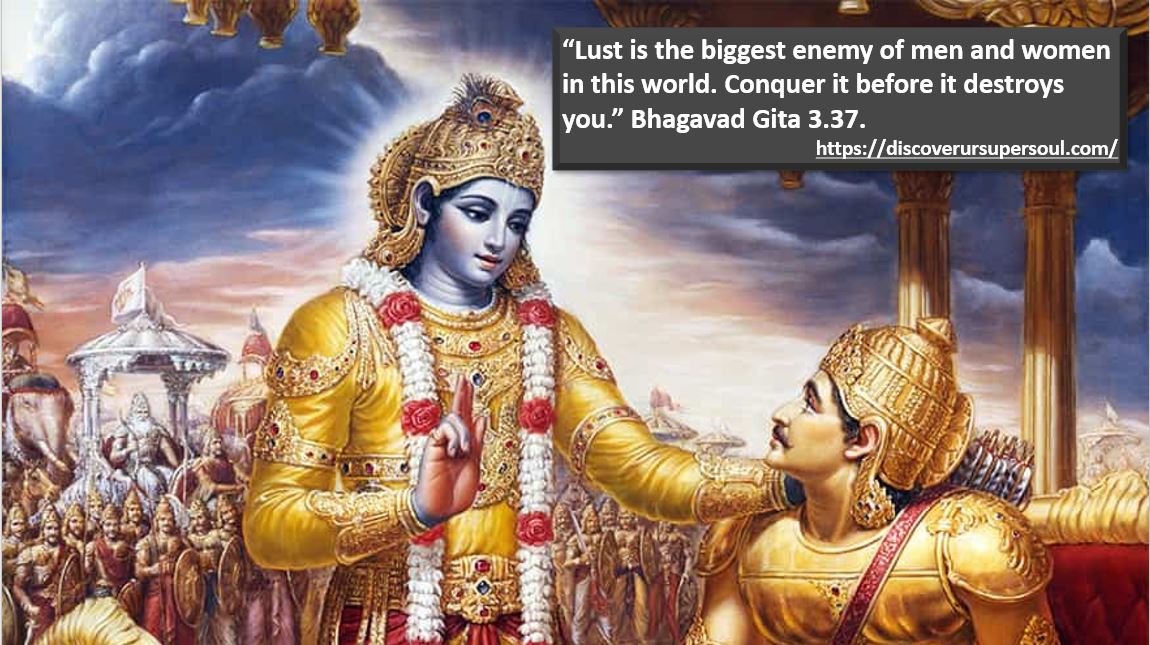
In Bhagavad Gita 3.39, Krishna calls “lust as an eternal enemy” because it can never be satisfied and it always burns like fire.  If unchecked lust can be devastating, it can ruin a person’s life forever. Few days ago Tarun Tejpal was considered one of the most prominent journalists of India but today he is one of the most hated figures. He is charged with attempted rape and sexual assault.  Whether it is Bill Clinton or Dominique Strauss-Kahn, former chief of International Monetary Fund (IMF chief), lust addiction has caused the downfall of scores of reputed personalities. While counseling Yudhisthira, Vidura told that lust is one of the main reasons why people commit heinous crimes. History is filled with such examples – It was lust only which destroyed Ravana and which brought ignominy to Jayadratha.
This is why since ages sages have been voicing their opinion against lust addiction. The fire of lust should be doused before it becomes devastating. Lust can be checked by inculcating strong moral values and simultaneously cleansing our heart by sincerely chanting the holy names of the Lord like the Hare Krishna Mahamantra – Hare Krishna Hare Krishna Krishna Krishna Hare Hare/Hare Rama Hare Rama Rama Rama Hare Hare.
“There are three gates leading to this hell—lust, anger and greed. Every sane man should give these up, for they lead to the degradation of the soul”. (Bhagavad Gita 16.21).
>

Self Control brings success

Purushottam Nitai Das November 21, 2013
A person who remains undisturbed and unbewildered amidst internal and external chaos is called self controlled. One of the foremost reasons as why a person fails to accomplish his coveted goal is because of his inability to rein in on his emotions.  Just like a person possessed by alcohol becomes insane, similarly a person overpowered by his emotions behaves irrationally.  A person may possess the intelligence and may have abundant talents to succeed in life but if he does not have the ability to control his inner life then the chances of him doing some remarkable deeds will be very minimal. We should never get bogged down by our emotions but act as per the writ of the life transforming literatures like Bhagavad Gita and Srimad Bhagavatam. This world is full of duality – good and bad things will keep on happening in our life. Bu without getting too much disturbed by life’s negativity we should determinedly march ahead.

“A person who is not disturbed by the incessant flow of desires—that enter like rivers into the ocean, which is ever being filled but is always still—can alone achieve peace, and not the man who strives to satisfy such desires.” Bhagavad – Gita 2.70.
>

Envision the world through the prism of Gita

Purushottam Nitai Das November 13, 2013
When confronted with adversities we look towards God and hope that he will change the situation as per our own liking. We expect God to do a magic in our life. But we see that in case of Arjuna the external situations and circumstances always remained the same. When Arjuna was utterly confused, he beseeched Krishna to show him the right path. “Now I am confused about my duty and have lost all composure because of miserly weakness. In this condition I am asking You to tell me for certain what is best for me. Now I am Your disciple, and a soul surrendered unto You. Please instruct me.” (Bhagavad Gita 2.7). Before Krishna spoke to him the message of Gita he was about to fight the war and after the Gita was spoken he still had to fight. Externally nothing changed. Krishna showed Arjuna the right path by purifying his consciousness.

Spirituality does not necessarily change the circumstances but it spiritualizes and cleanses our consciousness helping us to distinguish between righteous and unrighteous path. If we bring Krishna in our life then like Arjuna he will grant us a vision to envision the world through the prism of Gita which would help us to overcome any difficulties of our life.
>

Are we still spiritually blind?

Purushottam Nitai Das November 12, 2013
The message and the messenger was the same but still two different people interpreted it in different ways. Arjuna heard the message of Gita from Krishna directly and Dhritarashtra heard from Sanjay, his assistant. After hearing the wisdom words Arjuna’s life completely got transformed, his all doubts got dispelled and he became ready to face the battle of life.  But in spite of hearing the astute words of Krishna, Dhritarashtra remained spiritually blind. His desire to enjoy the kingdom overpowered his intelligence. Dhritarashtra lost all his 100 sons and was responsible for the death of thousands of warriors.
Gita’s message is not just for Arjuna but for entire humanity. We need to introspect and find out if we are following the footsteps of Arjuna or of Dhritarashtra. Do we want to remain materially diseased like Dhritarashtra and keep on hankering for material positions and possessions at the cost of our spiritual life? The only reason why Arjuna emerged victorious was because he acted as per the wishes of Krishna. Are we listening to Krishna’s words or are we succumbing to our material lust, we need to ask ourselves.
>