What did Chaitanya Mahaprabhu do to spread Krishna Consciousness?
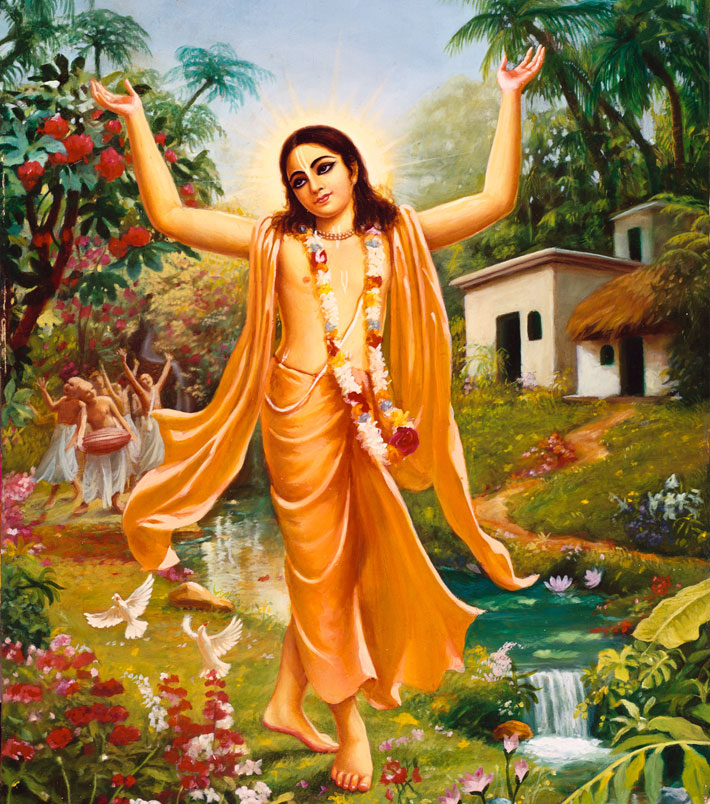
Chaitanya Mahaprabhu, a major proponent of Vaisnava philosophy, played a significant role in spreading Krishna Consciousness. He inundated entire India in the 16th century with the chanting of the Hare Krishna Mahamantra – Hare Krsna Hare Krishna Krishna Krishna Hare Hare/ Hare Rama Hare Rama Rama Rama Hare Hare.
Birth of Chaitanya Mahaprabhu
Caitanya Mahaprabhu was born in Mayapur, West Bengal, India on 18th Feb 1486. His father’s name was Jagannātha Miśra and mother’s name was Śacī-devī. During his childhood he was called as Gaurahari owing to his golden complexion. However, his mother called him Nimai because he was born near a neem tree. At the age of 5 he was admitted to a pathasala, school. By the age of 14 or 15 he became one of the most renowned and erudite scholars of Sanskrit and nyaya philosophy.
Chaitanya Mahaprabhu initiation
At the age of 16 or 17 he took spiritual initiation from a great Vaisnava Sannyasi, Isvara Puri. After initiation he became a religious preacher, his teachings transformed the hearts of many. Some of his intimate and sincere followers were Nityanand Prabhu, Haridas Thakura, Murari Gupta, Advaita Prabhu and Srivasa Pandita. In fact, numerous preachers of Vainavism started to flock to Nadia to meet Chaitanya Mahaprabhu.
Mahaprabhu’s teachings
Chaitanya Mahaprabhu wrote Siksastakam which comprises of eight verses. In the first verse he glorifies sankirtana i.e. the congregational chanting of the Hare Krishna Mahamantra.
“Glory to the Sri Krishna Sankirtana, which cleanses the heart of all the dust accumulated for years and extinguishes the fire of conditional life, of repeated birth and death. This sankirtana movement is the prime benediction for humanity at large because it spreads the rays of the benediction moon. It is the life of all transcendental knowledge. It increases the ocean of transcendental bliss, and it enables us to fully taste the nectar for which we are always anxious.” Sri Siksastakam
Through his life and teachings, he has underlined the importance of chanting the names of Krishna.
In Bhagavad Gita, Krishna says that the only reason why people like you and me suffer in this world is because we have disassociated ourselves with Krishna. And the only way by which we can free ourselves from all our miseries is by reassociating with Krishna.
So, Sri Chaitanya Mahaprabhu who is an incarnation of Krishna says that if we just chant the names of Krishna then we will be able to reunite with Krishna. Chanting will also cleanse our hearts of lust, greed, pride, anger, envy and illusion. These are the vices because of which we indulge in sins which eventually becomes the cause of our suffering. But once we chant then holy name of Krishna, we will get freedom from these vices. And once our heart becomes pure, it will automatically get attracted to Krishna. Just like a rust-free iron bar get attracted to a magnet.
Chaitanya Mahaprabhu spreads Krishna Consciousness
Mahaprabhu was full of compassion. So, he wanted to spread the holy name of Krishna in every nook and corner of the world. He instructed Prabhu Nityananda and Haridas to go to the streets, knock at every door and plead the inhabitants to chant the name of Lord Krishna.
suno suno nityananda, suno haridas sarvatra amar ajna koroho parkas
[Sri Caitanya-Bhagavata, Madhya-Khanda 13.8-10]
Denizens of Nadia were pleasantly surprised when Jagai and Madhai’s hearts were transformed. They were the most notorious and abominable figure of Nadia. But by the mercy of Chaitanya Mahaprabhu they became pure and devotees of Krishna. Mahaprabhu’s followers started increasing. Almost everyone in Nadia became devotees of Krishna, they all began chanting the names of Krishna.
When Chand Kazi, the chief magistrate of Navadvipa, tried to stop Mahaprabhu’s sankirtan movement then Mahaprabhu led a huge procession of the devotees to the residence of Chand Kazi. Mahaprabhu divided his Sankirtan into 14 groups; each devotee had a torch in his hand. Upon reaching Kazi’s house Mahaprabhu had a philosophical discussion with him. And finally Mahaprabhu was able to inculcate the Vaisnava philosophy in the heart of Kazi. Kazi lamented bitterly upon realizing his grave mistake and he himself decided to join the sankirtan party.
Why Chaitanya Mahaprabhu took sannyasa?
Mahaprabhu although a soft-hearted person was very strong in principles. Mahaprabhu’s preaching and his ever-increasing influence aroused jealously among some of the lowly minded brahmanas who decided to oppose Mahaprabhu. Mahaprabhu was of the belief that party feelings and sectarianism are the two biggest enemies of progress. He thought that as long as He will continue to identify Himself to a certain city (Nadia), and certain family His mission of spreading the message of Krishna will not succeed.
He no longer wanted to identify himself to certain city, certain family, caste and creed. Chaitanya Mahaprabhu thought that by taking sannyasa, he will be able to freely spread Krishna Consciousness. Therefore, at the age of 24 he decided to take sanyasa. After taking sanyasa Mahaprabhu travelled through entire India. He preached Vaisnavism and nama-sankirtan throughout the journey. On his way he preached pure bhakti and instilled Krishna Prema in the hearts of several people. And in this way thousands of people became devotees of Krishna.
Mahāprabhu’s spiritual ecstasy
Chaitanya Mahaprabhu would exhibit transcendental ecstasy remembering Krishna. These spiritual emotions are not of this material world. So, it cannot be understood by everyone. Only those who have love for Krishna and those who are trying to become devotees of Krishna can comprehend such spiritual ecstasies.
And this is the reason that mundane historians and scholars say that Chaitanya Mahaprabhu was suffering from epilepsy. Those who have never uttered the name of Krishna with love cannot understand someone who was madly in love with Krishna. It is their spiritual ignorance.
Kṛṣṇadāsa Kavirāja Gosvāmī, the author of Chaitanya Charitamrita, knew that the mundane scholar will fail miserably to understand Sri Chaitanya Mahaprabhu’s devotional ecstasies. So, writes, “When transcendental love of Kṛṣṇa awakens in someone’s heart, even a learned scholar cannot comprehend his activities. The activities and symptoms of that exalted personality in whose heart love of Godhead has awakened cannot be understood even by the most learned scholar.” Śrī Caitanya-caritāmṛta, Antya-līlā, 19.104 – 105
Chaitanya Mahaprabhu although Krishna appeared as a devotee of Krishna to spread Krishna Consciousness. And so to understand him one has to become a devotee of Krishna.
Mahaprabhu came to Puri at the age of 31. And he continued to live there till his disappearance at the age of 48.
Search
Recent Posts
-
Srimad Bhagavatam at ISKCON Newtown...
September 3, 2026
-
Srimad Bhagavatam at ISKCON Newtown...
September 1, 2026
-
Janmashtami: Celebrating Krishna’s Appearance Through...
August 17, 2026
-

Gopinatha Pattanayaka: 6 Lessons for...
August 16, 2026
-
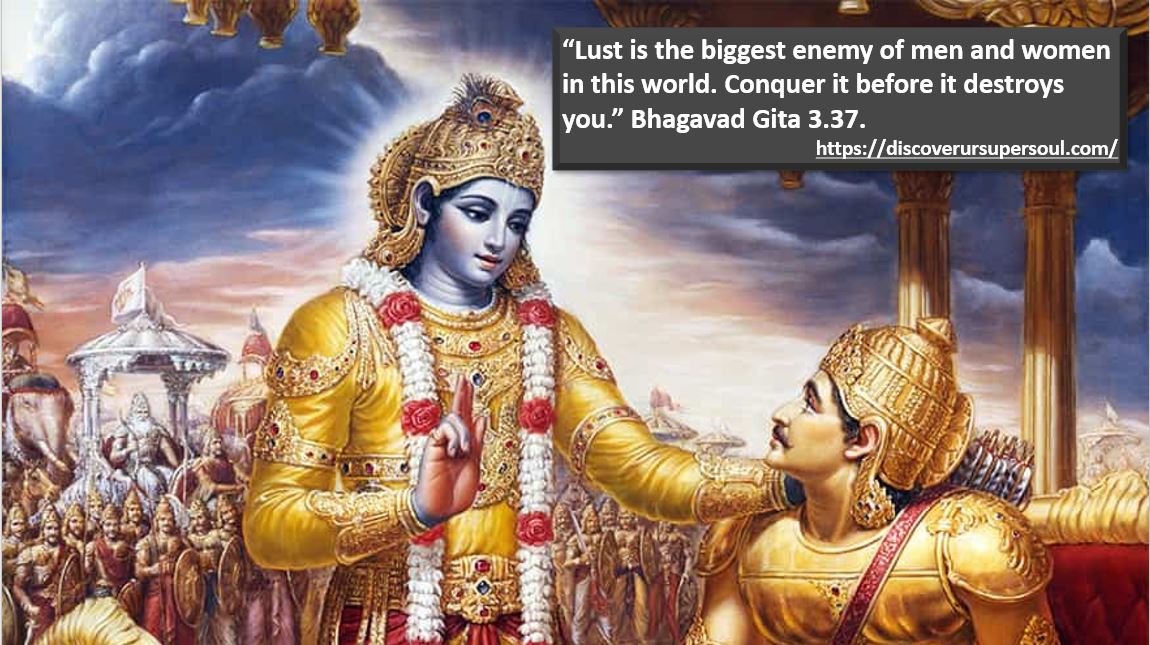
What Does Krishna Say About...
August 11, 2026
Nava Vidha Bhakti & the Examples of Devotees who Perfected Their Life by practicing Nava Vidha Bhakti
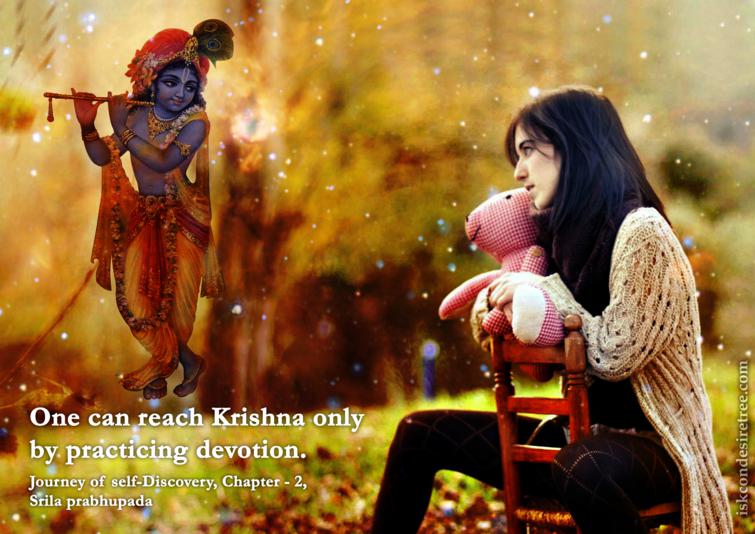
In Srimad Bhagvatam, Prahlad explains about the nine processes of pure devotional service which is called nava vidha bhakti.
śravaṇaṁ kīrtanaṁ viṣṇoḥ
smaraṇaṁ pāda-sevanam
arcanaṁ vandanaṁ dāsyaṁ
sakhyam ātma-nivedanam
“Hearing and chanting about the transcendental holy name, form, qualities, paraphernalia and pastimes of Lord Viṣṇu, remembering them, serving the lotus feet of the Lord, offering the Lord respectful worship with sixteen types of paraphernalia, offering prayers to the Lord, becoming His servant, considering the Lord one’s best friend, and surrendering everything unto Him (in other words, serving Him with the body, mind and words) — these nine processes are accepted as pure devotional service.” Srimad Bhagavatam 7.5.23-24
Scriptures explain that just by practicing one of the principles of nava vidha bhakti one can attain complete perfection and return back to the spiritual world. Srila Rupa Goswami in Bhakti-rasāmṛta-sindhu (1.2.265) gives the examples of devotees who attained salvation just by practicing one of the processes of nava vidha bhakti.
śrī-viṣṇoḥ śravaṇe parīkṣid abhavad vaiyāsakiḥ kīrtane
prahlādaḥ smaraṇe tad-aṅghri-bhajane lakṣmīḥ pṛthuḥ pūjane
akrūras tv abhivandane kapi-patir dāsye ’tha sakhye ’rjunaḥ
sarvasvātma-nivedane balir abhūt kṛṣṇāptir eṣāṁ param
Examples of nava vidha bhakti given by Srila Rupa Goswami
Let us understand in detail:
śravaṇaṁ (hearing):
śravaṇaṁ or hearing is one of the most important devotional activities. Parīkṣit Mahārāja attained complete perfection by hearing Srimad Bhagavatam continuously for seven days from Sukadeva Gosvāmī.
kīrtanaṁ (chanting):
Sukadeva Gosvāmī attained perfection by reciting i.e. by chanting(kīrtanaṁ) Srimad Bhagavatam for seven days to king Parikshit.
smaraṇaṁ (remembering):
Prahlāda Mahārāja always remembered (smaraṇaṁ) the Lord. He never forgot the Lord even for a moment.
pāda-sevanam (serving the feet of the Lord):
Lakṣmīdevī , the goddess of fortune, is always busy serving the lotus feet of the Lord.
arcanaṁ (offering worship):
Pṛthu Mahārāja worshipped the deity of the Lord and perfected his life.
vandanaṁ (offering prayers):
Akrūra while entering Vrindavan offered prayers to Lord Krishna. He thus pleased Krishna by his beautiful prayers and attained salvation.
dāsyaṁ (becoming the servant):
Hanumān, the great devotee of Lord Rama, was always eager to serve the orders of Lord Rama. Like a humble and loyal servant, he loved to serve the Lord and thus he attained mercy of Lord Rama and ultimate perfection.
Sakhyam (becoming the best friend):
Arjuna became a dear friend of Lord Krishna and attained salvation.
ātma-nivedanam(surrendering everything, whatever one has):
Bali Mahārāja surrendered everything including his own self to Lord Vamana and attained the mercy of Lord.
All the nine processes of nava vidha bhakti was practiced by King Ambarish.
Examples of nava vidha bhakti from Ramayana
The devotees who participated in the pastimes of Lord Rama also practiced nava vidha bhakti. This was revealed by HG Radha Gopinath Prabhu in one of his Srimad Bhagavatam class at Iskcon New Town Kolkata temple. Let us see the examples which he discussed from Ramayana of the devotees who perfected their life by practicing one of the processes of nava vidha bhakti.
Sravanam (hearing):
Hanuman is the best example of a devotee in Ramayana who perfected his life by sravanam. Wherever there is Rama Katha, Hanuman is present. He delights in hearing the glory of Lord Rama. He has attained complete perfection by being engaged in hearing the wonderful pastimes of Lord Rama. We also see that he is always engaged in serving the instructions of Lord Rama.
While comparing with different devotees Rupa Goswami has said that Hanuman perfected his life by being a humble and obedient servant of Lord Rama. But if we just focus on the devotees in Ramayana then it is said that Hanuman is the best among all the devotees who always liked to hear Rama Katha.
Hanuman is so great devotee that he does not want anything in return from the Lord. Once Lord Rama said to Hanuman, “You have served me so much, I will always be indebted to you. Let me know what you want, and I will grant you that benediction.” For few moments Hanuman did not say anything. He then folded his hands and with tears in his eyes, he humbly said, “My dear Lord I want nothing from you. I just want to be yours forever.” Lord Rama was overwhelmed with joy. He dd not say anything. He just embraced him.
kīrtanaṁ (chanting):
Sage Valmiki perfected his life by writing Ramayana. In Ramayana he has sung (kirtanam) the glories of Lord Rama and Mother Sita. He got boon from Brahma that he will be able to know all the minute details of the pastimes of Lord Rama and based on that he will be able to write in detail about Lord Rama’s different activities in this world. Ramayana is the only book sage Valmiki wrote and he attained eternal glory and eternal mercy of Lord Rama.
There have been many wonderful books written on the glorious pastimes of Lord Rama but Valmiki’s Ramayan standout amongst them. It is the first authoritative book on Lord Rama and any book which is written is based on Valmiki’s Ramayana. Sage Valmiki has captured each and every detail in his book. Lav Kush, the twin sons of Lord Rama and Mother Sita heard Ramayana from sage Valmiki and then recited it with great feeling of love and reverence.
An interesting pastime related to Ramayana
There is one interesting pastime related to Ramayana which is discussed amongst the devotees of Lord Rama. Once Valmiki was narrating Ramayana. So, Hanuman also came. Because wherever Lord Rama’s pastimes are discussed Hanuman is there. But he was sitting behind. Valmiki did not notice him. While narrating Ramayana, Valmiki said that when Hanuman entered Ashok Vatika in Lanka then there were white flowers in the garden.
From behind Hanuman said that the flowers were red in colour. Valmiki said that it was white. Again, Hanuman said that it was red. Valmiki who had not seen Hanuman said how can you say that the flowers were red. Hanuman then said because I am Hanuman and I was the one who entered Ashoka Vatika. Valmiki said I agree that you entered the Ashok Vatika but the flowers there were white and not red. You saw the flowers red because you were angry at that time.
smaraṇaṁ (remembering):
Mother Sita always remembered Lord Rama. This is the reason that while entering into fire she said that if even for a moment I have thought of anyone else other than Lord Rama then let me burn to ashes. She was completely absorbed thinking about Lord Rama.
pāda-sevanam (serving the feet of the Lord):
The best example is of Bharath. He is the personification of pada sevanam. For 14 years he served the paduka of Lord Rama.
arcanaṁ (offering worship):
Sabari is the best example. She offered half eaten berry to Lord Rama with great love. Rama, the Supreme Lord, was so pleased with her service, with her love that he ate the remnants of Sabari. Her purity, her humility, her sincerity and her great devotion attracted Lord Rama’s heart. She perfected her life by serving Lord Rama. In Bhagavad Gita, Lord Krishna says that he is hungry for our love and not for anything else. So, if someone offers him even the simplest thing with love, he accepts it.
“If one offers Me with love and devotion a leaf, a flower, a fruit or water, I will accept it.” Bhagavad Gita 9.26
vandanaṁ (offering prayers):
The sages of Dandakaranya offered beautiful prayers to Lord Rama when Lord Rama visited them in the forest. Because of their prayers they pleased the Lord. And when the Supreme Lord appeared as Lord Krishna in Vrindavan then these sages too appeared as gopis and got an opportunity to associate with Lord Krishna and serve Lord Krishna.
dāsyaṁ (becoming the servant):
In Ramayana Lakshman was the perfect servant of Lord Rama. He was the shadow of Lord Rama. It is said that when Lord Rama was in exile for 14 years then Lakshman did not sleep even for a moment because he was serving Lord Rama and Mother Sita each moment. Not just he served Rama and Sita in the forest but throughout his life he served Rama. He was given many thankless tasks but he did it because he always wanted to follow the instructions of Lord Rama.
Sakhyam (becoming the best friend):
In Ramayana Sugriva perfected his life by becoming the best friend of Lord Rama.
ātma-nivedanam(surrendering everything, whatever one has):
Vibhishana and Jatayu are the best examples of atma nivedanam in Ramayana. They both completely surrendered to Lord Rama. Jatayu sacrificed his life for the Lord and Vibhisan completely gave up everything to be with Lord Rama.
The devotee who practiced all the 9 processes of devotional life and perfected his life was Maharaj Guhu.
Search
Recent Posts
-
Srimad Bhagavatam at ISKCON Newtown...
September 3, 2026
-
Srimad Bhagavatam at ISKCON Newtown...
September 1, 2026
-
Janmashtami: Celebrating Krishna’s Appearance Through...
August 17, 2026
-
Gopinatha Pattanayaka: 6 Lessons for...
August 16, 2026
-
What Does Krishna Say About...
August 11, 2026
What is true religion according to Bhagavad Gita?
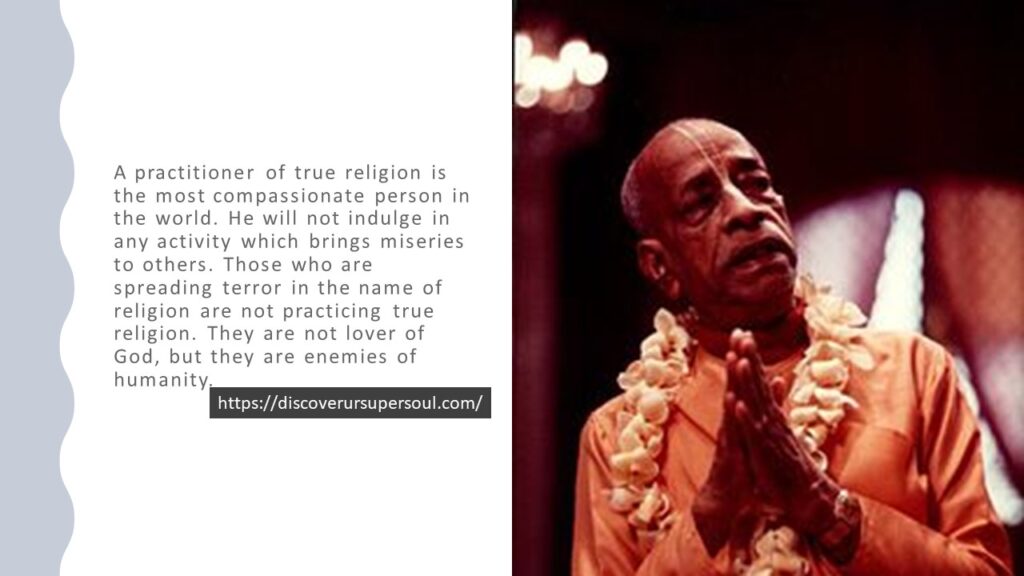
Vedic scriptures like Bhagavad Gita explains what true religion is. A practitioner of true religion is the most compassionate person in the world. He will not indulge in any activity which brings miseries to others. Those who are spreading terror in the name of religion are not practicing true religion. They are not lover of God, but they are enemies of humanity. They are religious extremists, fanatics who have no knowledge about God.
Religious fanatics are human viruses. They are as deadly as Coronavirus, sometimes even more lethal. These misguided people can kill anyone because they believe that people of other faith do not have right to live. They consider their religious doctrines to be supreme. In the garb of religion, they spread terror in the world. Infants, children, women, elderly people, men, they can harm anyone because for them no one’s life is sacred. But that is not true religion. It is fanaticism.
You cannot say you love God and kill all
Practice of true religion makes one saintly. It removes the impurities from the hearts of the practitioners and make them a civilized human being. He develops love for God, and he sees everyone as children of same God. Such an enlightened person lives and let others also to live.
But if people start considering irreligion to be religion, then irreligious people in the garb of religion indulge in irreligious and impious activities. This is what is happening at many places in the world today. It is the responsibility of the leaders to control the religious or rather irreligious extremists and put them behind bars.
It is also equally important that teachings of bona fide religious literatures like Bhagavad Gita is spread far and wide. When people start reading these authentic books then they get to know what it means to be religious and what it means to love God. You cannot say you love God and kill children of God.
This is why spiritual leaders like Bhaktivinod Thakura, Srila Bhaktisiddhanta Saraswati Thakura, Srila Prabhupada worked extremely hard to spread the teachings of Vedic scriptures like Bhagavad Gita.
It is because of Srila Prabhupada’s vigorous preaching that today millions of people all over the world have understood the transcendental teachings of scriptures like Bhagavad Gita. Their life has got transformed.
Children of same God
Every student of Gita understands that every living being in this world is children of same God. So, they love all, serve all. They do not inflict pain on others. And they do not discriminate people because of caste, creed, gender, religion, nationality. For them rich and poor, black and white, men and women, Hindus and non-Hindus, Indians and non-Indians all are same.
You go to any Iskcon temple or Iskcon centre in any part of the world, no one will ask you about your caste, your religion. No one is going to discriminate you because you are black or white, men or women, rich or poor. You will be treated equally. During the kirtan devotees hold each other’s hand and dance together. Of course, men and women dance separately because in civilized spiritual society men and women are given equal respects, but they do not mix freely.
Devotee has no enemy
In Bhagavad Gita 11.55, Lord Krishna says that one of the important qualities of a devotee is that he is nirvairaḥ i.e. “without an enemy.” A devotee does not have any enemy because he is friendly to everyone. He does not harm anyone not even in his thoughts. He always tries to serve others and always prays for others happiness. We see that Hiranyakasipu gave so much suffering to Prahlada but little Prahlada prayed to Lord Nrsimhadeva to forgive his father of all the sins and give him benediction. Srila Prabhupada risked his life to make people devotees of Krishna. The devotees of the Lord always look for ways to serve the humanity. And the best way to serve others is by connecting them to Krishna, the Supreme God.
Once a person becomes a devotee of God, he develops godly qualities. Developing godly qualities does not mean that a person becomes God. It means that a devotee of the Lord, like Lord becomes best well-wishing friend of all.
Qualities of a devotee according to Bhagavad Gita
In Bhagavad Gita 12.13-12.19, Lord Krishna explains in detail about the qualities of a devotee.
- One who is not envious but is a kind friend to all living entities, who does not think himself a proprietor and is free from false ego, who is equal in both happiness and distress, who is tolerant, always satisfied, self-controlled, and engaged in devotional service with determination, his mind and intelligence fixed on Me – such a devotee of Mine is very dear to Me. Bhagavad Gita 12.13-12.14
- He by whom no one is put into difficulty and who is not disturbed by anyone, who is equipoised in happiness and distress, fear and anxiety, is very dear to Me. Bhagavad Gita 12.15
- My devotee who is not dependent on the ordinary course of activities, who is pure, expert, without cares, free from all pains, and not striving for some result, is very dear to Me. Bhagavad Gita 12.16
- One who neither rejoices nor grieves, who neither laments nor desires, and who renounces both auspicious and inauspicious things – such a devotee is very dear to Me. Bhagavad Gita 12.17
- One who is equal to friends and enemies, who is equipoised in honor and dishonor, heat and cold, happiness and distress, fame and infamy, who is always free from contaminating association, always silent and satisfied with anything, who doesn’t care for any residence, who is fixed in knowledge and who is engaged in devotional service – such a person is very dear to Me. Bhagavad Gita 12.18-12.19
True religion means to spread peace and bliss everywhere
According to Bhagavad Gita, true religion is that which teaches the followers to develop above attributes. True religion means to spread peace and bliss everywhere.
While the government of the world should take care of the law and order situation, the devotees of Krishna should try their best to make this world a better place by transforming the hearts of people by sharing the transcendental teachings of Bhagavad Gita.
Once people understand Bhagavad Gita, they will understand what true religion is. It will save the humanity from gliding towards the path of degradation and self-annihilation.
We should also beg Krishna to give sanity to the insane people who are killing people in the name of religion.
Search
Recent Posts
-
Srimad Bhagavatam at ISKCON Newtown...
September 3, 2026
-
Srimad Bhagavatam at ISKCON Newtown...
September 1, 2026
-
Janmashtami: Celebrating Krishna’s Appearance Through...
August 17, 2026
-
Gopinatha Pattanayaka: 6 Lessons for...
August 16, 2026
-
What Does Krishna Say About...
August 11, 2026
ISKCON & A. C. Bhaktivedanta Swami Prabhupada’s contribution in spreading Jagannath worship & Rath Yatra all over the world
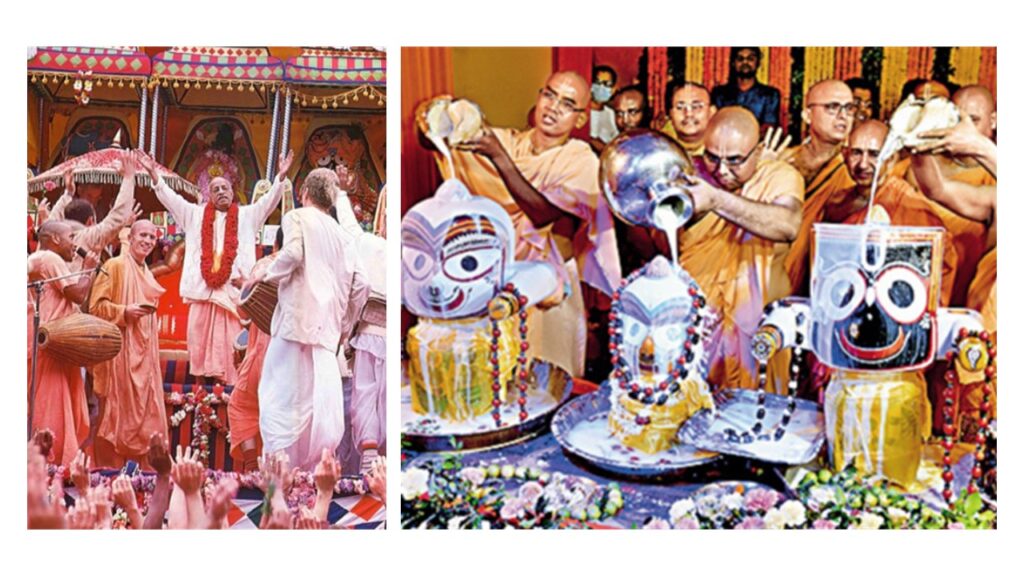
Srila Prabhupada, the founder acharya of Iskcon, has played a significant role in spreading Jagannath Rath Yatra and Jagannath worship all over the world. Let us explore some interesting facts about the Rath Yatra festival and how Prabhupada helped to spread it across the globe.
Friar Odoric was a Franciscan missionary. In early 14th century he visited India. In India, he saw a huge deity of Lord Jagannath on an enormous chariot in the streets of Puri. Thousands of people were pulling the chariot with a rope. He carried the story of Jagannath deity riding on a huge chariot to Europe. The story spread throughout Europe. By 19th century Europeans started using the word juggernaut, although they meant Jagannath. Any enormous object which had crushing capability was called juggernaut.
Little did the Europeans knew that the same massive chariots whose story had fascinated them would one day ride through the streets of Europe. Name any major cities of the world and you will see it celebrating Rath Yatra festival. The festival is celebrated in the same way as it is traditionally celebrated in Puri, India. The massive chariots of Lord Jagannath, Lord Baladeva and Subhadra Devi travels majestically and is pulled by hundreds of people.
Hundreds of men and women watch in amazement and even participate in pulling the ropes. Men and women, young and old, rich and poor, Hindus and non-Hindus, black and white all participate. Caste, colour, race, gender discrimination ceases to exist when everyone come together to pull the chariot of Jagannath.
Srila Prabhupada’s love for Jagannath
A. C. Bhaktivedanta Swami Prabhupada, founder acharya of Iskcon, established the worship of Jagannath outside India in a prominent way and made Rath Yatra global. He was fondly called “Srila Prabhupada.” He would say that Jagannath is Lord (nath) of the Universe (jagat), so why not give everyone, irrespective of caste, creed, religion and nationality, the opportunity to worship Jagannath. Srila Prabhupada was one of the most influential spiritual leaders of India post- independence. He played a crucial role in spreading Vaisnavism throughout the world. And he has made Jagannath Rath Yatra hugely popular.
Prabhupada was attracted to Jagannath since his childhood days. He was born in Kolkata in 1896. His parents, Gour Mohan De and Rajani De, gave him the name Abhay. Abhay means one who is fearless having taken shelter of the Lord. As a child he was fascinated by Rath Yatra festival. He always wanted to visit Puri to take darshan of Jagannath and participate in Rath Yatra. He would constantly look the train timetable to find out the trains for Puri. Especially he wanted to go during the Rath Yatra period and wanted to pull Jagannath’s chariot. But for little Abhay, it was not possible to go to Puri alone.
So, once he thought why not have my own Rath Yatra at home. His father bought him a small cart. He beautifully decorated it and invited his sisters and neighbourhood kids to join him in the Rath Yatra procession. Small deities of Jagannath, Baladeva and Subhadra was placed on the chariot. Seeing the enthusiasm of Abhay, his parents and neighbourhood elders too decided to participate. His mother cooked nice food items to offer to Lord. And on the Rath Yatra day little Abhay with his little friends organized a successful Rath Yatra. Everyone enjoyed the festival.
Prabhupada meets his spiritual master
When Abhay was a young man. He met Srila Bhaktisidhanta Saraswati Thakura, a renowned Vaisnav saint, scholar and founder of Gaudiya Math. The first meeting itself transformed Abhya’s life.
“You are an English educated young man. Why don’t you use your intellect and talent in enlightening the western world with the teachings of Krishna and Chaitanya? Indians are blindly imitating the west. They are forgetting their culture. So, if people in the west starts appreciating Indian wisdom and culture then the Indians will start valuing them too.”
These words of Srila Bhaktisiddhanta Sarasvati Thakura deeply touched Abhay. He decided to follow the sagely advice and requested Srila Bhaktisidhanta Saraswati Thakura to accept him his disciple. Srila Bhaktisidhanta Saraswati Thakura accepted him and initiated him in 1932 in Gaudiya-Vaishnava tradition.
Preaching in the western world
Prabhupada was working hard to fulfil the order of his guru. He took sannyasa, renounced order of life, in 1959 to dedicate his life completely in preaching Krishna Consciousness. Prabhupada wrote several books and tried his best to preach. He was also looking for an opportunity to go to west. Finally, he got the chance in 1965 to go to USA. Although he was 69 years old by that time but still he had burning desire to carry the message of Lord Krishna and Lord Chaitanya to the western world.
During his initial months in USA, he struggled hard to preach. But he did not give up. Slowly young American boys and girls started getting influenced by his preaching. His sincerity, simplicity and deep devotion to Krishna started attracting people. And slowly many started taking up devotion to Krishna. They became disciples of Prabhupada. Prabhupada engaged them in chanting Hare Krishna Mahamantra and also taught them how to worship the deity of Radha and Krishna.
In 1967 in San Francisco, Jagannath deity miraculously came to Prabhupada. And Prabhupada decided to establish the worship of Jagannath in Iskcon and planned to celebrate Rath yatra festival in different countries of the world.
Lord Jagannath appears in San Francisco
One day Malati, a female disciple of Srila Prabhupada, brought a unique looking wooden doll. She placed it in front of Srila Prabhupada. As soon as Prabhupada saw the wooden doll, he immediately folded his hands in reverence and paid obeisances. All the assembled students were amazed. What is so special about this doll? They wanted to know. They looked at Srila Prabhupada. Prabhupada had a big smile on his face. He looked so happy. It seemed that he was meeting his age-old friend after a long time. Prabhupada looked towards his young curious American disciples and said, “This is Jagannath, the Lord of the Universe. He looks different but he is Krishna.”
His American students had just begun learning about the Indian Vedic culture. They had started chanting the Hare Krishna Mahamantra on beads. They had begun donning Indian dress. Men would wear dhoti and kurta and women saris. Just like the devotees of Krishna in India, they would apply sandalwood tilak on their body. On the forehead they would put tilak in the shape of Krishna’s lotus feet and make a Tulasi leaf from the paste on the upper part of their nose touching Krishna’s feet. They looked perfect Vaishnavs. But still they had to know a lot about Indian culture, Indian tradition and the way the Indians worshipped the deities.
Devotees excited to know about Jagannath
Srila Prabhupada was their friend, philosopher, and guide. He would always encourage his disciples to go deep in spiritual life. He thanked Malati for bringing Jagannath. She had never thought that this wooden doll would please her spiritual master to such an extent. Everyone except Srila Prabhupada had heard the name “Jagannath” for the first time. In fact, majority of the Americans would not have known about Jagannath. Srila Prabhupada explained them in detail about the worship of Jagannath in India especially in Puri. He spoke about the grand rath yatra festival at Puri. When he said that thousands of people irrespective of caste, creed and gender come to pull the ropes of the chariot, everyone was mesmerised.
Srila Prabhupada explained them that Jagannath is none other than Krishna. He is worshipped along with his brother, Balarama, and little sister, Subhadra. Malati excitedly said that two similar looking dolls were also there in the shop.
“From where did you get this?” Prabhupada asked.
“From an import store at Cost Plus,” Malati said.
“Why don’t you get the other two dolls as well – of Balarama and Subhadra.” Prabhupada asked.
Installing the deity of Jagannath, Baladeva and Subhadra in San Francisco
She hurried back to the store with her husband, Syamasundara, and brought Balarama and Subhadra. Prabhupada was eagerly waiting for them. As soon as Balarama and Subhadra arrived, Prabhupada properly placed them – Jagannath to the right, little Subhadra in the centre and Balarama to the left. Srila Prabhupada loved Jagannath. Seeing him, he got a desire to start the worship of Jagannath in the western country in a grand way.
He wanted to spread the worship of Jagannath all over the world. Lord Jagannath had appeared in San Francisco by his own will. He wanted to establish the worship of Jagannath in San Francisco. For this to happen, a big wooden deity of Jagannath, Baladeva and Subhadra had to be built. He expressed his desire. His disciples were always eager to fulfil their guru’s wish. Syamasundara knew carpentry. He took the responsibility of carving the deities from the wood.
Srila Prabhupada explained him the shape, size, width and height of the deities. He took a pen and paper and wrote down all the details. He further said, “Jagannath should be painted black, Baladeva should be white, and Subhadra should be yellow.” Syamasundara began his work.
Jagannath deity was installed on Gaura Purnima
March 26 was Gaura Purnima, the appearance day of Lord Chaitanya. Prabhupada decided to install the deity of Lord Jagannath on that auspicious day. Lord Chaitanya had played a crucial role in spreading sankirtana – devotion to Krishna by congregational chanting of Hare Krishna Mahamantra – in India in 15th century.
After taking sannyasa, renounced order of life, Lord Chaitanya lived in Puri near the famous Jagannath temple. He visited the temple daily for darshan and stood for hours in front of Jagannath. Srila Prabhupada had gone to west to spread the teachings of Lord Chaitanya. So, the appearance day of Lord Chaitanya was the perfect day to install the deity of Lord Jagannath. A beautiful wooden altar from the redwood tree was built for the deities.
The deity installation day
On the installation day, which was also the Gaur Purnima day, Prabhupada said that entire day they all will read about Lord Chaitanya and his teachings, chant the Hare Krishna Mahamantra and sing kirtana. Everybody will fast the entire day. The much-awaited installation ceremony will be in the evening followed by big feast. Throughout the day devotees absorbed themselves in chanting the names of Krishna and hearing the pastimes of Chaitanya. Some of the devotees were also busy making arrangements for the evening. In the evening the temple room was full. Many people from the neighbourhood also came to see the installation ceremony.
Newly carved wooden deities of Jagannath, Baladeva and Subhadra were placed on the beautifully decorated wooden altar. A yellow canopy gave the altar a majestic look. Prabhupada led the kirtan and the disciples and assembled guests began offering lamp to the three deities. Blue, red and yellow lights on the altar glittered when devotees were offering the lamp. The deities looked beautiful and colourful. It was a festive atmosphere. Lamp offering was followed by big feast.
The installation ceremony was simple but devotional. Everyone present felt attracted to Jagannath, Baladeva and Subhadra. Prabhupada taught them the prayer which they should chant for Jagannath – jagannathaḥ svami nayana-patha-gami bhavatu me, O Lord of the Universe, please be visible to me. Prabhupada said that Jagannath has chosen to appear in San Francisco, so, let us call San Francisco as “New Jagannath Puri.”
Jagannath goes to Golden Gate Park
Devotees were happy. Next day some of the devotees took the deity of Jagannath from the altar to the nearby Golden Gate Park. They would often go out to do kirtan. So, they decided to even take Jagannath with them. Hundreds of Americans were excited to see Jagannath in the park. Devotees chanted the Hare Krishna Mahamantra and danced around Jagannath for several hours.
Meanwhile when Prabhupada saw the deity missing from the altar he was upset. Jagannath deity does not leave the altar except on one especially day. And that is called Rath Yatra. He said, “If you all really want to take the deities outside then organize a Rath Yatra festival.” His young American disciples got excited to hear this. Prabhupada said, “Let us have Rath Yatra in San Francisco.” Everyone agreed.
First Rath Yatra celebration in San Francisco on 9th July 1967
Prabhupada wanted to celebrate Rath Yatra festival the way it is celebrated in Jagannath Puri. Three different chariots for the three deities and devotees pulling the chariots with ropes. But he knew that it was not possible to arrange such big chariots in America. His disciples were not trained to build chariots. And to get it in a foreign land where Rath Yatra would be celebrated for the first time was not possible.
So, it was decided that a flatbed truck would be converted into a chariot. And in future devotees can plan for big chariots. They choose a yellow flatbed truck and decorated it in a way so that it looks like a chariot. Devotees made five-foot columns on the truck and a colourful cloth canopy. On the day of Rath Yatra they took the deities from the altar and placed it on the chariot under the canopy. Jagannath faced towards the right side of the truck, Baladeva towards the left and Subhadra towards the rear.
First Jagannath Rath year begins
The three deities rode on the streets of San Francisco on the yellow chariot. People on the road were amazed and excited to see this. The chariot moved slowly. Devotees sang the Hare Krishna Mahamantra and danced in front of Lord Jagannath. Hundreds of people participated in the procession. Police tried to finish the procession quickly. But so many people were in front of the chariot that they could not do anything. In fact, they too liked the devotional spirit.
Meanwhile devotees were distributing prasadam – oranges, apples and bananas were being given. From the chariot they were throwing flowers on the crowds, and people loved it. They were also releasing dozens of Rath Yatra ballons. It was a festive atmosphere. Devotees enjoyed their first Rath Yatra festival. Those who participated in the procession too loved it. Prabhupada was immensely pleased and satisfied. He had taken an arduous journey in his old age to the west to spread Krishna Consciousness. And it seemed he was succeeding.
Jagannath worship and Rath Yatra festival has spread all over the world
Today Jagannath worship and Rath Yatra celebration takes place in almost all the major countries of the world like USA, UK, Canada, Russia, Germany South Africa, New Zealand, Australia, Malaysia and even in Islamic countries like Pakistan and Bangladesh. One can see massive Rath Yatra chariots rolling through the streets of San Francisco, New York, Washington, London, Berlin, Moscow, Johannesburg, Melbourne, Kuala Lumpur, Dhaka. In India Iskcon organizes Rath Yatra in all the major cities like Delhi, Mumbai, Kolkata, Chennai, Bangalore, Hyderabad, Jaipur, Guwahati, Mayapur, Vrindavan and many more.
Iskcon organizes world’s first virtual Rath Yatra during Covid
During Covid Pandemic it was not possible to celebrate Rath Yatra on streets. So, Iskcon organized world’s first digital Rath Yatra which covered six continents. The festival was named as “Mercy on Wheels.” There were 108 rathas (chariots) and thousands of people from all over the world participated virtually.
References:
- Srīla Prabhupada-lilamrta Volume 1, Chapter TWENTY-FOUR, New Jagannātha Purī
Link: https://vedabase.io/en/library/spl/1/24/
- Srīla Prabhupada-lilamrta Volume 1, CHAPTER TWENTY-SIX, Swamiji’s Departure
Link: https://vedabase.io/en/library/spl/1/26/
- Definition of juggernaut: Merriam Webster
Link: https://www.merriam-webster.com/dictionary/juggernaut
- ISKCON plans world’s first virtual Rath Yatra across 6 continents amid Covid-19 pandemic: Hindustan Times
Search
Recent Posts
-
Srimad Bhagavatam at ISKCON Newtown...
September 3, 2026
-
Srimad Bhagavatam at ISKCON Newtown...
September 1, 2026
-
Janmashtami: Celebrating Krishna’s Appearance Through...
August 17, 2026
-
Gopinatha Pattanayaka: 6 Lessons for...
August 16, 2026
-
What Does Krishna Say About...
August 11, 2026
How to stop religious violence and create a better world?
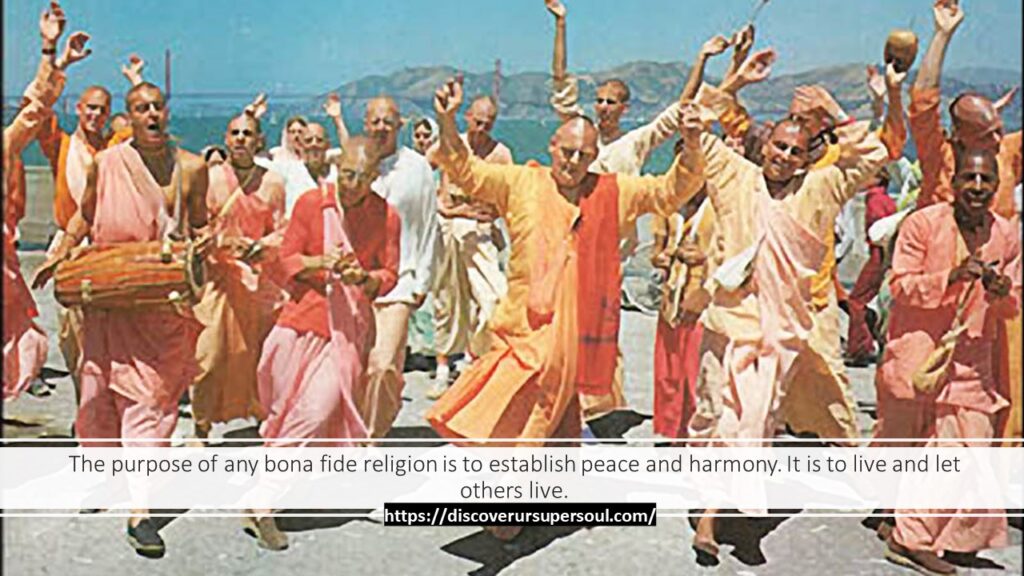
Is it possible to stop religious violence in the world? Seems to be a herculean task. Today religious violence has become so common. We see people killing each other in the name of God. Why? Because some believe that “My God is the Only God, the Best God and other’s God is Not God.” There was an incident in Bangladesh where temples belonging to Hindus were attacked. Iskcon temple was also attacked and in an unfortunate incident a young devotee was brutally killed. All this happened because of a false rumor and most importantly in the name of religion.
Same God different name
Oxford dictionary defines religion as “the belief in the existence of a god or gods, and the activities that are connected with the worship of them, or in the teachings of a spiritual leader”
Religion entails spiritual practices which helps believers to connect to God. All the major religions of the world be it Hinduism, Christianity or Islam accept God as the supreme father. And they accept that God created all the living beings. People of different faith may call God with different names but there is only one God who is the creator, maintainer, and destroyer of the creation. Just like there is only one sun which illuminates the whole world, but people may call it differently in different places and in different languages. For example, in Sanskrit Sun is called Surya, in Arabic shams, in English sun, in Spanish El Sol and so on. Similarly, it is the same God which all are referring to with different names.
Violence in the name of God is a great sin
Now God, the Supreme father is one, so it means that you and me, in fact everyone in this world, are children of same God. So, if someone in the name of their God is killing other human beings then it means that they are killing God’s own children. Will any father of this world like to see his innocent children being savagely massacred?
Similarly, will the Supreme father be happy to see one of his children killing his another child? Will God who is all loving approve such heinous crime? The answer is obvious. Suffice to say that if someone is killing in the name of religion or in the name of their God then either their religion is not bona fide, or they have not understood their religion properly. Or it could be that some unscrupulous people have usurped the position of a religious leader and is misguiding the gullible masses.
In Bhagavad Gita 16.9, Krishna says that there are demoniac people in this world who have no intelligence, and they engage in horrible works which are meant to destroy the world.
The 200 strong mob who attacked the Iskcon temple in Noakhali, Bangladesh and killed an innocent 25-year-old devotee of Krishna, Partha das, were full of demoniac mentality. There act was not an act of bravery. It was a cowardly act. A cruel act. A demoniac act. An insane act.
No bona fide religion preaches violence. All the religious literatures of the world teach to love God. And when we love God, we love all. We won’t be violent towards any living creatures physically or verbally. Because a genuine devotee of Lord, sees the same God in the heart of each living being. paṇḍitāḥ sama-darśinaḥ.
So, he discriminates none and hates none.
Even butchers became devotee by chanting the names of Krishna
In fact, if one starts following the religious principles given in the scriptures one becomes free from all evil tendencies and develops godly qualities. If we turn the pages of scriptures, we see many such examples.
One such example is of Mrigari. He was a cruel hunter, so much ruthless that he would half kill animals because he would enjoy seeing them suffer in pain and die. But after becoming a devotee of God, Krishna, his heart got completely transformed. He gave up all kinds of violence and would show compassion to even ants.
Similarly, when Srila Prabhupada went to west to share the teachings of Bhagavad Gita and other Vedic literatures then it transformed the lives of so many people. There were hippies in the west who were indulging in many sinful activities. They were drunkards and meat eaters. But once they became devotee of Krishna, they gave up all impious activities. They gave up eating meat and stopped taking intoxicants. There were butchers who also got transformed and quickly gave up the profession of killing animals.
This is what a bona fide religion does. It completely removes all the evil and sinful proclivities from the heart of the practitioner. One gives up all types of violence. So, if someone claims to be a follower of a particular faith but has no compassion and love for other living beings, it means that their practice of spirituality is a sham.
Violence towards animals in the name of religion should end
For example, one cannot keep on killing innocent animals, who are also children of God, in slaughterhouses and claim that he is a religious person. In fact, cruelty towards animal leads to cruelty towards fellow human beings. If someone since his childhood days have seen humongous animals being slaughtered in their courtyard, in the slaughterhouses, on the streets then his heart will be full of violent images. He sees animals crying in pain while their neck is being slit. He sees gallons of blood oozing out of the animal neck and flooding the streets. What consciousness a child will develop seeing so much blood, so much violence? He later sees that the animal flesh is cooked, and everyone feast upon it.
When brutality is normalized in the society, children become brutal, hard -hearted. And when they grow up, they do not hesitate in indulging in cruel acts. For them, killing other living beings including men, women and children is as simple as plucking a guava from a tree. No feeling. No remorse.
Animal slaughter in Vedas
Slaughter of animals is prohibited in the Vedic scriptures. However, in Vedas we do find some instances of animal sacrifice. But it was done in a controlled way for a higher purpose. During Vedic times, learned priests chanted mantras during animal sacrifice. The animal, which was sacrificed would immediately get a new life, sometimes even a human life. It was not that in Vedic times there were slaughterhouses operating on the streets and animals would be brutally killed.
Srila Prabhupada explains, “The animal sacrifice is never meant for killing the animal, but for achieving the successful result of the sacrifice. The animal offered in the sacrificial fire is, so to speak, destroyed, but the next moment it is given a new life by dint of the Vedic hymns chanted by the expert priest. When such an expert priest is not available, the animal sacrifice in the fire of the sacrificial altar is forbidden.” Srimad Bhagavatam 2.6.23
Today such expert priests are not there who can give a new life to the animals. So animal sacrifice is strictly prohibited in this age of Kali yuga.
What government should do to stop religious violence?
If we want to stop religious violence, then we should stop all kinds of violence including violence towards animals in the name of religion. The government should be prompt in taking action against those who indulge in any kind of religious violence.
Most importantly the government should identify those religious leaders who are preaching violence and intolerance. They are the mastermind behind the violence in the name of God. The less intelligent common citizens many times get swayed away by the sermons of such evil and cunning preachers. These pseudo religious preachers incite violence and sow the seed of hatred in the society. Such preachers should be nabbed and put behind bars. It is also the duty of the government to see if people are following tenets of the religion as it is and are not deviating from the path.
Srila Prabhupada says, “There is educational inspector, school inspector. They go see that the students are properly being educated in that school. Similarly, government should have expert men in the government to see that the Hindus are acting like Hindu, Muslims are acting like Muslim, and Christians are acting like Christian. The government should not be callous about religion. They may be neutral, that “Whatever religion you profess, government has nothing to do. You do nicely.” But it is the government’s duty to see that you are doing nicely, you are not bluffing. That is government duty.” Room Conversation with Indian Ambassador, Sept. 5, 1973, Stockholm
Bona Fide Religion Brings Peace & Harmony
Violence in the name of religion is the greatest sin, an unpardonable crime. To stop religious violence, government should severely punish the perpetrators. It is also the responsibility of the people to not get misled by the fanatic religious preachers. When they hear any sermons or read any religious literature which advocate use of violence against non-believers then they should ask themselves that how by inflicting pain upon others they will be able to please their God who is glorified as all merciful. They should think before accepting any religious doctrines and should not be a blind follower.
It is also equally important that the genuine devotees of the Lord spread the message of sacred scriptures far and wide so that people understand the purpose of religion. The purpose of any bona fide religion is to establish peace and harmony. It is to let live and let others live. All types of religious violence will stop once people will come to know the sacred teachings of bona fide religion. This will help in creating a better world where everyone can live happily.
Search
Recent Posts
-
Srimad Bhagavatam at ISKCON Newtown...
September 3, 2026
-
Srimad Bhagavatam at ISKCON Newtown...
September 1, 2026
-
Janmashtami: Celebrating Krishna’s Appearance Through...
August 17, 2026
-
Gopinatha Pattanayaka: 6 Lessons for...
August 16, 2026
-
What Does Krishna Say About...
August 11, 2026
Why Cow Protection is so important especially in India?
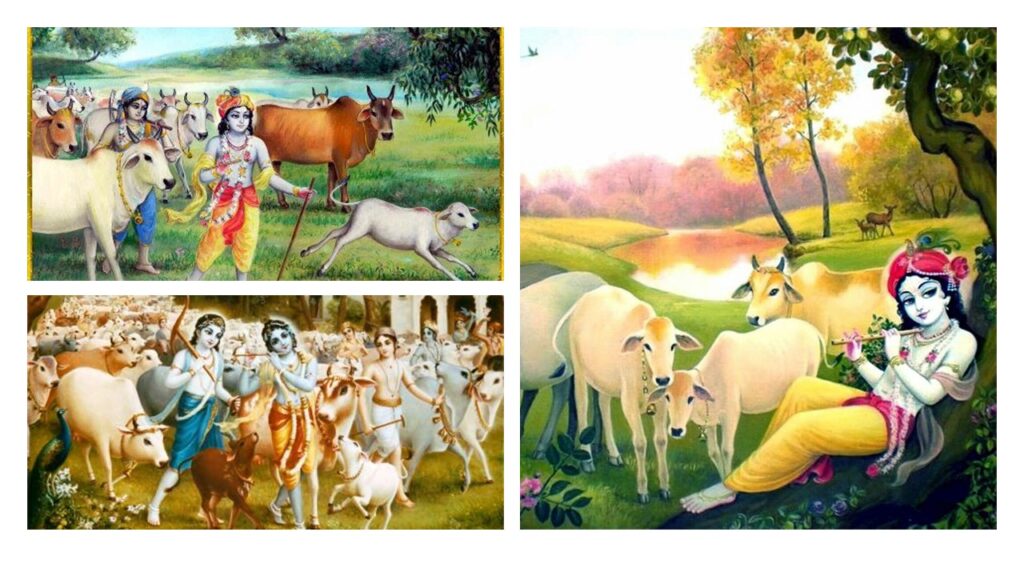
Vedic literatures highlight the importance of cow protection. Bhagavad Gita 18.44 recommends(go-rakṣya). Lord Krishna loves cows.
Krishna’s love for cows
He appeared in Vrindavan as a cowherd boy. In the sacred land of Vrindavan, Krishna would play with the cows and would take care of the cows. Cows too loved to be with Krishna. They felt protected and cared. Krishna, the Supreme Lord, is the best well-wisher of the cows. Viṣṇu Purāṇa 1.19.65 says
namo brahmaṇya-devāya
go-brāhmaṇa-hitāya ca
jagad-dhitāya kṛṣṇāya
govindāya namo namaḥ
Srila Prabhupada explains, “Lord Kṛṣṇa, the Supreme Personality of Godhead, is the prime protector of brahminical culture and the cow. Without knowing and respecting these, one cannot realize the science of God, and without this knowledge, any welfare activities or humanitarian propaganda cannot be successful.”
Krishna’s favourite food is butter and butter comes from milk. Mother Yashoda knew Krishna’s love for milk and preparations made from milk. So, she would prepare many delicacies of milk and give it to Krishna. Krishna enjoyed them. One of the names of Krishna is Govinda because he gives “pleasure to the cows.” Krishna is also called Gopal, the maintainer of the cows. Vrindavan is also known as Goloka Vrindavan. Goloka means “planet of cows.” So, cows have great spiritual significance in India. Millions worship cows daily here. And in India cow is always referred as “mother cow.”
Cow’s milk so precious and delicious
As a mother cow gives abundant milk which sustains life. Milk is also used to prepare varieties of nutritious and delicious food items. Cow’s milk is precious and delicious. Dozens of varieties of sweets are made from cow milk. It is not that cow milk is used only in India. People in all parts of the world use cow milk and milk products.
Like a mother she gives her milk to us. Milk is said to be complete food, it completely nourishes us. We start drinking cow’s milk when we are just an infant. But sadly, the same cow who serves us as mother is killed for flesh. Even in India cows are killed. It’s so unfortunate. Although millions of Hindus revere cows and in many provinces cow slaughter is banned but still cows are killed, many times brutally.
Liberals or pseudo seculars against cow protection
In India there are certain section of people who call themselves secularists, but they are mostly pseudo – secularists. They also call themselves as liberals. These people have lots of problems with Hindus religious belief system. Not only with the Hindus these people have issue with anyone who follows the Vedic teachings and respect the Vedic culture. For example, these liberals did not like APJ Abdul Kalam, former President of India and a renowned scientist. It was because although a Muslim APJ Abdul Kalam would love reading and deriving inspiration from Ramayana and Mahabharat.
These pseudo – secularists are few in number, but they wield tremendous power. Most of them are active in academics and in media. Today if anyone in power speak about cow protection then these pseudo secularists with their media partners will start making lots of noise. They will label him or her as communal, fascists and most importantly anti-Muslim. This despite the fact that majority of Muslims in India have Vedic roots. In fact, many Muslims in India happily participate in festivals like Janmashtami and Ramnavmi. One of my office colleagues was a Muslim and lived in Mumbai. He would tell me that he with his friends would participate in dahi handi festival during Janmashtami.
When once Menaka Gandhi, former Union Minister in Indian Government and well-known animal rights activist and environmentalist, raised her concern against cow slaughter then immediately the pseudo secularists lampooned her and labelled her as communal. The liberals support cow killing and vehemently oppose anyone who talks about cow protection.
People callous towards cow protection
It is disheartening to see cows being killed in India. But why to only blame the pseudo seculars or liberals or the inefficient government. People are also responsible. Many people keep cows till the time she gives milk. Once she grows old and stop giving milk the owner thinks that it is uneconomical to keep the cows. So, they abandon the cows.
Some are so callous that they even sell their cows to butchers. For many killing cows have become more profitable because selling meat bring instant profit.
Scriptures say that a person has 7 mothers and one of them is the cow. So, cow is called gau-mata (mother cow). But today people have become so wicked and so savage that they do not hesitate in inhumanly killing mother cow for money. Once cows grow old and become non profitable, they are unceremoniously driven out from the house. Height of insensitivity! Such cows can be seen loitering in the streets for want of food, water and shelter. They eventually end up in slaughterhouses or die on the road. Sometimes they are hit by trucks and buses or they die because of hunger or some disease.
The cows served their master by giving her milk. She should be loved and cared like a family member. It is high time that sane and pious men understand the gravity of the situation. People need to be educated about the need of cow protection and simultaneously government should take strong action against those who indulge in such acts. Although cow slaughter is banned in many states of India but nevertheless people illegally with implicit support of the local administration continue with the business.
Our spiritual responsibility to protect mother cow
A human being does not become a human if he does not show compassion towards other living beings. Srila Prabhupada gave emphasis on cow protection. Many Iskcon centres and farmhouses all over the world have cows which are well taken care. At Iskcon Mayapur Gaushala (or Goshala) there are scores of healthy and happy cows. Anyone can go there and see how joyfully they live. Those cows who stop giving milk are not thrown out from their homes but are properly taken care. They continue to get their share of food, water, shelter and love. In fact, at all the Gaushalas run by Iskcon all over the world cow gets complete protection and care. This is what scriptures teach. And this is what every God loving person should do.
Mother is always a mother whether young or old or diseased. Her value cannot be determined in terms of monetary benefit. Cow is our mother. So, it our spiritual responsibility, yours and mine, to protect her and protest against her killing. Those slaughterhouses which kill cows should be closed. And those who indulge in this gruesome act should be punished.
Lord Krishna appeared in India. Devotees love Krishna and Krishna loves cows. So, devotees of Krishna should take a lead role in protecting cows especially in India. They should do whatever possible legally to save cows and also should preach vigorously about the spiritual significance of cow protection.
Search
Recent Posts
-
Srimad Bhagavatam at ISKCON Newtown...
September 3, 2026
-
Srimad Bhagavatam at ISKCON Newtown...
September 1, 2026
-
Janmashtami: Celebrating Krishna’s Appearance Through...
August 17, 2026
-
Gopinatha Pattanayaka: 6 Lessons for...
August 16, 2026
-
What Does Krishna Say About...
August 11, 2026
Is violence in the name of religion sanctioned in the religious literatures?
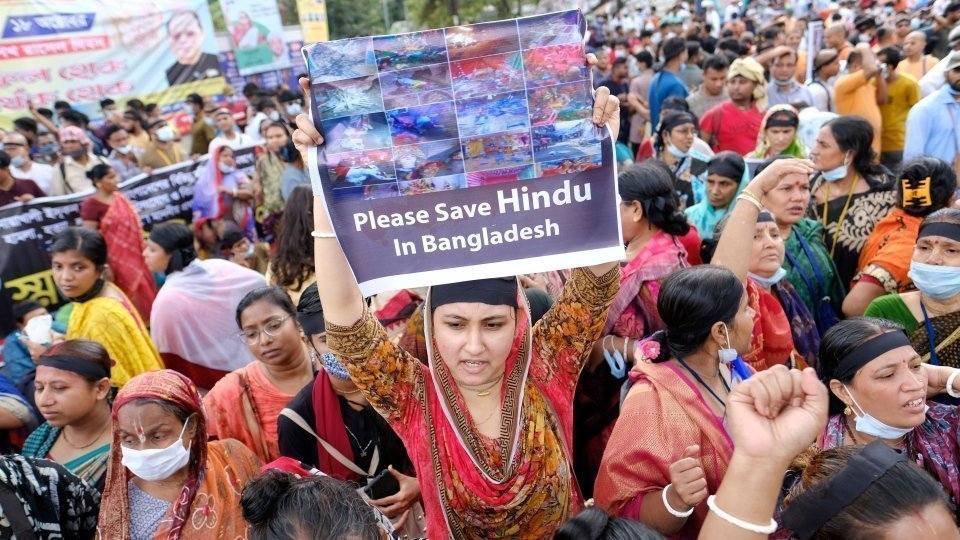
Is violence in the name of religion justified? Is it sanctioned in the scriptures? If we look around the world today, we see people are killing other people in the name of religion. Because some believe that their god is better than other gods. So in the name of God they have license to kill others.
Recently in Bangladesh, hundreds of fanatics attacked Hindus. They destroyed Hindu Temples burned their houses and unfortunately one Iskcon devotee was also brutally killed.
Few years back there was terrorist attack in Paris and when the terrorist were killing innocent people, they were also shouting “God is great”. It makes one wonder is religion the cause of violence in the world? Also does the great God justify the killing of innocent people and eulogize the killers. If yes then how could God be great? Or is it that the killers are the agents of devil who are on a mission to discredit the great God?
Violence in the name of religion
Violence & Killing in the name of religion has spread all over the world today. The brutal massacre of innocent men, women and children, and the beheading videos are not just frightening and distasteful but it is also shaking people’s faith in the idea of God. If people unleash violence in the name of God then the world will be a much better place without God. Why not have Godless world where there will be no discrimination and murder in the name of God?
Now before rejecting God and admonishing the books of God let us also try to understand these books to figure out if violence against innocents has ever been justified? Has God promised that those who shout my name and inflict pain on others achieve me?
Bona Fide Religion Preaches Peace
All the bona fide religions of the world believe in the Supreme Lord and unequivocally declare God to be our Supreme Father. For e.g. in Bhagavad Gita 14.4, Krishna says, aham bija-pradah pita, I am the seed giving father. If it is so then how could a father sanction the killing of one of his children at the hands of the other children because both the terrorist and the victims are his own children? More so it is said that a devotee of the Lord sees all the living beings of this world as parts and parcels of the Supreme Lord and sees them with equal vision without any discrimination (Bhagavad Gita 5.18).
If we study Vedic scriptures carefully we will find that these sacred books preaches the message of peace and love and not of violence. And if we read the lives of the great messengers of the Lord then we find that they have never used violence but have instead used love of God as a weapon to transform the lives of people. There are innumerable stories of people’s heart getting transformed by associating with holy men and holy books.
Story of Mrigari, the cruel hunter
Lord Nityananda and Haridas Thakura reformed ruffians like Jagai and Madhai by filling their hearts with love of God. It was the power of devotion to God that transformed the life of Valmiki, the composer of Ramayan. Scripture tells a story of a cruel hunter named Mrigari who used to rejoice seeing suffering of helpless animals and birds. He used to half kill them and then enjoy seeing them suffer and die.
When sage Narada saw the suffering beasts and birds, he was shocked. Why don’t you just kill them completely, he asked?
Mrigari replied smilingly, “Because I enjoy seeing them suffer and die”.
Narada understood that his cruelty is going to cost him dear, the hunter is going to get a terrible reaction for his sins. And so he decided to transform Mrigari’s heart. He explained the hunter how his act is not in accordance with the laws of God and so it is going to bring great misfortune to him. He told him to have love, compassion and mercy towards the other children of God and most importantly asked him to chant and take shelter of the supreme Lord.
Mrigari had never heard any sagely advice before because he belonged to the family of hunters. He had witnessed such cruelty since childhood.
Mrigari’s heart transforms
But Narada had now told him to see the world through the eyes of the scriptures. The hunter understood that he was swiftly moving to the path of self-annihilation. And so he decided to give up violence and lead a God conscious peaceful life. Soon his heart had got so transformed that while walking he used to be cautious so that he may not step on any small living beings such as ants.
A genuine devotee of the Lord will never try to cause any harm to others even in his dreams. He is para-dukha-dukhi i.e. seeing others in pain he himself feels pain. He does not go and voluntarily inflict pain on others as some misguided men and women are currently doing in the name of God. Instead he is ready to suffer for the sins of others.
Vasudeva Datta wanted to suffer for the sins of others
Vasudeva Datta was a great saintly person. He was ready to suffer on behalf of all people of the world so that they could be absolved of all the miseries. “I will take their sins and suffer in hell on their behalf, but please deliver them from their material disease, he prayed to Lord Caitanya” (Chaitanya Charitamrita Madhya 2.15.160-163). This is the true character of a devotee.
Qualities of a devotee of God
- A genuine lover of God does not wear the vest of bombs with a mission to inflict immeasurable sufferings on others. Instead they give their life to save the lives of the suffering masses.
- They do not carry weapons of destruction in their hands. But instead they carry the chanting beads on which they chant the names of God. And also inspire others to get connected to God.
- They do not speak words which fill people’s heart with fear. But instead they speak words of love which brings joy to people’s heart.
- The process of devotion to God is so enlightening that it makes a ruffian a sage and a crooked man a kind hearted man.
Conclusion: God does not sanction violence
“God is great” and the great God does not sanction violence. He is a loving and caring father. And has asked all of us to live together happily like brothers and sisters. He has asked us to shun violence and embrace peace and has advised us to fill our hearts with love, mercy and compassion (Bhagavad Gita 16.1-3).
And those who massacre people in the name of religion are not even humans; they are messengers of evil. In fact they are worst than the beasts. Violence in the name of religion is not sanctioned by God and is not mentioned in the scriptures. Those who are killing people in the name of religion or God are fanatical people and have no understanding who is God. In fact they are evil people. They should be severely punished by the government of the world. Along with this the genuine devotees of the Lord should spread the message of sacred scriptures far and wide. This will help to establish peace and harmony everywhere.
Search
Recent Posts
-
Srimad Bhagavatam at ISKCON Newtown...
September 3, 2026
-
Srimad Bhagavatam at ISKCON Newtown...
September 1, 2026
-
Janmashtami: Celebrating Krishna’s Appearance Through...
August 17, 2026
-
Gopinatha Pattanayaka: 6 Lessons for...
August 16, 2026
-
What Does Krishna Say About...
August 11, 2026
The Bhagavad Gita verse which enhances my faith & conviction in Krishna Consciousness
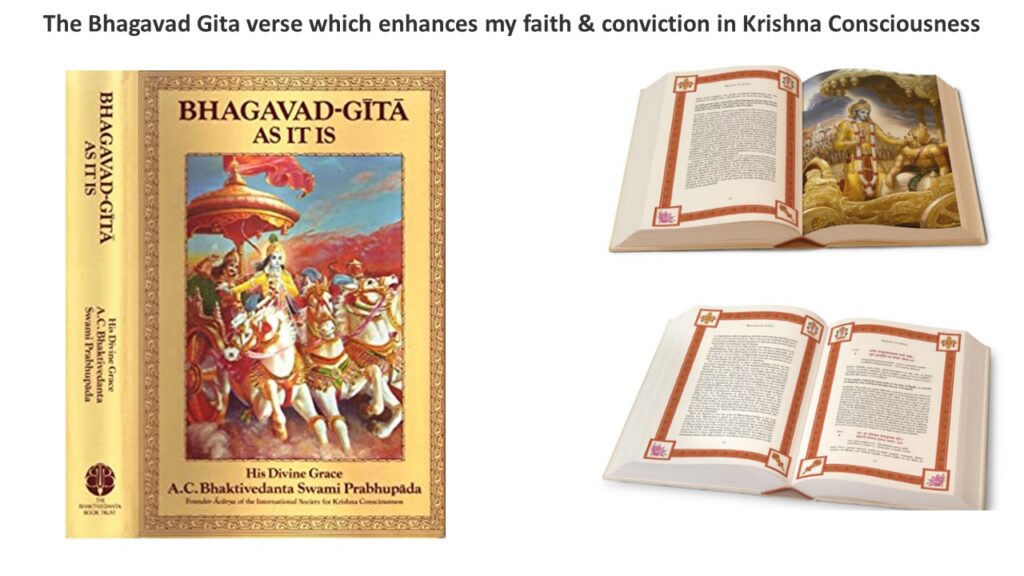
All the verses of Bhagavad Gita enhance my faith and conviction in Krishna. But one verse which stand out is the verse from Bhagavad Gita 18.37. In this verse Krishna says, “That which in the beginning may be just like poison but at the end is just like nectar and which awakens one to self-realization is said to be happiness in the mode of goodness.”
I can relate with this verse and can say with full conviction that each word of this verse is true. Especially this one from the verse “which appears poisonous in the beginning but becomes nectar in the end.” I have applied it in my life. And have always got the same result which is Krishna is saying. In fact, I apply this verse almost daily in my life.
Because of past conditioning and ignorance, spiritual activities appear troublesome to me. In fact, as mentioned in this verse, poisonous, viṣam iva.
Spiritual activities appear poisonous in the beginning but becomes nectar in the end
For example, getting up early in the morning and doing mangal arati appears very difficult. Chanting sixteen rounds of Hare Krishna Mahamantra appears tedious. And I do not find much interest in reading literatures like Bhagavad Gita, Srimad Bhagavatam and other books of Srila Prabhupada. All these important spiritual activities are poisonous to me. Every day I have to struggle to complete these important spiritual activities.
So, every morning I remind myself of this verse. I contemplate on its meaning. I tell myself that these activities are now looking poisonous but if I exert myself, give up laziness and complete these spiritual duties I will experience “happiness in the end.” This is what Krishna is promising in this verse. So, I keep faith in the words of Krishna and I complete all these activities like mangala arati, chanting the names of Krishna, reading spiritual books. And almost every day, at the end of the day, I find that once I complete these spiritual activities, I feel so satisfied and happy from within.
Sense gratification appears nectar in the beginning but becomes poisonous in the end
But if I indulge in sense gratification like browsing internet, reading political news, doing prajalpa (mundane talks) then while doing these activities I feel some sort of so-called happiness. But after spending time in these non-Krishna Conscious activities, almost all the time I fret. I curse myself saying that what was the need for me to waste my time in this way. Sense gratification is a waste of time, and it takes us away from Krishna. So, Krishna has warned us in Bhagavad Gita 18.38 that sense gratification may appear like nectar in the beginning, but it becomes poison in the end.
“That happiness which is derived from contact of the senses with their objects and which appears like nectar at first but poison at the end is said to be of the nature of passion.” Bhagavad Gita 18.38.
Once we begin doing, we begin enjoying
One of the great things about spiritual activity is that before we start doing it, it appears troublesome. But as soon as we start doing it, we start experiencing pleasure. For example, getting up early in the morning, taking bath, making preparation for mangal arati appears unpleasant. But as soon as we start making preparation for mangal arati and start worshipping the deity, we start enjoying from within.
Similarly, once we begin chanting, we feel nice. And once we complete chanting 16 rounds of Hare Krishna Mahamantra, we feel so happy and so lucky. It gives us a sense of accomplishment. And also, once we have read few sentences from Bhagavad Gita and Srimad Bhagavatam then slowly we find ourselves getting absorbed in reading.
How Bhagavad Gita 18.37 verse helps me on the day of fasting?
On the day of fasting especially on the day of nirjala ekadasi this verse helps me a lot to successfully complete nirjala ekadasi. Nirjala ekadasi means fasting for 24 hours without water. On that day I keep on reciting this verse in my mind throughout the day and contemplate on its meaning. I keep on telling myself, “One day of trouble and sacrifice and the next day I will be on cloud nine, I will get lots of spiritual happiness.” And by remembering this verse I have been able to complete nirjala ekadasi for last many years.
Similarly on other days when I have to fast like during Janmashtami, Gaur Purnima, Narasimha Chaturdasi and other ekadasi days I keep on remembering this verse.
Spiritual life is full of nectar
Upon contemplation I come to the conclusion that we all have developed a wrong understanding that spiritual activities are troublesome. Because if spiritual activities would have been troublesome then I would have felt miserable after completing it. I have never seen any devotee in my entire life who felt miserable after chanting Hare Krishna Mahamantra or after attending managal arati.
When we go to Mayapur we get up in the morning to attend 4:30 am Managal arati. We feel so blissful and happy seeing the deities of Radha Madhav and asta sakshis, of Panchatattva and of Lord Narasimhadeva. It’s a divine experience. And when we look around, we find everyone – men, women, children, old people – happy. Even those who come for the first time to the temple are also blissful.
When we do Govardhan Parikrama on foot in Vrindavan, we feel so exhausted. The parikrama marg is around 21 km and it takes 6-7 hours to complete the parikrama. During the parikrama, we get completely exhausted. Legs become stiff. We have to exert a lot to move ahead. But devotees do not give up. With full faith in Krishna they continue the parikrama. And once we are able to successfully circumambulate Giriraj Govardhan we feel so satisfied and happy. I have never met any person in my life who regretted the decision of doing Govardhan Parikrama.
Conclusion
This is the reason that I strongly believe what Krishna says in this verse “that spiritual life appears like poison in the beginning but becomes nectar in the end.” It has increased my faith and conviction in Krishna’s words. Because I have personally experienced it.
In this verse Krishna also says that activities in the mode of goodness such as spiritual practices lead to “self-realization.” I cannot say much about self-realization because I have not attained it. But one thing I have realized that no matter how hard we try, we can never be happy by satisfying the unholy demands of our mind and senses. But if we engage our mind and senses in Krishna Consciousness then we will be happy.
To conclude, “Krishna Consciousness appears difficult initially, but if we practice it with determination and faith then the end result is extraordinary.”
Search
Recent Posts
-
Srimad Bhagavatam at ISKCON Newtown...
September 3, 2026
-
Srimad Bhagavatam at ISKCON Newtown...
September 1, 2026
-
Janmashtami: Celebrating Krishna’s Appearance Through...
August 17, 2026
-
Gopinatha Pattanayaka: 6 Lessons for...
August 16, 2026
-
What Does Krishna Say About...
August 11, 2026
How to know Krishna?
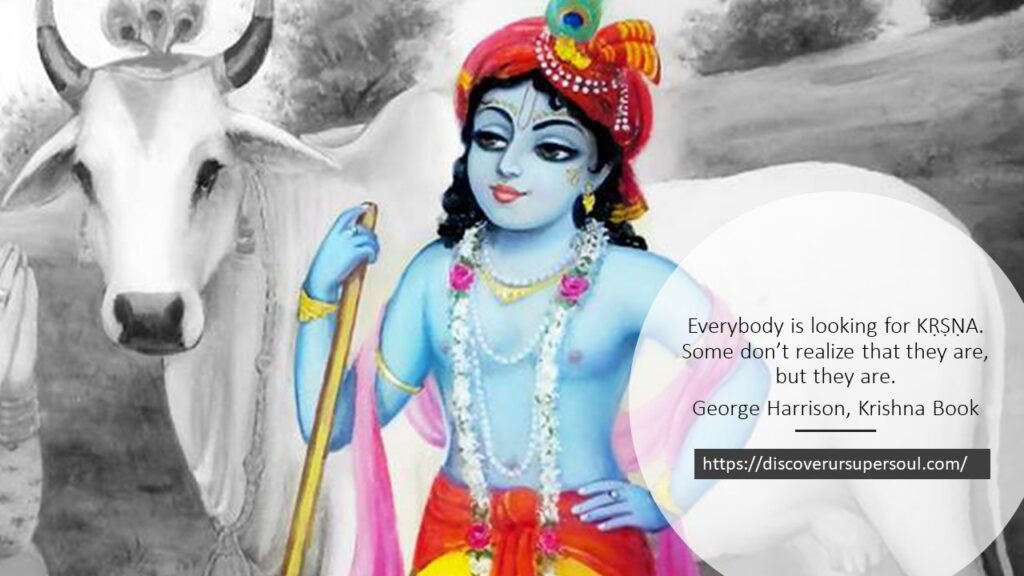
You want to know Krishna. I too want to know Krishna. In fact, everyone is looking for Krishna because we all have deep spiritual relationship with Krishna.
George Harrison explains it in a better way, “Everybody is looking for KṚṢṆA. Some don’t realize that they are, but they are.”
So, the question is, is it possible to know Krishna? Is it possible to understand Krishna? Is it possible to know our relationship with Krishna? And most importantly is it possible to develop relationship with Krishna?
If yes, then how?
To know Krishna, tell your mind to always remember Krishna
The answer is given by Krishna himself in Bhagavad Gita. In Bhagavad Gita 7.1, Krishna says that if we are always conscious of him, our mind is attached to him then we can know him completely without any doubt.
“The Supreme Personality of Godhead said: Now hear, O son of Pṛthā, how by practicing yoga in full consciousness of Me, with mind attached to Me, you can know Me in full, free from doubt.” Bhagavad Gita 7.1
Krishna spoke Bhagavad Gita to Arjuna and through Arjuna he is speaking this transcendental knowledge to you and me.
Prior to this verse i.e. in Bhagavad Gita 6.47 which is the last verse of Chapter 6 of Bhagavad Gita, Lord Krishna says that “amongst all the yogis one who with great faith always thinks of Me within himself and engages in transcendental loving service unto Me is the topmost yogi.”
Now immediately in the first verse of Chapter 7, Lord Krishna tells Arjuna that if we want to know him then our mind should be completely absorbed in him. Absorption should be 100%.
Here, Krishna also underlines the importance of hearing about Him. Unless we hear about Krishna, we won’t know him. And if we do not know Krishna then how we will always serve him with love. It is not possible to continuously serve a stranger. If someone is very powerful then we may be compelled to serve him, but that service will not be with love but will be because of fear.
From whom to hear about Krishna?
Now the question is from whom to hear. The best source is Krishna himself because he is the Supreme Personality of Godhead. So, Krishna tells Arjuna, tac chṛṇu, i.e. “Hear from Me.” Bhagavad Gita 7.1. Arjuna was fortunate because Krishna was present in front of him. But let us not be disheartened. We can also know Krishna by hearing about Krishna from pure devotees of Krishna. Pure devotees have so much love for Krishna that by the mercy of Krishna, he is able to speak about Krishna elaborately.
We see Sukhdev Goswami, a pure devotee of Krishna so eloquently described Krishna’s beautiful pastimes. Srila Prabhupada, a pure devotee of Krishna, in his commentaries on Bhagavad Gita and Srimad Bhagavatam have described unlimited glories of Krishna. If we read these books, we will know a lot about Krishna. In fact, the knowledge will be sufficient to not just know Krishna but also to develop a strong relationship with Krishna.
How to attach mind to Krishna?
We discussed that in Bhagavad Gita 7.1, Krishna says that our mind should be always attached to him, mayyasakta-manah.
Those who practice spirituality knows well that how difficult it is to always focus our mind on the object of meditation. As soon as we start meditation our mind begins to wander here and there. I always experience that as soon as I take the beads in my hand and begin chanting the names of Krishna, slowly my mind starts losing focus. Instead of focusing on Krishna and his names, mind takes me to a different world.
Now if we are chanting the names of Krishna but our mind is focusing on something else then although our mouth will be uttering the words, but our consciousness will be absorbed in sense gratifying objects. We are where our mind is. So, if we want Krishna then we have to focus our mind on Krishna.
Controlling the naughty mind
Mind is like a naughty child; it keeps on running here and there. So, as soon as we see our mind is wandering, we should immediately catch our mind and bring it back and focus it on Krishna. It is not that once we bring our mind from wherever it is to focus on Krishna it will stop wandering. Uncontrolled mind’s nature is to wander. So, as soon as we find that the mind is wandering, we will again have to bring it back on Krishna.
This we will have to do again and again. Easy to say, difficult to do. But it is also not impossible.
If we try again and again then a state will come when mind won’t wander much. Slowly it will start rejoicing in being with Krishna. And a state will come when our mind will completely stop wandering and will only focus on Krishna. Srila Prabhupada explains, “By concentrating one’s mind upon Kṛṣṇa, one is able to know the Absolute Truth completely, but not otherwise.” Bhagavad Gita 7.1 Purport.
The nine process of devotional service
Concentration of the mind upon Lord Krishna becomes easy when we practice the nine process of devotional service. The nine process of devotional service is also called nava-vidha bhakti and it begins with śravaṇam. Śravaṇam means hearing about Krishna. Vedic literature is shruti-shastra. Shruti means to hear. If we hear about Krishna from Krishna or from the scriptures, then we will become a perfect Krishna Conscious person.
Who cannot know Krishna?
In Bhagavad Gita 7.3, Lord Krishna says that many thousands of men endeavour for perfection but amongst those hardly few comes to know about Him. For non-devotees it is impossible to understand Krishna. But even those who practice jñāna-yoga and dhyāna-yoga, they are also not able to understand Krishna completely. For example, the followers of Śaṅkarācārya are not able to accept Krishna because they do not understand Krishna.
Yogis, jnanis, scholars, philosophers get bewildered when they see Krishna as little child playing in the courtyard of mother Yashoda. Or when they see Krishna as the charioteer of Arjuna they get confused. They wonder how the Supreme Personality of Godhead can be a little child or become subservient to Arjuna. The yogis and jnanis may attain impersonal Brahman realization but they will not attain Krishna and Krishna’s abode unless they develop personal relationship with Krishna. Even the great demigods get confused by Krishna’s different pastimes. This is why Krishna says that “yatatam api siddhanam kascin mam vetti tattvatah: those who have achieved perfection, hardly one knows Me in truth.” Bhagavad Gita 7.3.
Conclusion
But yogis, jnanis, scholars, philosophers can know Krishna if they start hearing about Krishna. “Hearing” about Krishna means hearing Krishna’s unlimited transcendental qualities and also hearing about Krishna’s many wonderful pastimes. If we hear about Krishna then we will be inspired to serve Krishna. We can focus our mind on Krishna. We will understand that we are eternal parts and parcels of Krishna. And in this world we are suffering because we have forgotten Krishna.
Chapter 6 ends by Krishna declaring that the yogi who meditates upon Him and renders devotional service to Him is topmost. And in Chapter 7 Krishna starts explaining the process by which one can know Him completely and can attain Him without doubt.
The only way to know Krishna as He is (tattvataḥ) by the practice of devotional service with complete absorption.
Search
Recent Posts
-
Srimad Bhagavatam at ISKCON Newtown...
September 3, 2026
-
Srimad Bhagavatam at ISKCON Newtown...
September 1, 2026
-
Janmashtami: Celebrating Krishna’s Appearance Through...
August 17, 2026
-
Gopinatha Pattanayaka: 6 Lessons for...
August 16, 2026
-
What Does Krishna Say About...
August 11, 2026
What is the relationship of Krishna with this material world?
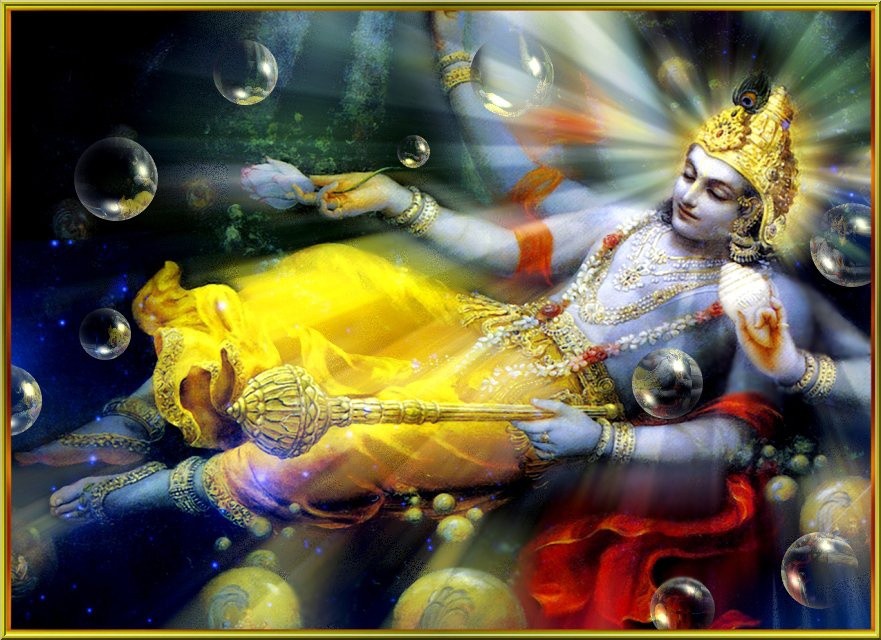
You may think what relationship Lord Krishna has with this material world. Is it that he created this world and later severed all his relationship with this material world? Let us see what Krishna says about this in the scriptures, especially in Bhagavad Gita.
In Brahma Samhita, Brahma says that Krishna who is the Supreme God is the origin of all, causes of all causes. It implies that he creates the spiritual world, and he also creates this material world.
“Kṛṣṇa who is known as Govinda is the Supreme Godhead. He has an eternal blissful spiritual body. He is the origin of all. He has no other origin and He is the prime cause of all causes.” Brahma Samhita 5.1
Material world is Krishna’s energies
Lord Krishna himself says in Bhagavad Gita that this material world is one of his energies and it works under his direction.
“This material nature, which is one of My energies, is working under My direction, O son of Kuntī, producing all moving and nonmoving beings. Under its rule this manifestation is created and annihilated again and again.” Bhagavad Gita 9.10.
So, everything is happening in this material world as per Krishna’s guidance and direction. Krishna is the Supreme director and has a special and unique relationship with this material world. The Supreme Lord Krishna creates this material world, maintains it, and ultimately destroys this material world.
Krishna has two energies – superior (para) and inferior (apara). Everything in this creation – moving and non-moving – is part of Krishna’s superior energy and inferior energy. We the living entities are Krishna’s superior energy, and the material nature is Krishna’s inferior energy.
Lord Krishna pervades this material world and supports it. Just as sunshine is spread everywhere similarly the energy of the Lord is everywhere in this entire creation.
How Krishna maintains this material world?
To maintain and sustain this creation it is not that Lord has to be present personally everywhere. For example, a king manages the kingdom with the help of various departments. The various departments of the king are his energies and to maintain them king does not have to be there personally. He appoints ministers to take care of finance, home, defence etc.
Similarly, the Supreme Lord maintains this world through his energies. He does not need to be personally present everywhere.
The Lord delegates the responsibility to different personalities based on their capabilities to run the affairs of this world. These empowered and respectable personalities are called demigods. So, we have a demigod who makes sure that it rains, he is called Indra. Then there is a demigod who takes care of the air, he is called vayu. Similarly, there is sun-god, moon-god and so on.
Why Krishna is not part of this cosmic manifestation?
Although Krishna creates and maintains everything in this material world and is present everywhere through his energies still he is aloof from this material creation. Krishna says in Bhagavad Gita 9.5, “although I am everywhere, I am not a part of this cosmic manifestation.” Why? Krishna explains it further in the same verse by saying that it is because “he is the source of creation.” By his supreme will Lord Krishna creates, sustains and destroys everything in this material world.
Krishna is also simultaneously present everywhere in this material world. As Supersoul or Paramatma he is not just present in each living entity but he even enters into each atom of this material world. This is Krishna’s inconceivable mystic power (yogam aiśvaram) and this is how he maintains his relationship with this material world. Srila Prabhupada explains, “From Brahmā, the most gigantic entity, on down to the smallest ant, all are existing because the Lord has entered each and all and is sustaining them.” Bhagavad Gita 10.42
Creation & Annihilation of this material world
Krishna, the supreme creator, says in Bhagavad Gita 9.8, “The whole cosmic order is under Me. Under My will it is automatically manifested again and again, and under My will it is annihilated at the end.”
This material world is temporary. So, it is destroyed and again created. Just like our material body is not permanent similarly the material world is also temporary.
Krishna annihilates this material world at the end of Brahma’s life. As per earthly calculation, Brahma lives for 311 trillion 40 billion years.
What actually happens at the time of annihilation? As a soul we do not die, so what happens to us at the time of annihilation? Where do we go? It is explained that at the time of cosmic devastation, the entire cosmic manifestation, sarva – bhutani, enters into the Supreme Lord Vishnu. Lord Vishnu is plenary expansion of Krishna. In the body of Vishnu, the souls like you and me remain in an unconscious state.
Again when the material world has to be created, the Supreme Lord creates it by his will. All the souls which remain unconscious during the period of devastation become unconscious again. They get a particular body based on their desires and past karma.
Is Krishna attached to this world?
Although the Supreme Lord has complete control over this material world, and everything happens by his will still he is always detached from all the material activities. Just as a high court judge may punish someone or reward someone but he remains neutral. Similarly, the Lord is involved in all the activities, yet he is neutral. He is transcendental to all material activities and is not attached to the creation and maintenance of this world. We the living entities also get different bodies because of our various deeds. We enjoy or suffer because of our own karma. Lord always remains neutral; he does not interfere.
Srila Prabhupada explains with an example from smṛti, “when there is a fragrant flower before someone, the fragrance is touched by the smelling power of the person, yet the smelling and the flower are detached from one another. There is a similar connection between the material world and the Supreme Personality of Godhead.” Bhagavad Gita 9.10 purport
Conclusion
In conclusion, we can say that the Supreme Lord is the Supreme director of this entire material creation. He is the source of this world. Yet, he remains detached from this material creation. The Supreme and intelligent designer, Krishna, maintains his relationship with this material world through his energies.
Search
Recent Posts
-
Srimad Bhagavatam at ISKCON Newtown...
September 3, 2026
-
Srimad Bhagavatam at ISKCON Newtown...
September 1, 2026
-
Janmashtami: Celebrating Krishna’s Appearance Through...
August 17, 2026
-
Gopinatha Pattanayaka: 6 Lessons for...
August 16, 2026
-
What Does Krishna Say About...
August 11, 2026