राम नाम की महिमा
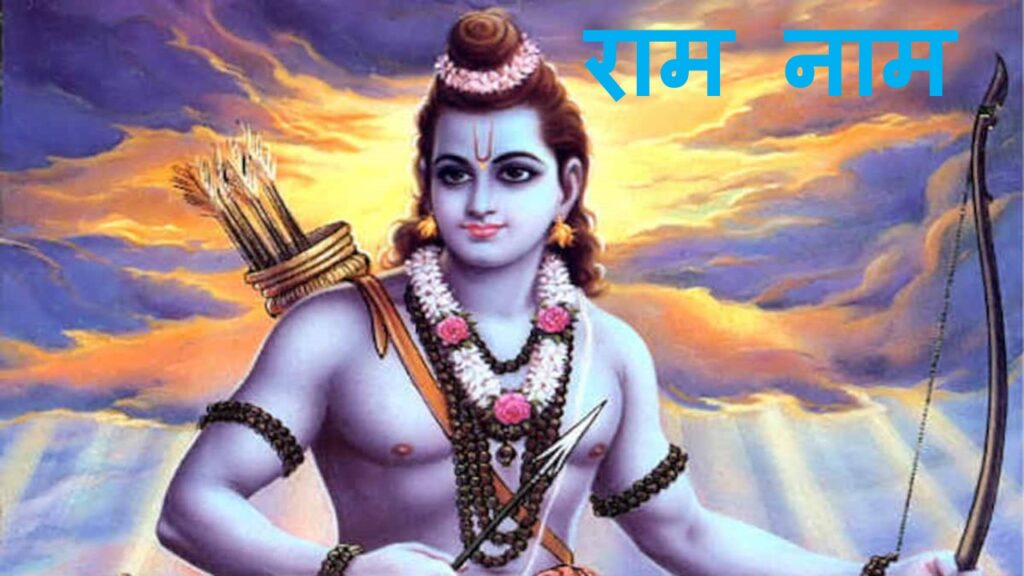
प्रिय भगवान राम,
राम नाम की महिमा अद्भुत है। राम नाम में स्वयं को लीन करके हम जीवन में शाश्वत सुख प्राप्त कर सकते हैं। आज रामनवमी का शुभ दिन है। यह आपका दिन है। यह वह दिन है जब आप मेरे जैसे लोगों के लिए इस दुनिया में प्रकट हुए थे। मुझे नहीं पता कि इस शुभ दिन पर आपसे क्या प्रार्थना करूं?
अगर मैं अपने जीवन पर विचार करता हूं, तो मुझे पता चलता है कि आपने मुझे सब कुछ दिया है, हालांकि मैं इन चीजों के लायक नहीं हूं। मेरे लिए आपका सबसे महत्वपूर्ण उपहार आपका पवित्र नाम है जिसमें असीमित शक्ति है। लेकिन दुर्भाग्य से, मैं आपकी कृपा को हल्के में लेता हूं। यह जानते हुए भी कि आपके नामजप करने मात्र से ही मुझे मोक्ष की प्राप्ति हो जाएगी, मुझे आपके नामजप करने में बहुत रुचि नहीं है।
राम नाम की महिमा – सागर में पत्थर तैरने लगे
माता सीता को बचाने में आपकी सहायता करने वाले भाग्यशाली वानर योद्धाओं ने आपके नाम की असाधारण शक्ति को अपनी आँखों से देखा। उन्होंने पत्थरों पर आपका नाम लिखा और राम नाम की महिमा ऐसी है कि पत्थर विशाल सागर पर तैरने लगे।
पत्थरों ने प्रकृति के नियमों, गुरुत्वाकर्षण के नियमों की अवहेलना की। पत्थरों की नियति समुद्र में गहरे डूबने की थी। लेकिन सिर्फ आपके नाम के कारण वह डूबा नहीं बल्कि विशाल लहरों से भरे अशांत सागर में तैरने लगा।
आपने पत्थर पर दया की। आप मुझ पर कब दया करेंगे? मेरी बुद्धि भी एक पत्थर की तरह है – मृत और नीरस, सभी आध्यात्मिक भावनाओं से रहित।
इस दुनिया में संघर्ष
मैं भौतिक संसार के इस सागर में कठिन संघर्ष कर रहा हूँ । लेकिन मैं इतना मंदबुद्धि हूं कि इस विकट स्थिति से बाहर निकलने के लिए कड़ी मेहनत करने के बजाय मैं यहां आनंद को खोजने की कोशिश कर रहा हूं।
इस भौतिक संसार में सुख की आशा करना जंगल की आग के बीच सुख की अपेक्षा करने के समान है। यह बहुत आश्चर्यजनक है कि यह जानते हुए भी कि यह दुनिया हमें दुख देने के लिए है, हर कोई इस दुनिया में खुशी खोजने की कोशिश कर रहा है।
जैसे जेल सजा और सुधार के लिए होती है, वैसे ही यह भौतिक जेल हमें दंडित करने और सुधारने के लिए है। लेकिन एक ऐसे परिदृश्य की कल्पना करें जिसमें एक अपराधी यह सोचने लगे कि जेल उसका मूल घर है और वह जेल में एक आरामदायक जीवन जीने की योजना बनाने लगता है! क्या कभी जेल में सुखी जीवन जीना संभव हो सकता है? उत्तर स्पष्ट है।
इसी तरह, हम कितनी भी कोशिश कर लें, हम इस दुनिया में खुश नहीं हो सकते। इस संसार में तीन प्रकार के दुखों से हर समय हमें जूझना पड़ता है – आध्यात्मिक (दैहिक), आधिभौतिक (भौतिक) और आधिदैविक (दैविक) । लेकिन हम इन दुखों के इतने अभ्यस्त हो गए हैं कि हम इसे अपने जीवन का हिस्सा मान चुके हैं।
जिस तरह एक हठी अपराधी पुलिस से मार खाने के बावजूद अपराध करता रहता है, उसी तरह हम भी इस भौतिक दुनिया से इतनी सजा पाकर भी अपनी इंद्रियों को सांसारिक गतिविधियों में लगाने का प्रयास करते हैं। यह दुनिया भयानक प्रजातियों से भरी हुई है जो हर पल हमें नुकसान पहुंचाने की कोशिश करती है।
यही कारण है कि भगवद गीता 8.15 में, कृष्ण कहते हैं कि यह संसार दु:खालयमशाश्वतम् है। इसलिए किसी भी तरह हमें इस दुनिया से बाहर निकलने की पूरी कोशिश करनी चाहिए।
इस भौतिक संसार में भी मुक्ति
बाहर निकलना न केवल भौतिक है, बल्कि अभौतिक भी है। इसका अर्थ है कि हमें अपनी चेतना को भौतिक गतिविधियों में लीन करने के बजाय आध्यात्मिक गतिविधियों में लीन करनी चाहिए। मन और इंद्रियों को अपनी भौतिक इच्छाओं को पूरा करने के लिए नहीं लगाना चाहिये बल्कि हमें अपने मन और इंद्रियों को भगवान की सेवा में लगाना चाहिए। हमें भौतिक भावनाएँ के बजाय आध्यात्मिक भावनाओं को विकसित करनी चाहिए। अगर हम ऐसा करते हैं तो इस दुनिया में रहते हुए भी हम मुक्त हो जाएंगे।
अपने दम पर, भौतिक महासागर को पार करना असंभव है। इसलिए, शास्त्र बार-बार हमें राम नाम की शरण लेने के लिए कहते हैं। यदि हम ऐसा करते हैं तो हम जीवन की सभी दयनीय परिस्थितियों से तुरंत मुक्त हो जाएंगे। लेकिन यह जानने के बावजूद हम शायद ही इस निर्देश को गंभीरता से लेते हैं।
दूरियां दूर करने में मदद करता है राम नाम
वानर योद्धाओं ने प्रेम से पत्थरों पर आपका नाम लिखकर सेतु का निर्माण किया। वह पुल जिसे रामसेतु के नाम से जाना जाता है, न केवल रामेश्वरम को लंका से जोड़ता है, बल्कि उस पुल ने वानर योद्धाओं की मदद की भौतिक सागर को पार करने में और अंत में आपके चरण कमलों की शरण दी। रामसेतु ने उनके हृदय को आपके हृदय से जोड़ दिया जो प्रेम और करुणा से भरा है।
ऐसा नहीं था कि आपके पास खुद से पुल बनाने की छमता नहीं थी। आप ब्रह्मांड के निर्माता हैं तो क्या आपके लिए समुद्र पर सेतु बनाना इतना कठिन है? लेकिन इस आध्यात्मिक लीला से आपने हमें अपने नाम का महत्व समझाया। आप हमें बताना चाहते हैं कि अगर हम सिर्फ प्रेम से आपके नाम का जप करें तो हमारे बीच जो दूरी है, उसे ख़त्म किया जा सकता है। हमारा हृदय आपके हृदय से जुड़ सकता है और हम भव सागर को पार कर सकते हैं।
राम नाम का जप आनंदपूर्वक करता रहूं
समुद्र के किनारे खड़े वानर असमंजस में थे। आपने उन्हें पुल बनाने की बुद्धि दी। भौतिक सागर के बीच में पड़ा मैं भी बिल्कुल असहाय स्थिति में हूँ । हालांकि मुझे पता है कि अगर मैं सिर्फ राम नाम में खुद को लीन कर लूं, और शास्त्रों के दिशानिर्देशों के अनुसार अपना जीवन जीऊं तो मैं सारे दुखों से मुक्ति प्राप्त कर सकता हूं। लेकिन दृढ़ निश्चय की कमी और हृदय में असीम अशुद्धियों के कारण मैं ईमानदारी से आपकी भक्ति नहीं कर पा रहा हूँ।
रामनवमी के इस शुभ दिन पर, मैं आपसे विनती करता हूं कि आप मुझ पर कृपा करें जैसे आपने वानर योद्धाओं पर की थी। कृपया मुझे बुद्धि दें ताकि मैं राम नाम की असीमित महिमा को समझ सकूं। मैं आपसे प्रार्थना करता हूं की आप मेरे हृदय को शुद्ध कर दें और मुझे धर्मग्रंथों के आदेशों का ईमानदारी से पालन करने की शक्ति दें। और मुझ पर कृपा करें ताकि मैं हर समय आपके नाम का जप आनंदपूर्वक करता रहूं – हरे कृष्ण हरे कृष्ण कृष्ण कृष्ण हरे हरे / हरे राम हरे राम राम राम हरे हरे।
Search
Recent Posts
-
Srimad Bhagavatam at ISKCON Newtown...
September 3, 2026
-
Srimad Bhagavatam at ISKCON Newtown...
September 1, 2026
-
Janmashtami: Celebrating Krishna’s Appearance Through...
August 17, 2026
-

Gopinatha Pattanayaka: 6 Lessons for...
August 16, 2026
-
What Does Krishna Say About...
August 11, 2026
What are the benefits of praying and chanting in Brahma Muhurta?

Since ages, the divine sages have been saying that Brahma Muhurta has unlimited benefits and so it is the best time to pray to God and chant the mantras.
Now the question is why Brahma Muhurta is so important and what benefits one gets by praying and chanting mantras during this time.
What is Brahma Muhurta:
Let us first try to understand what is muhurta and how it is calculated.
- As per Vedic calculation, one danda is equal to 24 minutes.
- Two dandas, or forty-eight minutes, is equal to one muhurta.
- In 24 hour cycle, we have 24*60 = 1440 minutes.
- Total muhurta is (1440 min/48 min) = 30 i.e. from sunrise to sunrise, there are 30 muhurtas.
- Brahma Muhurta starts 2 muhurtas (48 * 2 min) before the rise of the sun i.e. 1 hour 36 minutes before sunrise is the time of the start of Brahma Muhurta and it ends 48 minutes before sunrise.
Let us understand it with an example:
- Suppose that on a particular day sun rises at 5:30 am.
- That day, the Brahma Muhurta starts 48×2=96 minutes before 5:30 am i.e. 1 hour 36 minutes before sun rise, i.e. at 03.54 am.
- It ends 48 minutes before sunrise, i.e. at 04.42 am.
- So, on that day, the Brahma Muhurtha falls between 03.54 am to 04.42 am
Now, let us understand what does Brahma means. It has many meanings. Brahma can mean impersonal Brahma or can refer to Brahmaji or it also means something big or great or auspicious. So, Brahma Muhurta means, auspicious time or greatest time or best time. It is also called amrit vela.
Why meditation in Brahma Muhurat?
Early morning, our mind is at peace. Anger, anxiety, frustration, lamentation, hankering does not torture the mind much in the early morning hours. One reason is because at the night-time when we take rest then the impurities of the mind settles down. For example, when water is in agitated state then the dirt can be seen on the surface and all over the water. Now leave the water to calm down and you will see that the dirt settles down.
Similarly, our mind is busy throughout the day, it is full of thoughts – both positive and negative. When we take proper rest in the night then our mind relaxes, and the thoughts too settle down. So, when we get at this time then our mind is peaceful, and we can focus well on any activity we do. This is why parents and teachers would tell us to study tough subjects like mathematics or physics in the morning because mind is fresh and alert so it can grasp concepts quickly.
Also, if we look around, we will see that nature is also at peace at this time. It is neither too hot nor too cold, no traffic, no people, no noise pollution, we can smell the cool breeze, serenity is everywhere, everything looks so divine. There is no disturbance outside and inside. So, at this time when we pray to God and chant mantras then we can completely focus on the Supreme Lord and the divine mantras sounds.
Praying in Brahma Muhurta brings us in mode of goodness
One of the benefits of Brahma Muhurta is that it brings us to the mode of goodness.
Just like the living entities are in different gunas or modes, similarly the day can also be divided into three gunas. Morning time is in the mode of goodness, day in passion and night in ignorance. We can practically experience every day.
Morning hours are cool and calm. Atmosphere is serene and we are at peace. As the day progresses, passion starts taking over. We become more passionate to work, we see people running here and there and everyone gets busy in some sort of activities. Night is in ignorance. In the night people become lazy, sleep overpowers them.
In Bhagavad Gita, Krishna says that if we want to be happy then we should rise above ignorance and passion and come to the level of goodness.
It is not that we can say that we are in complete goodness or passion or ignorance. Most of us are in mixed modes i.e., sometimes mode of goodness is prominent in us, sometimes passion takes over and sometimes we are overpowered by ignorance. If we are mostly in passion and ignorance then we will be always in stress and will be unhappy. So, it is imperative that our life is guided by goodness.
Life should be guided by goodness
To work we need passion, no doubt. But passion without proper direction can create havoc. Especially youths have lots of energy and are passionate to achieve results. But if they are not guided by goodness then their energy or enthusiasm may get wasted and sometimes can become destructive too.
For example, river water is controlled by its banks. Dams are built to use the water for constructive purpose. Kite can fly high in the sky only if it is properly controlled by a string. For gas stove, we have regulator else it will burn the whole house. Similarly, passion should be guided by goodness. This is why kings used to have qualified gurus. To rule and to check the inimical forces one needs passion. But if a king is guided by a guru who is in goodness, then king can use his passionate energy for the welfare of the society.
We see that Duryodhana, or Karna never listened to any sagely advice. They were chivalrous but since they did not utilize their energy properly, so they created havoc. Whereas the Pandavas were always guided by saintly personalities and especially by Krishna. So, ultimately Pandavas emerged victorious.
Krishna in Bhagavad Gita 14.6 – 9 gives the characteristics of the three modes
- Mode of goodness gives sukha (happiness) and jnana (knowledge)
- But mode of passion fills one with unlimited desires and hankerings
- Mode of ignorance is characterized by pramāda (madness), ālasya, (indolence), nidrābhiḥ (sleep).
How association affects our life?
Association plays a key role in our life. If we associate with a person who is lazy, is full of negativities then we will develop those bad qualities. And if we are with someone who is greedy and has lots of material desires then slowly such desires will fructify in our hearts tool.
But if we associate with those people who are self-controlled, is free from lust, anger and greed, who likes to pray and do meditation then gradually such noble qualities will also develop in us. This is about associating with people.
Similarly, with which part of the day we associate with impacts our life. If we are an early morning person, then it means that we are associating with that time of the day when it is in goodness. If we are getting up very late and just rushing to our office or getting busy in our household activities, then it means that we associating with that time of the day when it is in passion.
We can say that around 10 am passion starts and continues till evening till sunset. During this time anyway almost all of us have to be active. Ignorance is prominent in night. It is the time to rest our body and mind. But if we are awake till late night watching TV or movies or playing video games then we will develop ignorance.
Based on the modes we cultivate; we experience happiness and misery in life. In Bhagavad Gita 14.14-15 Krishna also tells what kind of destination people of different modes get.
- People who are in goodness goes to the heavenly planets or get higher destinations.
- Those in passion is reborn on this earthly planet and continue with their material pursuits.
- Those in ignorance gets animal body or even may go to hell.
So, one of the benefits of getting up in Brahma Muhurta is that we get time to associate with that part of the day which is in goodness.
Spiritual practices in Brahma Muhurta brings us to mode of goodness
But if we are getting up in Brahma Muhurta and during this time, we get involved in spiritual activities then gradually we will develop mode of goodness. This is one of the great benefits of Brahma Muhurta. Srila Prabhupada says that all the sincere devotees should try their best to at least come to the stage of goodness. In goodness it is easy to fight with anarthas or impurities and get free from sufferings.
In military parlance it is said that if you sweat in peace then you bleed less in war. Similarly, if we sweat in the peaceful morning hours then we will be troubled less by our anarthas during the day and night hours.
Praying and chanting mantras like the Hare Krishan Mahamantra helps us a lot in fighting with our vices which is the root cause of our suffering. Chanting mantras throws out dirt from our mind making it cleaner and purer. And more our mind becomes clean more our life becomes auspicious and happy.
Imagine a life which is free of anger, anxiety, greed, lust, hankering, frustration and negative thoughts! Only positive spiritual thoughts fill our mind. How much happiness we will experience internally! In fact, the purpose of practicing devotion to God is to come to a state where we are free from all the negativities which brings so much suffering.
In the gurukuls students were trained to get up early in the morning and do sadhana. Unfortunately, in today’s time people do not understand the importance of time.
Flickering happiness or everlasting happiness?
Time plays a very important role in our life. Many people watch late night shows, watch YouTube videos and think that they are enjoying their life. But in fact, this is wastage of time and human form of life. Happiness which a movie or TV show gives is so flickering and temporary. It may last for few minutes.
But by practicing devotion to God we remove impurities from our mind and heart and we connect to God. This gives us lots of joy. And this joy is everlasting. The happiness which a self-controlled person experiences is far greater than the happiness which even the emperor of the world may get.
So, we have to choose if we want flickering happiness or everlasting happiness.
Srila Prabhupada about Brahma Muhurta and morning program
In Iskcon, Srila Prabhupada has talked about the benefits of practicing devotion to Krishna in Brahma Muhurta. He made sure that all the devotees who sincerely wants to practice devotion gets up early in the morning in Brahma Muhurta. Especially those who stay in the temple, it is compulsory that they get up for morning program. Even for grihastas it is important that they get up early in the morning.
Srila Prabhupada writes, “The brāhma-muhūrta takes place about one and a half hours before sunrise. It is recommended that one should rise from bed at that time and, after finishing daily ablutions, take to spiritual activities by performing maṅgala-ārati and chanting the Hare Kṛṣṇa mantra. This period is very convenient for the execution of spiritual activities.”
In a letter to one of his disciples, Srila Prabhupada underlins the importance of spiritual program in the morning.
“Everything is done in conformity to a regular standard. For example, all the temple members, without exception must rise by 4:00 A.M. and attend Mangal aratik. Everyone living in the temple must agree to the standard by proper understanding of the philosophy of tapasya. We cannot expect our guests to follow all our principles, but whoever lives in the temple must follow.” Srila Prabhupada letter on January 12, 1974 to Mudunda däsa
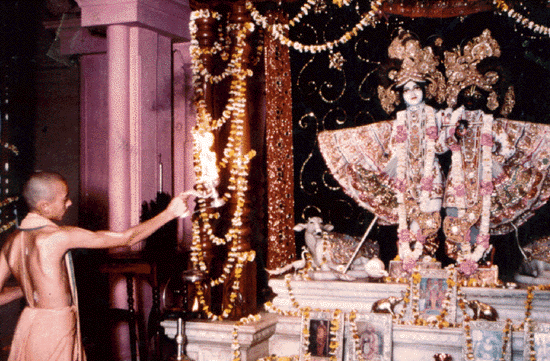
Attaining perfection by practicing devotion in Brahma Muhurta
If you go to any Iskcon temple, in any part of the world you will find that they have morning program. And as far as I have seen and known in all the temples in all over the world, morning program starts at 4:30 am. There could be few exceptions because of certain local issues. Even sincere grihastas get up early in the morning and do complete morning program at home.
All sincere devotees of Iskcon, follow following morning program schedule. Day begins with Mangala Arati at 4:30 am followed by Narasimha Arati, Tulasi Arati and Sistastakam prayers. All these aratis complete by around 5:30 am. After this devotees chant 16 rounds of Hare Krishna Mahamantra which takes around 2 hours. At 7:30 am there is darshan arati which is followed by guru puja. After guru puja there is Srimad Bhagavatam class for an hour. The entire morning is packed with spiritual programs.
We discussed what is Brahma Muhurta and its benefits. But the greatest benefit of Brahma Muhurta is that by praying and chanting mantras during this time we can perfect our life and come to a stage where we develop genuine and spontaneous love for the Supreme Lord.
Search
Recent Posts
-
Srimad Bhagavatam at ISKCON Newtown...
September 3, 2026
-
Srimad Bhagavatam at ISKCON Newtown...
September 1, 2026
-
Janmashtami: Celebrating Krishna’s Appearance Through...
August 17, 2026
-
Gopinatha Pattanayaka: 6 Lessons for...
August 16, 2026
-
What Does Krishna Say About...
August 11, 2026
प्रह्लाद के अनेक गुण
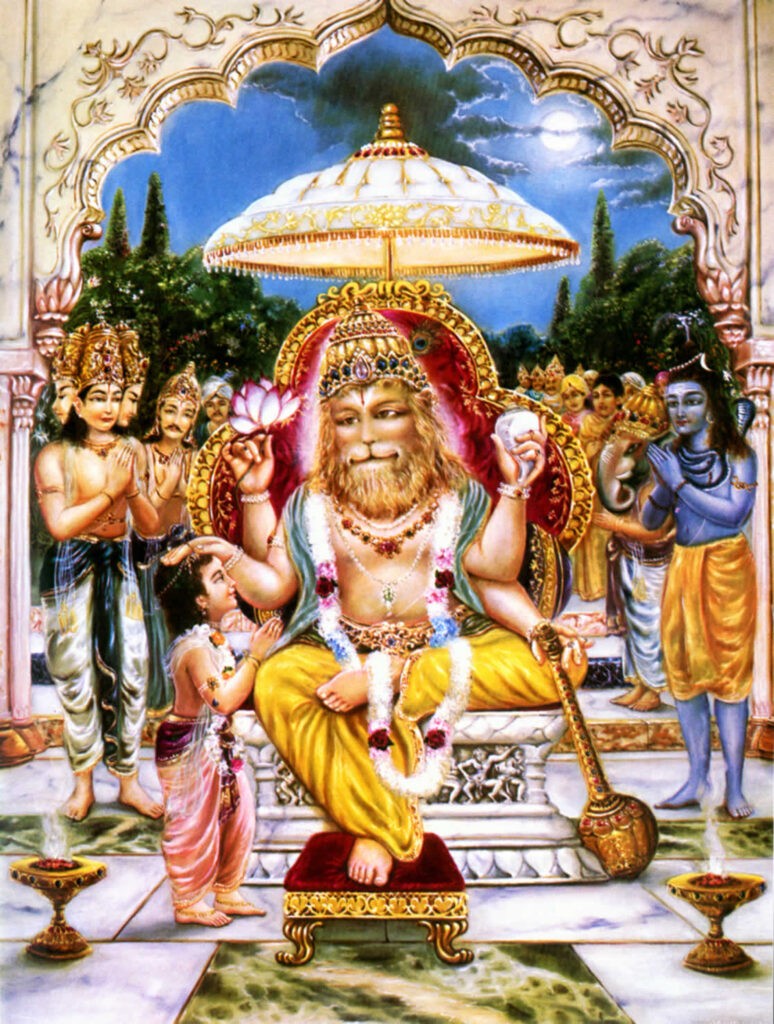
श्रीमद्भागवत में ऋषि नारद ने प्रह्लाद महाराज के गुणों का वर्णन किया है। प्रह्लाद भगवान विष्णु के बहुत बड़े भक्त थे। उन्होंने अपने जीवन का प्रत्येक क्षण भगवान के सुंदर रूप का ध्यान करते हुए बिताया।
बचपन से ही उनके दिल में एक ही इच्छा थी – भगवान कृष्ण को हृदय में विराजमान करने की इच्छा।
आप और मेरे जैसे साधारण लोग सांसारिक चीजों पर विचार करते हैं और सांसारिक गतिविधियों में मानसिक और शारीरिक रूप से संलग्न रहते हैं। लेकिन प्रह्लाद जैसी पवित्र आत्माएं कभी भी सांसारिक विषयों पर विचार करने में अपना समय बर्बाद नहीं करती हैं और अपने मन और इंद्रियों को उन गतिविधियों में संलग्न करती हैं जो शास्त्रों द्वारा अनुमोदित हैं, और जो भगवान के चरण कमलों के करीब ले जाती हैं। भगवान की शरण में वे सुरक्षित महसूस करते हैं और हमेशा खुश रहते हैं।
निडर प्रह्लाद
इसलिए, हम देखते हैं कि जब प्रह्लाद के पिता हिरण्यकशिपु ने उसे मारने की कोशिश की, तो नन्हा प्रह्लाद विचलित नहीं हुआ। इससे हिरण्यकश्यप बहुत क्रोधित हुआ ।
प्रह्लाद हमेशा निडर क्यों रहता है? वह मौत से भी क्यों नहीं डरता? पूरे ब्रह्मांड को अपने घुटनों पर लाने वाले पराक्रमी अत्याचारी हिरण्यकशिपु ने निश्चित रूप से इस पर विचार किया होगा। उसने पांच साल के बच्चे को प्रताड़ित करने और अंत में उसे मारने के लिए हर संभव उपाय किया। लेकिन प्रह्लाद हमेशा शांति और आनंद में रहते थे। यह कैसे संभव हो सकता है? इसे समझने के लिए, हमें श्रीमद्भागवतम 7.4.31-42 में ऋषि नारद द्वारा वर्णित प्रह्लाद के गुणों को जानना होगा।
प्रह्लाद के गुण
नारद मुनि कहते हैं कि यद्यपि प्रह्लाद का जन्म असुरों के परिवार में हुआ था, लेकिन फिर भी वे भगवान विष्णु के बहुत बड़े भक्त थे। बचपन के दिनों से ही वेदों में दी गई फलदायी गतिविधियों में उनकी रुचि नहीं थी। वह सभी भौतिक इच्छाओं से मुक्त थे और अपने मन और इंद्रियों पर पूर्ण नियंत्रण रखते थे। प्रह्लाद को बचकानी हरकतों में कोई दिलचस्पी नहीं थी और खतरे में होने पर भी वह उत्तेजित नहीं होता थे।
उन्हें वासुदेव, भगवान कृष्ण, की दया और सुरक्षा में पूर्ण विश्वास था, और हमेशा भगवान के विचारों में लीन रहते थे। और चूंकि वह हमेशा भगवान का ध्यान करते थे, वह हमेशा खुश रहते थे.
“कृष्ण भावनामृत में रहने के कारण, वे कभी रोते थे, कभी हँसते थे, कभी प्रसन्नता व्यक्त करते थे और कभी ज़ोर से गाते थे ।” श्रीमद्भागवतम 7.14.39
प्रह्लाद का मन और इंद्रियों पर पूर्ण नियंत्रण
ऋषि नारद कहते हैं कि प्रह्लाद का अपने मन और इंद्रियों पर पूर्ण नियंत्रण था। वह मन और इंद्रियों की अंतहीन मांगों से प्रभावित नहीं थे, इसलिए, वह पूरी तरह से भक्ति गतिविधियों पर ध्यान केंद्रित करने में सक्षम थे। या हम कह सकते हैं कि चूंकि प्रह्लाद हमेशा कृष्णभावनामृत गतिविधियों में लीन थे, इसलिए उनका अपने मन और इंद्रियों पर पूर्ण नियंत्रण था।
कई बार हम शिकायत करते हैं कि हम हरे कृष्ण महामंत्र के जाप पर ध्यान केंद्रित नहीं कर पाते हैं क्योंकि हमारा मन हमारे वश में नहीं होता है। लेकिन असली मुद्दा यह हो सकता है कि चूंकि हम कृष्ण के पवित्र नामों में खुद को लीन नहीं कर रहे हैं, इसलिए हमारा मन भटकता है और हमारे नियंत्रण में नहीं है।
प्रह्लाद को बचकाने खेल में कोई दिलचस्पी नहीं थी
प्रह्लाद के गुणों में से एक जो मुझे सबसे ज्यादा पसंद है वह यह है कि एक बच्चे के रूप में उन्हें “बचकाना खेल” में कोई दिलचस्पी नहीं थी। वह अपना सारा समय भगवान की भक्ति में लगाना पसंद करते थे। जब फुरसत का समय होता तब प्रह्लाद के मित्र जो उनकी उम्र के थे, उन्हें अपने साथ खेलने के लिए आमंत्रित करते थे।
लेकिन प्रह्लाद एक सच्चे मित्र और शुभचिंतक के रूप में अपने दोस्तों को सलाह देते थे कि वे सांसारिक गतिविधियों में समय बर्बाद न करें, बल्कि समय का उपयोग, भगवान की महिमा का जप और गायन करने में करें। प्रह्लाद के मित्र उनके दयालु और प्रेमपूर्ण शब्दों से इतने प्रभावित हुए कि उन्होंने भी जप और प्रार्थना करने का फैसला किया।
आइए अब हम अपने जीवन पर विचार करें। उस समय को भूल जाइए जब हम बच्चे थे, अब जब हम बड़े हो गए हैं, तब भी, हम खेल खेलने या खेल देखने में रुचि रखते हैं। भारतीय क्रिकेट के दीवाने हैं, यूरोपीय और अमेरिकी फुटबॉल के दीवाने हैं। कई बार, या यूं कहें कि ज्यादातर समय हम खेलों में इस कदर डूब जाते हैं कि हम बाहरी दुनिया को भूल जाते हैं। इस तरह का अवशोषण कुछ अस्थायी आनंद दे सकता है, लेकिन यह हमारे हृदय को कभी भी संतुष्ट नहीं करने वाला है और न ही हमें स्थायी खुशी देने वाला है।
आनंद की तलाश
हम आत्मा हैं, इसलिए हम हमेशा आनंद की तलाश में रहते हैं, आनंद-म्यो ‘भ्यासात। सिर्फ खेल से ही नहीं, हम फिल्में देखकर, फिल्म के गाने सुनकर, राजनीति के बारे में बात करके या बेकार की गपशप करके भी अपने जीवन का आनंद लेने की कोशिश करते हैं। ये गतिविधियाँ हमें अपने उबाऊ नियमित जीवन से बचने में मदद कर सकती हैं, लेकिन शायद ही इससे हमारे दिल को बहुत खुशी मिलती है। यह हम सबने अनुभव किया है।
लेकिन प्रह्लाद हमेशा आनंद में रहते थे क्योंकि वह हमेशा कृष्णभावनामृत में लीन रहते थे। भगवान के शुद्ध भक्त अपने जीवन के हर पल का भरपूर आनंद लेते हैं क्योंकि वे आध्यात्मिक गतिविधियों में आनंद पाते हैं, जैसे कृष्ण का नामजप करना, कृष्ण के बारे में सुनना, कृष्ण के विग्रह की पूजा करना।
श्रीमद्भागवतम में प्रह्लाद जैसे महान भक्तों के जीवन का वर्णन किया गया है, ताकि हम उनके जीवन से सीख सकें और इसे अपने जीवन में लागू कर सकें।
भगवान विष्णु ने हमेशा प्रह्लाद की रक्षा की
प्रह्लाद ने लगातार भगवान विष्णु के चरणकमलों का ध्यान करके अपने जीवन को शुद्ध किया और सभी कष्टों से मुक्ति पाई। इसलिए, जब उनके भौतिक पिता, हिरण्यकशिपु ने उन्हें प्रताड़ित करना शुरू किया, तो वे मानसिक या भावनात्मक रूप से परेशान नहीं थे क्योंकि वे अपने आध्यात्मिक पिता, भगवान विष्णु की शरण में थे।
जैसे एक बच्चा अच्छी तरह जानता है कि उसके पिता हमेशा उसकी मदद के लिए मौजूद रहते हैं जब वह खतरे में होता है। इसी तरह, प्रह्लाद पूरी तरह से जानते थे कि परम पिता हमेशा उनके साथ हैं। और दुनिया जानती है कि हिरण्यकशिपु अपनी सारी शक्ति के बावजूद, महान प्रह्लाद को थोड़ा भी नुकसान नहीं पहुंचा सका।
प्रह्लाद की महिमा करते हुए, ऋषि नारद कहते हैं, “किसी भी सभा में जहां संतों और भक्तों के बारे में चर्चा होती है, हे राजा युधिष्ठिर, यहां तक कि राक्षसों के दुश्मन, अर्थात् देवता, प्रह्लाद महाराज को एक महान भक्त के उदाहरण के रूप में प्रस्तुत करते हैं।” श्रीमद्भागवतम् 7.4.35.
निष्कर्ष
प्रह्लाद में कई आध्यात्मिक गुण थे, इसलिए उन्हें भगवान का बहुत बड़ा भक्त माना जाता है। आइए हम भी प्रह्लाद के नक्शेकदम पर चलें और महान भक्त के कुछ गुणों को आत्मसात करने का प्रयास करें। प्रह्लाद की तरह, आइए हम अपनी सभी भौतिक इच्छाओं को त्यागें और भगवान कृष्ण की पूर्ण शरण लें, जो भगवान नरसिंहदेव के रूप में प्रकट हुए और जो सभी भक्तों के रक्षक हैं।
Search
Recent Posts
-
Srimad Bhagavatam at ISKCON Newtown...
September 3, 2026
-
Srimad Bhagavatam at ISKCON Newtown...
September 1, 2026
-
Janmashtami: Celebrating Krishna’s Appearance Through...
August 17, 2026
-
Gopinatha Pattanayaka: 6 Lessons for...
August 16, 2026
-
What Does Krishna Say About...
August 11, 2026
Many qualities of Prahlada Maharaja
In Srimad Bhagavatam, sage Narada describes many devotional qualities of Prahlada Maharaj to King Yudhishthira. Prahlada was a great devotee of Lord Vishnu. He spent every moment of his life meditating on the beautiful form and transcendental qualities of the Supreme Lord. Since his childhood days only one desire blossomed in his heart – the desire to enthrone the Supreme Lord Vasudeva, Lord Krishna, in his heart.
Ordinary souls like you and me contemplate on mundane things and engage mentally and physical in worldly activities. But pure souls like Prahlada never wastes their time in contemplating on mundane subject matters and engage their mind and senses in those activities which are sanctioned by the scriptures, and which takes one closer to the lotus feet of the Lord.
Prahlada has unlimited qualities, and it is not possible to discuss all of them in a single article. So, let us try to discuss seven qualities of Prahlada and meditate upon them.
1. A great devotee
Sage Narada has described many wonderful qualities of Prahlada. In Srimad Bhagavatam 7.4.33, sage Narada, says that although born in the family of the demons, Prahlada was a great devotee of Lord Vishnu. It was because of Narada’s spiritual instructions; Prahlada became a devotee of the Lord. He got enlightened in Krishna Consciousness when he was in the womb of his mother, Kayadhu. Prahlada constantly meditated on the lotus feet of the Lord and experienced great happiness.
Prahlada’s devotional ecstasy is described by Narada, “Because of advancement in Kṛṣṇa consciousness, he sometimes cried, sometimes laughed, sometimes expressed jubilation and sometimes sang loudly.” Srimad Bhagavatam 7.4.39
Srimad Bhagavatam 6.3.20 -21 says that there are twelve mahajans, great devotees of the Lord, and Prahlada Maharaja is one of them.
2. Fearless Prahlada
When Prahlada’s father, Hiranyakasipu, tried to kill him, little Prahlada remained unperturbed. The demon king because of ignorance and ego considered Lord Vishnu, his enemy. So, he was seething with anger when he discovered that his own son was a devotee of his enemy. Maddened by anger, he decided to torture and eliminate Prahlada, a five-year-old innocent boy.
Srimad Bhagavatam explains how Prahlada was being tortured. “The demons [Rākṣasas], the servants of Hiraṇyakaśipu, thus began striking the tender parts of Prahlāda Mahārāja’s body with their tridents. The demons all had fearful faces, sharp teeth and reddish, coppery beards and hair, and they appeared extremely threatening.
Making a tumultuous sound, shouting, “Chop him up! Pierce him!” they began striking Prahlāda Mahārāja, who sat silently, meditating upon the Supreme Personality of Godhead.” Srimad Bhagavatam 7.5.39-40.
Prahlada did not even try to protect himself. He was fearless in front of the mighty demons. This would infuriate the blood thirsty demons. Why is Prahlada always fearless and jubilant in spite of threat to his life? Hiranyakasipu, the mighty tyrant who had brought the entire universe on his knees, would have surely contemplated on it.
He devised all means to torture the five-year-old kid and eventually get him killed. But Prahlada was always at peace and also in bliss. How could it be possible? To understand this, let us reflect on the next quality of Prahlada.
3. Faith in Lord
He had complete faith in Lord’s protection and so he was not worried about anything in this world. He was never agitated when put in danger. He only thought how best he can utilize every moment of his life in remembering and serving the Lord. Just like a child knows very well that his father is always there for him when he is in danger. Similarly, Prahlada was fully aware that the Supreme father is always there for him.
So, we see that when Prahlada’s material father, Hiranyakasipu, began torturing him then he was not mentally or emotionally disturbed because he was under the shelter of his spiritual father, Lord Vishnu. And the world knows that in spite of all his power the mighty demon, Hiranyakasipu, was not able to do even a little harm to great Prahlada. Finally, Lord Vishnu appeared as Lord Narasimhadeva for the pleasure of Prahlada and to kill the demon.
Expressing his complete faith in the mercy of the Lord, Prahlada says, “Nothing is unobtainable for devotees who have satisfied the Supreme Personality of Godhead, who is the cause of all causes, the original source of everything.” Srimad Bhagavatam 7.6.25.
4. Compassion for all
After killing Hiranyakasipu, Lord Narasimhadeva asked Prahlada for any benediction. Prahlada could have asked anything, and the Lord would have immediately fulfilled that desire. However, Prahlada who was just five years old was not much bothered about his own well-being. He did not fear this world because he was always taking shelter of the Lord. But he felt sorry for the souls suffering in this world and also for those who although are suffering but are imagining that they are enjoying in this world.
“O best of the great personalities, I am not at all afraid of material existence, for wherever I stay I am fully absorbed in thoughts of Your glories and activities. My concern is only for the fools and rascals who are making elaborate plans for material happiness and maintaining their families, societies and countries. I am simply concerned with love for them.” Srimad Bhagavatam 7.9.43
Just as without sun there cannot be light, similarly, without Krishna there cannot be happiness. So, Prahlada had a great desire that everyone should take shelter of the Supreme Lord. He again and again prayed to Narasimhadeva to free everyone from their suffering.
Just as the Supreme Lord is equal towards everyone and he does not have any friend or enemy, similarly, Prahlada did not consider anyone his enemy. He was everyone’s best well – wisher, he had compassion for all living entities. He even begged the Lord to forgive his father of all the sins. He did not have revengeful mind. And the sinful demon too got purified just by the touch of Lord Narasimhadeva.
5. Not interested in childish playthings
One of the qualities of Prahlada which I like the most is that as a child he was not interested in “childish playthings” but utilized all time in practicing devotion to the Supreme Lord. When there would be leisure time to play then Prahlada’s friend who were of his age group would invite him to play with them.
But Prahlada as a true friend would persuade his friends not to waste time in worldly activities but utilize the given time in chanting and singing the glories of the Supreme Lord. And Prahlada’s friends would be so much moved by his kind and loving words that they would follow his advice and would chant and sing prayers.
Now let us reflect on our own life. Forget the time when we were child, now also when we are grown up, still, we are interested in playing sports or watching sports. Indians are mad after cricket, Europeans and Americans after soccer. Many times, or rather most of the time, we get so much immersed in sports that we forget the external world. Such absorption may give some flickering enjoyment, but it is never going to satiate our heart and give us endless happiness.
We are pleasure seekers
As souls, we are pleasure seekers, ananda mayo bhyasat. So, we always look for pleasure everywhere. Not just from sports, we also try to enjoy our life by watching movies, listening movie songs, watching YouTube videos, talking about politics or in idle gossips. These activities may help us to escape from our boring routine life, but hardly it brings great joy to our heart. We all have experienced this.
But we see that Prahlada was always in bliss because he was always absorbed in Krishna consciousness. Pure devotees of the Lord enjoy every moment of their life to the fullest because they find joy in spiritual activities like chanting the names of Krishna, hearing about Krishna, worshipping the deity of Krishna.
In Srimad Bhagavatam, life of great devotees like Prahlada has been described, so that we can learn from their life and apply it in our own life.
6. Free from Pride
Prahlada did not have any tinge of pride. He was the son of the emperor of the universe, had all the riches, but lived like an ordinary child. He never considered himself superior to others. Srimad Bhagavatam 7.4. 31-32 describes Prahlada’s qualities.
“To respectable persons he acted exactly like a menial servant, to the poor he was like a father, to his equals he was attached like a sympathetic brother, and he considered his teachers, spiritual masters and older Godbrothers to be as good as the Supreme Personality of Godhead.”
We see that although his father was insulting him and torturing him but Prahlada was always respectful towards his father.
7. Heroic Preacher
Hiranyakasipu had banned practice and preaching of Krishna Consciousness. Prahlada took it upon himself to propagate Krishna consciousness. He was a fearless preacher. Even the king of heaven, Indra, was fearful of Hiranyakasipu but Prahlada was fearlessly speaking truth to the powerful demon. He risked his life for that. This is one of the great qualities of Prahlada and we should try our best to follow the footsteps of Prahlada when we are preaching the message of Krishna Consciousness.
As discussed previously, he asked his friends not to waste time but utilize it in practicing Krishna Consciousness. Prahlada said that people are so absorbed in worldly activities that they hardly have any time to practice devotion to God. He gave a mathematical explanation for this.
- Assuming that a human being lives for 100 years
- One wastes half of one’s life in sleeping. So, one has just 50 active years.
- In childhood one passes 10 years in ignorance and in boyhood another 10 years is wasted in playful activities.
- In old age, one becomes invalid and is not able to perform any material activities, so how will he perform spiritual activities. In this way another 20 years is wasted.
- So, one has only 10 active years [100 – (50 + 10 + 10 + 20)]. But unfortunately, this is also lost in earning money and taking care of household activities.
So, he asked his friends not to waste their life in sense gratification. Instead, they should immediately start practicing devotion to God and Prahlada’s friends were convinced.
Preaches the mighty demon
But he did not stop there. To the horror and surprise of all, he began preaching Krishna Consciousness to Hiranyakasipu. The demon would have never expected that a five-year-old child will try to make him a devotee of Vishnu. Hiranyakasipu had great pride in his strength, and he thought that with this strength he will succeed in killing Lord Vishnu. Prahlada tried his best to make the ignorant demon understand that he will never be able to kill the Lord.
He would tell the demon that all his strength is coming from the Supreme Lord only, “My dear King, the source of my strength, of which you are asking, is also the source of yours. Indeed, the original source of all kinds of strength is one. He is not only your strength or mine, but the only strength for everyone. Without Him, no one can get any strength. Whether moving or not moving, superior or inferior, everyone, including Lord Brahma, is controlled by the strength of the Supreme Personality of Godhead. Srimad Bhagavatam 7.8.7.”
The demon was trying his best to kill Prahlada and Prahlada was trying his best to make Hiranyakasipu a devotee of the Lord.
Glorious Prahlada
Glorifying different qualities of Prahlada, sage Narada says, “In any assembly where there are discourses about saints and devotees, O King Yudhishthira, even the enemies of the demons, namely the demigods, what to speak of you, would cite Prahlada Maharaja as an example of a great devotee.” Srimad Bhagavatam 7.4.35.
Prahlada had many spiritual qualities and so he is celebrated as one of the great devotees of the Lord. Prahlada shunned all material desires and took complete shelter of Lord Krishna who appeared as Lord Narasimhadeva and who is the protector of all the sincere devotees. Such devotees are rare.
Note: This article of mine is published in https://btg.krishna.com/the-exalted-qualities-of-prahlada-maharaja/
Search
Recent Posts
-
Srimad Bhagavatam at ISKCON Newtown...
September 3, 2026
-
Srimad Bhagavatam at ISKCON Newtown...
September 1, 2026
-
Janmashtami: Celebrating Krishna’s Appearance Through...
August 17, 2026
-
Gopinatha Pattanayaka: 6 Lessons for...
August 16, 2026
-
What Does Krishna Say About...
August 11, 2026
गौर पूर्णिमा के पावन अवसर पर श्री चैतन्य महाप्रभु को मेरी प्रार्थना
प्रिय श्री चैतन्य महाप्रभु, कृपया मेरे दुस्साहस को क्षमा करें कि मैं गौर पूर्णिमा के शुभ अवसर पर प्रार्थना लिखने का साहस कर रहा हूँ। लेकिन मुझे पता है कि आप बहुत दयालु हैं और आप मुझे मेरी ढीठता के लिए क्षमा कर देंगे।
एक व्यक्ति दूसरी दीक्षा के बाद कृष्ण के विग्रह की पूजा करने के योग्य हो जाता है। इसी प्रकार समस्त भौतिक अशुद्धियों से मुक्त व्यक्ति आपकी स्तुति करने के योग्य हो जाता है। जब आप हिरण्यकशिपु को मारने के लिए भगवान नरसिंहदेव के रूप में प्रकट हुए तो प्रह्लाद जैसे महान भक्त ने सुंदर प्रार्थनाओं के साथ आपकी महिमा की। सुखदेव गोस्वामी ने भी परीक्षित महाराज को श्रीमद्भागवतम सुनाते हुए आपकी महिमा गाई।
आशा
लेकिन मेरी सभी कमियों और मेरी अज्ञानता और आपकी प्रशंसा में सही शब्दों का उपयोग करने में असमर्थता के बावजूद, मुझे दृढ़ विश्वास है कि आप अपने दिव्य चरणों में मेरी पुकार सुनेंगे। अगर आप मेरी प्रार्थना नहीं सुनेंगे तो मेरी प्रार्थना कौन सुनेगा। पिता पुत्र का त्याग करे तो पुत्र के लिए क्या आशा रह जाती है। लेकिन हम देखते हैं कि एक पिता अपने पुत्र को कभी नहीं छोड़ता, चाहे वह कितना भी शरारती या मूर्ख क्यों न हो।
तो, कृपया आप मुझे त्यागें नहीं। मैं इतना शरारती हूं कि मैंने आपको इस नश्वर दुनिया में आनंद लेने के लिए छोड़ दिया, जहां हर कदम पर दुख है। मैं मूर्ख हूं क्योंकि यह जानते हुए भी कि दुख मेरे चारों ओर है, फिर भी मुझे आशा है कि मैं इस दुनिया में बिना आप के खुश रहूंगा।
असहाय व्यक्ति का उद्धारकर्ता
ऐसा नहीं है कि मैंने आपके स्नेहपूर्ण आश्रय को छोड़ कर इस दुनिया में खुश रहने की कोशिश नहीं की है। यह भी एक सिद्ध तथ्य है कि मैं इन्द्रिय भोग के अपने प्रयास में हमेशा असफल रहा हूँ। लेकिन दुर्भाग्य से, मैंने कभी अपना सबक नहीं सीखा। कभी-कभी मैं अपनी इंद्रियों का आनंद न लेने की पूरी कोशिश करता हूं, लेकिन मेरी इंद्रियां इतनी शक्तिशाली हैं कि वे मुझे आपके चरण कमलों से दूर खींचती हैं। मैं क्या कर सकता हूँ? मैं आपके बिना कितना असहाय हूँ।
सभी महान ऋषि-मुनि बार-बार कहते हैं कि आप असहाय व्यक्तियों के रक्षक हैं। श्रील नरोत्तम दास ठाकुर अपनी सुंदर प्रार्थना में कहते हैं कि आप जैसा दयालु कोई नहीं है। महान भक्ति कवि कहते हैं कि आप इस दुनिया में पतित आत्माओं को पुनः प्राप्त करने और उन्हें आध्यात्मिक दुनिया में वापस ले जाने के लिए आए हैं।
श्री-कृष्ण-चैतन्य प्रभु दोया कोरो मोरे
तोमा बिना के दोयालु जगत संसार
“मेरे प्रिय भगवान चैतन्य, कृपया मुझ पर दया करें, क्योंकि इन तीनों लोकों में आपसे अधिक दयालु कौन हो सकता है?” श्रील नरोत्तम दास ठाकुर
आध्यात्मिक स्पर्श
हालांकि मैं सबसे ज्यादा पतित हूं, लेकिन मुझे यह स्वीकार करने में शर्म आती है कि मैं सबसे ज्यादा पतित हूं। मेरा अहंकार, मेरा अभिमान मुझे यह स्वीकार नहीं करने दे रहा है कि मैं आपसे दूर, आपके बिना खुश रहने में असफल रहा हूं।
हे श्री चैतन्य महाप्रभु, आपके चरणकमलों में मेरी प्रार्थना है कि कृपया मेरे अहंकार, मेरे अभिमान को कुचल दें। कृपया अपने दिव्य स्पर्श से मेरे हृदय के समस्त दोषों को भस्म कर दें। मैं आपसे प्रार्थना करता हूं कि मेरे हृदय को शुद्ध करें और इसे आध्यात्मिक मधुरता से भर दें।
अपराध–स्वीकृति
मैं यह स्वीकार करना चाहता हूं कि मुझे अब इस दुनिया में रहना पसंद नहीं है। मैं जानता हूं कि किसी तरह मेरा मन मुझे यहां रहने के लिए मनाने की कोशिश करता है और मुझे एक उम्मीद देता है कि मैं यहां आनंद ले सकता हूँ। लेकिन जब मैं अतीत पर चिंतन करता हूं और जब मैं भविष्य देखने की कोशिश करता हूं, तो मुझे इस भौतिक दुनिया में मेरे लिए कोई आशा नज़र नहीं आती।
मैं जानता हूं कि मैं आध्यात्मिक दुनिया में लौटने के योग्य नहीं हूं। क्योंकि अध्यात्म जगत में शुद्ध भक्त ही निवास करते हैं। मेरे जैसी अशुद्ध व्यक्ति को आपके लोक में प्रवेश नहीं मिलेगा। मैं अपनी अशुद्ध इच्छाओं के कारण यहाँ कष्ट भोगने के लिए अभिशप्त हूँ। अपने स्वयं के प्रयास से मैं अपनी गलत इच्छाओं को शुद्ध करने में असमर्थ महसूस करता हूँ। तो, क्या आप कृपया मेरी प्रार्थना सुन सकते हैं और मेरी इच्छाओं को शुद्ध कर सकते हैं?
स्वतंत्र इच्छा
मुझे पता है कि मेरी अशुद्ध इच्छा का कारण मेरी स्वतंत्र इच्छा का दुरुपयोग है। मुझे पता है कि शास्त्र कहते हैं कि भगवान किसी की स्वतंत्र इच्छा में हस्तक्षेप नहीं करते हैं। हालाँकि आपने मुझे स्वतंत्र इच्छा दी ताकि मैं इसे अपने लाभ के लिए उपयोग करूँ। लेकिन दुर्भाग्य से, मैंने अपनी स्वतंत्र इच्छा का बहुत दुरुपयोग किया है।
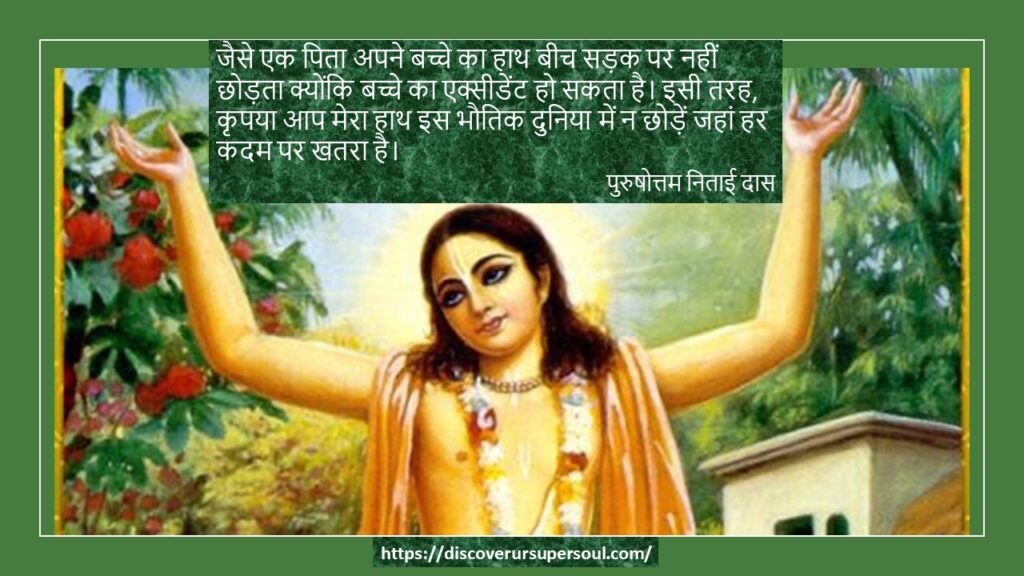
कृपया मेरी स्वतंत्र इच्छा को मुझसे छीन लें। कृपया मेरा हाथ कसकर पकड़ लें, ताकि मैं भटक न जाऊं। जैसे एक पिता अपने बच्चे का हाथ बीच सड़क पर नहीं छोड़ता क्योंकि बच्चे का एक्सीडेंट हो सकता है। इसी तरह, कृपया आप मेरा हाथ इस भौतिक दुनिया में न छोड़ें जहां हर कदम पर खतरा है।
आपका आश्रय
एक बच्चा नहीं जानता कि उसके लिए क्या सही है और उसके लिए क्या खतरनाक है। इसी तरह, मुझे नहीं पता कि मेरे लिए क्या अच्छा है और मेरे लिए क्या अच्छा नहीं है। भगवान और सभी जीवों के पिता होने के नाते आप जानते हैं कि मेरे लिए क्या अच्छा है।
तो कृपया मेरे जीवन में मेरा मार्गदर्शन करते रहें। कृपया मुझे अपने चरण कमलों का आश्रय दें। कृपया मुझे अपने सच्चे भक्तों की शरण दें ताकि मैं उनके सहयोग और मार्गदर्शन में अपने हृदय को शुद्ध कर सकूं और आध्यात्मिक जगत की ओर बढ़ सकूं।
आप हमारे लिए आए
आप कृष्णभावनामृत की किरणों को फैलाने के लिए पूर्णिमा के दिन प्रकट हुए। आप कलियुग के इस अंधकारमय युग में हमारे हृदय से अज्ञान के अंधकार को दूर करने के लिए प्रकट हुए। आपने हमें हरे कृष्ण महामंत्र का जाप करने के लिए कहा जो हमें सभी दुखों से बचाता है। आप हमारे लिए आए और हमें आध्यात्मिक लक्ष्य प्राप्त करने के लिए आवश्यक सब कुछ दिया।
लेकिन दुर्भाग्य से मेरे जैसा दुर्भाग्यशाली व्यक्ति आपकी दया को समझने में विफल रहता है।
हे परम दयालु महाप्रभु
हे महाप्रभु, कृपया मुझे मेरी मूर्खता के लिए क्षमा करें। मैं आपसे बार-बार विनती करता हूं कि आप मेरे हृदय को शुद्ध करें। कृपया मुझे बुद्धि प्रदान करें ताकि मैं आपकी भक्ति के महत्व को समझ सकूं। कृपया मुझे दृढ़ संकल्प दें ताकि मैं उस प्रक्रिया का अभ्यास कर सकूं जो आपने हमें दी है। कृपया मुझे आशीर्वाद दें ताकि मैं खुशी-खुशी हरे कृष्ण महामंत्र का निरंतर जाप कर सकूं।
मैं, पुरुषोत्तम निताई दास, फिर से अपनी प्रार्थना के लिए क्षमा माँगता हूँ जो अज्ञानता से भरी है। कृपया मुझे अपना आश्रय दें।
हे परम दयालु भगवान, यदि आप मेरे जैसे पतित व्यक्ति को स्वीकार नहीं करेंगे तो मुझे पूरे ब्रह्मांड में कौन स्वीकार करेगा।
आपका तुच्छ सेवक
पुरुषोत्तम निताई दास
Search
Recent Posts
-
Srimad Bhagavatam at ISKCON Newtown...
September 3, 2026
-
Srimad Bhagavatam at ISKCON Newtown...
September 1, 2026
-
Janmashtami: Celebrating Krishna’s Appearance Through...
August 17, 2026
-
Gopinatha Pattanayaka: 6 Lessons for...
August 16, 2026
-
What Does Krishna Say About...
August 11, 2026
Prayer to Sri Chaitanya Mahaprabhu on the auspicious occasion of Gaur Purnima
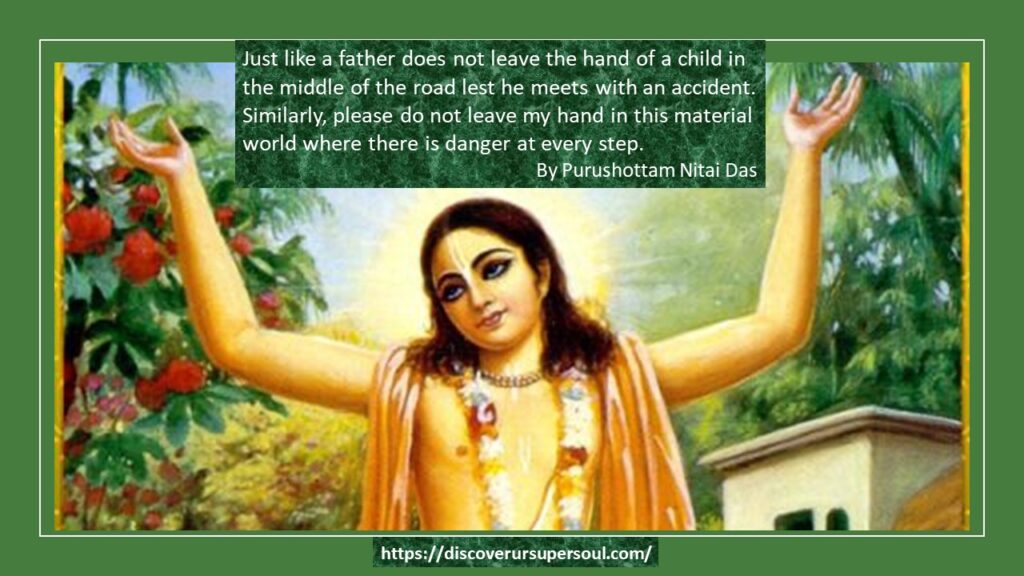
Dear Sri Chaitanya Mahaprabhu, Please forgive my audacity that I am daring to write a prayer in your glorification on the auspicious occasion of Gaur Purnima. But I know that you are extremely merciful that you will forgive me for my temerity.
A person becomes qualified to worship the deity of Krishna after second initiation, similarly a person free from all material impurities are qualified to say words in your glorification. Great devotees like Prahlad glorified you with beautiful prayers when you appeared as Lord Narasimhadeva to annihilate Hiranyakasipu. His glorious words were sung by another of your greater devotee, Sukhadeva Goswami, while narrating Srimad Bhagavatam to Parikshit Maharaj when he had just 7 days to live.
Hope
But in spite of all my short comings and my ignorance and my inability to use right words in your praise, I have firm believe that you will hear my cry at your mystical feet. If you will not hear my prayers, then who will hear my prayers. If a father abandons his son, then what is the hope for the son. But we see a father never abandons his son, no matter how mischievous or how foolish he is.
So, please do not abandon me. I am so mischievous that I left you to enjoy in this mortal world where miseries are at every step. I am foolish because in spite of knowing that miseries are everywhere around me, still I have a hope that I will be happy in this world without you.
Saviour of the helpless soul
It is not that I have not tried to be happy in this world by giving up your warm shelter. It is also a proven fact that I have always failed in my attempt of sense enjoyment. But unfortunately, I have never learnt my lessons. Sometimes I do try my best to not enjoy my senses, but my senses are so powerful that they drag me away from your lotus feet. What can I do? I am so helpless without you.
All the great saintly personalities say again and again that you are the saviour of the helpless and hapless souls. Srila Narottama Dasa Thakura in his wonderful prayer say that there is no one as merciful as you are. The acclaimed bhakti poet says that you have come in this world to reclaim the fallen souls and to take them back to the spiritual world.
śrī-kṛṣṇa-caitanya prabhu doyā koro more
tomā binā ke doyālu jagat-saḿsāre
“My dear Lord Caitanya, please be merciful to me, because who can be more merciful than Your Lordship within these three worlds?” Narottama Dasa Thakura
Transcendental touch
Although I am the most fallen, but I am ashamed to admit that I do not consider myself as fallen. My ego, my pride is not allowing me to accept that I have failed to be happy without you, away from you.
Dear Sri Chaitanya Mahaprabhu, my prayer at your lotus feet is to crush my ego, my pride. Through your transcendental touch please burn all the vices from my heart. I beseech you to purify my heart and fill it with transcendental mellow.
My confession
I want to confess to you that I do not like to be in this world anymore. I know somehow my mind tries to convince me to be here and gives me a hope that I can enjoy here. But when I contemplate and when I reflect on the past and when I try to see the future, I do not find any hope for me in this material world.
I know that I am not qualified to return to the spiritual world. Because in the spiritual kingdom only pure devotees reside. An impure soul like me will not get an entry to your kingdom. I am doomed to suffer here because of my impure desires. With my own effort I feel unable to purify my wrong desires.
So, dear Sri Chaitanya Mahaprabhu, can you please hear my prayer and purify my desires?
The free will
I know the reason for my impure desire is the misuse of my free will. I know the scriptures say that the Supreme Lord does not interfere with anyone’s free will. Although you gave me free will so that I will use it for my own benefit. But unfortunately, I have terribly misused my free will.
Please take away my free will. Please hold my hand tightly, so that I do not go astray. Just like a father does not leave the hand of a child in the middle of the road lest he meets with an accident. Similarly, please do not leave my hand in this material world where there is danger at every step.
Your Shelter
A child does not know what is right for him and what is dangerous for him. Similarly, I do not know what is good for me and what is not good for me. Being the Supreme Lord and the father of all the souls you know what is good for me.
So, please keep on guiding me in my life. Please give me shelter of your lotus feet. Please give me shelter of your sincere devotees so that in their association and guidance I purify my heart and march towards the spiritual sky.
You came for us
You appeared on the day of full moon to spread the transcendental ray of Krishna Consciousness. You appeared in this dark age of Kaliyuga to remove darkness of ignorance from our heart. You gave us to chant the Hare Krishna mahamantra – the mantra of deliverance from all miseries.
You came for us and gave us everything required to perfect our life. But unfortunately, unfortunate soul like me fail to take up your mercy seriously.
Most Merciful Lord
My dear most merciful Lord, please forgive me for my foolishness and stupidity. Again and again, I beg you to purify my heart of all nasty desires and give me intelligence so that I can understand the great value of practicing devotion to you. Please give me determination so that I can practice the process which you gave to us. And please grant me benediction so that I chant the Hare Krishna Mahamantra continuously and happily.
I, Purushottam Nitai Das, again beg forgiveness for my incoherent prayer at your lotus feet. Please give me your shelter.
O most merciful Lord, if you won’t accept a fallen soul like me then who will accept me in the entire universe.
Your insignificant aspiring servant
Purushottam Nitai Das
Search
Recent Posts
-
Srimad Bhagavatam at ISKCON Newtown...
September 3, 2026
-
Srimad Bhagavatam at ISKCON Newtown...
September 1, 2026
-
Janmashtami: Celebrating Krishna’s Appearance Through...
August 17, 2026
-
Gopinatha Pattanayaka: 6 Lessons for...
August 16, 2026
-
What Does Krishna Say About...
August 11, 2026
कृष्ण भगवद गीता में मानव जीवन का उद्देश्य बताते हैं
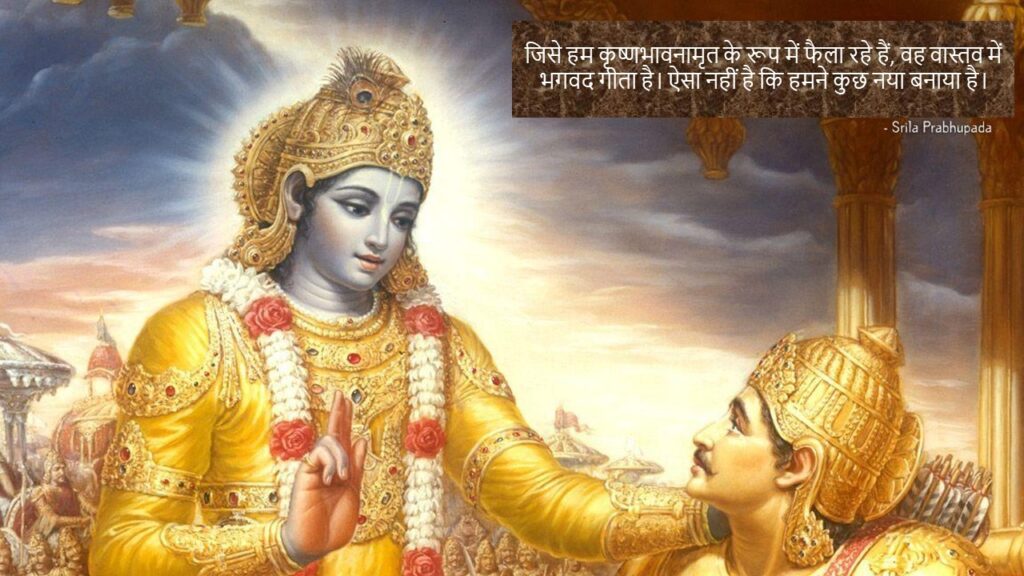
भगवद गीता में, भगवान कृष्ण व्यक्तिगत रूप से मानव जीवन का उद्देश्य बताते हैं। उनका कहना है कि मानव जीवन का उद्देश्य उनका भक्त बनना और उनके पास वापस आना है।
लेकिन पहला सवाल जो किसी के भी मन में कौंधेगा वह यह कि कृष्ण भक्त बनने की क्या जरूरत है? इसका उत्तर वैदिक शास्त्रों में व्यापक रूप से दिया गया है। हमारे जीवन यानि मानव जीवन का उद्देश्य भौतिक चेतना से ऊपर उठकर कृष्णभावनाभावित बनना है और यह भगवद गीता और अन्य वैदिक शास्त्रों का निष्कर्ष है। अगर हम ऐसा नहीं कर रहे हैं और केवल भौतिक गतिविधियों में फंस गए हैं, तो हम अपना मानव जीवन बर्बाद कर रहे हैं।
इस संसार के विभिन्न जीव
शास्त्र बताते हैं कि इस दुनिया में 2 प्रकार के जीव हैं – शाश्वत मुक्त और शाश्वत बद्ध। शाश्वत मुक्त जीव आध्यात्मिक दुनिया में हैं और शाश्वत बद्ध जीव इस भौतिक दुनिया में हैं।
शाश्वत रूप से बद्ध जीवों को 2 प्रकारों में विभाजित किया गया है – गतिमान और गतिहीन। उदाहरण के लिए वृक्ष एक स्थान पर स्थिर रहते हैं इसलिए उन्हें गतिहीन जीवों के रूप में वर्गीकृत किया जाता है।
**यहाँ यह ध्यान दिया जाना चाहिए कि प्राचीन काल से हमारे वैदिक शास्त्रों ने स्पष्ट रूप से ‘पेड़ों’ को जीवित प्राणियों के रूप में वर्गीकृत किया है। प्रसिद्ध वैज्ञानिक जगदीश चंद्र बोस ने वैज्ञानिक रूप से इस तथ्य को स्थापित किया।
गतिशील जीवों को 3 श्रेणियों में बांटा गया है – वे जो जमीन पर चल सकते हैं (मनुष्य), पानी में तैर सकते हैं (मछली) और आकाश में उड़ सकते हैं (पक्षी)। भूमि पर पाए जाने वाले लाखों और खरबों जीवों में से मनुष्य संख्या में कम हैं। और इनमें से अधिकांश मनुष्य आध्यात्मिक जीवन में रुचि नहीं रखते हैं। वास्तव में, इन आध्यात्मिक रूप से मृत लोगों और एक जानवर के जीवन में कोई अंतर नहीं है। ये दोनों जीव केवल खाने, सोने, संभोग करने और रक्षा करने में रुचि रखते हैं।
धार्मिक और अधार्मिक
वे भाग्यशाली मनुष्य जो शास्त्रों और ईश्वर के अस्तित्व को मानते हैं, धार्मिक कहलाते हैं। और जो परमेश्वर के अधिकार को स्वीकार नहीं करते, वे अधार्मिक कहलाते हैं। धर्मी पवित्र शास्त्रों में दिए गए ईश्वर के नियमों का पालन करते हैं और अधर्मी शास्त्रों के दिशानिर्देशों का पालन नहीं करते हैं।
धार्मिक में भी हर कोई नहीं समझता कि भगवान कौन हैं। बहुत कम लोग ईश्वर के बारे में जानते हैं और अपने जीवन के उद्देश्य को समझते हैं। ज्ञानी और योगी भी परम सत्य को जानने का भरसक प्रयत्न करते हैं।
ज्ञान योग और अष्टांग योग का मुख्य उद्देश्य
लेकिन भगवद गीता में, कृष्ण स्पष्ट रूप से कहते हैं कि जब तक कोई पूरी तरह से उनकी शरण नहीं लेता, तब तक कोई उन्हें नहीं जान पाएगा। क्योंकि हम कृष्ण की कृपा से ही परम भगवान कृष्ण को समझ सकते हैं।
ज्ञानी अंततः इस निष्कर्ष पर पहुंचते हैं कि उन्हें भगवान कृष्ण की शरण लेनी है।
“कई जन्मों और मृत्युओं के बाद, जो वास्तव में ज्ञान में है, वह मुझे सभी कारणों का कारण जानकर मेरी शरण में जाता है। ऐसी महान आत्मा दुर्लभ है।” भगवद गीता 7.19
योगी भी सभी भौतिक गतिविधियों को बंद करके जीवन की भौतिक अवधारणा से बाहर निकलने के लिए कड़ी मेहनत करते हैं। लेकिन योग का अंतिम उद्देश्य कृष्ण को जानना, कृष्ण को समझना और कृष्ण का ध्यान करना है।
भगवद गीता 6.47 में कृष्ण इसकी पुष्टि करते हैं।
“और सभी योगियों में, जो हमेशा मुझमें वास करता है, मेरे बारे में सोचता है और मेरी दिव्य प्रेमपूर्ण सेवा करता है – वह योग में मेरे साथ सबसे घनिष्ठ रूप से जुड़ा हुआ है और सबसे ऊंचा है। यही मेरी राय है।”
श्रेष्ठ योगी वह है जो सदा कृष्ण का चिन्तन करता है, कृष्ण का ध्यान करता है और कृष्ण के लिए सब कुछ करता है।
तो, ज्ञान योग और अष्टांग योग का अंतिम उद्देश्य कृष्ण को जानना है।
कृष्ण के भक्त जीवन के वास्तविक उद्देश्य को समझते हैं
ऐसा भाग्यशाली भक्त समझता है कि उसकी वास्तविक संवैधानिक स्थिति लगातार भगवान की सेवा करने की है। यह जानकर वह अपने मन, शरीर और इंद्रियों को पूरी तरह से भगवान की सेवा में लगा देता है। वह अपना जीवन भगवान की खुशी के लिए समर्पित कर देता है और उसकी केवल एक ही आकांक्षा होती है, कृष्ण का सेवक बनने की।
कृष्ण का भक्त सभी भौतिक इच्छाओं से मुक्त रहता है। वह अतीत के बारे में शोक नहीं करता है या भविष्य के लिए लालसा नहीं करता है। वह अपना सारा समय और ऊर्जा ईमानदारी से कृष्ण की सेवा में लगाता है। इसलिए, वह सभी भौतिक दुखों से मुक्त रहता है और हमेशा शांत रहता है। श्रीमद्भागवतम ऐसे महान भक्त की महिमा करता हैं:
मुक्तानामपि सिद्धानां नारायणपरायण: ।
सुदुर्लभ: प्रशान्तात्मा कोटिष्वपि महामुने ॥
“हे महान ऋषि, लाखों मुक्त व्यक्तियों और अष्टांग योग में सफलता प्राप्त करने वाले व्यक्तियों में से, जो पूरी तरह से भगवान के लिए समर्पित है और जो शांति से भरा है, उसे खोजना बहुत मुश्किल है।“ श्रीमद्भागवतम् 6.14.5
शुद्ध भक्त की गतिविधियाँ
कृष्ण के शुद्ध भक्त अपना समय कैसे व्यतीत करते हैं?
यह कृष्ण द्वारा भगवद गीता 9.14 में समझाया गया है
“निरंतर मेरी महिमा का जप करते हुए, बड़े संकल्प के साथ प्रयास करते हुए, मेरे सामने झुककर, ये महान भक्त निरंतर मेरी पूजा करते हैं।”
ये कृष्ण के शुद्ध भक्तों की गतिविधियाँ हैं। वे किसी भी सांसारिक गतिविधियों में रुचि नहीं रखते हैं। वे राजनीति, फिल्मों, फुटबॉल या क्रिकेट मैच पर चर्चा नहीं करते हैं।
श्रील प्रभुपाद बताते हैं, “किसी भी व्यक्ति पर रबर-स्टैम्प लगाकर महात्मा का निर्माण नहीं किया जा सकता है। उनके लक्षण यहां वर्णित हैं: महात्मा हमेशा भगवान कृष्ण की महिमा का जप करने में लगे रहते हैं, वे किसी अन्य गतिविधि में रुचि नहीं लेते हैं, वे हमेशा भगवान की महिमा में लगे रहते हैं।
कृष्ण के भक्त का एक और गुण यह है कि वह कभी नहीं सोचता कि वह कृष्ण का सबसे अच्छा भक्त है। वह हमेशा सोचता है कि वह कृष्ण की ठीक से सेवा नहीं कर रहा है। वह कृष्ण से उनके हृदय को शुद्ध करने की प्रार्थना करता है ताकि वह उनकी और अधिक सेवा कर सके।
तो, अगली बार यदि आप कहीं भी किसी से मिलते हैं और वह कहता है कि वह कृष्ण का परम भक्त है तो पहले यह देखने की कोशिश करें कि वह अपना पूरा दिन और पूरी रात कैसे बिताता है। क्या वह हमेशा कृष्ण के नाम जप में लगा रहता है? क्या वह हमेशा कृष्ण की लीलाओं पर चर्चा करने में लगा रहता है? यदि नहीं तो वह कृष्ण का शुद्ध भक्त नहीं है।
लोगों को कृष्ण का भक्त बनाता है
साथ ही, कृष्ण का एक शुद्ध भक्त दूसरों के दुखों को देखकर बड़ा दुख महसूस करता है। वह जानता है कि लोग दुख में हैं क्योंकि वे कृष्ण को भूल गए हैं। इसलिए, वह दूसरों को कृष्ण का भक्त बनाने की पूरी कोशिश करता है।
श्रील प्रभुपाद वृंदावन के राधा दामोदर मंदिर में खुशी-खुशी रह रहे थे। लेकिन जब उन्होंने दुनिया भर में लोगों को दुख में देखा तो उन्हें दुख हुआ।
उन्हें विश्व के सभी जीवों के प्रति बड़ी दया थी। इसलिए, उन्होंने अपना जीवन पूरी दुनिया में कृष्ण भावनामृत फैलाने में समर्पित कर दिया। ऐसा भक्त जो दूसरों को कृष्ण का भक्त बनाता है, वह कृष्ण को बहुत प्रिय हो जाता है। भगवद गीता 18.68-69
निष्कर्ष
तो, निष्कर्ष में हम कह सकते हैं कि भगवद गीता के अनुसार मानव जीवन का परम उद्देश्य कृष्ण का शुद्ध भक्त बनना है। ज्ञान योग या अष्टांग योग का अभ्यास करने वाले भी अंततः इसे समझते हैं।
इसलिए, हमें अपने मानव जीवन का सही उपयोग करना चाहिए और बिना किसी भौतिक उद्देश्य के गंभीरता से कृष्ण भक्ति करनी चाहिए, जैसा की भगवद गीता में कहा गया है।
Search
Recent Posts
-
Srimad Bhagavatam at ISKCON Newtown...
September 3, 2026
-
Srimad Bhagavatam at ISKCON Newtown...
September 1, 2026
-
Janmashtami: Celebrating Krishna’s Appearance Through...
August 17, 2026
-
Gopinatha Pattanayaka: 6 Lessons for...
August 16, 2026
-
What Does Krishna Say About...
August 11, 2026
Krishna explains the purpose of human life in Bhagavad Gita
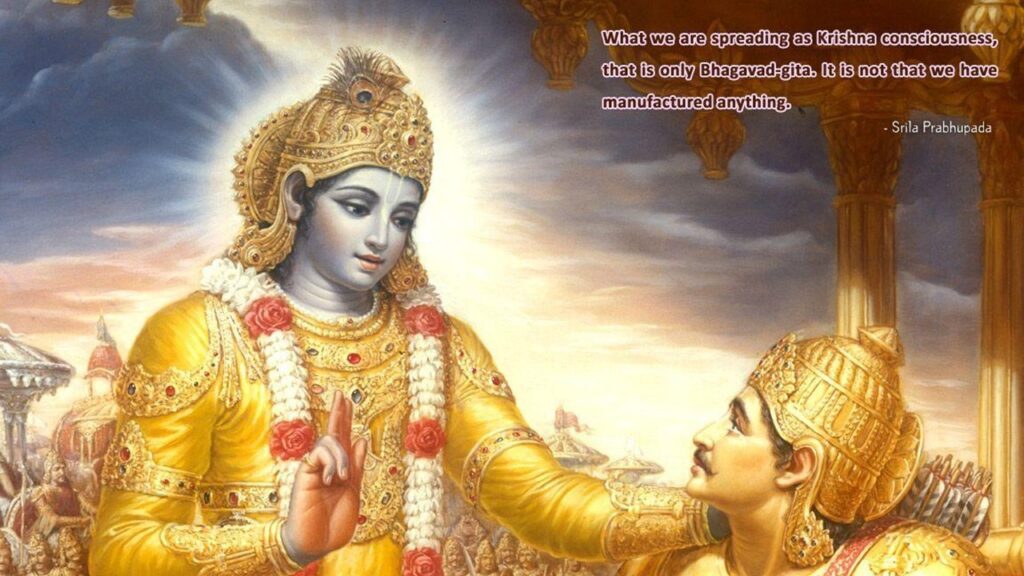
In Bhagavad Gita, Lord Krishna personally explains the purpose of human life. He says that the purpose of human life is to become his devotee and come back to him.
But the first question which will strike anyone’s mind is that what is the need to become a devote of Krishna? It is because Krishna is our Supreme Father, and we all are his children. It is comprehensively explained in the Vedic scriptures. So, the holy scriptures say that the purpose of our life i.e. human life is to rise above material consciousness and become Krishna Conscious and return back to the kingdom of Krishna. If we are not doing so and are caught up in only material activities, then we are wasting our human life.
Different living entities in this world
Scriptures explain that there are 2 kinds of living entities in this world – eternally liberated and eternally conditioned. Eternally liberated living beings are in the spiritual world and eternally conditioned living beings are in this material world.
Eternally conditioned living entities are divided into 2 types – moving and non-moving. Trees for example remain fixed in one place so are categorized as non-moving living entities.**
**Here it should be noted that our ancient Hindu scriptures since time immemorial have clearly categorized ‘trees’ as living entities. Renowned scientist Jagdish Chandra Bose scientifically demonstrated this fact.
Moving entities are divided into 3 categorizes – those that can walk on land (human beings), swim in water (fish) and fly in sky (birds). Out of millions and trillions of living entities found on land, human beings comprise a small portion. Out of these small portions most of them are ignorant about spiritual life. In fact, there is no difference between the lives of these spiritually dead people and that of an animal. Both of these living entities are only bothered about eating, sleeping, mating and defending.
Righteous and unrighteous
Those fortunate human beings who believe in the scriptures and the existence of God are called righteous or religious. And those who do not accept the authority of God are called unrighteous or irreligious Righteous follows the laws of God given in the holy scriptures and unrighteous live whimsically and do not abide by the guidelines of the scriptures.
Among righteous also not everyone is able to understand the Supreme Lord. Few come to know about him and understand the purpose of life. Jnanis, the empiric philosophers, and the Yogis also try their best to know the Absolute Truth.
Ultimate purpose of Jnana Yoga and Ashtanga yoga?
But in Bhagavad Gita, Krishna clearly says that unless one surrenders to him it is not possible to know him. Because we can understand Krishna, the Supreme Absolute, only by the mercy of Krishna.
Jnanis ultimate come to the conclusion that he has to surrender to the Supreme Lord.
“After many births and deaths, he who is actually in knowledge surrenders unto Me, knowing Me to be the cause of all causes and all that is. Such a great soul is very rare.” Bhagavad Gita 7.19
Yogis also try hard to get out of the material concept of life by ceasing from all material activities. But the ultimate purpose of yoga is to know Krishna, understand Krishna and meditate upon Krishna.
Krishna confirms this in Bhagavad Gita 6.47.
“And of all yogīs, the one with great faith who always abides in Me, thinks of Me within himself and renders transcendental loving service to Me – he is the most intimately united with Me in yoga and is the highest of all. That is My opinion.”
The best yogi is that who always thinks about Krishna, meditates on Krishna and does everything for Krishna.
So, the ultimate purpose of Jnana Yoga and Astanga Yoga is to know Krishna.
Devotee of Krishna understands the real purpose of life
Such a fortunate devotee understands that his real constitutional position is to constantly serve the Supreme Lord. Knowing this he completely engages his mind, body and senses in the service of the Lord. He dedicates his life for the pleasure of the Lord and has only one aspiration i.e. to become a humble servant of Krishna.
The fortunate devotees of Krishna are free from all material desires. He does not lament about the past or hanker for the future. He utilizes all his time and energy in serving Krishna sincerely. So, he is free from all material miseries and is always peaceful. Srimad Bhagavatam glorifies such an exalted devotee:
Muktanam api siddhanam
narayana – parayanah
sudurlabhah prasantatma
kotisv api mahamune
“O great sage, out of many millions of liberated persons and persons who have achieved success in mystic yoga, one who is completely devoted to the Supreme Personality of Godhead and who is filled with peace is very hard to find.” (Srimad Bhagavatam 6.14.5)
Activities of a pure devotee
How do exalted devotees of Krishna spend their time? This is explained in Bhagavad Gita 9.14 by Krishna
“Always chanting My glories, endeavoring with great determination, bowing down before Me, these great souls perpetually worship Me with devotion.”
These are the activities of pure or best devotees of Krishna. They are not interested in any mundane activity and they do not discuss politics, movies, football or cricket match.
Srila Prabhupada aptly says, “The mahātmā cannot be manufactured by rubber-stamping an ordinary man. His symptoms are described here: a mahātmā is always engaged in chanting the glories of the Supreme Lord Kṛṣṇa, the Personality of Godhead. He has no other business. He is always engaged in the glorification of the Lord.”
Another quality of a devotee of Krishna is that he never thinks he is the best devotee or doing sufficient for Krishna. He always thinks that he is fallen and begs Krishna for mercy so that he can serve him more.
So, next time if you meet anyone at anyplace, it could be Vrindavan also, and he says that he is an exalted devotee of Krishna then first try to see how he spends his entire day and also entire night. Is he always engaged in chanting the names of Krishna and discussing pastimes about Krishna? If not then we know the answer.
Makes other devotees of Krishna
Also, a pure devotee of Krishna feels great pain when he sees others are suffering. He knows that people suffer because they have forgotten Krishna. So, he tries his best to give Krishna to others. Srila Prabhupada was happily living in Radha Damodara temple of Vrindavan. But he could not tolerate other’s suffering.
He had great compassion for all living entities of the world. So, he dedicated his life in spreading Krishna Consciousness all over the world. Such a devotee who makes other devotees of Krishna is very dear to Krishna. Bhagavad Gita 18.68-69
Conclusion
So, in conclusion we can say that the ultimate purpose of human life as per Bhagavad Gita is to become a pure devotee of Krishna. Even those who practice Jjnana yoga or Astanga yoga finally understands this. So, we should best utilize our human life and practice Krishna consciousness seriously without any material motive.
Search
Recent Posts
-
Srimad Bhagavatam at ISKCON Newtown...
September 3, 2026
-
Srimad Bhagavatam at ISKCON Newtown...
September 1, 2026
-
Janmashtami: Celebrating Krishna’s Appearance Through...
August 17, 2026
-
Gopinatha Pattanayaka: 6 Lessons for...
August 16, 2026
-
What Does Krishna Say About...
August 11, 2026
मानव जीवन का उद्देश्य पैसा कमाना नहीं है
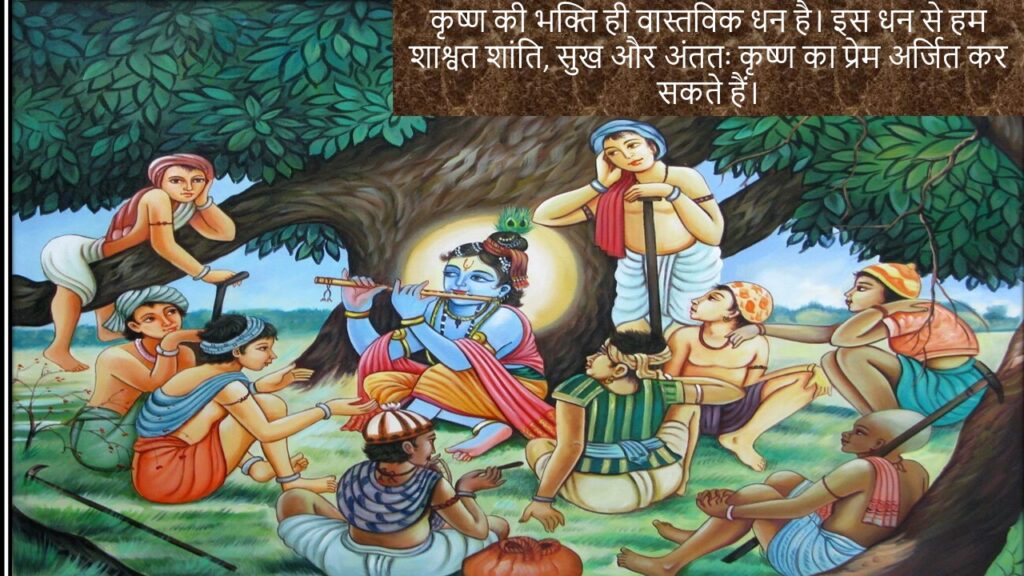
हम इस मानव जीवन के साथ क्या कर रहे हैं? क्या हम मानव जीवन का उपयोग किसी उच्च उद्देश्य के लिए कर रहे हैं या हम इसे पैसे कमाने में बर्बाद कर रहे हैं? कई बार हम धन-संपत्ति के लिए इतने अधिक मोहग्रस्त हो जाते हैं कि हम भूल जाते हैं कि यह जीवन केवल धन संचय करने के लिए नहीं है, बल्कि यह आध्यात्मिकता का अभ्यास करने के लिए भी है। बेशक, पैसा महत्वपूर्ण है, लेकिन पैसा ही सब कुछ नहीं है। पैसा हमारे जीवन की सभी समस्याओं का समाधान नहीं कर सकता। मृत्यु के समय हमें वह सब कुछ छोड़ना पड़ता है जो हमने इस दुनिया में कमाया है।
पैसे की लत
लेकिन फिर भी, हम देखते हैं कि बढ़ती उम्र के बावजूद लोग पैसा कमाने के पीछे पागल रहते हैं। 60 या 70 साल की उम्र में भी कुछ लोग नया बिजनेस शुरू करना चाहते हैं। पैसे के लिए उनके जुनून को समझना मुश्किल है। जिस प्रकार नशे के आदी व्यक्ति के लिए शराब छोड़ना कठिन होता है, उसी प्रकार धन व्यसनी के लिए धन कमाने की लत को छोड़ना कठिन होता है। उन्हें इस बात का अहसास नहीं होता कि वे पैसा कमाने में अपना मानव जीवन बर्बाद कर रहे हैं। पैसे की लत के कारण वे असहाय हो जाते हैं और पैसे कमाने के लिए तरह-तरह के रास्ते तलाशते रहते हैं।
पैसे कमाने के जुनून में डूबे एक बिजनेसमैन की कहानी
एक बार एक व्यापारी था। उसने अपना पूरा जीवन धन कमाने में लगा दिया था। उसके लिए पैसा ही सब कुछ था और वह इसे पाने के लिए कुछ भी कर सकता था। व्यापारी के दो बेटे थे। वे अपने पिता की तुलना में पवित्र थे। कालान्तर में व्यापारी बूढ़ा हो गया।
उसके दो पुत्र अपने पिता की भौतिक सुख की लालसा से बहुत चिंतित थे। उन्होंने सोचा कि उनके पिता बूढ़े हो रहे हैं और अपने पूरे जीवन में उन्होंने कोई पवित्र और भक्ति कार्य नहीं किया है, इसलिए वह निश्चित रूप से नरक में जाएंगे। वे अपने पिता की अपवित्र जीवन शैली के कारण चिंतित थे। इसलिए, उन्होंने अपने पिता को एक साधु के साथ तीर्थ यात्रा पर भेजने का फैसला किया।
उन्होंने एक साधु से पिता को सभी पवित्र स्थानों पर ले जाने का अनुरोध किया, ताकि पिता मानव जीवन के उद्देश्य को समझ सकें।। और उन्होंने साधु से यह भी अनुरोध किया कि जब तक उनके पिता का दिल पूरी तरह से बदल न जाए, तब तक उन्हें घर वापस न लाएं। साधु जिम्मेदारी लेने के लिए तैयार हो गया।
तीर्थयात्रा पर
साधु वृद्ध को विभिन्न पवित्र स्थानों पर ले गया। और उन्हें दर्शन के माध्यम से समझाने की कोशिश की कि भौतिक सुख अस्थायी है और स्थायी सुख आध्यात्मिक अनुभूति में है। साधु ने विभिन्न भक्ति कथाएं सुनाईं। लेकिन फिर भी बूढ़े का दिल नहीं बदला।
धीरे-धीरे साधु ने हार माननी शुरू कर दी। उसने सोचा, “इस आदमी के दिल को बदलना मेरी क्षमता से परे है।” इसलिए, उन्होंने बुजुर्ग के बेटों को संदेश भेजा कि उनके पिता के दिल को बदलना असंभव है। लेकिन बेटों ने जोर देकर कहा कि कम से कम उसे एक बार और कोशिश करनी चाहिए। शायद कोई चमत्कार हो जाए, उन्होंने सोचा। साधु अंतिम प्रयास करने के लिए तैयार हो गया।
इस बार साधु वृद्ध को वाराणसी ले गए और वे दोनों श्मशान घाट गए।
व्यवसायी का पछतावा
वृद्ध ने जैसे ही लकड़ी के लट्ठों पर जलते हुए शवों को देखा, उसकी आंखों से आंसू बहने लगे। आँसुओं को देखकर साधु प्रसन्न हो गया। साधु ने सोचा, “अब, यह बूढ़ा अपने होश में आ गया है। इसे अब इस दुनिया की सच्चाई का एहसास हो गया है।”
साधु ने बूढ़े के कंधे पर हाथ रखा और कहा, “यह सब देखने के बाद आपको कैसा लग रहा है?”
अपने आँसू पोछते हुए बूढ़े ने कहा, “मुझे बहुत बुरा लग रहा है। ऐसा लगता है कि मैंने अपना पूरा जीवन बर्बाद कर दिया।”
साधु ने पूछा, “आपको ऐसा क्यों लगता है?”
बूढ़े ने कहा, “क्योंकि मुझे अपने पूरे जीवन में कभी भी सच्चाई का एहसास नहीं हुआ।”
साधु ने कहा, “चिंता मत करो। अभी भी समय है, कुछ किया जा सकता है।”
बूढ़े ने कहा, “नहीं, यह असंभव है। मैंने बहुत कुछ खोया है और उन सभी नुकसानों की भरपाई करना संभव नहीं है।”
साधु ने पूछा, “आपको क्यों लगता है कि आप नुकसान की भरपाई नहीं कर सकते?”
बूढ़े की आंखों से आंसू बहते रहे। उसकी आवाज दब गई।
भारी मन से उसने कहा, “देखो, मैंने जीवन भर कपड़ों का कारोबार किया। मुझे कभी नहीं पता था कि लकड़ी की इतनी बड़ी मांग है। अगर मुझे यह पता होता तो मैं कभी कपड़ों का कारोबार नहीं करता।“
साधु ने बूढ़े को छोड़ दिया और वह कभी वापस नहीं आया।
कहानी की शिक्षा:
बुढ़ापे में आदतों को बदलना बहुत मुश्किल होता है। इसलिए कम उम्र में ही भक्ति शुरू कर देना बेहतर है, बुढ़ापे का इंतजार नहीं करना चाहिए। मानव जीवन के उद्देश्य को समझने के लिए युवावस्था सबसे अच्छी उम्र है।
मानव जीवन बहुत कीमती है
मानव जीवन अनमोल है क्योंकि मानव जीवन में ही ईश्वर की भक्ति करना और अपनी चेतना को शुद्ध करना संभव है। यदि हम ऐसा करने में विफल रहते हैं, तो यह संभव हो सकता है कि अगले जन्म में हमें मानव शरीर न मिले। इसके बजाय, हमें किसी जानवर, पौधे, मछली या कीट का शरीर मिल सकता है। और हम किसी जानवर या कीट को अध्यात्म का अभ्यास करते नहीं देखते हैं ।
यही कारण है कि वेदांत सूत्र का सबसे पहला सूत्र ” अथातो ब्रह्म जिज्ञासा“” है। इसका अर्थ है कि “चूंकि आपको मानव जीवन मिला है, इसलिए इसका उपयोग परम सत्य की प्राप्ति के लिए करें।”
हां, यह सच है कि इस दुनिया में हमें जीने के लिए पैसे की जरूरत है। और शास्त्र हमें पैसा नहीं कमाने के लिए नहीं कहता है। शास्त्रों और संतों का कहना है कि अपनी सांसारिक जिम्मेदारियों को निभाते हुए कृष्ण की भक्ति के लिए पर्याप्त समय निकालें।
कृष्ण के भक्त वास्तविक धन कमाते हैं
कृष्ण के सच्चे भक्त कड़ी मेहनत करते हैं लेकिन वे हमेशा कृष्ण को केंद्र में रखते हैं। वे ऐसा कुछ भी नहीं करते जो शास्त्रों के विरुद्ध हो और उन्हें कृष्ण से दूर ले जाएं।
श्रीमद्भागवतम् 5.5.3 में, भगवान ऋषभअपने पुत्रों को समझाते हैं कि जो लोग कृष्णभावनामृत का अभ्यास करके अपने जीवन को शुद्ध करने में रुचि रखते हैं, वे भौतिक गतिविधियों में अपना समय बर्बाद नहीं करते हैं। ऐसे बुद्धिमान लोग अपने निर्धारित कर्तव्यों को ईमानदारी से करते हैं और पर्याप्त धन कमाते हैं जिससे उन्हें अपने शरीर और आत्मा को एक साथ रखने में मदद मिलती है।
श्रील प्रभुपाद बताते हैं, “एक गृहस्थ को ऐसा जीवन व्यतीत करना चाहिए ताकि उसे कृष्ण के बारे में सुनने और जप करने का पूरा अवसर मिले। उसे घर पर कृष्ण की पूजा करनी चाहिए, त्योहारों का पालन करना चाहिए, दोस्तों को आमंत्रित करना चाहिए और कृष्ण प्रसाद देना चाहिए। गृहस्थ को इन्द्रियतृप्ति के लिए नहीं, इसी उद्देश्य से धन अर्जित करना चाहिए।”
हमें यह आत्मनिरीक्षण करना चाहिए कि क्या हम अपना मानव जीवन धन कमाने में बर्बाद कर रहे हैं या हम शास्त्रों के दिशानिर्देशों का पालन करके अपने मानव जीवन का सही उपयोग कर रहे हैं?
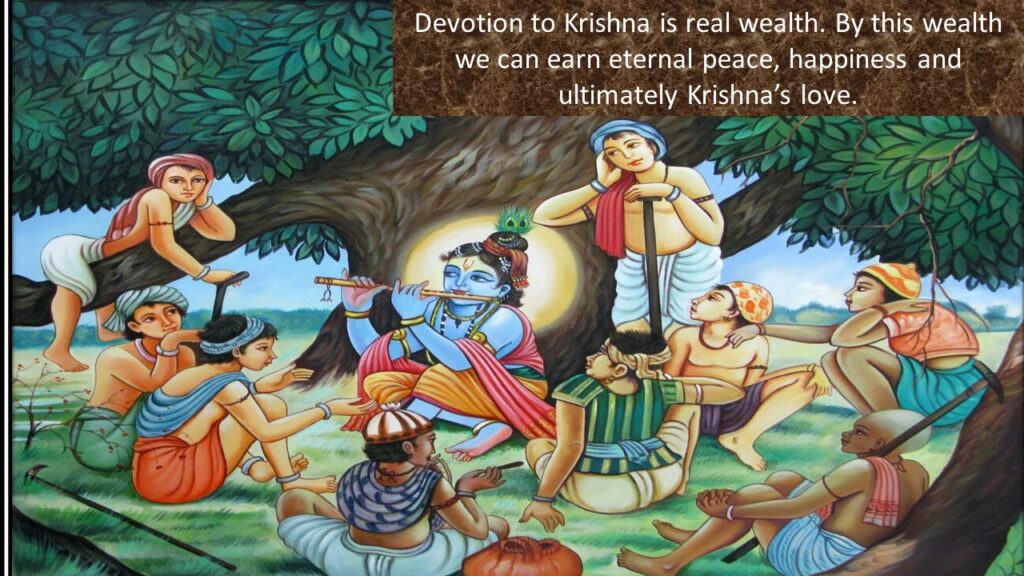
कृष्ण की भक्ति ही वास्तविक धन है। इस धन से हम शाश्वत शांति, सुख और अंततः कृष्ण का प्रेम अर्जित कर सकते हैं। मानव जीवन का उद्देश्य कृष्ण की भक्ति है।
Search
Recent Posts
-
Srimad Bhagavatam at ISKCON Newtown...
September 3, 2026
-
Srimad Bhagavatam at ISKCON Newtown...
September 1, 2026
-
Janmashtami: Celebrating Krishna’s Appearance Through...
August 17, 2026
-
Gopinatha Pattanayaka: 6 Lessons for...
August 16, 2026
-
What Does Krishna Say About...
August 11, 2026
Are you wasting your human life in earning money?
What are we doing with this human life? Are we using it for a higher purpose or are we wasting our life in only earning money? Many times, we get so obsessed with amassing wealth that we forget that this life is not just meant for amassing wealth, but it is also meant for practicing spirituality.
No doubt, money is important, but money is not everything. Money cannot solve all the problems of our life and we will have to leave everything what we earn here only after we die.
Money addiction
But still, we see people in spite of advanced age remain mad after earning money. At the age of 60 or even 70 some people want to start new business. What goes on in their mind, I fail to understand. It seems like they get addicted to earn money.
Just like a drug addict finds it hard to give up alcohol. Similarly, a money addict finds it difficult to give up his addiction to earning money. They do not realize that they are wasting their human life in earning money or because of addiction they become helpless and continue exploring different avenues to earn money.
An old businessman’s story who is obsessed with earning money
Once there was a businessman. He had spent his entire life amassing wealth. For him money was everything. He could do anything to get it. The businessman had two sons. They were pious as compared to their father. In due course of time the businessman grew old.
His two sons were very much concerned about their father’s hankering for material pleasure. They saw that their father is wasting his life in earning money. They felt that as their father is growing old and in his entire life, he hasn’t done any pious and devotional activity so he would definitely go to hellish planet. Being concerned about their father’s unholy lifestyle they decided to send him on a pilgrimage with a sadhu.
They requested a sadhu to take their father to all the holy places and not to bring him back home unless his heart completely changes. The sadhu agreed to take up the responsibility.
On Pilgrimage
He took the old man to different holy places and tried to convince him through philosophies that material pleasure is temporary and permanent happiness is in spiritual realizations. He told him various devotional stories, but nothing would seem to change the old man’s heart.
Finally, the sadhu started to give up. He thought, “It’s beyond my capability to change this man’s heart.” So, he sent a message to his sons saying that it is impossible to change their father’s heart. But the sons insisted that at least he should try once more. Maybe some miracle might take place, they thought. The sadhu agreed to give a last try.
This time he took the old man to Varanasi. He decided to visit the crematorium.
Businessman’s regret
The moment the old man saw the burning dead bodies kept on logs of wood, tears started flowing down his eyes. The sadhu was ecstatic. He thought, “Now, he has come to his senses and has realized the truth of this world.”
So, he put his hand on the old man’s shoulder and said, “Now after seeing all this how you feel?”
Wiping out his tears the old man said, “I feel very bad. It seems I wasted my entire life”.
The sadhu asked, “Why do you feel so?”
The old man said, “Because I never realized the truth”.
The sadhu said, “Do not worry. Still time is there, something can be done.”
The old man said, “No it’s impossible. I have lost a lot and it’s not possible to undo all those losses.”
The sadhu asked, “Why do you think you can’t make up the losses?”
Tears kept on flowing from the old man’s eyes. His voice was choked.
With a heavy heart he said, “Look, throughout my life I did business in clothes. I never knew that wood is in such a great demand. If I had known this I would have never done business in clothes.”
The sadhu left him never to return back again.
Moral of the story
It’s very difficult to change habits in old age. So, it’s better if one starts practicing spirituality when he is young instead of waiting for the old age to arrive.
Human life is so precious
Human life is precious because in human life only it is possible to practice devotion to God and purify our consciousness. If we fail to do so, then it could be possible that in next life we do not get a human body. Instead, we may get the body of an animal, a plant, a fish or of an insect. And we do not see any animal or insect practicing spirituality.
This is the reason that the very first aphorism of Vedanta sutra is “athato brahma jijnasa.” It means that “since you have got a human life so utilize it for realizing the Absolute Truth.” So, we should not be wasting our life in only earning money.
Yes, it is true that in this world we also need money for survival. And the scriptures do not ask us not to earn money. What the scriptures and the saintly personalities say is that while taking care of your worldly responsibilities take out sufficient time for practicing devotion to Krishna.
Devotees of Krishna earn real wealth
Sincere devotees of Krishna work hard but they always keep Krishna in the centre. They do not deviate from scriptural injunctions and do not do anything which will take them away from Krishna.
In Srimad Bhagavatam 5.5.3, Lord Ṛṣabhadeva explains to his sons that those who are interested in purifying their life by practicing Krishna consciousness do not waste their time in material activities. Such intelligent people do their prescribed duties honestly and earn enough money which helps them to keep their body and soul together.
Srila Prabhupada further explains in the purport, “A householder should lead such a life that he gets full opportunity to hear and chant. He should worship the Deity at home, observe festivals, invite friends in and give them prasāda. A householder should earn money for this purpose, not for sense gratification.”
We can also check if we are wasting our human life in earning money or we are properly utilizing our human life by following the guidelines of the scriptures.
Devotion to Krishna is real wealth. By this wealth we can earn eternal peace, happiness and ultimately Krishna’s love.
Search
Recent Posts
-
Srimad Bhagavatam at ISKCON Newtown...
September 3, 2026
-
Srimad Bhagavatam at ISKCON Newtown...
September 1, 2026
-
Janmashtami: Celebrating Krishna’s Appearance Through...
August 17, 2026
-
Gopinatha Pattanayaka: 6 Lessons for...
August 16, 2026
-
What Does Krishna Say About...
August 11, 2026